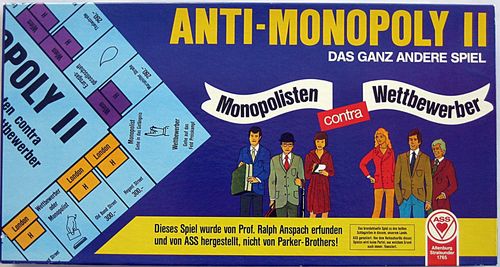
Anti-Monopoly II
Anti-Monopoly II Rulebook
Table of Contents
Table of Contents
- Components
- Rules
- 1. Object of the Game
- 2. Treasurer
- 3. Competitor and Monopolist Cards
- 4. Assignment of Roles
- 5. Starting Budget
- 6. Turn Order
- 7. Movement Around the Board
- 8. A Double Is One Extra Turn
- 9. Buying Properties and Payments
- 10. Monopolizing a City
- 11. Building Houses and Hotels
- 12. Mortgage
- 13. Returning Houses to the Treasurer
- Special Spaces
- Additional Rules
- Two-Hour Game Rules
- Attention All Risk-Taking Entrepreneurs!
Components
- Game board
- Rulebook
- 3 blue wooden tokens (monopolists)
- 3 green wooden tokens (competitors)
- 25 Monopolist cards
- 25 Competitor cards
- 28 Property cards
- 2 dice
- 35 houses
- 15 hotels
- Money:
- 50 bills of €1
- 40 bills of €5
- 50 bills of €10
- 50 bills of €50
- 50 bills of €100
- 20 bills of €500
Rules
Rules that are unique to Anti-Monopoly and distinguish this game from Monopoly are printed in bold in the original. Remember that the game is balanced, so monopolists and competitors have equal chances of winning. If in your first games one side seems to win consistently at first, it means that player is simply luckier or plays better.
1. Object of the Game
Before the start of a game, the players agree which of two goals they will pursue during play.
- Goal A: To win, a player must bankrupt all the other players.
- Goal B: To win, a player must become the richest competitor after the last monopolist goes bankrupt, or the richest monopolist after the last competitor is eliminated. (Wealth is determined according to rule 25.)
2. Treasurer
Select one player to be the Treasurer. The Treasurer keeps, pays out and collects money, property cards, houses and hotels. The Treasurer must keep their own money and property apart from the common supply.
3. Competitor and Monopolist Cards
The Treasurer shuffles the Competitor and Monopolist card decks and places them in the spaces on the board set aside for them.
4. Assignment of Roles
- Players are divided into monopolists and competitors evenly.
- "Evenly" means that the number of competitors at the table equals the number of monopolists or, if the number of participants is odd, one group may be larger than the other by only 1 player. Thus, a game of 2 monopolists against 3 competitors is still allowed, but "4 against 2" is a violation of the rules.
- Roles are assigned starting with a roll of two dice by each player. The player with the higher sum of the numbers on the dice chooses first whether to be a monopolist or a competitor. The right to choose passes clockwise from that player. Before the game begins, players may swap roles if they really need to.
- Once the role chosen at the start is taken, changing it during the game is prohibited.
5. Starting Budget
The Treasurer gives each player €1500: 2 bills of €500, 3 of €100, 2 of €50, 7 of €10, 5 of €5, and 5 of €1. Take care of your money: in other games there is more money than needed, but in this one there is exactly as much as is needed.
6. Turn Order
The result of the dice roll that determined the roles also sets the order of play. The player who rolled the best result goes first, and the turn passes clockwise. Now take the tokens: monopolists take the blue ones, competitors take the green ones.
7. Movement Around the Board
At the start of the game, all players place their tokens on the "Start" space. From there, in turn order, the players begin to go around the track around the board. On a turn, a player rolls 2 dice and moves their token forward by as many spaces as the dice show. Players may also move their tokens when instructed to do so by other rules of the game.
8. A Double Is One Extra Turn
If a player rolls a double (two identical values on the dice), the player takes a turn under the normal rules and then must roll the dice and take one more turn. If a double is rolled again on that second turn, it counts as an ordinary roll and does not give the right to a third turn in a row.
9. Buying Properties and Payments
A player who ends a move on a space with an unowned street or company may buy that street or company for the price printed on the front of its property card. The Treasurer places the money paid by the player into the bank and gives the buyer the property card. If the player declines to buy, the property remains with the Treasurer.
When another player (not the owner) ends a turn on a property that has been bought, that player pays the owner the amount shown on the property card in the "rent" or "tariffs" section.
10. Monopolizing a City
When monopolists take possession of any two streets of one city, they monopolize that city. After this, they may collect double rent from players who end a turn on their properties in that city. If the city has a third street, the monopolists collect double rent from it too, once they take possession of it. Monopolists may build houses only in cities they have monopolized.
11. Building Houses and Hotels
- Houses and hotels may be built only on the player's own turn.
- On each street the player owns, a competitor may build up to ___ houses. [Source gap: the digit is missing from the printed Russian text (it reads "up to [blank] houses" in the original). The figure is inferred as 4 from this same rule, which makes the fifth building a hotel, and from the page 1 summary that a competitor may build 5 buildings against a monopolist's 4 in one property.] If the competitor wants to develop the property further, instead of building a 5th house the player gives 4 houses to the Treasurer and builds a hotel on that property. Building costs are printed on the property card. Houses are placed on the city name on the board.
- On each street the player owns, a monopolist may build up to 3 houses. If the monopolist wants to develop the property further, instead of building a 4th house the player gives 3 houses to the Treasurer and builds a hotel on that property. Building costs are printed on the property card. Houses are placed on the letter M beneath the city name on the board.
- The player decides for themselves which buildings their properties need. Thus, in one property of a city they may stop at one house, while in another they may take it all the way to a hotel; but once a building is erected it may not be moved to another property.
12. Mortgage
- The mortgage value of a property is half its purchase price. If a player has mortgaged a property, they do not receive rent from it and may not have houses or hotels there. Monopolists may not have houses or hotels in a city where at least one of the two properties required to monopolize the city is mortgaged. From any unmortgaged property in such a city, the monopolist receives the ordinary (not doubled) rent.
- When mortgaging a property, the player gives the property card to the Treasurer. The Treasurer keeps mortgaged properties separately from unowned ones.
- Before a property is mortgaged, all houses and hotels on it must be returned to the Treasurer at the regular return price (see rule 13).
- Mortgaged properties may be sold to any player at a negotiated price. After the sale they remain mortgaged, and the player who bought the property must redeem it.
- If a player wants to get a mortgaged property back, they must pay the Treasurer the amount shown on the back of the property card. The Treasurer returns the property card to the player.
13. Returning Houses to the Treasurer
The compensation for returning houses to the Treasurer is half the cost of a house. Players may sell houses only to the Treasurer.
Special Spaces
14. Start
Players receive €100 each time they stop on the "Start" space or pass through it.
15. Jail, Price War, Sightseeing
A player can end up on this space in one of two ways.
- If a player's token stops on this space at the end of a normal move, nothing happens. The player is merely sightseeing. On the next turn, the player leaves this space in the normal way, with no penalty.
- The other case is when a player is sent here by a Monopolist or Competitor card instruction, or ends a turn on the space "Monopolist? To Jail! Competitor? To Price War!". In this case, the player moves their token to the triangular sector "Price War" or "Jail" (depending on whether the player is a competitor or a monopolist), without receiving anything for passing "Start". To continue moving, a fine may be required.
16. "Competitor or Monopolist" Spaces
When a competitor stops on this space, the competitor takes the top card from the Competitor deck and follows its instructions.
In the same situation, a monopolist draws the top card from the Monopolist deck and follows its instructions. In both cases, after the instructions are carried out, the card is returned to the bottom of its deck.
17. Income Tax
When a player stops on this space, the player pays the Treasurer either €200 or a percentage of their capital. (Capital means cash, houses, hotels and unmortgaged properties.)
- A monopolist pays €200, or:
- 20% of their cash, plus
- 10% of the value of their unmortgaged properties (streets, transport companies and utility companies), plus
- 10% of the total building cost of all their houses and hotels.
- A competitor pays €200, or:
- 10% of their cash, plus
- 10% of the value of their unmortgaged properties (streets, transport companies and utility companies), plus
- 10% of the total building cost of all their houses and hotels.
18. Property Tax
When a player stops on this space, the player pays €75.
19. Transport Companies
When a player stops on a transport company space owned by a competitor, the player must pay the owner 10% of its price, regardless of how many such companies the owner holds. The prices of these companies' services are subject to external regulation under free competition.
Monopolists are treated differently. A monopolist's income from transport companies doubles with each additional transport company they acquire. Beware: a monopolist who acquires all four transport companies in the game becomes practically invincible. Consider: if in the real world all forms of transport were subject to one person with no external restrictions, how high could transport prices climb?
20. Utility Companies (Gas and Electricity)
When a player stops on the space of a utility company owned by one of their opponents, the player rolls the dice.
- If the company is owned by a competitor, the player multiplies the dice result by 4. This is the amount the player must pay the owner.
- If the company is owned by a monopolist, the player multiplies the dice result by 4 if the monopolist owns one utility company, or by 10 if the monopolist owns both utility companies. This is the amount the player must pay the owner.
21. Anti-Monopoly Fund
When a monopolist stops on this space, the monopolist gives €160 to the fund. The money is passed to the Treasurer.
When a competitor stops on this space, the competitor rolls 1 die. If a "1" is rolled, the competitor receives a grant of €25 from the Treasurer. If a "2" is rolled, the grant is €50. For all other results there is no grant, and the competitor receives no money.
Additional Rules
22. Shortage of Houses
If the Treasurer runs out of houses or hotels, players may use tokens from other games as replacements, or make house pieces themselves from cardboard, paper or other available materials.
23. Trading
Players may trade and barter with each other for anything except houses and hotels. Before a property is sold to another player, its owner must return all houses or the hotel on that property to the Treasurer (see rule 13).
24. Bankruptcy
A player who goes bankrupt (loses all their cash) must first sell all their houses and hotels to the Treasurer at half price. After that, all the money and properties of the bankrupt player (mortgaged properties remain mortgaged) are transferred to the player who bankrupted their opponent. The bankrupt player leaves the game.
If a player was bankrupted by the Treasurer, the money and properties of the bankrupt player go to the Treasurer, the properties become unowned, and the players still in the game may buy unmortgaged properties under the normal rules (see rule 9).
25. Richest Player
The richest player, and the winner of a Goal B game (see rule 1), is the one with the largest sum of cash plus the combined income from their unmortgaged properties at the current moment. The owner determines the income from utility companies by rolling a die according to rule 20.
26. Rule on Borrowing Money from Other Players
A player may not borrow money from other players.
Two-Hour Game Rules
These rules are recommended for tournaments. In this variant, the winner and the richest player are determined when 2 hours of play have elapsed, using the following procedure:
- Players may deal with their property as they see fit (buy or sell houses, mortgage or redeem previously mortgaged properties). These transactions are concluded only with the Treasurer; players may not trade with each other.
- Competitors keep 10% of their cash, and monopolists keep 20% of their cash. The remaining money is handed over to the Treasurer.
- After this, the Treasurer goes around the board, stopping at each property except unowned ones. For each property, the Treasurer pays the owner the rent or tariff under the normal rules.
- The player who has the most cash when the Treasurer has completed the circuit becomes the winner of the game.
This variant takes into account the fact that the winner of a two-hour game must be the best both at accumulating cash and at investing it.
Attention All Risk-Taking Entrepreneurs!
Our business consultant advises: do not play this game the way you play Monopoly!
- To keep up with the monopolists and have equal chances of winning, competitors are advised to buy up as much available property as possible, as quickly as possible.
- Do what you must, but you must have the money to acquire new properties.
- Plan your expenses carefully, since you will have very little money in the game. This is done on purpose, so that the game does not bore you.