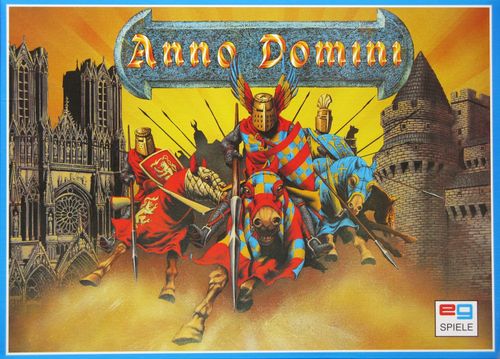
Anno Domini
Anno Domini Rulebook
Table of Contents
Table of Contents
Components
- 1 board representing Middle Age Europe
- 1 deck of cards
- 2 die-cut sheets of coins
- 6 red and 6 blue dice
- 4 sets of plastic castles of different colours
- 1 set of plastic cathedral
- 1 rulebook
Aim of the game
To conquer 8 cathedrals.
The board
The board represents Middle Age Europe and it's subdivided into 36 territories, which are marked by a name and a 2 digit code (one red and one blue). The code is useful when determining one territory at random, with the throw of two dice, one red and one blue.
(example: 1(red)-3(blue) is the code for England)
On the board there are also 7 sea areas: Northern Sea, Baltic Sea, Atlantic Ocean, West Mediterranean Sea, East Mediterranean Sea, Black Sea.
On the board there is also the "random events table", which is described later on.
Getting started
Take 16 cathedrals and keep them handy. The remaining are not used during the game, and serve as replacement. Take the 12 dice and keep them handy. Punch out the coins from the paperboard and keep them handy to serve as the bank. It is advisable that one of the player takes care of the bank: of course this does not give any advantage.
Take the deck of cards and deal one card to each player until someone gets the Pope card. Leave this card in front of the player who received it, and reshuffle the others, making a face down deck.
The Pope (the player who has the Pope card) chooses what colours to play with, and takes 80 castles of the chosen colour. The other players, clockwise, do the same thing. Castles in excess are not needed and can be put back in the box.
Starting with the Pope, all players randomly select one territory (throwing one blue and one red die) and place on it one cathedral and one of their castles. If the territory is already occupied, the player may choose any territory he/she wishes. This operation is repeated until all the territories have been occupied (once the cathedrals are finished, players occupy territories just with castles). With this operation this phase is over, and we can proceed to the real game.
How to play
The game takes place in two phases, that are repeated until one of the player has reached the goal of controlling 8 cathedrals. The two phases are:
- Administrative
- Military
1. Administrative phase
During this phase all players, at the same time, get money from collecting taxes on their territories. Each player gets (# cathedrals) x (# territories) x 10 Florins.
Example: during the very first turn each player has 4 cathedrals and 9 territories, for a total of 360 Florins.
The administrative phase is over once everyone has taken the money from the bank.
2. Military phase
The military phase is divided in turns, starting from the player who is seated to the left of the Pope and then following clockwise. The Military phase is over with the turn of the fourth player, and all the actions that a player is allowed to perform are not mandatory, i.e. each player may decide what action(s) to perform. During the turn you can:
- Roll on the event table
- Build new castles
- Attack other players' territories
How to roll on the event table
Throw two dice, sum them and apply the effect written in the table corresponding to the total rolled.
Event table:
- 2. Plague: One random territory is hit by a terrible plague. Remove all the castles on that territory
- 3. Barbarous: Randomly select three different territories, and remove one castle from each of them
- 4. Imperial crisis: the player who has rolled the dice must discard one card (with the exception of the Pope card which can never be removed from play)
- 5. Tithe: pay to the Pope 10 Florins for each cathedral you control
- 6. Taxation: gather 20 Florins for each territory you control
- 7. Taxation: gather 30 Florins for each territory you control
- 8. Taxation: gather 20 Florins for each territory you control
- 9. Crusade: the player who has rolled the dice has to pay 50 Florins to the Pope
- 10. Council: the player who has rolled the dice receives the Pope card
- 11. Schism: the Pope has to give 10 Florins for each cathedral he/she controls to each player
- 12. Deposit: a new deposit is discovered. Collect immediately 500 Florins.
How to build new castles
New castles can be build at the cost of 100 Florins each, taking them from the box and putting them on any of your territory with just one limitation: there may never be more than 6 castles on a territory.
This operation can be done anytime during the military phase, before or after attack. Money spent has to be given back to the bank.
How to attack enemies' territories
On your turn you may attack enemies' territories with the aim of removing their defending castles and thus put there yours, following the limitation hereby described. From a territory you control you may attack a bordering enemy territory or a territory which borders to the same Sea area.
Example: from England you may attack Gales or Scotland, but also Fiandre and Normandy, Ireland, or any territory that borders with the Northern Sea.
Each attack is conducted as follows:
the player declares from which territory he/she is willing to attack, takes as many dice as the number of castles in that territory, declares the territory target of the attack and sum, if any, his/her attack points (see "Attack/Defence points").
The attacked player takes a number of dice equal to the number of castles in the attacked territory and sum, if any, his/her defence points (see "Attack/Defence points").
Both players now roll at the same time, and sum their respective attack/defence points (if any) to each result.
The attacker removes one castle from the territory he/she is attacking for each 6+ (6 or more) obtained (see example). The defender, similarly, removes one castle from the attacker's territory for each 6+ (6 or more) obtained (see example).
Attack/Defence points
These points are obtained thanks to some special cards (see "The cards"). Moreover, if on the attacked territory there is a cathedral, the defender gains 1 "defence point".
Example: You are the player acting this turn and you want to attack Fiandre (3 castles and 1 cathedral there) from England (where you have 4 castles and 1 cathedral). Let's assume you have the "Templar" card (The Templar card is worth 2 attack points, but only if the attacked territory includes a cathedral), while your opponent has another card, The Relic (It is worth 1 defence point if the attacked territory includes a cathedral). Thus, you have 2 attack points and your opponent 2 as well (1 for the card and 1 for having a cathedral).
You roll the dice and obtain the following results:
| Attacker | Defender |
|---|---|
| 6 (+2) = 8 | 6 (+2) = 8 |
| 5 (+2) = 7 | 4 (+2) = 6 |
| 4 (+2) = 6 | 2 (+2) = 4 |
| 3 (+2) = 5 |
The attacker has three results equal or more than 6, thus he/she removes three castles from the defender's territory. The defender removes 2 castles from the attacker's territory. Removed castles are given back to the players, who put them in the box.
Occupying a territory
If all the defender's castles are removed (like in the above example), the attacker may occupy it with a free castle taken from the box.
Note: the cathedral are never removed as a result of an attack. Cathedrals are considered part of the territory itself, and belongs to the player that controls that territory.
Limitation
During each turn the maximum number of attacks is three, unless you have some special card which says otherwise. Each thrown of the dice is one attack.
The defender may never remove all the attacker's castles (the last always stays, ignoring the result of the dice).
Nobody may control the eighth cathedral before the fourth turn.
You may not attack from a territory occupied by one castle.
You may not use more than 4 attack/defence points for each attack.
The cards
If at the end of your military phase you have managed to conquer at least one territory, you may draw one card from the deck, and follow its indications. Some of them are worth money, others are worth attack/defence points, and others let you perform particular actions. Some cards have to be kept face up in front of you so that anyone can see them, and have long-lasting benefits, others have to be used immediately and then put at the bottom of the deck.
At the end of each turn you may never gain more than one card, regardless the number of territories conquered.
Free Territories
It may happen, due to some random event, that a territory is not occupied by castles and, thus, is free. Free territories may be occupied by player whose turn is, by simply building one (or more) castles on them, at the normal cost of 100 Florins each.
Prosecution
At the end of the military phase, there is a new administrative phase and then another military phase and so forth until the end of the game. Please note that administrative phase takes place at the same time for all the players, whilst the military is over with the turn of the fourth player.
Elimination of a player
A player is out of the game when he/she loses the last of his/her territories on the board. All the money passes to the player who has caused this elimination, while the cards are put back at the bottom of the deck. No player may be eliminated from the play before the fourth turn.
Castles
The castles included in the box are a physical limitation to the number of castles that a player may employ during the game. When a castle is removed, it goes back to the box, and may be used again later.
The first player to control 8 cathedrals is the winner.
Variant
If you want a longer game, you may decide an higher number of cathedrals to control. This has to be agreed upon before game starts.
For a more realistic placement, you may also assign the Pontifical State as the first territory to the player who is the Pope.
FAQ
Q: If a player does not have enough money to pay a debt to another player, what does it happen?
A: the player has to fulfil the debt as soon as he/she can. You may not win the game if you are a debtor.
Q: Is it possible to trade cards, lend money or gift or lend cards to an opponent?
A: No!
Q: I conquer a territory and, after placing there one free castle, I immediately build other three castles there (I regularly pay 300 Florins to the bank). May I lead an attack from the territory I have just conquered?
A: Yes, if this does not exceed the maximum number of attack per turn (3).
Q: I have terminated my attacks for this turn and, since I have conquered a territory, I draw a card from the deck. I draw the "Commander" which gives me one extra attack. May I use this bonus immediately?
A: Yes.
Q: I attack an opponent's territory but, after I have rolled the dice, there are still some castles on that territory. May I attack that territory again?
A: Yes, but each thrown of the dice has to be considered separately and counts as an attack.
Q: May I attack the same territory from two bordering territories I control, summing all the castles I control?
A: No! Each attack starts from one single territory.
Q: During my turn, due to a random event, one territory results free, and I occupy it with a castle paying 100 Florins. Does the occupation of this territory grant me a card anyway, assuming I cannot manage to conquer any other territory in the remaining of the turn?
A: Yes.
Q: If a territory is free during my turn must I occupy it? And, if not, what does it happen?
A: No, the occupation of a free territory is not mandatory. The territory remains free and my be occupied by the next player during his/her turn, paying the regular cost for the castle.
Q: I ran out of castles, but I want to build more on some territories: may I remove castles I need from other territories I control, paying the regular money to build them?
A: No. Once placed, castles may never be voluntarily removed or moved in other territories.
Q: It may happen, though very improbable, that a player loses his/her last castle due to a random event. The player is eliminated from the game, but who gets his/her money?
A: The money are given back to the bank. The cards at the bottom of the deck as usual.
Q: I have 2 "Templar" cards and one "Mercenary" for a total of 5 attack points. Does this mean that any result rolled is valid to remove one of my opponent castles?
A: No! As the rules state, you may use a maximum of 4 attack/defence points. This means that the roll of a "1" is never a win.
Cards: (number of cards in the deck)
The Mercenary (8) It is worth 1 attack point. To keep.
The Heroine (1) It is worth one extra attack for each cathedral you control. To keep.
The Templar (2) It is worth 2 attack points, but only against territories that include a cathedral. To keep.
The Pope (1) This card may never be eliminated from the game. To keep.
The Commander (8) It is worth one extra attack each turn. To keep.
The Ambassador (7) Steal a card to any player. Use and discard.
The Bishop (6) Take one cathedral from an opponent territory (with the exception of the Pope) and put it on one of your territory that does not already has one. Use and discard.
The Toll Collector (4) During the administrative phase, gain 10 Florins for each territory you control. To keep.
The Arquebuseer (2) It is worth 1 attack and 1 defence point. To keep.
The Relic (4) It is worth one defence point if the attacked territory includes a cathedral. To keep.
The Merchant (6) Gain 50 extra Florins during each administrative phase. To keep.
The Cut-throat (6) Discard one card of an opponent. Use and discard.
The Maecenas (2) Gain immediately 500 Florins. Use and discard.
The Architect (2) Build one castle on each of your territories for free, without exceeding the maximum of 6. Use and discard.
The Genius (1) His incredible war machines are worth 2 attack and 2 defence points. To keep.