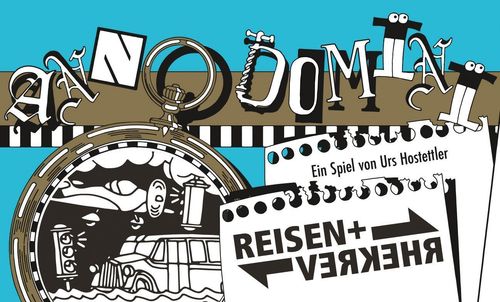
Anno Domini: Reisen und Verkehr
Anno Domini: Reisen und Verkehr Rulebook
Table of Contents
Table of Contents
The Cards
This box contains 340 cards. The front side (black) names an event of world history, though not always a world-shaking one. The back side (coloured) names the Year of the Lord, ANNO DOMINI, in which this event took place.
ANNO DOMINI is an expandable game. You can buy further series and mix them with this one. Yes, we warmly recommend the Wild Mix! Every new colour in the mixture will increase the fun of the game. But of course ANNO DOMINI can also be played with the cards of a single series.
Deal
Now deal 9 cards to each player. At random, of course; choosing is strictly forbidden. And one more thing is strictly forbidden: looking at the back sides.
Everyone lays their cards out in front of them, face up, with the black-printed event side showing. The rest of the cards is placed as a stack in the middle. Here too: events face up, coloured solution year (back side) not visible.
Important: leave the cards on the table during the game! When you move your cards, slide them; do not wave them around in the air, otherwise your fellow players will unintentionally learn solution years that you had better keep secret.
A Chain of Unholy Events
The chain begins with the top card of the stack. Event 1 is read aloud and the card is placed on the table, visible to everybody; its back side remains secret from everybody.
The owner of the game begins.
They choose one of their cards, read it out, and place it above the first card if they believe their event 2 took place before event 1. They place it below the first card if they believe their event 2 took place after event 1.
Going around, the players add one of their cards to the chain of events in this way. They may insert their card anywhere in the chain, so also between cards that have already been laid out, if they believe their event fits in there chronologically.
Doubt
Doubt is often better than blind trust.
Whoever is on turn and believes that they have discovered mistakes in the existing chain of events may correct them before they insert their new card and pass the chain on.
They may also decide not to add a further card and instead to publicly doubt the chronological order of the events. In that case a round of play comes to an end.
All cards of the chain are turned over from top to bottom.
- If the chronological order is correct, the doubter is punished: they must take four new cards from the stack (as always: without looking at the back sides).
- If the chain of events shows any error whatsoever, the doubter's predecessor, the player who laid down an event last, takes two new cards from the stack.
Be it even a single little year, and completely independently of who laid down the chronologically faulty card: the last one gets bitten by the dogs.
So whoever does not express any doubt and lays a card into the row thereby accepts the whole chain of events, and under some circumstances has to take responsibility for it towards the distrustful next player.
After the round of play, the cards of the chain are cleared away. They have done their duty for today; they may go (after Schiller, 1783).
A New Round
A new round begins with a new starting card from the stack.
The first player is now the doubter. Then it goes nicely around again.
Special case: the new beginning is somewhat harder for a player who has only a single card left. Instead of one card, they must take two cards from the stack straight away, order these, and insert their last card.
Reversal of the Direction of Play
The reversal of the direction of play happens immediately and once only, as soon as a player has only two cards left.
Winning
The winner is whoever is the first to get rid of their last card, in a correct chain, of course. Without doubt the following player will express doubt once again. If a mistake comes to light, there are two new cards, and the game goes into overtime.
Explanations and Examples
The Decisive Year
The decisive year is printed clearly and in bold on the back side of the card.
Supplementary comments, including indications of month and day, remain without influence on the game.
Some cards offer spans of time as the solution, for example '1903 – 1907' or '5. Jh. v. Chr.' (5th century BC).
Explanations:
- Jh. (Jahrhundert, century): a century lasts from the year 01 to the year 00. Example: the 20th century (20. Jh.) began with 1901 and ends with the year 2000.
- um (around) means that the event cannot be pinned down to an exact year. For the purposes of the game, 5 years before and 5 years after are accepted as correct. Example: for 'um 1900' (around 1900), the years 1895 to 1905 count as correct.
The First Appearance
The first appearance of a thing, the beginning of an event, is decisive whenever no time span is clearly asked for.
Examples:
A) 'Menschen auf dem Mond' (People on the Moon) asks for the first Moon landing by Apollo 11. An answer such as '2025' is wrong, even though it cannot be ruled out that people will be on the Moon again at that time.
B) 'Gezuckerte Kondensmilch auf dem Markt' (Sweetened condensed milk on the market) asks for its market launch. That it is still available today is splendid, but it has nothing to do with the matter.
Simultaneous and Chronologically Overlapping Events
Simultaneous and chronologically overlapping events are handled according to the principle 'In dubio pro reo' (in case of doubt, for the accused). The chain is considered correct.
Examples:
A) One event took place in the 8th century BC, a second in 805 BC, and the third in the 1st millennium BC. No. 2 took place before No. 1, because the 8th century BC lasted from 800 to 701 BC, while No. 3 overlaps chronologically with the other two events and may be inserted among them in any order.
B) Two events took place in 1987, the third is 'um 1990' (around 1990), and a fourth took place in 1991. If No. 4 was placed behind Nos. 1 and 2, the order is correct. No. 3 reads 'between 1985 and 1995', so it overlaps with the other three events and may be placed among them in any order, also between the two 1987 cards. Month and day details within the year 1987 are irrelevant; the two cards are equivalent.
Place Names
Location details without a direct connection to the event are simply location details, not cryptic hints at the year being sought.
Example: 'Neanderthals dwell in the Neander Valley near Düsseldorf' does not mean that in the epoch being sought, the fashion centre of Düsseldorf already existed.
Tactical Hints
Well, self-confidence is a virtue, especially when you know nothing. Your successor will think twice about whether to doubt your chain if you declare your event a clear matter and insert it quickly and decisively, with at least some plausibility.
As a sneaky variant, you can also play the uncertain one now and then, while you place a rock-solid event in a correct chain ...
Psychology and a certain feeling for sequences are much more important in ANNO DOMINI than specialist historical knowledge. Do not let your ignorance discourage you! You can safely assume that your fellow players do not have all the dates of these strange events stored in their little grey cells either, and that, just like you, they often have to guess.
Use your common sense, estimate, and sell your solutions well. Never forget: what you lay down does not necessarily have to be right; above all, it must seem credible to the table neighbour who plays after you.
If you have completely lost track of a long chain, then go ahead and express doubt. Usually there is a nasty surprise lurking somewhere.
If possible, hold back an event that you can place well in time as a safe closing card. Conversely, place the little cards that cause you great worries, to the best of your knowledge and conscience, in short chains, which are certainly doubted less often than the tapeworms.
Who Plays ANNO DOMINI?
In principle the game is suitable for 2 to 10 players; the ideal number is 3 to 6. With large groups we recommend dealing out fewer than the usual 9 cards at the start.
Children can join in as soon as they can read fluently. Experience shows that they soon make up for their lesser historical knowledge through clever tactics, and they learn quickly. Once the used cards are shuffled back into the game, their ability to learn pays off. The group may also decide to deal children who are taking part fewer cards at the start.
The Series Published So Far
So far the following series have been published: Kirche & Staat / Schweiz / Sex & Crime / Lifestyle / Natur / Erfindungen / Frauen / Seefahrer & Flieger / Sport / Kunst / Flops / Deutschland (with Uwe Rosenberg) / Münzen / Im Namen des Gesetzes / VIP / Spiel des Jahres (with Bernward Thole) / Österreich / Wort, Schrift, Buch / Showbizz / America / Europa / Im Osten / Süden / Fussball (with Mämä Sykora) / Wissenschaft & Forschung / Bern / Reisen & Verkehr / Gesundheit (with Konrad Bochennek) / Essen & Trinken / Kuriositäten / Maschinen
A Note on Sources
We are aware of one thing: even usually reliable sources can be wrong. Facts can change, and research brings new findings to light. We are open to criticism, corrections and new questions (whenever possible with a citation of the source!). Where corrections are necessary, we will make them in future printings (we firmly hope for them, so buy, people, buy!). A corrigenda for ANNO DOMINI can be found at urs.fatamorgana.ch/adpleite.html. We always keep it up to our latest state of knowledge. Correspondence please to [email protected].
We plan new thematic series for ANNO DOMINI at loose intervals. Information about our new releases and our range can be found for Switzerland at www.fatamorgana.ch, and for Germany and Austria at www.abacusspiele.de.
Have fun with bluffing and half-knowledge!