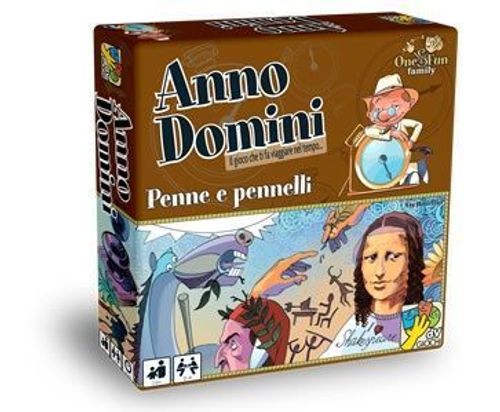
Anno Domini: Penne e Pennelli
Anno Domini: Penne e Pennelli Rulebook
Table of Contents
Table of Contents
Contents
- 336 cards: the front (black side) describes an event, and the back (colored side) gives the year in which it happened.
- These rules.
Setup and Object of the Game
Shuffle the cards with the black side facing up, so that no one sees the colored side. Each player receives 9 cards (if there are more than 6 players, each receives only 7 cards) and lays them out on the table in front of them, spread out, always with the black side facing up. The year on the back is secret to everyone! (When you move the cards, slide them across the table so that the back is never visible.)
Place the remaining cards in the middle of the table as a draw pile. Draw the first card, always making sure that no one sees its back, place it in the middle of the table, and read the event aloud.
The object of the game is to be the first to get rid of all of your cards.
Playing the Game
The youngest player begins. On your turn, you may do one of two things:
-
Continue the timeline. Choose one of your cards and place it where you think the event happened. Place the card to the left of the event in the middle if you think your event happened earlier; further to the right if you think it happened later. You may also insert the card between two events, if you think your event happened exactly between those two. Always take care not to change the order of the cards. Play then continues clockwise, until someone doubts.
-
Doubt. If you believe there is an error in the timeline, instead of adding a card you may doubt. In this case the hand ends: turn over all the cards of the line, the moment has come to discover the years on the back!
- If the timeline is correct, that is, if all the cards are in order from the oldest to the most recent, then you doubted wrongly! Take two cards from the draw pile and place them in front of you.
- If instead the timeline is wrong, that is, if one or more cards are not in the correct order, the player who played before you takes three cards from the draw pile and places them in front of them. Note: it does not matter how many errors there are in the line; a single one is enough. It does not matter who actually misplaced the card: it is always the player who precedes you who takes the three cards, even if it was not them who made the error.
After the hand ends, all the cards of the line are discarded, and a new hand begins. Draw a new card from the draw pile and place it in the middle of the table as the starting point. The first to play is the player who doubted, if they were right; otherwise it is the player who follows. The game continues as before.
Exception: if you are the one starting a new hand, and you have only one card left to place, then draw two cards from the draw pile instead of one, and try to place all three cards in the correct order. (The player who plays after you can always doubt; see the next paragraph.)
End of the Game
The winner is the first player to place their last card.
Note: the player following the one who places their last card has the chance to doubt. If they are right, the player who was doubted draws three cards, and the game continues.
Tactical Hints
- Showing confidence is often helpful, even if you do not have the faintest idea... The player who follows will think twice before doubting a card you played with certainty, as if it were obvious. Conversely, you may hesitate, as if you had a doubt, when you know exactly where to place a card.
- Always try to form an idea of the year, but remember that even if the card is not in the right position, it is more important that the other players believe it is. The other players are probably guessing just as much as you!
- If you feel lost, try doubting: often there are events placed incorrectly.
- If you can, keep an event you are sure of for as long as possible. You can play it as your last card.
- Play cards you have no idea about in short timelines. They are more likely to be correct, and less likely to be doubted.
Notes
- Year. The year is clearly expressed on the card. Further information, such as month and day, has no influence on the game. Some cards indicate spans of time, such as 1903-1907 or "5th century B.C."
- Century. A century is a span of 100 years starting from 01-01-01. Example: the 20th century began in 1901 and ended in 2000.
- B.C. Stands for "Before Christ" (a.C., avanti Cristo).
- Circa. Means that the year of the event cannot be determined precisely. In this case, up to five years before and five years after are accepted. Example: for "Circa 1900", all years between 1895 and 1905 are correct.
- The start of the event. Unless otherwise specified, what counts is the start of the event, and not its recurrence in the present and future. Examples: "The man on the moon" refers to the first moon landing of Apollo 11; an answer such as 2135 is not valid, since the reference is to that first moon landing (it does not matter whether there will be others in the future). "Powdered milk on the market" refers to the year of its launch on the market: the fact that it is still on sale counts for nothing.
- Simultaneity and overlapping times. The timeline is considered correct if two or more neighbouring events are simultaneous, or if their spans of time overlap.
Examples
Example 1 (correct line). The timeline shows four cards: 1987, 1987, 1991 and "1990 circa". In this case the line is correct. "1990 circa" indicates a span of time running from 1985 to 1995.
Example 2 (incorrect line). Four cards are labelled A, B, C and D, with the years 8th century B.C., 805 B.C., 1st century B.C. and 451. In this case the line is wrong. B should be placed before A, since the 8th century B.C. runs from the year 800 B.C. to the year 701 B.C. Remember that years before the birth of Christ are counted backwards!
The Series
ANNO DOMINI is an expandable game. You can buy several topics that can be mixed together. Each new set increases the fun: the wild mix is recommended! And if there are more than 8 players, play in teams.
- 01 - Sotto i riflettori (Under the Spotlight)
- 02 - Sport e svago (Sport and Leisure)
- 03 - Penne e pennelli (Pens and Brushes) — this set
- 04 - Invenzioni e scoperte (Inventions and Discoveries)
- 05 - Avvenimenti bizzarri (Bizarre Events)
- 06 - Scienza e natura (Science and Nature)
Note on Sources
The data on the cards come from a variety of sources on the internet and official institutional sites. Some sources may report different data. In most cases the average of the data has been used.