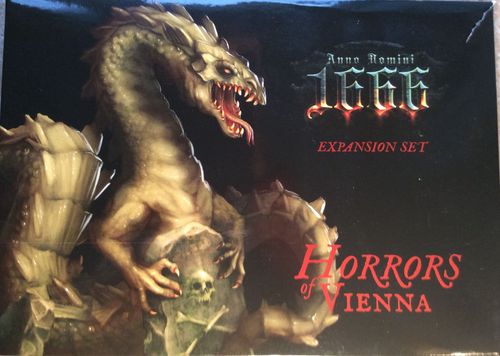
Anno Domini 1666: Horrors of Vienna Expansion Set
Anno Domini 1666: Horrors of Vienna Expansion Set Rulebook
Table of Contents
Table of Contents
Moving the Horror
The horrors of Vienna are different from standard characters. They are strong independent beasts. They cannot be fielded in bands, unless you have a special item (see Die Zauberflöte). Horrors are used mainly in special adventure scenarios, as well as in battle mode.
A horror is usually a Non-player Character. Individual scenarios impose various restrictions and patterns of behavior on it. In case of a horror controlled with the Die Zauberflöte, it is a normal Character from the band (at least as long as someone is playing the flute).
Lindwurm – Moving and Fighting
Lindwurm and other figures on double bases are moved in the following way (see the drawing).
This type of Character has two separate parts – head (space A) and tail (space B). When making a move by one space, move the figure's head onto the target space, and the tail onto the space which was occupied by the head. The movement points cost is paid only for moving the head. The tail moves for free. You may move the head onto the space occupied by the tail and the tail onto the space occupied by the head. This costs a normal amount of movement points (usually 1, unless there is an obstacle between the spaces etc.).
If the figure occupying 2 spaces has Dexterity: 1 or more, then the head may move diagonally, as per normal rules. The tail moves onto its place. However such a horror may not move in a way that ends its move on two spaces that are adjacent only at corners. If it does not have enough movement points or the terrain/zones of control etc. make it impossible to continue the movement and end it on two fully adjacent spaces then a diagonal move cannot be performed.
Example 1: Lindwurm moves 4 spaces, between the buildings. After spending 1 MP the head (A) will move to space number 1, and the tail (B) where the head was. After spending 4 MP the head will occupy space number 4 and the tail space number 3.
Example 2: Lindwurm (Move: 5(2)) moves through bushes. For 2 movement points its head will move into the space with the bush. Next for two more (a total of 4 MP) the head will move out of the bushes. Although the tail is also crossing the obstacle it does not cost an additional MP. Next for the fifth, and last, movement point Lindwurm moves one more space. Even though the tail is still moving through the obstacle this move costs only 1 MP as only the head's move is considered.
When shooting at a figure that occupies 2 spaces you may choose the space at which you shoot. Any ranges and modifiers are considered as in case of shooting at a figure that takes up only the targeted space. If there are no obstacles on the line of fire then it is irrelevant whether the other part of the figure occupying the adjacent space is in cover or not.
A figure occupying 2 spaces fights in the same way regardless if it is attacking with its head or tail. When shooting at such a figure when it is engaged it is enough for one of its parts to be engaged for the -1 to hit modifier and the chance to hit a friendly figure to apply.
Figures occupying 2 spaces are large and not very mobile. They never withdraw from combat and never test for being knocked down.
A figure occupying 2 spaces does not block its own line of sight or line of sight to itself (e.g. you may draw line of sight through a space with the head to a space with the tail).
Daredevils and Horrors
Both of the following scenarios include daredevil characters – dwellers of Vienna who decided to deal with the terrifying beast that lays waste to their city. They follow these rules:
-
Daredevils operate according to NPC (Non-player Character) rules, and their objective is to attack the horror. All other Character (including players' Characters) treat them as friendly and are treated as such.
-
At the start of the game take all Thugs character cards, one card of a Footman with glaivie and pistol and Peasants Character (if you have the appropriate set) – they become the daredevil pool. Draw 4 of those cards, these Characters start the game on the table. When a daredevil is killed put his card back into the pool and draw a new one that arrives as reinforcements,
-
Before each activation of a daredevil play an event card. If it is red, the daredevil moves towards the horror (if it is not in close combat with it) using 4 MP and in accordance to standard NPC movement rules. If the card is black the daredevil is scared and stays in place.
-
Combat between daredevil and the horror: at the start of the combat phase, before all other fights, play an event card for each daredevil and check its value in the chart below. Players' Characters that are in close combat with the horror may (at the player's option) support this "combat", deducting 1 (or 2, if the Character is surrounding the horror) from the event card's value. Serious wounds of the horror or daredevil do not influence the outcome.
- I-IV: The horror receives 1 wound bypassing the armor;
- V-VIII: Nothing happens, the Characters remain in close combat;
- IX-XVI: The daredevil receives 4 wounds bypassing the armor and must withdraw, if possible, as after a lost combat (it it is not possible do not test Strength);
- XVII-XXIV: The daredevil is instantly killed.
-
The horror is a Non-player Character, and its objective is to attack the daredevils. It is activated every turn (no need to play an event card) after all the daredevils. If it is not in close combat with a daredevil, it spends its MP to move towards the closest daredevil. It treats all Characters as enemies and is treated by all characters in the same way.
Die Zauberflöte
The enchanted flute, its music makes beasts submissive and obedient to the player. Nobody knows the origin of the instrument. Some say that it is the very flute that, according to legend, was used by the mysterious flute-player of Hammeln to get rid of the infestation of rats, and when he did not receive his pay he used it to enchant children. Others say that the flute is even older – that it was reworked from the ancient god Pan's flute, or made from the lire used by Orpheus to calm Cerberus himself.
The flute can only be used in battle scenarios. The flute card is drafted at the same time that demon cards are. After completing the standard draft and placing the demons and demonic pact cards, place the flute card among them. Place the horrors' cards aside. Just like in the case of demons first each player draws 1 magic card and in addition 1 card for each Character possessing the Sorcery special rule in his pool. The players keep the lowest card and discard the rest. The player with the lowest card is first to pick a demon, or the flute, then the next one and so on, alternating, until there are no more cards. The player that took the enchanted flute, also takes horrors cards. When creating a Band give the enchanted flute to one of your Characters. In such case you may field one of the horrors specified on the flute card in your Band (paying the cost given on the card).
The Character holding the flute loses the Inconspicuous and Inconspicuous counter (it may not be used even to deploy in special spaces provided in the scenario). When you deploy the Character with the flute put a generic counter on it. It means that the Character is playing the enchanted flute.
If at the start of your turn the Character with the flute and the counter is on the board then the fielded horror is under your control. It is activated as any other Character from your Band. If at the start of your turn the Character with the flute is not on the board, or there is no counter on it, then the horror becomes an NPC with the Attack rule until the end of turn.
When the Character with the flute is activated remove the counter from it. The Character may perform flute playing action. When the Character is playing the flute it may move – it gets 3 movement points, but may not perform maneuvers. When the flute playing action is performed put the counter back on the Character's card. The Character looses the counter if it is knocked down, stunned or in close combat. In addition if the Character playing the flute has the counter Characters with the Beast rule treat it as friendly and vice versa.
Skills
Beast – The Character is not Human for the purpose of skills, special rules etc. It may not participate in [talking] and is immune to [talking] attacks. May not pick up items.
Short Flight – The Character may freely move through other figures, high terrain, obstacles and high edges without penalties to movement (it flies over them). During movement it ignores zones of control of all the figures. In addition put a counter on its card. If any player reshuffles his deck, put the counter on it again. You can have no more than 1 counter. When the figure is activated you may discard the counter and instead of a standard action you may move (fly) 8 spaces (full action).
Retaliation [X] – If this character loses Close Combat (but not draws), but survives, before resolving any potential retreat, make an Unopposed Test of this Character's Weapon Skill that was just used, with the DL of X. On a failure nothing happens. On a success, the opponent receives damage calculated like a Ranged Attack. It may not be parried, does not count as new Close Combat, does not require retreat etc.
Monstrous Size – Line of sight to and from this Character is not obstructed by other intervening Characters who do not have the Monstrous Size skill. If a Character that has this rule has nowhere to withdraw after a lost combat it does not test Strength.
Move: X(Y) – When performing a Full Move, this Character may spend X Movement Points. When performing a Partial Move, it may spend Y Movement Points.
Fear [X] – Enemy characters within Line of Sight, range of 6 spaces, and with Fortitude lower than X, receive -1 to all Tests. At the end of each turn discard one additional Alarm counter for each model with Fear on the board.
Huge – This character may not perform the Climb through a Window Maneuver.
Deadly Gaze – At the start of each activation the closest enemy figure, in line of sight and within 6 spaces is attacked with the gaze. If several figures are at the same range the player holding initiative chooses the target. This attack require line of sight, like shooting. It hits automatically. The Character hit must perform a DL:7 Intelligence or Perception test (the Character knows or has a hunch that basilisk's gaze should be avoided). A failed test means the Character is Stunned. Passed – nothing happens. Triumph – the basilisk saw its own reflection and is Stunned. Misfortune – the target dies of fear.
Scenarios
Suburban Nightmare
Bands:
-
Red and Blue 4 Heroes and 3 Commoners each
-
All Thugs, Peasants and one Footman with glaivie and one with pistol go into the pool of Vienna daredevils who gathered their courage and decided to kill the beast.
-
Put the horrors figures and cards aside and prepare the scenario.
Board and Figures Set-Up:
- The scenario is played on the attached map. The players must agree on or randomly decide the scenario's difficulty level – whether they are going to play against a young, or older and stronger horror. After the Band composition is decided, draw one horror card and place its figure on the space marked with a circle. In case of figures occupying 2 spaces (as Lindwurm) place it on spaces marked with an ellipsis, so that the head is on the space marked with the circle. After placing the horror set up the 4 daredevils figures on starting spaces marked with the letter S. Put reserve counters (universal) on all spaces marked for daredevils. After the horror is deployed the players alternate to deploy one figure at a time on spaces marked with their color. 1 hero and 1 commoner of each player is left in reserve. These figures will enter the game on any space marked with their color in the turn following the turn in which such player lost his first hero or commoner.
Victory Conditions:
-
When all the reserves (daredevils) counters are removed the game ends, both players lose and the horror "wins".
-
If a horror was killed by the daredevil the mob proclaims the killer as the new emperor and both players lose.
-
The game may also end if the horror is killed by a player's Character and then all the reserves counters are removed (see: notes). In such a situation calculate victory points in order to determine who won:
- Killed enemy commoner is worth 1 VP.
- Killed enemy hero is worth 2 VP.
- Enemy Characters killed by the horror also grant VP – to the opponent of the player who lost a Character.
- Each time when the player's Character deals damage to the horror, this player gets VP equal to half of the damage dealt rounding down. Each counter is worth 1 VP. This means that hits dealing only 1 wound do not grant VP.
- If at the end of the game the horror's head is held by a player's Character, the player gets 5
The player with the most VP wins. In case of a draw the player holding the horror's head wins.
Notes:
-
Initiative is established normally in the first turn.
-
Daredevil's death and reserve counters: when a daredevil is killed immediately take a reserve counter that is the farthest from the horror and place a new daredevil on this space (you may reuse the same figure). When the last counter is removed the game ends and the horror wins (both players loose). See the "Daredevils and Horrors" rule.
-
The horror itself does not attack the players' Characters but the Characters may not avoid close combat with the horror (they must attack the horror or an enemy Character). When a player's Character fight a horror cards for the horror are played by the other player.
-
The horror attacks daredevils first, but uses other abilities (as Basilisk's gaze) against the closest player's Character.
-
The horrors ignore enemy zones of control, it may move through spaces occupied by them without paying additional cost, but may not end movement on such spaces. The horrors have normal zones of control.
-
If the horror is killed by a player's Character put the horror's head counter on the space it occupied. Holding this counter at the end of the game is worth 5 VP. After the horror is killed take all daredevils off the board but keep the reserve counters. They will tell you how many game turns are left. At the end of each turn, starting with the one in which the horror was killed, take one reserve counter off. When the last counter is taken off the game ends and VPs are counted. For example: if the horror managed to kill 4 daredevils before it is killed this means that there are still two reserve counters on the board. One is removed at the end of the turn in which the horror was killed, and the other one at the end of the following turn. The game ends then.
A Hunt in the Forest
Bands:
-
Red and Blue 3 Heroes and 3 Commoners each
-
No Thugs, Peasant and only one Footman with glaivie and one with pistol go into the draft. Instead these Characters go into the pool of Vienna daredevils who gathered their courage and decided to kill the beast.
-
Thief also does not go into draft.
-
Put the horrors figures and cards aside and prepare the scenario.
Board and Figures Set-Up:
- The scenario is played on the attached map. The players must agree on or randomly decide the scenario's difficulty level – whether they are going to play against a young, or older and stronger horror. After the Band composition is decided, draw one horror card and place its figure on the space marked with a circle. In case of figures occupying 2 spaces (as Lindwurm) place it on spaces marked with an ellipsis, so that the head is on the space marked with the circle. After placing the horror set up the 4 daredevils figures on starting spaces marked with the letter S. Put reserve counters (universal) on all spaces marked for daredevils. Next place the thief on the appropriate space. Give him the ring. After the horror and daredevils are placed the players alternate to deploy one figure at a time on spaces marked with their color. 1 hero and 1 commoner of each player is left in reserve. These figures will enter the game on any space marked with their color in the turn following the turn in which such player lost his first hero or commoner.
Victory Conditions:
-
When all the reserves (daredevils) counters are removed the game ends, both players lose and the horror "wins".
-
If a horror was killed by the daredevil the mob proclaims the killer as the new emperor and both players lose.
-
The game may also end if the horror is killed by a player's Character and then all the reserves counters are removed (see: notes). In such a situation calculate victory points in order to determine who won:
- Killed enemy commoner is worth 1 VP.
- Killed enemy hero is worth 2 VP.
- Enemy Characters killed by the horror also grant VP – to the opponent of the player who lost a Character.
- Each time when the player's Character deals damage to the horror, this player gets VP equal to half of the damage dealt rounding down. Each counter is worth 1 VP. This means that hits dealing only 1 wound do not grant VP.
- If at the end of the game the horror's head is held by a player's Character, the player gets 3 VP.
- If at the end of the game the ring is held by a player's Character, the player gets 3 VP.
The player with the most VP wins. In case of a draw the player holding the horror's head wins.
Notes:
-
Initiative is established normally in the first turn.
-
Daredevil's death and reserve counters: when a daredevil is killed immediately take a reserve counter that is the farthest from the horror and place a new daredevil on this space (you may reuse the same figure). When the last counter is removed the game ends and the horror wins (both players lose). See the "Daredevils and Horrors" rule.
-
The horror itself does not attack the players' Characters but the Characters may not avoid close combat with the horror (they must attack the horror or an enemy Character). When a player's Character fight a horror cards for the horror are played by the other player.
-
The horror attacks daredevils first, but uses other abilities (as Basilisk's gaze) against the closest player's Character.
-
The horrors ignore enemy zones of control, it may move through spaces occupied by them without paying additional cost, but may not end movement on such spaces. The horrors have normal zones of control.
-
If the horror is killed by a player's Character put the horror's head counter on the space it occupied. Holding this counter at the end of the game is worth 3 VP. After the horror is killed take all daredevils off the board but keep the reserve counters. They will tell you how many game turns are left. At the end of each turn, starting with the one in which the horror was killed, take one reserve counter off. When the last counter is taken off the game ends and VPs are counted. For example: if the horror managed to kill 4 daredevils before it is killed this means that there are still two reserve counters on the board. One is removed at the end of the turn in which the horror was killed, and the other one at the end of the following turn. The game ends then.
-
A Thief who stole a ring from the horror is hiding in the gallows. It is treated as a neutral NPC. Treat him as if he had Inconspicuous:2 rule – as long as he is not recognized no player Character can attack or recruit him. The Inconspicuous rule does not work on the horror. The horror attacks the Thief as any other daredevil.
-
The player's Character may acquire the ring by killing the Thief or by recruiting him (after a successful conversation test). When the Thief is recruited remove him from the board – he just gives the ring to the Character that recruited him and flees.