Anno Domini 1666: Chamber of Curiosities Expansion Set
Anno Domini 1666: Chamber of Curiosities Expansion Set Rulebook
Table of Contents
Table of Contents
Newton and Monstrum
The genius Izaak Newton and his creation – the first being given artificial life. Monstrum is intelligent, although with some mental deficiencies. However it may only be a matter of time that the creature remembers its former life and rebels against its creator…
The set includes a card for Newton and i 2 cards for Monstrum – Obedient Monstrum and Rebellious Monstrum. [The source prints "i 2" here; it reads as "2".] Put the Obedient Monstrum card aside. Put Newton and Rebellious Monstrum cards into the character draft pool.
- If among the 6 drawn mercenaries there is a Rebellious Monstrum then you may not deploy Obedient Monstrum.
- If there is no Rebellious Monstrum in the pool but Newton's card is, then the player that drafts Newton takes the previously put aside Obedient Monstrum card into his character pool.
- If both the Rebellious Monstrum and Newton cards are among the 6 drawn mercenaries then a player may not draft both, unless it is the last card available for draft.
The Rebellious Monstrum and Newton may never be fielded in the same band.
Father Maximilian
Jesuit, former soldier of the Pontifical Swiss Guard, currently an exorcist.
Maximilian can be fielded by the Monster Hunters faction, or as a mercenary in other factions. He may not be used in the same band as a character with Sorcery, Kabbalah, Vampire, Ghoul, Werewolf or Demon rules.
Faust
Doctor of theology, astrology and medicine of the university in Wittenberg. 20 years ago he signed a pact with Lucifer himself. Since that time Mephistopheles, one of the demons, was sent to serve him.
Faust can be fielded as a mercenary according to normal rules. The player who has him in his pool also receives the Pact (Mephistopheles) card.
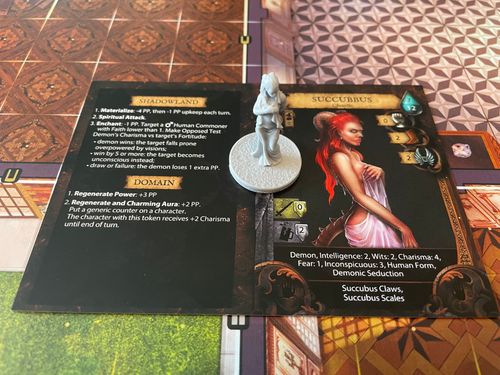
Succubus
Succubus is the demon of men's desires. It can take the illusory form of a beautiful woman. It appears to each man as the most beautiful woman the man has ever seen, or one that the man knows and secretly desires. They usually appear in dreams, but can also seduce an awake person. When materialized, they have an innocent appearance that can fool anyone but the smartest men. Under this illusion, however, lies the demon's true form – a monstrosity covered in scales and armed with long, sharp claws.
Succubus is fielded as any other demon (see rules for demons).
Mephistopheles
Mephistopheles is a fallen angel. No one knows where his name came from. Some claim it comes from Hebrew, meaning "spreader of lies". Others say it goes back to Classical Greek and translates to "not bringing light". Mephistopheles himself claims he used to be the Lord's angel and he was honored to see the very face of God. However, he was cast down to hell for siding with Lucifer. Since then, he must serve the Demon Prince as one of the damned. He travels Earth looking for people ready to sell their souls for a moment of fame, knowledge, or honors. Mephistopheles can take any human form. We depicted him in 1580s clothes. It was the time when Marlowe's play "The Tragical History of the Life and Death of Doctor Faustus" was staged for the first time.
If nobody drafts Faust, Mephistopheles is deployed as a normal demon (see rules for demons).
Demons
Demons are beings inhabiting the spirit dimension (or dimensions) – the Netherworld. Some of these beings are very powerful, but they have a hard time entering and affecting the material world. In Anno Domini 1666, the spirit world is divided into several areas. The two opposing poles are heaven and hell. In between demons, minor deities, have their domains, their own separate worlds. Somewhere among all this hangs the entire material world. Shadowlands, its reflection, exists just "beside" it. It's the place where ghosts of the dead may exist, if for some reason they haven't moved on to the Netherworld. It is also the place where demons go if they want to affect the material world, or materialize in it.
Demons and other spirits lack material form. When materializing, they can take almost any appearance. For a mortal observer they can look like a regular human. In Marlowe's play, Mephistopheles sometimes looks like a hideous demon, and like a modest monk at other times. Boruta reportedly appeared as a bulky nobleman, a huge bird, a black horse, or a hooded monk. But there's even more to it. Different people can perceive a demon differently. Most of its form is an illusion, after all. People of great faith, or keen senses, may catch glimpses of something strange going on. A hoof or a chickenfoot instead instead of a human foot, horns, split tongue, perhaps a tail. Sometimes they can smell a faint hint of sulfur. Whether the game characters are fooled by the demon, depends on their skills and abilities. Many demons are very deceptive and few mortals can see through their tricks. Obviously, our players are not mere mortals and as such can see the demonic features on their miniatures just fine.
Fielding Demons
Do not think of a demon as a part of your band. Even mercenaries are more reliable. Humans, their struggles and joys are dull and repetitive for demons. All they care about are the immortal human souls.
In order to field a demon you need a human with the Sorcery skill, or with a pact card attached. Do not include demons in the draft. After the draft is finished, put all available demons along with their pacts between the players. Each player draws one Magic card plus one additional Magic card for each Character with the Sorcery skill in their Character pool. Each player keeps one card with the lowest value and discards the others. The player with the lowest card picks a demon from the pool (along with their pact card), then the player with the next lowest card picks and so on until you run out of available demons.
After the demons have been drafted, players may field them. You may field one demon for each Character with the Sorcery skill. Demons fielded along sorcerers have been coerced into service by more powerful beings. If the sorcerer dies, the demon stays on the board, but loses interest in helping the mortals. From now on it may not regenerate power in the Domain.
The other way to field demons is signing the pact. Put the demon's pact card (it is an additional equipment card) on any human character, who is not good or lawful. A single Character may only have one pact. The Character has signed a deal with the demon, so when the Character dies, the demon immediately seizes the opportunity and grabs their soul. Remove the demon from the board.
Whenever you field a demon, whether in a sorcerer's service, or by signing a pact, you must pay its gold cost normally. The cost of fielding the demon by the means of the pact is printed on the pact card. You must observe all Character restrictions listed on your faction card.
Due to their power, demons are worth more Victory Points. A banished demon (ie. one that lost all its Power Points) is worth 3 VP for the player who banished it. A demon that is in its domain at the end of the game, or seized the soul of its pact owner, is worth 1 VP for each opponent. A demon's "death" does not cause an Alarm counter to be discarded.
Characters Skills
You can find skills of Richelieu, Milady and Rochefort on Cardinal's Men faction card. Hot and Dangerous skills are on their faction card. Skills of other characters are:
Ambush – Before the game starts, during setup, you may choose not to deploy this character normally. Instead, you may deploy it during any Action Phase, after all other characters have been activated (including the last model of the player with fewer models, who may normally keep passing the opportunity to activate). This Character must be placed on a space that would be legal to enter (e.g. not blocked or deep water space). It must be outside enemy Line of Sight, or at least 12 spaces from enemy characters that do have line of sight to this space. This character may then activate normally.
Demon – this Character does not count as Human. The following special rules apply to demons:
- Instead of Wounds threshold, demons have Power. Treat Power like Wounds – when Demon is hit in the material world and would receive Wounds, he loses as many points of Power instead. Power has two values. The higher one is the maximum value, and the lower is the value at which the demon starts the game. Power rises when the demon retreats to its domain and regenerates, and is lost (spent) when it uses its demonic abilities, materializes, receives Wounds etc. When it reaches 0, the demon is banished – remove it from the game. A demon may also disappear voluntarily after each "Wound" suffered. If it has any power left, remove it from the board and put it in the Shadowlands or the Domain. You can use Wound markers to trace how many Power points demon have. When demon regenerates add more markers, when it gets Wounded or uses power – remove markers.
- Demons are immune to Poison, Thrust to the Heart, and Night rules.
- Instead of regular character cards, demons have their own mini-boards. They are divided into two parts – statistics card on the right and the Netherworld on the left. Netherworld is divided into 2 zones: Shadowlands and the Domain. At the start of the game place the demon on the mini-board in either zone.
- When a demon on the mini-board is activated, the player must first decide whether to move the demon from one zone to the other, and then perform one of the actions listed in the zone in which the demon currently is.
- If the demon materializes, it is placed on the board following the Ambush rules. The only difference is that the demon is placed immediately, not at the end of the Action phase. After the demon is placed, it may immediately activate normally. While the demon is materialized, it has the characteristics listed on the right side of the mini-board. When it suffers Wounds, it loses power equal to the Wounds.
Demonic seduction – Treat as standard Seduction (see Rulebook p. 33), but after You succeed and take both miniatures from the board the demon is not treated as killed. Put him on his mini-board, in the Shadowlands instead. Demon may seduce both men ♂ and women ♀. Treat him as if his gender being opposite to seduced model for purposes of any relevant rules and skills.
Exorcisms – The Character may perform one of the two possible actions each turn:
- Banishment. No action required, this may be performed for free in the Interaction Phase as long as the Character has not performed Exorcism in the Action phase. Carry out spiritual combat against any non-Inconspicuous Demon or Vampire within line of sight and 6 spaces range. If the Exorcist wins, in addition to suffering Wounds, the losing Demon must retreat to either the Shadowlands or the Domain (Demon's choice). A losing Vampire must retreat to the Shadowlands or fall prone (Vampire's choice).
- Exorcism. Full Action, receive 2 MP to spend. Carry out spiritual combat against any Demon or Vampire in the Shadowlands. If the Exorcist wins against a Demon, it must retreat to the Domain.
During all spiritual combat the Character may add the Exorcism score to Fortitude (or any other ability used for the spiritual combat). In addition, while the Character is on the board (in the material world) receives only half damage (rounding down) when losing spiritual combat.
Fear [X] – Enemy characters within Line of Sight, range of 6 spaces, and with Fortitude lower than X, receive -1 to all Tests. At the end of each turn discard one additional Alarm counter for each model with Fear on the board.
Genius – While making an Intelligence test (opposed or unopposed), play additional card from Players deck and choose the one which You prefer.
Human Form – Whenever the Demon materializes, it can take the Human Form. In Human Form, it may use its Charisma for [talking] tests, receives an Inconspicuous marker and loses Fear. It may switch to demonic form at any time (losing Inconspicuous and the talking ability, gaining Fear), but not the other way around (unless materializes again). Losing Inconspicuous marker (i.e. when recognized by enemy Character) doesn't mean that Demon switches to demonic form.
Mute – The Character may only participate in [talking] tests if they are the direct target of the [talking] skill. Therefore they may not initiate [talking] or support it.
Pact with Lucifer – through Mephisto, Faust signed a pact with Lucifer, the Demon Prince himself. It guarantees he can't die for 24 years.
- Demons may not initiate attacks (any attack skills, close or ranged combat) against Faust. If he attacks a Demon in Close Combat and the Demon wins, Faust does not receive any Wounds, but is treated as the loser of the combat and retreats normally.
- If Faust would die, he is instead carried off by demon hosts. Remove him from the board. For the purposes of victory conditions, he counts as a killed Commoner, rather than Hero. The Scenario items he was carrying are left in his space. For other purposes he is not considered killed, e.g. do not remove an Alarm Counter.
Retaliation [X] – If this character loses Close Combat (but not draws), but survives, before resolving any potential retreat, make an Unopposed Test of this Character's Weapon Skill that was just used, with the DL of X. On a failure nothing happens. On a success, the opponent receives damage calculated like a Ranged Attack. It may not be parried, does not count as new Close Combat, does not require retreat etc.
Slow Thinking [Character] – This Character's Intelligence counts as 1 lower than the printed value (possibly being negative). If this Character does not have [Character] mentioned in the skill in his Line of Sight, he may not be the first Character you activate on a given turn (unless he's the only Character in the Band).
Touch of the Unknown – If this character if is the target of a skill or attack of another Character with the Demon or Beast rule, or attempting to recognize an Inconspicuous character with one of these rules, this Character's Wits, Intelligence and Fortitude are all considered 1 higher.
If this character is involved in an opposed test against a Character with the Demon or Beast rule, this character receives +1 to the test total.
Astrology and Numerology
| Roll | Effect |
|---|---|
| I-II See the Future | Look at the three top cards of your Player Deck and put them back in any order. |
| III Feel the Moment | Skip the Initiative Phase next turn. Instead, you decide who has the Initiative. If the opponent draws the same effect, they offset. |
| IV Profound prophecy | Immediately draw two Player Cards into your hand. If you go over the card limit, you must discard down to the limit. You may discard the cards you just drew. |
| V-VI Prophecy | Immediately draw an extra Player Card into your hand. If you go over the card limit, you must discard one. It may be the card you just drew. |
| VII Good fortune | Put a generic counter on the Divinating Character's card. You may discard it when playing a card from the deck. Draw three more cards, choose one to use, and shuffle the others into the deck. |
| VIII Foiled | Look at the cards in the opposing Player's hand. You may discard one chosen card. |
| IX Teachings of the Past | Search your discard pile, choose two cards and shuffle them into your Player Deck. Only shuffle the deck and the two extra cards, not the discard pile and hand. |
| X Powerful Good Omen | Put a generic counter on the Divinating Character's card. You may use (discard) it when a Divinating Character or a friendly Character that has it in its field of vision perform a test. They get a +2 modifier to the test. |
| XI-XII Anticipation | Look at the cards in your opponent's hand. |
| XIII Vision of Own Death | The Divinating Character must pass a DL7 Fortitude test or passes out (is Unconscious). If at least one of the drawn effects is the "Vision of Own Death", then you may not choose "The Stars are Silent" effect. |
| XIV-XV Good omen | Put a generic counter on the Divinating Character's card. You may use (discard) it when a Divinating Character or a friendly Character that has it in its field of vision perform a test. They get a +1 modifier to the test. |
| XVI Chaos | Both players shuffle their Player Decks as if their discard piles contained four 8-value and Joker cards. |
| XVII-XXIV The Stars are Silent | Nothing happens. |