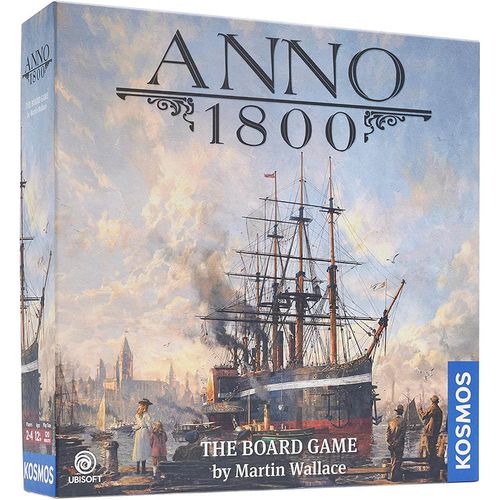
Anno 1800
Anno 1800: The Board Game Rulebook
Table of Contents
Table of Contents
Game Components
- 4 Game aids
- 1 Gameboard
- 4 Home islands
- 12 Old World islands
- 8 New World islands
- 120 Construction tokens
- 1 Starting player token
- 130 Naval tokens (77 trade tokens (bronze), 53 exploration tokens (silver))
- 1 Fireworks token
- 38 Gold tokens (26 tokens worth 1, 12 tokens worth 5)
- 102 Population cards (46 Farmers/Workers, 32 Artisans/Engineers/Investors, 24 New World cards)
- 22 Expedition cards
- 20 Objective cards
- 125 Population cubes (25 Farmers (green), 40 Workers (blue), 25 Artisans (red), 20 Engineers (purple), 15 Investors (turquoise))
Game Setup
- Place the gameboard in the centre of the table. Sort all the construction tokens and place them on the gameboard according to their images. The blueprint side with the costs (purple bar) must be visible. Number of construction tokens:
- 35 industries x 2 of each
- 4 x shipyard strength 1
- 6 x shipyard strength 2
- 4 x shipyard strength 3
- 6 ships x 6 of each
- Shuffle the 3 population card stacks and the expedition cards separately and place them on their respective spaces on the gameboard facing down.
- Shuffle the Old and New World island boards separately and place them to the right of the gameboard. Lay out the naval and gold tokens ready beside them.
- Sort the population cubes and place them in the correct position to the left of the gameboard.
- Place 5 objective cards and the fireworks token next to the population cubes. For the first game, take the objective cards with the 3 diamonds above their names: Alonso Graves, University, Edvard Goode, Isabel Sarmento, Zoo.
- Each player is given one home island and places 4 farmers, 3 workers and 2 artisans on their respective residential districts. 1 trade token is placed on each of the two merchant ships and 1 exploration token is placed on the exploration ship.
- To finish, each player is additionally given 7 farmer/worker and 2 artisans/engineer/investor cards as their hand.
- Whoever was abroad most recently is the starting player and is given the starting player token.
- The second player is given 1 gold, the third player is given 2 gold and the fourth player is given 3 gold. The starting player then starts the game.
Home Island Layout
- Residential district: Place the available population cubes ready here.
- Island field types: land field; land field with coast; sea field.
- Personal exhausted area: When you are required to "exhaust" population cubes or naval tokens, place them in this area (to the left of the home island).
Gameplay and Aim of the Game
In Anno 1800 – The Board Game, each player expands their own island by erecting new buildings, shipyard and ships, trading resources and satisfying the needs of the population. By producing or trading goods, cards can be played and yield influence points at the end of the game.
The starting player begins, then one by one the players take turns in a clockwise direction until the end of the game is triggered by one player playing the last card from their hand. The current round is then completed. This is followed by a final round, after which the influence points are counted and the winner established.
The 5 population tiers are: Farmers (green), Workers (blue), Artisans (red), Engineers (purple), Investors (turquoise).
Turn Overview
During their turn, each player has 1 action available. The possible actions are:
- Expand (industries, shipyards or ships)
- Play & activate population cards
- Swap population cards
- Increase the workforce
- Upgrade
- Open up the Old World
- Explore the New World
- Take expedition cards
- Celebrate a festival
In addition, there are the free actions "activate population cards" and "activate objective cards", which can be carried out during your turn, provided that there are enough resources available to do so.
Resource Management
Resource management consists of the elements: production, trade and shift end.
Production
Almost all actions require resources in order to carry them out. Resources are produced by population cubes. There are 5 different population cubes, each of which is assigned to a colour and a symbol.
In order to produce a resource, a population cube is moved from its residential district and placed on a free workplace on your island. The workplace specifies which population cube is required. By placing it down, the resource depicted is produced just once and must be used in the same turn. This resource cannot be produced in advance for later turns. Population cubes that have been placed down remain on their workplaces, but do not produce any more resources so long as they are there.
Example: Linda needs beer for her turn. She already has the brewery for it, so she therefore moves one of her workers from their residential district to one of the two available workplaces. She has thus immediately produced 1 beer, which she can use during her turn. If she still needs beer, she has to use another worker.
In some cases no resources are required, just the population cube. In this case, the "workforce" of the population cube is used, as it were, without this cube being required on a specific workplace. In these cases, a population cube of the required type is moved from its residential district to the exhausted area to the left of the home island. Population cubes in the exhausted area cannot be used for any other action temporarily.
Example: Andreas wants to build a warehouse and needs 1 brick and 1 artisan for this. He places one of his artisans on the brickworks and exhausts another artisan, who he places to the left of his home island.
Naval Tokens
Certain actions require naval tokens in order to carry them out. There are 2 types of naval tokens that always have a value of 1: trade tokens and exploration tokens.
In order to carry out these actions, naval tokens of the type and amount depicted are exhausted and taken from your own ships. Naval tokens in the exhausted area cannot be used for any other action temporarily.
Example: Linda wants to play a card that requires 2 exploration tokens. She has two merchant ships each having 1 trade token and one exploration ship having 2 exploration tokens. She can take the 2 tokens from the exploration ship and exhaust them. These can be used to play the card.
Trade
If a resource that the player cannot, or does not want to, produce themselves is required for an action, this resource can be obtained by trading it with one of the other players. For each resource traded, 2 requirements have to be fulfilled:
- The active player has a sufficient number of trade tokens on their ships.
- At least 1 other player has a construction token that can produce the resources required.
The number of trade tokens required is predetermined by the population tier that produces this resource. The costs are shown on the residential districts: 1 trade token for farmers and workers, 2 for artisans and 3 for engineers. After the active player has exhausted the trade tokens required, the resource has therefore been produced.
The other player cannot refuse the trade, but does not place a population cube on a workplace either. They are given 1 gold from the supply for this. Each trade is compensated for with 1 gold, regardless of how many trade tokens had to be used for this.
IMPORTANT!
- The same resource can only be traded once per turn. However, several different resources can be traded as long as the player has a sufficient number of trade tokens.
- Trading is also possible when the other player's workplaces are already occupied.
- Resources from the New World, population cubes and exploration tokens cannot be traded.
- Players cannot trade with themselves!
Example: Andreas needs 1 penny farthing, but does not have the industry for this. His two teammates Diana and Maxim can both produce penny farthings. Therefore, he would like to trade with one of them. Since penny farthing production requires an engineer, Andreas has to exhaust 3 trade tokens (for the number, see residential district). He can now freely choose between Diana and Maxim, even if both of Maxim's workplaces are already occupied. He decides on Maxim, who is given 1 gold from the supply. Andreas has immediately "produced" 1 penny farthings in doing so, which he can use during his turn. However, he wouldn't be able to trade penny farthings with Maxim or Diana for a second time in this turn, but could trade other resources.
Shift End
During their turn, each player can spend gold in order to ring in the shift end for their population cubes that have already been used. The chosen population cube is taken from its workplace or from the exhausted area and placed back on its residential district. It can therefore immediately be used again. Spending gold always means placing it back in the supply.
The amount of gold required for each population cube can be found in the respective residential districts.
Example: Linda needs timber and several workers for her next actions. She spends 2 gold in order to send her two farmers from the sawmill back to their residential district (1 gold for each). As a result, both the workforce and the workplace are free. In addition, she spends 2 gold in order to send her worker from the exhausted area to their residential district. All three can be used again from now on.
Actions
Expand
With the expand action, the players expand their islands by means of new industries or shipyards or ships. As a whole, the possible expansions are referred to as construction tokens. After the resources required for the construction have been produced, a built construction token is removed from the gameboard, turned over and placed on your own island with its built side face up.
Only one construction token can lie on each island field. However, already built or pre-printed construction tokens may be built over. This also applies to construction tokens that have been used for the token that has just been built. The construction tokens that have been built over are placed back on the gameboard.
During the expand action, 1 already built construction token may be removed from your islands and placed back on the gameboard at any point. If there are any population cubes on a construction token that has been removed in this way, these counters are exhausted.
Industries
There are two of each industry on the gameboard. Each player may have no more than one of each industry. Only 1 industry can be built per expand action. Industries can be built on all land squares. The blueprint side of the industries shows which resources are required as costs (purple bar at the top), which resource can be produced there (resources symbol in the middle) and which type of population cube will be required for this (border colour and symbol). The building side shows two workplaces for specific population cubes (colour and symbol) and the resource that can be produced there.
Every player may only have built identical industries once. This means that alternatives to the pre-printed starting industries may be built in addition to these. These alternative industries offer workplaces for workers instead of farmers or artisans and are therefore not identical with the starting industries. For example, a second sailmakers' workshop for workers may not be built. An exception occurs with the benefits of the Old World islands. It is not compulsory to build an alternative industry over its corresponding starting industry.
Shipyards
Shipyards show a number in a ship's wheel on their blueprint side and on their shipyard side. This indicates which maximum ship strength applies for the particular shipyard. Shipyard strength 1 can only build ships of strength 1, shipyard strength 2 can build ships of strength 1 or 2 and shipyard strength 3 can build all ships. Only 1 shipyard can be built per expand action, but each player can have any number of shipyards in each strength. Shipyards can only be built on land squares with a coast.
NOTE: The construction tokens "timber" and "shipyard strength 1" on the gameboard are actually free and can be built as normal in one expand action without resources having to be produced for this.
Ships
Ships are built in shipyards and the number of naval tokens on their blueprint side and on their ship side display which strength they have (1, 2 or 3). During each expand action, you can build up to as many ships as there are shipyards on your island. Each shipyard can build 1 ship, with its strength being lower or equal to that of the shipyard. As with the shipyards, each player can have any number of ships of each strength.
The corresponding number of naval tokens is immediately placed on a constructed ship. New trade tokens can then be used instantly in order to trade resources for additional ships.
There are merchant and exploration ships and each shipyard can build both types. Ships can only be built on sea squares.
Play & Activate Population Cards
Specialists are depicted on the population cards which provide influence points and a one-time advantage effect for resources. In order to play a population card, the population's needs have to be met and the resources required have to be produced. These required resources are indicated on the card in the purple bar at the top. The card is then placed face up below your home island.
Each population card played displays an effect that can be applied once. This can be activated at any time during the same turn or one of your later turns. For this, the card is turned over face down, but remains with the player. The effect takes place immediately. Activating a card is a free action, and therefore any number of cards can be activated per turn.
Each card played in the player region, whether it has been activated or not, provides its respective influence points at the end of the game.
Swap Population Cards
In this action, up to 3 of the population cards in your hand can be placed under their respective population card stacks. After this, draw the same number of cards from the respective population card stacks. If a stack is empty, it is not possible to swap population cards of this type.
Increase the Workforce
With the "Increase the Workforce" action, up to 3 new population cubes can be added to your home island from the supply. In order to add 1 population cube, the resources required for this have to be produced, which are indicated above the individual residential districts. The costs always correspond to exactly 1 population cube. Population cubes obtained in this way can be directly used to produce resources that are required for further increasing the workforce.
For each new farmer or worker, 1 farmer/worker population card must be drawn and added to your hand. For every new artisan, engineer or investor, 1 artisan/engineer/investor population card must be drawn and added to your hand.
If the workforce is to be increased but the corresponding population card stack has already been used up, no cards are drawn. Instead, for every population cube added, the amount of gold indicated on the gameboard must be spent. If this is not possible, the workforce cannot be increased and the population cube cannot be added.
Upgrade
With this action, up to 3 upgrades can be made to your population cubes. The resources required for this action are indicated above the upgrade symbol in between the residential districts of two population tiers. These resources are needed to make 1 upgrade from one type of population cube to the next: Farmer → Worker → Artisan → Engineer → Investor. The 3 upgrades can be divided between 1 to 3 population cubes.
A population cube that is to be upgraded is replaced by the new type from the supply. Since the number of population cubes is therefore not increased by upgrades, no new population cards are drawn either.
IMPORTANT: If the population cube to be upgraded is located on a construction token, the new population cube is also placed on this workplace. This means that the colours of the workplace and the population cube will now not match until the next shift end or festival.
Open Up the Old World
With the "Open up the Old World" action, your island can be extended in order to provide more space for additional construction tokens. In order to provide access to an Old World, the number of exploration tokens currently needed for this has to be exhausted. The first Old World island of each player requires 1 exploration token, the second 2, the third 3 and the fourth 4. These costs are independent from the number of New World islands that the player has. No player can provide access to more than 4 Old World islands. A maximum of 1 Old World island can be opened up per "Open up the Old World" action.
Old World islands are taken from the stack and set up to the right of your group of islands, face up. They extend the group of islands by 2 sea squares and 4 land squares, including 2 with coasts, all of which can be used for the expand action. The home island's squares do not need to be completely covered before providing access to an Old World island. Construction tokens can also still be built on the home island.
Old World islands bring a one-time advantage for the player. These are either effects that are immediately triggered as soon as the island is opened up, or industries, shipyards or ships that can be used as usual. Only this way is it possible for players to have exact duplicates of an industry. For example, when the sailmakers' workshop for workers has already been built but another one is added by providing access to an Old World island.
Explore the New World
With the "Explore the New World" action, valuable resources can be discovered from faraway islands for trading. In order to explore a New World island, the number of exploration tokens currently required for this has to be exhausted, similar to providing access to Old World islands. The first New World island of each player requires 1 exploration token, the second 2, the third 3 and the fourth 4. The costs are independent from the number of Old World islands that the player has. No player can explore more than 4 New World islands. A maximum of 1 New World island can be explored per "Explore the New World" action.
For each New World island explored, the player must also draw 3 New World cards and add them to their hand.
New World islands are taken from the stack and placed in your player region face up. Each New World island displays 3 resources that it can produce.
In order to be able to use a resource from your New World island, a trade token must be exhausted, which can also be done several times during each turn. The New World resources of other players cannot be traded. However, this only applies to the New World resources and not to their succeeding industries. Tobacco, for example, cannot be traded, but cigars that require tobacco, can. No construction tokens can be built on New World islands.
Take Expedition Cards
By means of the "Take Expedition Cards" action, players draw expedition cards that can bring additional influence points at the end of the game, but do not yield any other advantages until then. In order to start an expedition, the resources required for this have to be exhausted: 2 exploration tokens for up to 3 expedition cards.
Expedition cards are drawn from their stack on the gameboard and form a personal stack of cards facing down for each player below their home island. They do not count as the player's hand cards. You may look at your own expedition cards at any time.
Expedition cards each display an animal for the zoo on the left and an artefact for the museum on the right. The background colour and the symbol underneath indicate which population cubes are required as visitors at the end of the game in order to obtain the influence points indicated underneath the images. Each population cube can only be used for one square.
Celebrate a Festival
If a player cannot, or does not want to, carry out any other actions, celebrating a festival allows them to reset population cubes and naval tokens. They can then be used again during later turns. For this, the entire population returns to their residential districts and all ships enter the harbours. In order to celebrate a festival, all population cubes and naval tokens are taken from the workplaces and from the exhausted area and returned onto their respective residential districts in the town or on the ships.
End of the Game
As soon as a player has played the last card from their hand, i.e. they do not have any more population cards in their hand, the end of the game is triggered. This player immediately obtains the fireworks token. The current round is still played to the end so that every player has the same number of turns. After this, a final round is played before the game ends.
If the player that has triggered the end of the game receives any more population cards in their hand at any point, the end of the game still remains triggered and the player does not have to give up the fireworks token either.
Scoring
Each player then counts their own influence points:
- Each population card played in their player region, whether facing up or down, gives the number of influence points indicated thereon:
- Farmer/worker cards: 3 influence points.
- Artisan/engineer/investor cards: 8 influence points.
- New World cards: 5 influence points.
- The expedition cards are revealed and are occupied with the player's own artisans, engineers and investors corresponding to their background squares. These can be taken from the residential districts, from workplaces or from the exhausted area. Each population counter can only be used for one field on the expedition cards. Each occupied field is scored separately and then gives the influence points indicated underneath. Expedition cards do not have to be fully occupied to yield influence points.
- 3 gold yields 1 influence point.
- The fireworks token yields 7 influence points.
- Finally, check for influence points on the displayed objective cards.
Whoever now has the most influence points, wins! If there is a tie, the person who has the most industries, shipyards and ships overall, wins. Pre-printed construction tokens that have not been built over thus, of course, count. In the event of another tie, whoever has the fewest hand cards left, wins. Otherwise, the victory is shared.
Scoring example: Linda counts her influence points: (1) 11 cards each having 3 influence points, 3 cards each having 8 influence points and 4 cards each having 5 influence points: 11x3 + 3x8 + 4x5 = 77 influence points from population cards. (2) 3 expedition cards, but which are missing an engineer: 3x1 + 1x2 + 1x3 = 8 influence points from expedition cards. (3) 5 gold = 1 influence point. (4) Since she triggered the end of the game, she has the fireworks token = 7 influence points. (5) The objective cards bring her: since she neither has the most nor the second-most engineers = 0 influence points; 6 influence points for each gramophone/penny farthing/steam motor industry = 6 influence points (penny farthing); 6 influence points for each New World island that she has = 6 influence points (1 New World island); 1 additional influence point for each zoo animal visited = 2 influence points (2 visited zoo animals). Linda therefore has a total of 77 + 8 + 1 + 7 + 0 + 6 + 6 + 2 = 107 influence points.
Objective Cards
Objective cards present you with chances and challenges of different figures and achievements from the Anno world. At the beginning of each game, you draw 5 random objective cards that stay in for the entire game. You can of course also select your favourite combination. For the first game, we recommend the objective cards Alonso Graves, University, Edvard Goode, Isabel Sarmento and Zoo.
There are two types of objective cards. Most of the objective cards reward you with influence points at the end of the game if you have fulfilled their requirements. They have a darker background than the effect objective cards. The effect objective cards have the same bright background as the population cards. They offer you specific effects that you can use during the game. These effects are not actions and are not used up during the game either. Each of you can therefore use them during your own turn if it ever seems appropriate or necessary.
Effect Objective Cards
- Alonso Graves – Exhaust 3 exploration tokens and spend 3 gold in order to be able to carry out an additional action.
- Aarhant – Exhaust 1 investor in order to obtain 5 gold from the supply.
- The Editor – Exhaust 2 exploration tokens in order to return any 1 hand card under its appropriate population card stack. No new cards are taken.
- Beryl O'Mara – 2 exploration tokens can be used as 1 trade token. The tokens are not exchanged! However, 2 exploration tokens, for example, can be exhausted in order to trade for 1 resource produced by a farmer or worker. In this way, several resources can also be traded in one turn.
IMPORTANT: The effect objective cards Alonso Graves, Aarhant and The Editor can each only be used 1 per turn.
Scoring Objective Cards
- Carl Leonard von Malching, Eli Bleakworth, The Queen, Edvard Goode, Willie Wibblesock, Princess Qing – at the end of the game, each industry depicted on these cards gives the player that built them the adjacent number of influence points.
- Hannah Goode, University, World's Fair, Madame Kahina, The Tourist – Each of these cards gives the player that has the most of the depicted elements (total population cubes, engineers, investors, trade tokens, expedition cards) 10 influence points at the end of the game. Whoever has the second most of these elements is given 4 influence points. In the event of a tie, all players involved in the tie are given the respective influence points. In the event of a tie between the players that have the most elements, the influence points for the second-most elements are also awarded.
- Zoo, Museum – Each of these cards increases the influence points that you receive for visited animals or artefacts by 1. Therefore, an animal field of an expedition card occupied by an engineer is worth 3 influence points at the end of the game instead of 2, for example, if the zoo objective card is in play.
- Bente Jorgensen – Each player that has provided access to a maximum of 1 Old World island at the end of the game obtains 18 influence points. The home island is not an Old World island!
- Isabel Sarmento – Each New World island that a player has explored gives 6 influence points at the end of the game.
- Pyrphorian – At the end of the game, players lose 2 influence points for each population card that they still have in their hand. Populations cards that have been played but not activated do not count as hand cards.
Combination of Objective Cards
You normally draw 5 random objective cards at the beginning of the game. However, if you want to steer the game in a specific direction, you can orient yourself towards these suggestions in order to specifically combine the 5 objective cards:
- For a more complex game with more possibilities, take any number of effect objective cards (Alonso Graves, Aarhant, The Editor, Beryl O'Mara).
- For a more confrontational game in which you compete for points harder, take any number of objective cards that make the majority of specific game elements worth your while (Hannah Goode, University, World's Fair, Madame Kahina, The Tourist).
- For a more fun game with the focus on expanding the islands, take any number of objective cards that give you points for different industries (Carl Leonard von Malching, Eli Bleakworth, The Queen, Edvard Goode, Willie Wibblesock, Princess Qing).
- The Zoo and Museum objective cards place the focus on expedition cards.
- Use the Pyrphorian objective card to change both the feel of the game and your strategy. Since the card penalises you for leftover population cards at the end of the game, there is even more competition to trigger the end of the game and greater caution is taken when increasing the workforce.
Effects of the Population and Objective Cards
- You receive the depicted population cubes (place them on their respective residential districts) and the corresponding population cards to your hand. If the corresponding stack is empty, gold must be spent instead. If this is not possible, the effect cannot be used or not used to the full extent.
- You receive the depicted amount of trade or exploration tokens and place them on the population card. You can use them like regular naval tokens, but after being used they are returned to the supply. They are also returned to the supply if they have not been used before your next festival.
- You receive the depicted amount of gold. Place it in your personal supply.
- You draw 2 expedition cards. This effect expires if the expedition card stack is already empty.
- You receive one of the depicted New World resources, for free one time and you have to use it when activating the card.
- You receive up to 3 free upgrades for your population cubes. You may only use them to improve the population cubes depicted. All upgrades that you want to use have to be used in the same turn and cannot be spread out across several turns.
- You are given an additional action that you may carry out in accordance with the normal rules.
- You may return any 2 hand cards under their respective population card stacks. No new cards are taken.
IMPORTANT: Unlike all the other effects, you can only activate this effect (the additional action) during the turn where you played the card. At the end of your turn, you have to turn the card face down. You may no longer use this effect, and you cannot activate it in a later turn!
Tips for Getting Started
Anno 1800 – The Board Game can be quite overwhelming, particularly for your first few games. We would therefore like to share some tips with you that you can also use to offer some guidance to new players.
You will probably have the impression that the end of the game is far away. This is because the end is only triggered when a player has played the last card from their hand. For most of the game you will take population cards quicker than you can fulfil them. This is quite normal since your islands only have very sparse production possibilities at the beginning. As your town grows and gains inhabitants, population needs also grow and have to be met. It is not unusual for you to double the number of hand cards you started with. However, don't be fooled by the feeling that your game will never end! An important element of the game is to discover when to stop increasing your workforce, because you can effectively meet the needs of your population with what you already have. You should bear this in mind if you want to be the player to fulfil all of your hand cards in order to obtain the 7 bonus points.
However, this does not mean that this is always the correct path. Whoever triggers the end of the game ultimately still hasn't won and, in several game strategies, you are not at a disadvantage having leftover hand cards at the end of the game (unless the Pyrphorian objective card is in the game). You therefore may try to get cards and meet the needs of as many inhabitants as possible, while others may want to minimise their number of inhabitants in order to be able to control the end of the game more effectively.
The following is very important: each player's island gets better with every round. You have more industries, a larger navy and, as a result of trading, each person also profits from the advancement of the other players. And if a certain point of development is reached by all the players, the end of the game can happen quite suddenly because you are able to play your population cards far quicker than you receive new ones.
It is also important to carefully consider the number of festivals that you celebrate. This is because, when the entire town is celebrating, they aren't working. You should therefore try to make optimum use of your possibilities between these festivities.
Particularly at the beginning of a game, the question "where should I actually start?" may arise. It is worth noting the needs of your inhabitants on your hand cards. If specific resources crop up several times, you can begin with constructing one of their respective industries. Do some inhabitants require soap? Then start building a soap factory right away. In this way, you can go through the industries that are most important to you straightaway and get your game moving. There's nothing wrong with an early push to new shores either, in which you open up the Old World island with your fleet. The construction space may not yet be required at the beginning, but the one-time advantages of each island are.
Do not underestimate those industries that you already have either. For your 5 starting industries, each of which requires artisans, you can build alternative versions. Each of these require workers for the same resources and replace the artisans variant. Such an investment can, of course, be entirely worth it, since you come across workers more easily than artisans during the game and several cards and tokens need the resources produced in these industries.
As the game continues, it is also worth taking a look at industries that are a prerequisite for several others. Weapons are required, for example, when the exploration fleet is to be expanded, while cotton fabric is incredibly important for New World cards. An early investment in such industries will make you a lucrative trade partner for the other players.
Remark Regarding the "Goods" Resource
Knowledgeable Anno-1800 fans and members of the Anno Union are sure to have stumbled over the "goods" resource. They don't know it as a resource from the PC game, but as an icon for "flotsam". Lastly, all resources are in fact goods, the production and use of which you organise. However, in Anno 1800 – The Board Game, the goods are an independent and equal resource such as, for example, timber. The crates represent a colourful mixture of different special goods: the grapes in champagne, copper and zinc for bronze or cargo for ships. The corresponding building on their construction token is therefore also the warehouse. It is a very versatile place of transshipment on your island and an important part of the infrastructure.
We have drawn on this solution in order to be able to capture the complexity of the PC game, but to guarantee accessibility and playability at the same time. Therefore, we can comprehensibly depict a wide range of resources and predominantly their connection to one another.
Quick Reference
Game Play
- In turns, 1 action each until one player does not have any more hand cards.
- Play the round to the end.
- Play an additional last round.
- Count influence points. Most influence points = winner.
Count Influence Points
- Played population cards (facing up and down).
- Visited fields of the expedition cards.
- 3 gold = 1 influence point.
- Fireworks token = 7 influence points.
- Fulfilled objective cards.
Production
- Place down population cubes that are predetermined by the workplace in order to produce the depicted resource 1x and to use it in the same turn.
- Directly required population cubes or naval tokens are exhausted.
Trade
- Exhaust trade tokens in order to use 1 of the other players' industries. The number is determined by the population tier that the other player would need in order to produce this resource.
- The other player receives 1 gold from the supply.
- Trade cannot be refused and you cannot trade with yourself.
- Occupied workplaces do not hinder trade.
- Population cubes, naval tokens and resources of the New World islands that are directly required cannot be traded.
Shift End
- Spend gold to return a population cube to its residence from either a workplace or the exhausted area. The number of gold tokens is determined by the population tier.
- Provided that sufficient gold is present, several population cubes can be returned.
Expand (industries, shipyards or ships)
- Produce resources in order to build 1 construction token.
- You can build up to 1 ship per shipyard in an expansion action (pay attention to ship strengths of the shipyards!).
- Ships immediately obtain naval tokens in order of their strength.
- Place construction tokens that have been built over back on the gameboard.
- Industries → land squares, shipyards → land squares with coast, ships → sea squares.
- A maximum of 1 of each industry can be built at the same time, shipyards and ships can be built as often as you want.
Increase the Workforce
- Produce resources in order to place up to 3 new population cubes on their residential district and to take 1 corresponding card for each new population cube.
- If the population card stack is empty, gold must be spent for every card that is not drawn. If this is not possible, the action cannot be (fully) carried out.
Upgrade
- Produce resources in order to carry out up to 3 upgrades.
- Each tier change is 1 upgrade. Order of the upgrades: Farmer → worker → artisan → engineer → investor.
Open Up the Old World
- Exhaust exploration tokens in order to set up 1 Old World island and to carry out its effect, if possible.
- 1/2/3/4 exploration tokens → 1st/2nd/3rd/4th Old World island.
- Maximum 4 Old World islands per player.
Explore the New World
- Exhaust exploration tokens in order to set up 1 New World island and to take 3 New World cards.
- 1/2/3/4 exploration tokens → 1st/2nd/3rd/4th New World island.
- Maximum 4 New World islands per player.
- Exhaust 1 trade token in order to produce 1 New World resource (cannot be traded).
Take Expedition Cards
- Exhaust 2 exploration tokens in order to draw up to 3 expedition cards and place them face down in front of you.
- You may look at your own expedition cards at any time.
Celebrate a Festival
- Return all population cubes and naval tokens from workplaces and from the exhausted area back to their residential district or on their ship.
Activate Objective Cards
- Apply the action specified on the available objective card — free action!
- Alonso Graves, Aarhant and The Editor can be activated no more than 1 per turn.