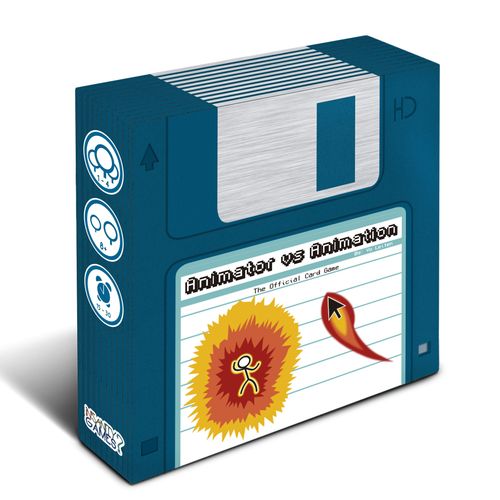
Animator vs Animation
Animator vs Animation Rulebook
Table of Contents
Table of Contents
Components
- 16 Character Cards
- 26 Quick cards and 30 Item cards
- 40 Action tiles
- 32 Acrylic tokens
- 1 First Player Token
Gameplay
In Animator vs Animation you are an animator helping your animation fight the other animations.
Through 10 (or less) rounds, characters fight and take points from each other. The first player to reach 16 points, or the player with the most points when the game ends, is the winner!
Set Up
- Place the 4 characters ards as shown. (Printed as "characters ards".)
- Each player picks a meeple that matches his character and places it in front of them.
- Randomly choose a player to start the game.
- Give every player 10 action tiles, divided as follows: 4 Rotate tiles / 2 Move tiles / 2 Click tiles / 2 Drag tiles.
- Place the Card Deck where everyone can reach, and deal 1 card to each player.
- Give 8 Acrylic tokens of a chosen color to each player.
How to Play
The game is played in rounds. Each round starts with the first player and play goes counter-clockwise during each step. Each round consists of the following:
-
Each player takes a card from the deck.
-
Starting with the first player, each player must place 1 action tile face down in front of any character of their choice.
-
Starting with the first player, each player may choose to move the action tile they placed to another character card. Each player has only one opportunity to move their tile.
-
Players reveal their action tile and resolve them as follows:
- Move: Switch positions of the target character with another character next to it.
- Drag: Unequip target's character item. The player may equip it to another target character that is next to it.
- Click: Deal 1 damage to target character.
- Rotate: Rotate the character card either 90° or 180° in any direction.
Then discard the action tiles.
-
Players may use cards from their hand in order to equip any character on the table (check Item Cards section for details).
-
Players may use quick cards in the previous player order, in order to change the odds of the battle. Quick cards are noted with a pointer icon on the cards. To do so, use the same method as the action tiles (steps 2 to 4).
Attacking
The characters automatically attack each other.
Each character deals 1 point of damage, but items can increase this number.
The character cards attack using the top side of the card with fist icons on it.
When the fists are facing another character, the character will deal damage to that character as follows:
- If the other character is facing the other way, deal 1 damage to that character.
- If both characters are facing each other, and the damage they dealt is the same, they block each other's damage (0 damage).
Item Cards
You can equip any character with item cards in order to increase their damage. However, characters can't have more than 1 item at the same time.
There are also some special effects:
- Reach: The character hits the two targets in front of him (in a straight line), instead of only one. Each character blocks and takes damage independently. (Works only for 5+ Players.)
- Cleave: The character can hit both the character in front of him, and the character by his side (the second character is dealt damage from the item only). If the second character is facing the equipped character's direction, it blocks the attack normally. (Works only for 4- Players.)
- Once: You can choose when to activate this item. After you use it then discard it.
- Throwable: The animation deals the damage of the item to any other character diagonally, instead of attacking. Then discard the item.
If one of the characters deals more damage than the other, the one with the highest damage deals the difference to the other character.
When you deal damage, take points (tokens) from that character equal to the damage you dealt.
Players can keep playing even if they run out of points.
Pass the pointer to the next player clockwise to designate a new first player and start a new round. Repeat the round process in steps 1-7.
The first player to get 15 points (tokens), or the player with the most points when there are no more action cards, wins the game!
Note on the printed rulebook: the Gameplay section gives the winning total as 16 points, while the end-of-game rule above gives 15 points. Both are transcribed as printed. The turn-order passages also differ: "play goes counter-clockwise" in the round description, and "pass the pointer to the next player clockwise" at the end of a round. Both are transcribed as printed.
Item and Quick Card Examples
Item Cards have a white background behind the text and Quick Cards have a blue background and a "pointer" icon.
- Item Card example: Gun, +3.
- Quick Card example: Hand Tool, "+1 Extra move".
The rulebook's examples of item cards show the following effects:
- Brush: +1 (reach 2).
- Pencil: +1 (cleave).
- Magnifying Glass: +1 (once) (throwable).
- Laser: +1 (once) (can't be dragged).
- SideBar: +2 (throwable).