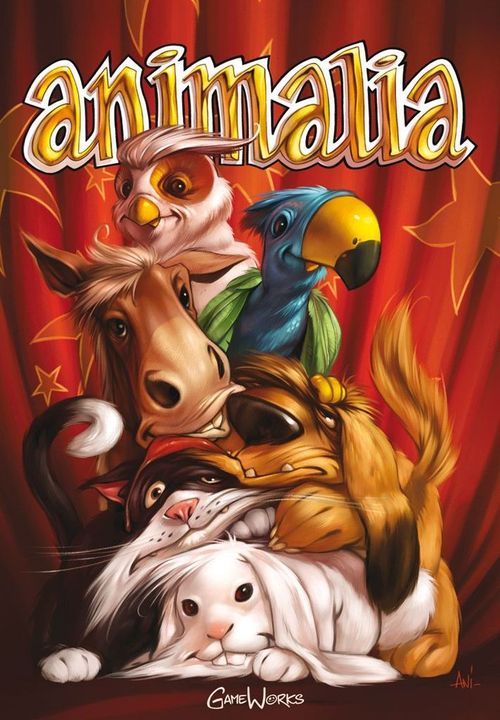
Animalia
Animalia Rulebook
Table of Contents
Table of Contents
Components
- 90 medals: 15 of each type (5 animal medals and the "5" medal)
- 42 cards:
- 6 reference cards, in 4 languages, presenting the special powers of certain animals
- 5 families of 7 animals (cats, horses, dogs, rabbits, parrots)
- 1 owl (a joker that can replace any animal)
Each family is made up of 7 members:
- the champion (3 stars)
- the dandy (2 stars)
- the cutie (neutral)
- the mangy one (black mark)
- the thief (mask)
- the spy (binoculars)
- the prankster (gift)
Setup
Set the reference cards aside within easy reach.
With 2, 3, or 4 players, remove the 5 cutie animals from the game. With 5 or 6 players, use all the cards.
One player is chosen as the first dealer. They shuffle all the cards thoroughly and form a face-down draw pile in front of them.
The first season begins. Each season is divided into 3 phases.
Phase 1: Building Your Collection
The dealer draws a card and places it on the table, face up. They now have 2 options: keep it or pass it:
A) They keep it. In this case, they slide the card in front of them — still face up — and add it to their collection. Their turn is then over.
B) They do not want to take it. In this case, they pass the card to the next player on their left, who in turn decides whether they want the card or pass it to the next player, and so on until a player takes the card or it returns to the dealer.
- If a player takes it for their collection, they slide it in front of them and the dealer's turn is over.
- If instead the card, after going all the way around the table, comes back to the dealer, the dealer must draw an additional card. This new card is placed next to the first, and the two cards now form a lot.
The dealer again has 2 options: A) They take both cards and put them in their collection, which ends their turn. B) They don't want them and pass them to the player on their left.
- If this lot of 2 cards also comes back to them after going around the table, they must draw a third card and again face the same two options: take these 3 cards or pass them.
- If everyone passes while the lot consists of 3 cards, the dealer must take them into their collection.
As soon as one or more cards are placed into a collection, the dealer's turn is over. They then pass the draw pile to the player on their left, who becomes the new dealer. This player begins by drawing a card and placing it in front of them. They may now either take it or pass it, and so on.
Watch out: a collection can never exceed 5 animals. So a player who already has, for example, 4 animals in their collection must refuse a lot of 2 or 3 cards. For the same reason, if a card or lot of cards comes back to the dealer after going around the table, and these cards would exactly complete their collection at 5 animals, they must accept them. Their turn is then over and their collection complete.
Examples
- Noémi already has 3 cards in her collection and is offered a lot of 3: she must pass.
- Maël, who is the dealer, already has 4 cards in his collection, and the first card he flips is passed by everyone else: he must take it, completing his collection.
Players who have completed their collection are skipped for the rest of this first phase. Play continues in this way until every breeder has 5 animals in their possession.
When only one player is left who has not completed their collection, they become the dealer and must take the cards as they draw them, without being able to refuse them.
For example, if they have no cards yet, they take the first 5 cards of the draw pile one at a time, and that becomes their collection. If they already have 3, they take the first 2 cards of the draw pile one at a time to complete their collection, and so on.
Special Cards
The spy (binoculars), thief (mask), and prankster (gift) animals each have a special power that can be activated when the animal in question is taken into a collection, and at least one other animal with the same power is already there.
Special case: animals with the same power are found together within a lot. In this case, the power can be activated even if it was not yet present in the collection.
An activated power must be used immediately. If a player declines to use it, it is lost until they take another new card with that same power.
The powers themselves are explained on the reference cards.
Notes
- There is no "cascading" activation of powers. A power can only be used when a card or lot of cards is taken "normally." A "stolen" or "gifted" card never triggers the activation of a special power.
- Using one or more bonus cards during Phase 3 (awarding medals) never triggers a power!
- It can happen that a player whose collection is already complete has a card stolen from them. In this case, the robbed player rejoins the turn order.
Phase 2: Elegance Prize and Bonus Cards
Now determine which collection totals the most elegance points, namely the stars at the top edge of certain cards. The 5 mangy animals, for their part, have a black mark: this is a negative point to be deducted from the sum of elegance points.
Example
Salomé's collection totals 7 elegance points: 3, -1, 3, 2, 0.
The player whose collection totals the most elegance points draws 2 bonus cards from the draw pile and keeps them hidden. The player in second place receives 1 card. These cards are used to improve collections, in order to optimize the medal harvest (see Phase 3).
Special cases:
- If several players are tied for second, each takes 1 card.
- If several players are tied for first, each takes only 1 card, and there is no second place.
Phase 3: Awarding Medals
For each pair, three-of-a-kind, four-of-a-kind, or five-of-a-kind of animals from the same family, a player receives that many matching medals. For example, a three-of-a-kind of dogs = 3 dog medals. Lone animals are therefore not counted.
Exception: a player who has put together a collection of 5 animals from different families receives one medal for each animal.
Medals collected are turned face down and kept secret.
Before medals are awarded, each player may cover one or more cards in their collection with one or more bonus cards earned during Phase 2 (elegance prize). This improves their collection and optimizes their medal harvest. They are not obliged to do so, however, and may keep their bonus cards for a later season.
Examples
- Thanks to this collection of 5 different animals, Luana receives one medal of each animal.
- Fanny can take 4 dog medals, or 3 dog medals and 2 rabbit medals, because the owl (joker) counts as whichever animal she chooses.
- Thanks to the joker, Maël also has several options: he can take one medal of each animal, or a pair of medals of his choice (dogs/cats/horses/rabbits).
Example
Noémi, who has two cat bonus cards in reserve, uses them to cover her parrot and her horse, which lets her collect 3 cat medals and 2 dog medals, instead of only 2 dog medals.
Awarding the medals ends the season, and the next one can begin.
New Season
The player to the left of the last dealer becomes the new dealer. They shuffle all the cards, except any unused bonus cards, and form a draw pile in front of them. They then flip over a first card, which they may take or pass, and so on.
End of Game and Scoring
The game ends after 3 seasons. Points are then tallied:
- Each player adds up their medals.
- Each group of 5 identical medals earns its owner a prize of excellence, in the form of a "5" medal, worth 5 additional points.
- The player with the highest point total is declared the winner. In case of a tie, the player holding the largest single family of medals wins the game. If there is still a tie, the players share the victory.
Examples
- Luana has collected 10 medals. Since she has 5 cat medals, she receives 1 bonus prize-of-excellence medal. Her final total is therefore 15 points.
- Fanny has collected 13 medals. Since she has 6 rabbit medals and also 7 horse medals, she receives 2 prize-of-excellence medals. Her final total is therefore 23 points.
- Salomé has collected 15 medals. Her 11 dog medals earn her 2 additional prize-of-excellence medals, so her final total is 25 points.
Two-Player Rules
Each player builds 2 collections, which they arrange in 2 rows, one below the other. The rules stay the same, with a few clarifications:
- When a player takes a card or a lot of cards, they are free to put them into whichever collection they choose. A lot of cards, however, can never be split up in order to divide the cards between the two collections.
- A power activated by one of a player's collections must be used for that same collection.
- A player's two collections cannot give or steal cards from each other.
- When playing the prankster's power, a player chooses which opposing collection receives their "gift." The opponent cannot contest this choice.
- Medals are collected separately for each collection, but they all still count together at the end of the game.
- Prize-of-excellence medals are awarded for each group of 7 medals earned in the same animal family.