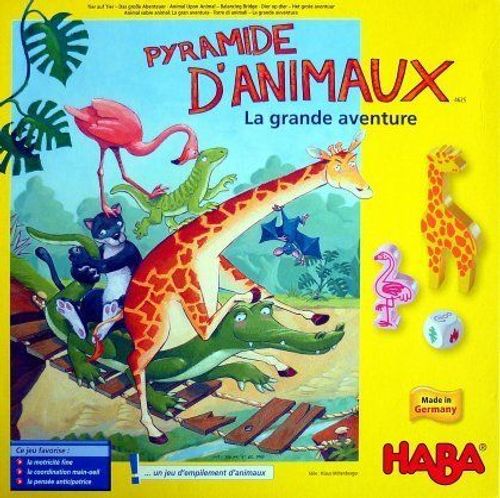
Animal Upon Animal: Balancing Bridge
Animal Upon Animal: Balancing Bridge Rulebook
Table of Contents
Table of Contents
Game Info
An exciting stacking game for 2-4 players ages 5-99.
- Author: Klaus Miltenberger
- Illustrations: Michael Bayer
- Length of the game: approx. 20 minutes
Contents
- 5 giraffes
- 5 iguanas
- 5 panthers
- 5 flamingos
- 5 bats
- 1 crocodile
- 35 assignment cards
- 1 die
- Set of game instructions
Game Idea
Each player is given three secret assignments. Your aim is to stack the animals on your assignment cards on top of the hanging bridge. The animals must be stacked so that the three animals shown on one card actually touch each other. Whoever manages to skillfully stack the animals, thereby being the first to accomplish the assignments, wins the game.
Preparation of the Game
Take all the animals and the die out of the box and look at the layout of the box. There are four compartments and a hanging bridge that hangs over these compartments. Place the box in the center of the table and place the crocodile in the center of the hanging bridge. Arrange the animals - as shown - deliberately next to the sides of the box.
Place seven animals along the side of the water valley and six animals along the sides of each the desert valley, the volcano valley and the jungle valley. You are free to choose which animals you place where.
Shuffle the assignment cards and deal three cards to each player, facedown. The remaining assignment cards are kept in a pile facedown next to the game box. Get the die ready.
Compartments
- Volcano valley
- Water valley
- Desert valley
- Jungle valley
How to Play
First take a look at your three assignment cards. You play in a clockwise direction. Whoever has already crossed a hanging bridge may start. If you cannot agree the youngest player starts and rolls the die.
What Appears on the Die?
The symbol of a valley
The four sides of the box each correspond with a valley. Look at which valley you have rolled and take any one of the animals standing next to the corresponding side of the game box. Stack the animal on the hanging bridge or on top of any animals that are already there. If there are no animals of the valley appearing on the die left, you can choose any animal to stack.
The question mark
You can choose any animal to stack.
The hanging bridge
Take an animal of your choice from the bridge or the animal pyramid and change its place. If there is just the crocodile on the bridge, you can choose any animal from any side of the box and pile it on the crocodile.
Once you have had your go at stacking, it is the next player's turn.
Important Animal-upon-Animal Rules
- When stacking an animal, it must always touch at least one other animal, that animal can be the crocodile.
- You are only allowed to use one hand for stacking.
Accomplishing an Assignment
As soon as the three animals on one of your assignment cards touch, your assignment is considered complete. This can happen any time, even during the turn of another player. To prove it you show the assignment card in question to the other players and point out the corresponding animals of the pyramid.
Then you turn this card over and keep it face down in front of you. This assignment has been carried out.
The Animal Pyramid Collapses
If during your stacking maneuvers animals fall off or the pyramid collapses, your turn is then over. Your penalty is that you must then take another new assignment card that you will have to complete.
If however after a crash there are still animals left on the bridge and they happen to form an animal trio that corresponds to one of your assignment cards, you are allowed to take this card and keep it in front of you.
If the crocodile falls off the bridge it is then placed back. The animals that fell off remain in the valleys into which they fell. From that point on, when rolling a valley symbol on the die you are free to choose an animal to stack either from the valley inside the box or from the animals still standing outside the box.
End of the Game
The game ends as soon as a player has accomplished his last assignment card. He has found the best way across the hanging bridge and wins the game.
The Author
Klaus Miltenberger was born in 1963 in Aschaffenburg/Main and grew up surrounded by many animals, on a small farm in the woods of Spessart. After finishing his training as a cook, he studied education, psychology and sociology at the Ludwig-Maximilian's University in Munich. He lives in Munich where he works in the field of pedagogy and inventing games.
He already invented the original version of the prize winning game Animal upon Animal.
I dedicate this game to my late parents Anton and Scholastika Miltenberger.
The Illustrator
Michael Bayer, born in 1971 in Friedrichshafen, next to the beautiful Lake Constance, since early childhood he has absorbed the variety of shapes nature offers and still profits from it.
He completed his graphic design and illustration studies at the polytechnic of Münster (Westfalia). After a short detour into publicity he has worked since 2001 as a freelance illustrator for the "Hafenstrasse 64" studio community in Münster.
Michael Bayer has already illustrated the whole Animal upon Animal series.
I dedicate this game to my niece Jette.