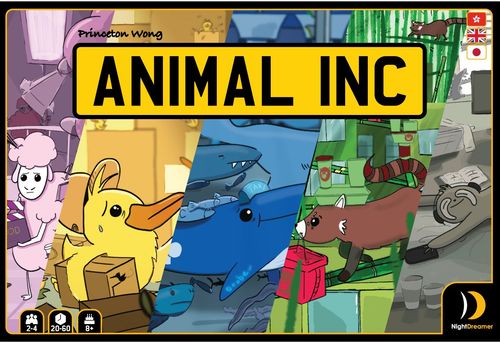
Animal Inc
Animal Inc Rulebook
Table of Contents
Table of Contents
Introduction
2-4 Players, 20-60 Minutes
Animals are working their best for the corporate. In this unusual semi-cooperative hand management game, only those with patience, intelligence and luck can take on the fruit of others and build their own empire.
Components
- 36 animal cards (in 5 companies)
- 7 Quackazon cards (yellow, numbered 0, 2, 6, 7, 8, 9, 10)
- 7 Ooober cards (blue, numbered 2, 3, 4, 5, 6, 10, 12)
- 7 Bollywood cards (pink, numbered 0, 2, 4, 6, 8, 10, 12)
- 7 Bamboost cards (green, numbered 3, 4, 5, 6, 7, 8, 9)
- 8 Zzz cards (grey, all numbered 6)
- 100 scoring sheets (front: 2- or 4-player game, back: 3-player game)
Object of the Game
The game is played in a number of rounds. In each round, players will play a card in turn to build a company empire in a pyramid shape. Depending on whether the building is successful or failed, players score points according to their hand or the top of the pyramid. At the end of the game, the player who has the most points wins the game.
Game Preparation
At the start of the game, get a scoring sheet and turn it to the appropriate side according to the number of players. The youngest player is the starting player. He writes down the names of the players in clockwise order.
Each player starts with 200 points.
Playing the game
The starting player shuffles all the animal cards and deals them out evenly to each player, which they take into their hands. Each player then discards X animal cards face-down to the discard pile. (2-player game: X=3; 3-player game: X=2; 4-player game: X=1). These cards are not used in this round.
With the aid of the scoring sheet, do drafting accordingly.
Example: In a 4-player game, in 1st-4th rounds there is no drafting. The starting player for the first round is player Sheep, then player Duck, and so on. In 5th-8th rounds, after seeing their hands, each player simultaneously chooses 4 cards and passes them to the player on the left. In 9th-12th rounds, to the player opposite. The last 4 rounds to the player on the right. After 16 rounds, this is the end of the game.
The scoring sheet shows the drafting direction for each round: no drafting, 4 cards to the left, 4 cards to the opposite player, 4 cards to the right, and an icon indicating the starting player.
Players take turns in clockwise direction, until the game ends.
When it is your turn, you play an animal card from your hand to the center of the table. Then, the next player in turn plays any card from his hand to the table, and so on.
Animal cards are always played face up. As the game progresses, players build a tiered animal pyramid. The lowest tier consists of eight animal cards lying side by side. The tier above this one consists of seven cards, the one above that of six, and so on.
The illustration shows a complete eight-tiered pyramid. However, because some cards are discarded at the start of the round, it is impossible to complete the pyramid at the end of the round.
The first animal card played in the round marks the bottom tier. The next player must place an animal card next to the first one. The animal's company is irrelevant.
There are a few possibilities for playing the next animal cards:
-
If there are fewer than 8 animals in the bottom tier, the card can be placed next to them on the left or right side.
-
Animals can be placed in a tier higher up whenever two animals are already in place immediately below. However, the new animal's company has to match at least one of the animals below.
Correct: An Ooober is placed on top of another Ooober. A Bamboost is put on top of two Bamboost cards.
Incorrect: A Bamboost is placed on top of an Ooober and a Quackazon. There is only one Zzz in place underneath the Zzz.
When a player has no legitimate cards, he has to pass and drop out of this round. The cards are then put face-down on the table in front of him. Note that when a player has legitimate cards to play, he must play the cards.
End of the Game
The game is over when no player can play a card anymore. This can be because they have all dropped out of the game or because they have played all the cards in their hands. It is possible that the last player can play several cards in a row, because all other players have dropped out of the game.
Scoring
Depending on whether the pyramid successfully reaches the 5th tier (i.e. has at least an animal card in the 5th tier), players score points accordingly.
If it successfully reaches the 5th tier,
- The last player sums all the animal cards from the 5th tier and above. He adds that many points to his scoring of this round.
- All other players each look for the highest card in their hand and deduct that many points from their scoring of this round.
Example (printed): the last player is the one who adds the pyramid total; the printed scoresheet example shows the results -12 (200 to 188), -4 (200 to 196), -10 (200 to 190) and +5 (200 to 205) for the four players.
If it fails to reach the 5th tier,
- The last player looks for the highest card in his hand and deducts that many points from his scoring of this round.
- All other players each look for the highest card in their hand and add that many points to their scoring of this round.
Example: the printed scoresheet example shows the results +9 (200 to 209), +5 (200 to 205), +6 (200 to 206) and -7 (200 to 193) for the four players.
After the starting player writes down all the scores in this round, the cards are then reshuffled for the next round. The scoring sheet is passed to the player on the left as the new starting player of the next round. The new starting player deals cards just like at the start of the first round.
The game consists of 8 rounds for a 2-player game, 9 rounds for a 3-player game, and 16 rounds for a 4-player game. (Players can discuss and agree on the length of the game.)
The player with the highest score at the end of the last round wins the game. If there is a tie, the victory is shared.