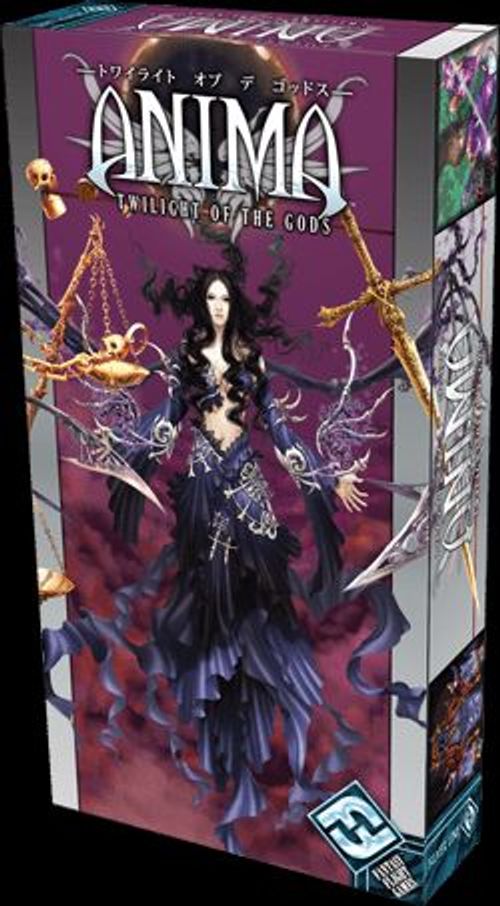
Anima: Twilight of the Gods
Anima: Twilight of the Gods Rulebook
Table of Contents
Table of Contents
Game Overview
Anima: Shadow of Omega is a non-collectible card game for two to five players. On average the game lasts 20-30 minutes per participant. It contains 110 game cards, two six-sided dice and five tokens of different colours.
Game Objective
The player who completes missions wins: first a Basic mission, and then the Final mission.
A player cannot begin the Final mission until he has completed at least one Basic mission. Each player draws two Mission cards at the start of the game. At first it is unknown what the Final mission will be; but when any player completes a Basic mission, he draws one of the three Final mission cards and places it face up in the centre of the table for all to see: it becomes the Final mission for all players.
Each completed mission gives the player bonuses, so players often prefer to complete both of their Basic missions before attempting the Final one.
Card Types
There are 5 types of cards in the game: Characters, Regions, Encounters (Contacts), Missions and Advantages (Bonuses). Before looking at the game itself, let us look at each card type and its purpose.
Characters and Parties
As in any epic story, each player needs Characters to travel the world and complete missions. At the start of the game a player controls only one character, but there are regions where you can hire more heroes. Certain Encounter cards can also add a character to the party. A Party is a group of one or more characters. The maximum number of heroes in a Party is four.
During a battle, an Encounter, or another player's action, a character in a party may die. When this happens, he is placed in the Character discard pile. When a player loses all his heroes, he draws one card from the Character pile and puts it into play to form a new party.
Each character has Gender, Strength and Speed, which are needed to resolve the outcome of battle and to determine turn order. The Strength and Speed of a Party is the sum of the Strengths and Speeds of all Characters in the Party. For example, if the party contains an Acrobat (Strength 4, Speed 4) and a Sorcerer (Strength 3, Speed 4), the party's total will be: Strength 7, Speed 8. The icons in the lower left corner of each Character card show the special abilities available to him. There are three kinds of abilities: Magic, Ki, Roguery (Trickery). Depending on which ability is active, the player can use certain Advantage cards when turning the Character card.
Turning (Tapping): Turning a Character means rotating the card 90 degrees. Some Characters have special abilities that can be used only when the card is turned. Cards are also turned when Skill cards are used. If a Character is turned, during that turn he cannot use his abilities or Skill cards. For example, if a Thief card is used (turned) at the start of the turn to steal, it remains turned until the end of the turn, and that Character cannot be used for Roguery cards. But even if a card is turned, the Character can take part in battles, that is, his Strength and Speed are not subtracted from the party's totals.
Regions
Region cards represent the various territories of the world that Characters can visit to gain Advantages, hire new party members or complete their missions' tasks. Playing a Region card consists of two phases: the Exploration Phase, in which the player tries to explore the territory, and the Reward Phase, in which the player receives a reward if the exploration was successful. Some regions have special additional rules written on the card itself. If a Region card shows a trade icon, the player may trade in that Region.
Each Region has a level ranging from 1 to 3, which shows how dangerous the place is. The level of the region is the maximum level of Encounter that can happen there. This is explained in more detail in the Encounters section.
Missions
There are two types of missions: Basic and Final. Each Basic mission has a specific goal, and when the player achieves it, he may proceed to the Final mission. When a player begins a mission which he must announce to the other players, he places the Mission card on the table to his left to show that he is working on it (unless the card says otherwise). When the mission is finished, the player places the Mission card to his right to show that he has completed it, and receives the reward indicated on the card.
- Resistance Mission: Some missions require the party to stay several turns in a certain region. In such a situation the Characters do not need to explore the territory again in order to stay there: the party stays there automatically. The mission is carried out during the Exploration phase, which means that other players may attack the Characters carrying it out during the Interaction phase. If the Party is defeated, whether by enemies from the mission or by rivals, the Party leaves the Region and must start the Mission over.
Advantages (Bonuses)
Advantage cards are used by players to achieve their goals more easily. There are two kinds of Advantages: Skill cards, which are used by characters, and Plot cards, which are used directly by the players to influence the course of the game. A player may have at most 5 Advantage cards in hand at once.
-
Skill cards: Skill cards represent abilities used by characters. Each character can use certain abilities, which are marked on the Character card itself. There are three types of skills: Ki, Magic and Roguery. To use a Skill card, the Character must possess that skill and must be turned.
-
Plot cards: Plot cards can be used without turning any characters, since they are played directly by the player to influence the game. Each Plot card has a different effect and duration. Some Plot cards, such as "Magic Object", stay in play, while other cards, such as "Zeppelin Trip", are played once.
-
Organizations: Organizations are a special type of Plot card. Playing such a card means your party joins a certain faction, which gives your characters new abilities but also places new obligations on them. A player may belong to only one organization at a time: if you want to join another, you must discard the card of the one you already belong to during the Discard phase. Also, some organizations are rivals of other organizations, and their members must fight one another. If two parties from rival organizations are in the same region at the same time, they must fight in the Interaction phase. If all members of the party have died and the player must choose a new character, he must discard the Organization card.
Encounters (Contacts)
Encounters are situations and problems that arise when your characters come to explore a new region. You may meet a monster and have to fight it, or you may suffer in an accident... Fortunately, not all encounters are negative; you may receive an unexpected reward. Encounters have levels from 1 to 3 (like Regions) indicating their difficulty. For an Encounter to occur, the Encounter's level must be equal to or lower than the level of the Region where it takes place. For example, in the Region "Corns Village" (level 1) you cannot meet the "Dragon God" (level 3), but you can meet a "Wandering Warrior" (level 1). If the Encounter's level is higher than the Region's level, the encounter does not occur and the card is put in the Encounter discard pile.
-
Monsters: If the encounter is a meeting with a Monster, your party must fight it according to the battle rules. Each monster has a Strength and special abilities.
-
Event: Events are problems and situations that have various effects on the party.
-
Preliminary Encounter: Every time a Region card is played, whether for the first time or from the discard pile, an Encounter is played first. If it is an event (not a monster), the party that has come to this territory is subject to its effect, and then the card is discarded. If it is a monster, it stays in the region until it is defeated (this means that if the monster wins the battle, it stays in the region until it is destroyed). Battles with Preliminary Encounters are played out during the Movement phase.
Turn Sequence
Each turn of the game consists of 4 different phases: Discard (Reset), Movement, Interaction, Exploration. The order in which players act depends on the Speed of their parties: the player whose party has the highest Speed goes first, then the player with the second-highest Speed, and so on. If two or more players have equal party Speed, a die is rolled, and whoever rolls the higher number goes first. A player does not play all the phases in a row; instead, each player in turn order plays the Discard phase, then each player in turn order plays the Movement phase, and so on.
The player order established at the start of the Discard phase stays the same until the end of the turn. If the Speed of any party changes during one of the phases, the turn order does not change.
When Are Advantage Cards and Special Abilities Used?
Using Plot cards, Skill cards and the special abilities of characters is usually limited to a certain phase of the turn. As a general rule, a player must wait for the proper phase before using them, except for Interrupt and Battle cards.
-
Interrupt: These cards can be used in any phase to intervene in or change an effect, result or action. For example, the card "Wrong Road", which lets you redirect another player's party to any region you like, can be played in another player's Movement phase when he announces where his party is going.
-
Battle: These cards can be used by players when entering a battle. Players must use such cards before the other side rolls the die, unless the card says otherwise.
Setup
Separate the 5 different types of cards into separate piles and shuffle each one separately. Then place the piles on the table according to the diagram. Finally, each player chooses a token which marks his party.
Starting the Game
Each player draws two Basic mission cards without showing them to the other players. Set the other mission cards aside so that nobody knows which missions remain in the pile. Then each player draws two Character cards and 4 Advantage cards. Each player chooses 1 character and 3 advantages; the 2 unneeded cards are discarded. The discarded cards are shuffled with the remaining cards of their type, and the piles are shuffled again.
After that, place face up as many Region cards as there are players in the game, and put an Encounter card face down on each Region card. These are the Preliminary Encounters of the first regions: they stay secret until players visit them.
Gameplay
Discard Phase
In the Discard phase all players return their turned characters to their original position, turn their inactive characters face up (making them active again), and then act in order of Speed count.
- Discarding and Dismissing: During the Discard phase a player may discard any Advantage card from his hand or dismiss (discard) a Character from his party. This is more important than it seems at first glance, because it is the only chance during the turn to voluntarily discard cards or characters. A player who already has 5 Advantages in hand (the maximum) cannot draw more cards; likewise a player with 4 characters in his party cannot hire a new character when the opportunity comes up. If you want to leave an organization, this is exactly the moment when you must announce it. The player with the fewest characters in his party may automatically hire any character discarded this turn, and the player with the fewest Advantages may take any Advantage discarded by another player. But if two or more players are tied for the fewest characters or Advantages, then none of them may take the discarded cards.
Movement Phase
In this phase each player announces where his party is going. Each player may choose what to do:
-
Go to an active Region: You may go to any active region in the game. If the active region has a Preliminary Encounter (either the one placed there during the game setup, or an opened but undefeated monster), it must be played in order to advance further. If you lose a battle with a monster, or the event that occurs ends your turn, you can do nothing more this turn; that is, you cannot reach the place you were heading to. When you have successfully reached a region, place your token on the Region card. The maximum number of territories that can be on the table is twice the number of players (if three people are playing, there can be at most 6 active regions; if four, 8 active regions, and so on).
-
Explore a new Region (only one player per turn): in this case the characters explore the world and discover new territories. If you choose this option, you can do one of two things: draw a Region card from the Region pile and play it onto the table, or choose a region from the discard pile and make it active again. Either way, you must draw an Encounter card and place it face up on the Region as a Preliminary Encounter. As usual, when you enter a territory with a Preliminary Encounter, if you lose a battle with a monster, or if an event that occurs ends the turn, your characters do not reach the region, and you cannot act until the end of the turn. If you reached the region, place your token on it to mark the location of your party. When one of the players brings a new region into the game by choosing the Explore a new region option, this territory becomes active and any player may subsequently choose it to visit. Only one player per turn may choose to explore a new region. If the new Region card played makes the number of active regions excessive, one of them leaves the game and is placed in the Region discard pile. The player who played the new region chooses which region to remove. A region cannot be removed from the game if a party is in it, or if the Preliminary Encounter in that Region has not yet been played. Also, any player may prevent the removal of an active region by discarding one of his Advantage cards. In this case, the player who brought the new Region into the game must choose another region to discard. If it is impossible to remove a region without breaking these rules, the new region is added without removing an old one.
-
Rest: if you are not interested in visiting any of the active regions and do not want to (or cannot) explore a new region, you can rest and thereby increase the strength of your party. On the next turn (and only the next turn) your party receives +2 points to Strength and +2 to Speed.
Interaction Phase
This is the phase in which parties can interact with each other. They can exchange Advantage cards and Characters and attack other parties.
-
Trading: If two parties are in territories with a trade icon, they can freely exchange any Advantage cards and Character cards. Remember that the parties do not need to be in the same region; it is enough that both are in regions with a trade icon.
-
Declaring war: You may declare an attack on another party that is in the same region, but only if the difference in the number of characters between the parties does not exceed one (for example, a player with four characters cannot declare an attack on a party of two characters). If your parties belong to rival organizations, they are obliged to fight. The loser of the battle must give the winner a random Advantage card and leave that region. The loser's turn ends there: he cannot take any actions until the next turn.
Exploration Phase
This is the last phase of each turn. Only players whose parties successfully reached regions can do anything in this phase, and only if they were not removed from the territory during the Interaction phase. The goal of this phase is to explore the region in order to get a reward. A player is not obliged to explore the region if he does not want to.
-
Exploration: When a player announces his intention to explore the region he is in, he must roll a die and check the result on the exploration table located on the left side of the Region card. Depending on the number rolled, the result differs:
- Nothing: Nothing prevented you. You may safely receive the reward.
- Encounter: Some difficulties arose in the exploration, and the player must draw a certain number of Encounter cards from the pile. They must be revealed in the order in which the player drew them. If you drew a monster card, you must fight it in order to continue, and if it is an event, you must do what the card prescribes. If the monster defeats you, or the event ends your turn, you must leave the Region and do not receive a reward. Thus, if you did not overcome the first card, you do not draw the second. Monster cards drawn in this phase do not stay in the region, but are discarded after the battle. Remember that an event cannot be higher than the level of the region where it occurs. If the event's level is higher than the region's level, simply discard the event card. For example, if you visited Arkhangel (level 1) and drew a single event that turned out to be Shadow of Omega (level 3), the event is simply discarded, and you immediately receive your reward. The event turned out to be a false alarm.
- Special case: In some regions special events may occur. Such Region cards contain an explanation of what may happen on a particular die roll.
-
Reward: If the party successfully explored the region, it receives one of the region's three rewards. Naturally, nothing prevents the party from returning here in later turns and receiving another reward (or the same one, except Hiring, as explained below).
- Advantage: draw a number of Advantage cards equal to the level of the region where your party is. Remember that you cannot hold more than 5 Advantage cards in hand. For example, a player with 4 cards in hand can draw only one Advantage card, even if he is in a level 3 region.
End of the Game
The Final mission remains a secret to all players until at least one player completes one of his Basic missions. At the start of a turn, any player who has completed at least one of his Basic missions may reveal the Final mission by drawing a card from the Final mission pile and placing it face up on the table. There can be only one Final mission in the game. However, any player who has completed at least one Basic mission may begin to carry it out.
The Final mission has a time limit, indicated on the card in the "Crisis!" section. The number given there shows how many turns the players have to complete the Final mission.
When the Final mission is revealed, place the 10-sided die on its card. The number on the die must match the time limit. At the end of each Exploration phase, reduce this number by 1. If a player accomplishes the objective of the Final mission before this number reaches 0, he wins. If no player accomplishes the objective within the specified limit of turns, the Crisis occurs.
When the Crisis occurs, normal play ends. All players who have not completed any Basic mission automatically lose. If only one player remains, he wins the game. If more than one player remains, they immediately face the threat described in the "Crisis!" section on the Final mission card, regardless of which region their party is in.
Each player has only one chance to overcome the Crisis. Players try their luck in turn, in order of their parties' Speed. The first party to overcome the Crisis wins the game. If no party manages it, there are no winners: Omega has broken free, destroying the universe in the process.
Players cannot use Advantages to interrupt other players' actions during the Crisis.
Battle and Other Rules
Battle
In various situations you will have to fight monsters or other players. To resolve such a situation, each party rolls a die and adds the result of the roll to its Strength points (the sum of the Strength points of all characters in the party). If it is a monster, any opponent rolls the die for it. The one with more points wins.
In case of a tie in a battle with a monster, the party wins. If two players tie, the battle continues until someone loses (but they cannot enter battle again in the same turn).
If a party loses a battle by 5 or more points, one of the characters of the party (chosen by the player) dies and must be discarded.
Speed Check
Some missions require Speed checks. Add the die roll to the party's Speed (the sum of the speeds of all its members). If the sum is equal to or greater than the difficulty indicated for the mission, the check is successful.
Discarding
Each time a character dies, you use an advantage, you face an encounter or you discard a region, the card goes to the corresponding discard pile. When one of the piles is completely used up, the corresponding discard pile is taken, shuffled and returned to the game as the main pile.
The only exception to this rule is the Region pile. If all 14 Region cards have been played, they remain in the discard pile without being shuffled, allowing each player who declared Exploring a new region to draw any region he chooses from the pile of used Region cards. For example, if all Event cards have been played, take them from the discard pile, shuffle them and return them to the game.
Incapacitated Characters
Certain cards, such as "Sleep", or special abilities, such as those of the Assassin, take a character out of action for a turn. When this happens, place that character face down. An incapacitated character cannot act during the turn, and his Strength points are not added to the party's Strength total. During the Discard phase such a character is turned face up and becomes active again.
Losing a Turn
When you are forced to lose a turn (if you lost a battle or because of special events), you lose the current turn, but not the next one. If an event obliges you to lose your next turn, the card will say so.
Changes in Speed
If a player's Speed changes during the Discard phase (a character or an Organization card leaves), the play order remains the one established at the start of the turn.
Additional Rules
There are several additional rules that players may use to make the game more interesting.
-
Tree Structure of Regions: An interesting variation on the normal rules of the game is to arrange the territories in a tree structure by level. To reach a level 2 territory you must first have visited a level 1 territory. For example, you cannot go straight to the "Tower at the Edge of the World" (level 3), even if it is on the table: first you must go to a level 1 region, such as "Arkhangel", then on the next turn to a level 2 territory such as "Ruins", and only then, on the following turn, to the "Tower at the Edge of the World" (level 3). To introduce this rule, at the start of the game place the Region cards in three piles by level. Each time you want to go up or down levels, draw a Preliminary Event card. If you lost a battle or were removed from the territory by an Event, you temporarily leave the region tree, and at the start of the next turn you will again have to begin from a level 1 region. When this rule is in use, the card "Zeppelin Trip" allows you to move to any territory, regardless of its level.
-
Increasing the Number of Missions: If players want to make the game longer, it can be made mandatory to complete both Basic missions before the Final one.
-
Open Rolls: If a 6 is rolled on the die during a battle, the die is rolled again and the new value is added to the roll. This gives a small chance to win a battle against any opponent by rolling several sixes in a row.
Example of Play
The following is an example of play for a better understanding of the game process. The example covers several turns of three players: John, Peter and Steve.
- John's party has an Acrobat and an Illusionist (Strength 6, Speed 8).
- Peter has only a Mercenary (Strength 3, Speed 2).
- Steve has a Thief and a Mechanist (Strength 4 and Speed 7).
By Speed count, the turn order this turn is John, Steve, and last Peter.
Discard phase: First all players return their turned characters to the correct position, then John can start playing. He decides to play one of his Advantage cards, the "Black Sun Organization". He does not want to do anything more, so his phase ends. Now Steve goes. He announces that he wants to use the Thief's special ability to rob John; for this he turns the character card, rolls the die, rolls a 3, and the theft fails. After that he discards one of his Advantage cards. Since John and Peter have the same number of cards in hand, nobody can pick up the discarded card. Steve can do nothing more, and his turn ends. Finally it is Peter's turn, but he does not want to do anything. The Discard phase ends.
Movement phase: John begins the Movement phase by announcing that he wants to go to "Arkhangel", one of the active territories. There is no Preliminary Encounter there, so he places his token on the Region card and ends his turn. Steve is next, and he decides to Explore a new Region. He draws a territory card, which turns out to be "Lost Ruins" (level 2), then draws a Preliminary Encounter, which turns out to be "Shadow of Omega" (level 3). The Encounter's level is higher than the territory's level, and so it is discarded. Steve then places his token on "Lost Ruins", and his Movement phase ends. Finally Peter goes. He also goes to "Arkhangel", so he places his token there. Since everyone has moved, the Movement phase ends.
Interaction phase: John again goes first. He announces that he wants to trade with Peter. Peter accepts the offer, and they freely exchange their cards. Steve can neither attack nor trade. Peter can do nothing more: he has already traded with John, and he cannot fight because he is in "Arkhangel", a territory where fighting is forbidden.
Exploration phase: John announces the exploration of "Arkhangel", rolls the die and rolls 5. Then he checks the "Arkhangel" card and sees that he must draw 1 encounter. He draws a card from the Encounter pile and it turns out he must fight an "Old Warrior" (a monster card). He rolls 3 and adds his Strength points, for a total of 9. Another player rolls the die for the "Old Warrior" (Strength 2), rolls 4, for a total of 6. The monster is 3 points lower than John, so it loses the battle, and John may take the reward. He decides to hire a character, draws the top card of the Character pile, which turns out to be a "Weapons Specialist". Now it is the turn of Steve, who is in the "Lost Ruins". He decides he wants to explore, rolls the die unluckily and must draw 2 Encounter cards. The first encounter is "Dragon God", whose level is 3 and it is discarded ("Lost Ruins" is level 2). Steve is lucky with the second card, because it is "Treasure", which lets him draw 2 Advantage cards. After that, since he did not lose a battle and was not removed from the territory, he may choose a reward. Since one of his missions is "Defeat Tiamat", Steve goes to the "Hellpit" and tries to complete his mission. Unfortunately, although he uses several Advantage cards to improve his battle numbers, he loses. Finally Peter explores "Arkhangel". He rolls 2 on the die and avoids any incidents. Then he chooses hiring and draws a "Sorcerer", who joins his party. Now that all 3 players have finished the phase, the turn ends and the next begins.
Additions from Anima: Beyond Good and Evil
Anima: Twilight of the Gods is a stand-alone expansion to Anima: Shadow of Omega and Anima: Beyond Good and Evil. The rules of Beyond Good and Evil that add to the base game are as follows (the Twilight of the Gods additions follow in the next section).
Secret Characters
In addition to ordinary characters, Beyond Good and Evil introduces a new type of Character: the Secret Character. These powerful individuals can join a party under special conditions in order to strengthen it even more. These cards are easily recognized by their red (not blue) back and by the golden background of the name.
To get a Secret Character into the party, a player must have three ordinary characters in it, and then go to a Region that allows hiring characters as a reward. There, instead of hiring an ordinary character, the player takes a Secret Character card, discarding an Advantage card from his hand as payment for the Hire.
Secret Characters cannot be dismissed from the party in the Discard phase, although they can be killed like ordinary characters.
Advantages
In addition to ordinary Plot cards, Beyond Good and Evil introduces three new special types of Plot cards:
-
Incident: Incidents are Plot cards played in the Discard phase that give an effect lasting until the end of the turn.
-
Trap: Traps allow players to leave events in Regions that give them advantages or harm other parties. Traps are played in the Discard phase by laying them face down on a Region card, so that only the player who played it knows which card was played. Traps remain inactive unless at the end of the Movement phase some party is in the Region. At that moment the trap is turned face up and its effect is applied to all characters in the Region. After that the trap is discarded. Traps have priority over Incidents.
-
Factions: Factions are Plot cards representing a party's joining a certain community and giving it certain abilities. A party can belong to only one faction at a time. If a player wishes to change his party's faction, he must discard the current faction during the Discard phase. In addition, some factions are sworn enemies. If two parties belonging to such factions are in the same Region, they must declare a Battle during the Interaction phase. If this expansion is combined with Shadow of Omega, a party may belong to a Faction and an Organization at the same time, receiving the benefits of both.
Twilight of the Gods Additions
Anima: Twilight of the Gods is a stand-alone expansion to the games Anima: Shadow of Omega and Anima: Beyond Good and Evil. Played on its own it is designed for 2-4 players, but together with the base game or Anima: Beyond Good and Evil it is suitable for 2-5 players. What follows are additions to the rules relative to the base game.
The Legacy of Shadow and Evil
Although Twilight of the Gods is an independent game, it was also designed to be compatible with the base game Shadow of Omega and/or the expansion Beyond Good and Evil. By combining the card decks, players can exponentially increase the variety and number of gameplay possibilities in Anima.
To combine the sets, separate and group the cards of the two games by type (Characters, Advantages, Encounters and Regions), with one exception: the Mission cards from Shadow of Omega and/or Beyond Good and Evil, since they are not compatible with the Region and Event cards from Twilight of the Gods. Players should keep only the missions from this expansion. If players want to play with the old missions, they should remove the new Mission, Region and Event cards.
Advantages
In addition to the ordinary Plot cards, Twilight of the Gods introduces one more type of plot card, in addition to the Incidents, Traps and Factions from Beyond Good and Evil:
- Artifact: Artifacts are special Plot cards. Playing such a card means that the party has gained a certain Magical Link which grants it special abilities. A player may have only one Artifact at a time. If he wants to replace it, he must discard the old one in the Discard phase. If a player wins a battle against a player who has an Artifact, the winner may take the Artifact instead of choosing a random Advantage card from the loser's hand.
Movement Phase
- Exploring a new Region: If players use 2 or 3 combined sets, they may find that the Region deck contains very many Region cards and it is hard to find the one needed. In that case they may apply the following rule: when exploring a new region, replace not 1 region but 2 or 3, according to the number of sets in use. However, for the sake of game balance, the player must go to the region with the highest level among the newly revealed ones.
Attempting to Flee
At the party's option, instead of fighting a monster, it may try to flee from it. For this the party must pass a Speed check against the monster's Strength + 2. If the check succeeds, the party escapes from the Monster and leaves the region, immediately ending its turn. If it fails, the party must fight the monster as usual.
Turn Summary
- Discard phase:
- Turn back all turned cards and reveal all cards lying face down
- Discard (dismiss from the party) cards or characters you do not need
- Use special abilities or Advantages that can be used in this phase
- Movement phase:
- Declare the movements of your party:
- Go to an active Region
- Explore a new Region (only one player per turn)
- Rest
- Play Preliminary Encounter cards
- After all movements, reveal any triggered Traps
- Declare the movements of your party:
- Interaction phase:
- Trade with any player who, like you, is in a Region with a trade icon
- Attack any party that is in the same region
- Exploration phase:
- Declare whether or not you want to explore the region you visited
- If the exploration was successful, choose a reward