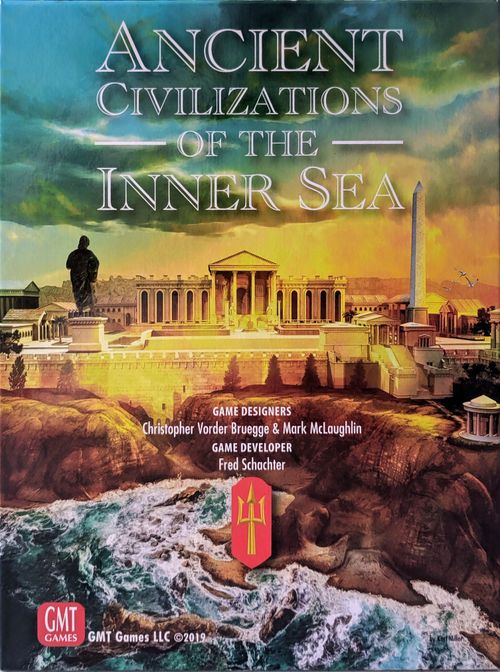
Ancient Civilizations of the Inner Sea
Ancient Civilizations of the Inner Sea Rulebook
Table of Contents
Table of Contents
Game Overview
In ACIS players will command one of the major powers of the time: Rome, Carthage, Celt-Iberia, Gaul, Mauretania, Mycenae, Troy, Phoenicia, Minos or Egypt.
The goal of the game is to have your civilization accumulate more victory points (VPs) than any other player's civilization. There are several ways for players to earn VPs such as building cities and wonders, looting cities, accumulating wealth, or dominating the sea.
A game can last up to four Epochs, each of which is broken down into two to four turns. During each turn there are four phases which must be conducted one at a time in the following order:
- Growth Phase
- Card Phase
- Competition Phase
- Reckoning Phase
At the end of the last turn of each Epoch there is a fifth End of Epoch Phase.
Additional scenarios found in the Playbook may start in later Epochs or end in earlier ones, have varying victory conditions, or add special rules.
To see a pair of instructional videos on how to play the game—including how to play it solitaire—as well as in-depth articles by the game's design team, please visit https://www.gmtgames.com/p-624-ancient-civilizations-of-the-inner-sea.aspx.
Important Game Terms
There are several terms that you should become familiar with in order to better understand the rules that follow.
Barbarians Barbarians generally enter the game through card play. They use the black disks. Barbarians are not a civilization. Their stacks are never Cities and thus cannot be looted; card effects that apply specifically to civilizations do not affect Barbarians; etc.
Camp In an area, a Camp is a stack of exactly 1 disk belonging to a single faction. Camps from multiple factions can occupy the same area. At sea you could think of a single disk as a group of fishermen.
City In a land area (only), a City is a stack of 3 or more disks belonging to a single civilization. Cities from multiple civilizations can occupy the same area (which would create a Contested area). Barbarians can have stacks of three or more disks, but do not have Cities.
Civilization A player's civilization uses one set of colored pieces and has a specific home area on the map. Note: depending on the scenario played [see Playbook], a player could control more than one civilization or the civilization could be run by the game system (an NPC).
Competition Card A type of card that can only be played during the Competition Phase, and usually affecting only the current competition.
Control An area solely occupied by a single faction—that is, it contains no opposing disks—is Controlled by that faction.
Contested If an area is occupied by more than one faction and at least one of those factions has two or more disks present, that area is Contested. Contested areas will have a competition resolved within them during the Competition Phase.
Dominante A civilization that Controls a shallow sea area also Dominates that sea area if it Controls all adjacent land areas.
Enemy (& Primary Enemy) In scenarios with one or more NPCs, one or more opposing civilizations may be enemy to each NPC, drawing its ire. If an NPC has more than one enemy, one of them will be determined to be its Primary enemy, drawing its ire preferentially.
Epoch Game play is broken down into four Epochs: I, II, III and IV. Each Epoch consists of 2-4 turns and each turn has several distinct phases.
Event Card A type of card that usually must be played immediately when drawn or revealed.
Faction The Barbarians and each of the civilizations are factions.
Investment Card A type of card that is played face-up to the table with a variable number of disks atop it. The removal of disks at a later point gives its owner a benefit.
Negation Card A type of card that can negate all effects of another played card.
NPC (Non-Player Civilization) In solitaire play as well as some multiplayer scenarios (see Playbook), an NPC is a civilization run by the game system instead of by a player.
Occupy A faction occupies an area if that area contains at least one of its disks.
Opposing All factions and their pieces oppose each other, even if controlled by the same player. A civilization's own pieces never oppose one another. In card text, opposing refers to every faction other than the one playing the card.
Settlement In an area, a Settlement is a stack of exactly 2 disks belonging to a single faction. Settlements from multiple factions can occupy the same area (which would create a Contested area). At sea you could think of a stack of two disks as a raiding party or small fleet.
Shared A shared area is an area occupied by two or more factions.
Supply When not on the board, on its Civilization Display or on a card, a civilization's disks are kept in a supply pile on the table in front of their owning player. When instructed to "remove" a disk from the map or from a card, place it back into its supply unless explicitly stated otherwise. If you are instructed to "place" a disk onto the map or onto a card, take it from your supply unless explicitly stated otherwise.
Game Components
The Board
Areas The main focus of the board is a map of the Mediterranean Sea and its environs. This map consists of spaces called "areas," each identified by a unique name. These include:
- Land Areas (brown)
- Sea Areas (blue)
Borders—Land areas are separated from one another by dark brown borders; sea areas by dark blue borders. A land area and a sea area are separated by a combination of the two. Areas are considered adjacent to one another if they share a common border.
Note: The depiction of the Nile River running through the Nile Delta, Egypt and Kush areas is not a border.
Islands—Some land areas or groupings of land areas are called "islands," denoted by being surrounded by a yellow border. For example, Corsica is an island, as is the combination of Sardinia/Nora. Each land area of an island is adjacent to every sea area abutting its yellow border. For example, both Sardinia and Nora are adjacent to Bay of Capua.
Dark brown island artwork without identifying names are not land areas; these are unplayable.
Clarification: The portion of water surrounding an island but within its yellow border is not a separate sea area.
Shallow & Deep Seas—Sea areas are broken down into two types: "shallow" and "deep." The two dark-blue sea areas are deep sea (for example, the Eastern Mediterranean); all other sea areas are shallow sea. Whenever the term "sea area" is used without a qualifier, it will refer to both types.
Deep sea areas have several defining characteristics:
- A civilization cannot have a disk in a deep sea area until Epoch IV and cannot have more than 1 disk present in each.
- Competition is not allowed in a deep sea area.
Home Areas—Home areas are the ten light-brown land areas that contain a symbol associated with its matching civilization. For example, Egypt.
Victory Point Track—The board contains a Victory Point Track for players to keep track of their civilizations' cumulative VPs throughout the game. If a civilization's score goes above 20, place white disks underneath its VP marker—each such disk indicates "+20". A civilization's VP total can never drop below 0.
Miscellaneous—The board contains a general records area for keeping track of the current Epoch, turn, and player order.
Board Errata—The "ATLANTIC" space is a shallow sea area. "Baeleric Sea" is a misspelling: it should be Balearic Sea.
The Cards
There are two types of cards in the game: Fate and Wonder.
Fate—Each Fate card includes:
- Name—The specific historical reference represented by the card. Some named individuals are tagged as a "Great Person."
- N—A red "N" inside a square indicates a Negate card that can be used to cancel all effects of another card [see page 18].
- E (not shown)—A horizontally-aligned card with a red "E" inside a hexagon indicates an Event card that must be played immediately when drawn or revealed [see page 18].
- I (not shown)—A red "I" inside a rectangle indicates an Investment card that is played face-up on the table for future benefits [see page 18].
- C (not shown)—A red "C" inside a circle indicates a Competition card that can only be played during the Competition Phase [see page 20].
- Text Box—Instructs the player when to play the card and what its effects are.
- Legend—Instructs the player as to what happens to the card after it's been played (if not discarded).
- ID Number—Each card's unique identifier, sometimes used for various game functions.
Drawing & Discarding—Fate cards are drawn from the top of a shuffled face-down deck throughout play. After a Fate card is played, it is discarded to the top of a face-up discard pile next to the draw pile unless its legend specifically states otherwise. If the draw deck should ever become depleted in the middle of a turn, shuffle the cards in the discard pile together to form a new draw pile.
Wonders—Wonders begin a game face-up next to the board, with their corresponding block atop them. Each Wonder includes:
- Name—The specific historical structure represented by the card.
- Text Box—Instructs players as to when the card can be used and what it's effects are.
Wonders are always in one of three states: "available" if they are still next to the board waiting to be built; "built" if they are face-up and active in front of a player; or "buried," if they are face-down and inactive due to certain card play.
Using Wonders—A Wonder's ability may only be activated if the owning civilization occupies the area containing its associated block.
Hand Size Each civilization's maximum hand size is 6. If a civilization ever has 7 or more Fate cards in hand, it must immediately discard the excess—this discard occurs after any drawn Event cards are resolved, since they are never put into a player's hand. A civilization's hand does not include cards it has face-up on the table.
Revealing Cards Whenever you are instructed to reveal the top card of the draw pile, if the revealed card is an Event card resolve it immediately, then follow the reveal instructions, then discard the card if it was not an Event card.
The Golden Rule Whenever a card effect contradicts a rule or conflicts with an ability on a Civilization Display, the card always takes precedence.
Clarification of some card effects can be found on page 59 of the Playbook.
The Wooden Bits
Cylinders—The white cylinders are used for marking the current Epoch, the current turn, and to sometimes mark an area needing consideration during the Competition Phase.
Blocks—The stickered blocks are used to mark the location of Wonders when they are built.
Before your first game, apply a sticker to each of the blocks.
Disks—Each civilization will use the 50 disks of one of the six civilization colors: red, green, blue, purple, brown or yellow.
Designer's Note: These disks represent not just population, armies or navies, but also economic and cultural forces. These include those elements and shared patterns of thought, beliefs, rituals, and actions that propel a people's common ethos and represent "the soul" of a civilization. Hence, a land area with one disk represents a rather dormant or stagnant culture that is not of itself growing. It's a kind of subsistence existence. A land area with two disks represents a more thriving growing culture: a Settlement. A land area with three disks represents the crown jewel of a civilization: a City. At sea a single disk represents fishing cultures or local trade, while two disks represent an interest in sea control, not necessarily an improved cultural construct.
The 50 black disks are used to represent Barbarians. The 50 white disks are used as talents and for various administrative purposes.
Civilization Displays
Each of the ten civilizations in the game has an associated Civilization Display. Each display includes (illustrated here using Rome as an example):
- Name and home area.
- Its unique special abilities.
- Ready Box—Used to hold its colored disks that are available for placement on the map that turn.
- Treasury Box—Used to hold white disks representing its current wealth, measured in "talents."
- Loot Box—Used as a temporary holding area for talents earned from sacking Cities during competition.
Ability Precedence—Whenever an ability on a Civilization Display contradicts a rule, the ability always takes precedence.
Civilization Abilities
Every Civilization Display shares the same Treasury and Loot boxes: Treasury lets you pay 1 talent to prevent the loss of a disk, pay 1 talent to buy 1 card during the Draw Step, or pay 3 talents to buy 1 VP during the End of Epoch Phase (unexpended talents are lost). Loot cannot be spent from directly; it transfers to the Treasury at the end of the Competition Phase. Most civilizations also carry the same Ready-box restriction: unless specifically allowed by card play, that civilization cannot place disks in either deep sea area (Central or Eastern Mediterranean) until Epoch IV. The unique name, home area and special abilities of each civilization used in the Basic Setups follow.
Rome
- SPQR & Italian Allies—During the Acquisition Step of your Growth Phase: If there is a Roman City in or adjacent to Rome, choose one: draw 1 card; or transfer 2 disks from supply to the Ready box. If no City is present, you may place 1 disk into Rome or into a land area adjacent to Rome. Once per turn, at the beginning of a Competition – Epochs I-III: You may place a white disk into Rome and another white disk into each of up to 2 Contested land areas adjacent to Rome.
- Imperial Rome—At the beginning of the first Competition each turn – Epoch IV: You may place a white disk into Rome or into a land area adjacent to Rome. You may then place a white disk into each of up to 2 other land areas occupied by a Roman disk. These disks may be placed in un-Contested areas (which could become Contested).
Egypt
- Gift of the Nile—During the Acquisition Step of your Growth Phase: If an Egyptian disk occupies an area containing the depiction of the Nile River (Egypt, Nile Delta or Kush), transfer 1 disk from supply to the Ready box. If an Egyptian City occupies a Nile River area, transfer an additional disk and gain 1 talent.
Celt-Iberia
- Metal-Working—During the Acquisition Step of your Growth Phase: Transfer 1 disk from supply to the Ready box. If there is a Celtic disk in or adjacent to Celt-Iberia, gain 1 talent. If there is a Celtic City in or adjacent to Celt-Iberia, gain 1 additional talent.
Carthage
- Family Barca (Hannibal, Hamilcar, etc.)—Once per turn, at the beginning of a Competition: You may place 1 white disk into Carthage. You may place 1 white disk into a Contested land area occupied by a Carthaginian disk. You may place 1 white disk into a Contested sea area occupied by a Carthaginian disk.
Mycenae
- Hoplites—Once per turn, at the beginning of a Competition: Place a white disk into each of up to 2 Contested land areas occupied by a Mycenaean disk.
Troy
- City Walls—As long as at least 2 Trojan disks occupy Troy, cards cannot cause the forced removal of Trojan disks from Troy. (Exception: Card #45 – Traitor; aka 'Trojan Horse')
- Amazon Allies—During the Acquisition Step of your Growth Phase: If there is a Trojan City in or adjacent to Troy, gain 1 talent. Once per turn, at the beginning of a Competition: Place a white disk into Troy and another white disk into a Contested land area occupied by a Trojan disk.
Gaul
- Wealthy Warrior Culture—Once per turn, at the beginning of a Competition: Gain 1 talent. You may place 1 Gallic disk into a Contested land area occupied by 2 or more Gallic disks. You may place 1 white disk into a different Contested land area occupied by 2 or more Gallic disks.
Mauretania
- Sub-Saharan Caravans—During the Acquisition Step of your Growth Phase: Transfer 1 disk from supply to the Ready box. If there is a Mauretanian City in or adjacent to Mauretania, gain 1 talent.
- Light Horse—Once per turn, at the beginning of a Competition: Place 1 white disk into a Contested land area occupied by a Mauretanian disk.
Phoenicia and Minos, the remaining two of the ten civilizations, do not appear in the Basic Setups below; they are used in additional scenarios found in the Playbook.
Basic 2-Player Setup
To set up a basic game for 2 players, follow the procedure outlined below. You can find many additional scenarios for all player counts (including solo play) in the Playbook.
If this is your first time playing the game, we recommend that after setting up you follow along with the Example of Play starting on page 50 of the Playbook.
Before your first game, apply a sticker to each of the square blocks.
Board—Place the board in the center of the table.
- Place a white disk into each of the following 6 areas: Dalmatia, Adriatic Sea, Gulf of Taranto, Central Mediterranean, Bay of Sirt and Sirt.
This line represent the western edge of the map for all rules purposes. Throughout play, no piece may ever move or be placed into these marked areas or any area west of them.
- Place the remaining white disks next to the board to form a supply pile.
- Cylinders—Place a white cylinder onto the Epoch I space, and another onto the Turn 1 space. Set aside the other cylinders for now.
- Player Colors—Have each player choose the color they would like to play: red, green, blue, purple, yellow or brown. Players takes the 50 disks matching their choice and place them on the table in front of themselves to form a supply pile.
- Barbarians—Place the 50 black disks on the table to form a generic supply for the Barbarians.
- VP Markers—Each player places one of their disks into the 0 space of the Victory Point Track.
- Turn Order—Take a disk from each player and randomly place them into spaces 1 and 2 of the Civilization Turn Order track.
- Civilizations—The first player selects either Egypt or Troy, takes its associated Civilization Display and places it on the table in front of them. The second player takes the other civilization's Display.
- Egyptian Deployment—The Egyptian player takes 12 disks from their supply and distributes them onto the map as follows:
- A Settlement into each of Egypt, Kush, Libya, Nile Delta and Sinai.
- A Camp into each of Red Sea and Egyptian Sea.
- Trojan Deployment—The Troy player takes 12 disks from their supply and distributes them onto the map as follows:
You may look at your hand of cards at any time, but keep them secret from your opponent.
Begin Play—Place the player aids nearby. Set aside all other pieces for now. Begin play with the first Growth Phase.
Basic 3-Player Setup
To set up a basic game for 3 players, follow the procedure outlined below. You can find many additional scenarios for all player counts (including solo play) in the Playbook.
Before your first game, apply a sticker to each of the square blocks.
Board—Place the board in the center of the table.
- Place a white disk into each of the following 6 areas: Phrygia, Lydia, Minoan Sea, Eastern Mediterranean, Libyan Sea and Marmarica.
This line represent the eastern edge of the map for all rules purposes. Throughout play, no piece may ever move or be placed into these marked areas or any area east of them.
- Place the remaining white disks next to the board to form a supply pile.
- Cylinders—Place a white cylinder onto the Epoch I space, and another onto the Turn 1 space. Set aside the other cylinders for now.
- Player Colors—Have each player choose the color they would like to play: red, green, blue purple, yellow or brown. Players takes the 50 disks matching their choice and place them on the table in front of themselves to form a supply pile.
- Barbarians—Place the 50 black disks on the table to form a generic supply for the Barbarians.
- VP Markers—Each player places one of their disks into the 0 space of the Victory Point Track.
- Turn Order—Take a disk from each player and randomly place them into spaces 1 through 3 of the Civilization Turn Order track.
- Civilizations—In Turn Order, each player selects one of Celt-Iberia, Carthage or Mycenae, takes its associated Civilization Display and places it on the table in front of them.
- Celtic Deployment—The Celtic player takes 12 disks from their supply and distributes them onto the map as follows:
- A Settlement into each of Celt-Iberia, Tarraconnesis, Idubeda, Saguntum, Novo Carthago and Gades.
- Carthaginian Deployment—The Carthaginian player takes 12 disks from their supply and places them onto the map as follows:
- A Settlement into each of Carthage, Saldae, Thapsus and Melite.
You may look at your hand of cards at any time, but keep them secret from your opponents.
Begin Play—Place the player aids nearby. Set aside all other pieces for now. Begin play with the first Growth Phase.
Basic 4-Player Setup
To set up a basic game for 4 players, follow the procedure outlined below. You can find many additional scenarios for all player counts (including solo play) in the Playbook.
Before your first game, apply a sticker to each of the square blocks.
Board—Place the board in the center of the table.
- Place the white disks next to the board to form a supply pile.
- Cylinders—Place a white cylinder onto the Epoch I space, and another onto the Turn 1 space. Set aside the other cylinders for now.
- Player Colors—Have each player choose the color they would like to play: red, green, blue purple, yellow or brown. Players takes the 50 disks matching their choice and place them on the table in front of themselves to form a supply pile.
- Barbarians—Place the 50 black disks on the table to form a generic supply for the Barbarians.
- VP Markers—Each player places one of their disks into the 0 space of the Victory Point Track.
- Turn Order—Take a disk from each player and randomly place them into spaces 1 through 4 of the Civilization Turn Order track.
- Civilizations—In Turn Order, each player selects one of Gaul, Carthage, Troy or Egypt, takes its associated Civilization Display and places it on the table in front of them.
- Gallic Deployment—The Gallic player takes 12 disks from their supply and places them onto the map as follows:
- A Settlement into each of Gaul, Aquitania, Tarraco, Massilia and Liguria.
- A Camp into each of Gulf of Tarraco and Ligurian Sea.
- Carthaginian Deployment—The Carthaginian player takes 12 disks from their supply and places them onto the map as follows:
- A Settlement into each of Carthage, Saldae, Thapsus and Tripolitania.
You may look at your hand of cards at any time, but keep them secret from your opponents.
Begin Play—Place the player aids nearby. Set aside all other pieces for now. Begin play with the first Growth Phase.
Basic 5-Player Setup
To set up a basic game for 5 players, follow the procedure outlined below. You can find many additional scenarios for all player counts (including solo play) in the Playbook.
Before your first game, apply a sticker to each of the square blocks.
Board—Place the board in the center of the table.
- Place the white disks next to the board to form a supply pile.
- Cylinders—Place a white cylinder onto the Epoch I space, and another onto the Turn 1 space. Set aside the other cylinders for now.
- Player Colors—Have each player choose the color they would like to play: red, green, blue purple, yellow or brown. Players takes the 50 disks matching their choice and place them on the table in front of themselves to form a supply pile.
- Barbarians—Place the 50 black disks on the table to form a generic supply for the Barbarians.
- VP Markers—Each player places one of their disks into the 0 space of the Victory Point Track.
- Turn Order—Take a disk from each player and randomly place them into spaces 1 through 5 of the Civilization Turn Order track.
- Civilizations—In Turn Order, each player selects one of Gaul, Mauretania, Rome, Troy or Egypt, takes its associated Civilization Display and places it on the table in front of them.
- Egyptian Deployment—The Egyptian player takes 12 disks from their supply and distributes them onto the map as follows:
- A Settlement into each of Egypt, Kush, Libya, Nile Delta and Sinai.
- A Camp into each of Red Sea and Egyptian Sea.
- Mauretanian Deployment—The Mauretanian player takes 12 disks from their supply and places them onto the map as follows:
- A Settlement into each of Mauretania, Tingitania, Numidia and Baleares.
You may look at your hand of cards at any time, but keep them secret from your opponents.
Begin Play—Place the player aids nearby. Set aside all other pieces for now. Begin play with the first Growth Phase.
Basic 6-Player Setup
To set up a basic game for 6 players, follow the procedure outlined below. You can find many additional scenarios for all player counts (including solo play) in the Playbook.
Before your first game, apply a sticker to each of the square blocks.
Board—Place the board in the center of the table.
- Place the white disks next to the board to form a supply pile.
- Cylinders—Place a white cylinder onto the Epoch I space, and another onto the Turn 1 space. Set aside the other cylinders for now.
- Player Colors—Have each player choose the color they would like to play: red, green, blue purple, yellow or brown. Players takes the 50 disks matching their choice and place them on the table in front of themselves to form a supply pile.
- Barbarians—Place the 50 black disks on the table to form a generic supply for the Barbarians.
- VP Markers—Each player places one of their disks into the 0 space of the Victory Point Track.
- Turn Order—Take a disk from each player and randomly place then into spaces 1 through 6 of the Civilization Turn Order track.
- Civilizations—In Turn Order, each player selects one of Gaul, Mauretania, Rome, Carthage, Troy or Egypt, takes its associated Civilization Display and places it on the table in front of them.
- Egyptian Deployment—The Egyptian player takes 12 disks from their supply and places them onto the map as follows:
- A Settlement into each of Egypt, Kush, Libya, Nile Delta and Sinai.
- A Camp into each of Red Sea and Egyptian Sea.
- Carthaginian Deployment—The Carthaginian player takes 12 disks from their supply and places them onto the map as follows:
You may look at your hand of cards at any time, but keep them secret from your opponents.
Begin Play—Place the player aids nearby. Set aside all other pieces for now. Begin play with the first Growth Phase.
Stacking
Throughout the game there are limits to how many disks belonging to a single faction can "stack" in an area. Never count white disks in an area toward stacking limits.
Stacking During the Growth & Card Phases
During both the Growth Phase and the Card Phase, each faction can never have more than:
- 4 disks in a land area
- 2 disks in a shallow sea area
- 1 disk in a deep sea area
If any of the above limits are exceeded, immediately remove excess disks back to their supply.
Stacking During the Competition Phase
During the Competition Phase, there is no limit to the number of disks that can occupy a land or shallow sea area. Deep sea areas are still limited to 1 disk each. If the deep sea limit is exceeded, immediately remove excess disks back to their supply.
Stacking During the Reckoning Phase
During the Reckoning Phase, each faction can never have more than:
- 3 disks in a land area
- 2 disks in a shallow sea area
- 1 disk in a deep sea area
At the beginning of the Reckoning Phase, all disks in excess of these stacking limits (left over from the Competition Phase) must be removed to their respective supplies.
Design Note: So why are four disks permitted in land areas during some phases but then removed after the Competition Phase? Well, the fourth disk represents a surge of cultural or barbarian invasion into a nearby area or a build up to resist such a surge. If a civilization is moving first, for example, and it suspects another civilization of harboring evil thoughts about destroying one of its Cities via card play or direct competition (attack), it might add that fourth disk for defensive insurance. When moving after another civilization, an aggressive civilization might move into an opposing City area (only 3 disks) with 4 disks, giving the moving civilization a possible advantage during the upcoming competition.
Growth Phase
Note: If this is your first time playing the game, after reading this section you may find it helpful to visit the example of a Growth Phase on page 50 of the Playbook.
During the Growth Phase each civilization, in Turn Order, performs the following steps in the order shown:
- Retirement Step
- Acquisition Step
- Resettlement Step
- Deployment Step
The civilization first in Turn Order performs all four steps, then the civilization second in Turn Order performs all four steps, and so on until all civilizations have performed their own individual Growth Phase.
Play Hint: One aspect of this game is managing your supply of disks. You have a total of 48 disks to deploy. Cities, Wonders and certain Fate cards require you to "invest" disks in them to reap their benefits. This presents opportunity costs in that the disks are tied up and cannot be used for other purposes on the map.
Retirement Step
During this step, you may remove any number of your civilization's non-City disks from the map and place them back into supply.
Play Hint: You are unlikely to do this early in the game, but as your civilization expands you may find yourself running short of disks in supply. This step allows disks that are not ideally placed to be redeployed later in the phase (during step 4). You may also wish to withdraw disks if you are facing a massive Barbarian invasion, or perhaps acting after another civilization that has expanded into some of your occupied areas and you do not wish to contest their expansion.
Acquisition Step
During this step, transfer disks from your supply to the Ready box of your civilization's Display in preparation for deployment onto the map. Transfer a number of disks according to the following criteria.
Settlements—Transfer 1 disk for every land area containing one of your Settlements (2 disks).
Stacks of 1 disk (a Camp) or stacks of 3 or more disks (a City) do not generate growth.
Sea Presence—Transfer 1 disk for every 2 shallow sea areas you occupy. Do not count deep seas.
Commerce—Transfer 1 disk for each opposing civilization that has a disk in or adjacent to a land or shallow sea area that you occupy.
In scenarios where you control two or more civilizations, those civilizations do perform commerce with one another. And, yes, you trade with all civilizations controlled by other players, even aggressively hostile ones.
Special Abilities—Transfer disks according to abilities on your Civilization Display and your active Wonders, if any.
Minimum Acquisition
A civilization may always transfer a minimum of 3 disks, even if the above criteria would yield fewer (unless you begin this step with two or fewer disks remaining in supply; in which case, transfer what you can and forfeit the rest).
Design Note: Later in the game, if you have built a lot of Cities, you may not have such generous growth—and that's one of the great trade-off puzzle challenges to solve with this game: Cities or Settlements… or Wonders...?
Resettlement Step
During this step, you may transfer up to 1 disk from any number of your Cities on the map to the Ready box of your Display (in preparation for deployment back to the map during step 4).
Play Hint: If Cities provide critical VPs, why would you voluntarily reduce a City to a Settlement just to get one disk to redeploy? Perhaps if another civilization moved before you and has placed a large number of disks into one of your City areas, you might decide you do not want to defend it and risk giving that aggressive civilization any loot [page 21]. The Resettlement rule allows you to remove a disk from an endangered City, reducing it to a mere Settlement.
Deployment Step
During this step, place the disks in your Ready box onto the map. Not all Ready disks need be placed, but any that remain in the Ready box at the end of this step are returned to supply. They do not carry over to future turns. You may place a Ready disk, subject to stacking limits:
- into an area you Control or a Contested area you occupy;
- into an area adjacent to an area you Control;
- into an area adjacent to a Contested area you occupy, but only if your civilization already has at least as many disks in that Contested area as each opposing faction.
Design Note: During the ensuing Card Phase you may be able to play cards that allow you to ignore this restriction—think of them as everything from political uprisings to religious conversions to bribing generals or chieftains.
- In or adjacent to your home area regardless of your Control or presence there, but only if you have exactly zero disks on the map.
Design Note: With regard to this last option, if your civilization did not occupy any areas at the beginning of this phase you will have had no growth other than the minimum growth of 3 disks plus possible bonuses. This placement option is provided as a social tool to keep a player who has suffered the slings and arrows of misfortune in the game. In all likelihood, though, that player may be wiped out each turn. Therefore, we have included the Aeneas Rule [page 22] to allow players to begin afresh with a new or renewed civilization.
Chaining
You may "chain" disks outward as you place them, meaning newly-placed disks may be placed into areas adjacent to previous newly-placed disks.
You could, in theory, traverse the entire map in a single Deployment Step.
Cohabitation
You may place disks into areas containing opposing factions.
Such placement will likely create a Contested area, leading to competition [page 20].
Play Hint: A word about strategy. Will you expand rapidly by emphasizing growth but at the expense of Cities (and thus lower VPs), or will you focus on an intensive civilization that emphasizes building Cities at the expense of future growth? Or do you pursue something in between? No single strategy is right for every civilization or even every player, and it can vary during a game depending on the proximity of encroaching civilizations and which of them is currently in the lead. This is something of a "get the leader" game if all players are to have an opportunity for victory.
Card Phase
Note: If this is your first time playing the game, after reading this section you may find it helpful to visit the example of a Card Phase on page 51 of the Playbook.
During the Card Phase, each civilization will, one at a time in Turn Order, perform one of the following three activities:
- play a Fate card; or
- build a Wonder (maximum of once per turn); or
- pass.
Civilizations will continue, in Turn Order, to perform one of the above three options until all civilizations have passed, at which time the Card Phase ends.
The Golden Rule
Whenever a card effect contradicts a rule, the card always takes precedence.
Event Cards
Some Fate cards are oriented sideways with a red title banner and a red E within a hexagon: these are termed "Event" cards.
Drawing Events Whenever an Event card is drawn, that player must immediately reveal the card and play it. After resolving its effects—or after being negated—that player draws another card to replace it.
Which could be another Event card; in which case, repeat the above process.
Revealing Events Similarly, whenever players are instructed to reveal the top card of the draw pile and an Event card is revealed, it is immediately resolved (before implementing the activity called for by the reveal).
Multiple Events If multiple Event cards need to be resolved at once, resolve them in high-to-low ID number.
Play a Fate Card
Negation Cards The Fate cards with a red N inside a square are termed "Negation" cards. Negation cards will state within their text which played cards they can respond to, entirely cancelling—"negating"—that other card's effects. A civilization may play Negation cards even after they have passed. Whenever a card is negated, it is automatically discarded regardless of what its legend may indicate at the bottom of the card; it is not considered to have been played and none its effects are implemented. If a Negation card targets another Negation card that was itself negating a third card, that third card will take effect since the negation targeting that third was itself negated.
Example: Egypt plays the Great Person: Demagogue. Troy does not want it to resolve so attempts to negate it by playing Great Person: High Priestess in response. Egypt attempts to cancel Troy's negation by playing a Negation card of its own: Bribery. There are no further responses so Bribery ends up negating High Priestess, which means High Priestess never occurs: it does not negate Demagogue and Troy does not get its 1 talent. Demagogue now resolves.
When a civilization plays a card, it must specify how and where its effects will occur. That player should allow opposing civilizations—especially ones being targeted—an opportunity to briefly review their cards in hand so as to decide whether to counter with an appropriate Negation card before the effects of the card begin resolving.
Investment Cards The Fate cards with a red I inside a rectangle are termed "Investment" cards. These cards allow a civilization an opportunity to invest in future gains. Investment cards are played face-up to the table with a specified number of disks atop it from its owner's supply. If the civilization has fewer disks remaining in supply than what is called for, they place as many as they have and ignore the remainder. Investment cards will instruct the player as to when they can remove one or more disks from the card to gain its benefit.
Investment cards are placed into the discard pile when their last disk is removed.
Resolving Effects A player must resolve their card's effects as much as possible and in the order they are presented, only ignoring any portion that is impossible to implement given the current game state.
Supply The word "supply" in a card's text refers to that civilization's supply unless stated otherwise. Whenever a card instructs a civilization to place disks somewhere, those disks come from its supply unless stated otherwise. Whenever a card instructs a civilization to remove disks from somewhere, those disks are put back into their owner's supply unless stated otherwise. Exception: Barbarian disks and white disks are always taken from, and placed back into, their own supply piles.
Disk Placement & Removal Whenever a card effect instructs a player to place one or more disks on the map, they may place the disks into any area(s) unless explicitly stated otherwise.
Similarly, whenever a card effect instructs a player to remove one or more disks from the map, they may come from any area(s)—and can belong to any faction—unless explicitly stated otherwise.
Alternate Loss—Whenever a civilization would have one of its disks removed from the map for any reason, it may instead choose to:
- lose 1 talent; or
- discard 1 card from hand.
If it does, the disk that would have been removed remains where it is instead of being put back into supply.
Barbarian Limits If a card effect would place more Barbarian disks onto the map then what remains among their supply, that player may take Barbarian disks from other areas as if those areas were the Barbarian supply. (See also Barbarian Hordes, page 24.)
Competition Cards Some Fate cards have a red C within a white circle. These are Competition cards, and are only playable during the Competition Phase: they cannot be played for their text effect during the Card Phase.
Build a Wonder
During the Card Phase, each civilization may build up to one Wonder that is still available to be built. To build an available Wonder, the civilization must pay 5 resources in any combination of:
- return 1 of its disks on the map to supply;
- pay 1 talent from its Treasury;
- discard 1 card from its hand.
At least two of the five resources must come from the first bulleted item: disks removed from the map; the remaining three resources may comprise any combination of the above.
When a Wonder is built, that civilization:
- Places the Wonder card face-up on the table in front of them.
- Places disks onto the Wonder as instructed in its text box. Note: If the civilization does not have sufficient disks in supply, the Wonder cannot be built—the action is undone and the civilization must instead choose to play a card or pass.
These disks will be used to activate the Wonder's ability, as described on the card.
- Places the Wonder's associated wooden block into any of its Controlled land areas not already containing a Wonder. Note: If the civilization does not occupy such an area, the Wonder cannot be built—the action is undone and the civilization must instead choose to play a card or pass.
Example: The Egyptian player seeks to build the Great Pyramid in Kush, a land area containing an Egyptian disk and no disks of any other color. To pay for it, they first remove 2 Egyptian disks from anywhere on the map, returning them to supply. They then choose to discard a card from their hand, spend a talent from Treasury, and finally removes another Egyptian disk from the map. They place the Great Pyramid card face-up beside their Civilization Display, place 5 disks from their supply atop it, then place the Great Pyramid block into Kush.
Once built, a Wonder is considered active and ready for use by its owner. A Wonder's ability can only be activated if the owning civilization occupies the area containing its associated block.
Pass
When a civilization cannot, or chooses not to, build a Wonder or play a Fate card, it must "pass." Once a civilization passes, it must choose to pass every time the Turn Order comes back around to it for the remainder of the Phase. A civilization that has passed can still play Negation cards from its hand in response to opposing card play.
Once all civilizations have passed, the Card Phase ends and the turn proceeds to the Competition Phase.
Competition Phase
Note: If this is your first time playing the game, after reading this section you may find it helpful to visit the example of a Competition Phase on page 52 of the Playbook.
During the Competition Phase, you will resolve a competition in every area that contains:
- 2 or more disks belonging to a single faction, and
- 1 or more disks belonging to any opposing faction.
These are termed "Contested" areas, and are the only areas that can be affected during the Competition Phase.
Empty areas and areas containing no more than a single disk belonging to each faction will remain at peace. Single disks represent basic subsistence agriculture and trade; they do not incite competition amongst one another.
Stacking
Remember that there are no stacking limits during the Competition Phase—with the sole exception of deep sea areas, which are always limited to 1 disk per faction.
So there will never be competition in deep sea areas. Any excess disks in other areas will be dealt with as soon as the Competition Phase ends and the Reckoning Phase begins.
Order of Resolution
Resolve competitions one at a time in northeast-to-southwest order—that is, beginning with the Contested area closest to the upper right side of the map and ending with the Contested area closest to the lower left.
If you are playing solitaire with an NPC, the order of competition will differ—see the Playbook.
Fully resolve a competition in each Contested area before proceeding to the next Contested area.
Play Hint: You may wish to use a cylinder with its star side face-down to indicate where the current competition is taking place. If there is a chance that loot may result from the competition [facing page], place the cylinder with its star face-up as a reminder. Having marked the area in this manner, if it is a particularly large competition you may wish to remove all disks involved to a convenient side area where they can more easily be handled.
Disk Removal
Whenever a civilization would have one of its disks removed from the map for any reason, it may instead choose to:
- lose 1 talent from its Treasury; or
- discard 1 card from its hand.
If it does, the disk that would have been removed remains where it is instead of being returned to supply. If disks from more than one civilization are being removed simultaneously, this option must be exercised in Turn Order.
Note: This option can be used whenever you see fit, and as many times as you desire, so long as you still have talents or cards to spare.
Clarification: Some Competition cards call for the "replacement" of one civilization's disks with those of another. The replaced disks are still removed even if the active civilization does not have sufficient disks in their supply to replace them. Furthermore, if the targeted civilization expends a talent or discards a card in lieu of losing a disk, the active civilization still adds a disk to the area for the opposing disk that would have been lost even as the targeted civilization retains its disk on the map.
White Disks in Competition White disks that a civilization adds to an area—via card play, Wonder, or special ability—become a temporary "ally" of that civilization. During competition, a civilization's allied disks must be the first disks it removes. Allied disks are always returned to the white supply pile when removed from the map; never to a civilization's supply. At the end of every Competition Phase, remove any surviving allied disks from the map.
Competition Cards
Some Fate cards have a red C within a white circle. These are "Competition" cards, and are playable only during this phase, usually at the start of a competition. Further, some Negation cards have the ability to negate certain Competition cards—otherwise no other cards may be played during the Competition Phase.
Competition cards often cause the removal of disks from the map, which can create a situation where a Contested area that was slated to have competition within it no longer qualifies due to factions being reduced below requisite numbers. For example, 3 blue disks are set to compete against 1 red disk in a land area. Red plays Siege Engines which eliminates 2 blue disks. With only 1 blue and 1 red disk remaining in the area, it is no longer Contested and the ensuing competition is canceled.
Competition cards can only affect Contested areas—current or pending, as indicated on the card.
Competition Procedure
Perform competitions one at a time, beginning with the Contested area nearest the northeast corner of the map and proceeding towards the southwest corner. In each competition, perform the following activities in the order given:
-
Each civilization present in the area may, in Turn Order, do any of the following:
- play any number of Competition cards from its hand face-down to the table;
- announce use of a relevant special ability on its Civilization Display;
- announce use of a relevant Wonder, if owned and active.
-
Simultaneously reveal all played Competition cards. Civilizations now have an opportunity to play Negation cards in an attempt to cancel revealed Competition cards.
-
In Turn Order, resolve
- all announced Wonders;
- all announced special abilities;
- and all played Competition cards that were not negated.
-
Participating factions now begin losing 1 disk at a time in the following manner: Simultaneously remove 1 disk belonging to each faction with exactly 1 disk present in the competition area. Then simultaneously remove 1 disk belonging to each faction with exactly 2 disks present in the Contested area, followed by the loss of 1 disk for each faction with exactly 3 disks present, then 4 disks present, and so on. A civilization's allied white disks, if any, must be removed before disks of their own color are removed.
Remember: (1) A civilization may spend a talent or discard a card in lieu of removing one of its disks. (2) Competition card effects may affect the loss of disks.
Immediately stop removing disks (and step 4 ends) when any of the following occurs: a) every participating faction has lost 1 disk; b) every participating faction has exactly 1 or 0 disks remaining; c) only a single participating faction remains.
-
If the area is still considered Contested, repeat step 4. Otherwise, proceed to step 6.
Thus the final situation after each competition will be (a) an empty area; (b) only one faction's disk(s) remain; or (c) multiple disks remain but no more than one belonging to each faction. The latter case suggests that the hostile cultures have worn themselves out.
- Check for possible loot [see below]. Then end the current competition and proceed to the next one, beginning anew with step 1. If there are no more Contested areas, the Competition Phase ends and the turn proceeds to the Reckoning Phase.
Loot (Sacking Cities)
At the conclusion of every competition in a land area, a civilization earns both 1 talent and 1 VP if it fulfills both of the following conditions:
- It Controls the area; and
- 3 or more disks belonging to a single opposing civilization (not Barbarians and not white disks) were removed during the competition.
A maximum of 1 talent/1 VP is gained per competition, even if multiple opposing civilizations had a City destroyed there.
Place all talents collected via looting into the Loot box of the civilization's Display. Looted talents are not part of a civilization's Treasury and thus cannot be spent for any reason during the Competition Phase. At the end of the Competition Phase, every civilization transfers its looted talents to its Treasury, ready for use in the upcoming Reckoning Phase.
Reckoning Phase
Note: If this is your first time playing the game, after reading this section you may find it helpful to visit the example of a Reckoning Phase on page 53 of the Playbook.
During the Reckoning Phase, perform the following six steps in the order shown:
- Sea Domination Step
- Victory Tally Step
- Turn Order Reset Step
- Aeneas Step
- Sudden Death Step
- Draw Step
Each of the above steps must be completed in its entirety before moving to the next.
Sea Domination Step
During this step, determine which civilizations, if any, Dominate shallow sea areas. Check the following criteria for every shallow sea area (only; not deep sea). If a civilization:
- occupies the sea area, and
- that civilization Controls every adjacent land area,
It is said to "Dominate" the sea area: remove all opposing disks from that sea area.
Remember that "Control" is when only a single faction occupies the space. Remember also that all land areas of an island are adjacent to all sea areas touching its yellow border, so the civilization in question would have to solely occupy all areas of an adjacent island.
Design Note: The control of all land abutting a sea represents the denial of ports of call to opposing cultures.
Victory Tally Step
During this step, each civilization gains 1 VP for:
- Each of its Cities.
- Each of its (unburied) Wonders that shares a land area with one of its disks.
Turn Order Reset Step
During this step, adjust the Civilization Turn Order track. The civilization with the most Cities on the map moves its Turn Order marker forward to the "1" space, and so on down the line based on the number of Cities each civilization currently controls. If there is a tie for number of Cities, the tied civilization with the lowest VP chooses which Turn Order space to occupy among the tied civilizations. If there is also a tie for fewest VPs, those tied civilizations determine their new Turn Order randomly.
Aeneas Step
During this step, each civilization may, in Turn Order, choose to invoke the "Aeneas Rule." The Aeneas Rule cannot be invoked during the game's final Epoch, and each civilization may only invoke it once per game. To invoke the Aeneas Rule, a civilization must either:
a) have at least 5 fewer VPs than every other civilization; or b) have no disks on the map.
If invoked, the civilization performs the following activities in the order given:
- Remove all disks from its Wonders and Investment cards, returning them to supply. Discard the Investment cards; keep the Wonders in play.
- Convert all of its disks on the map, if any, into Barbarians.
- Choose to either keep its current active civilization or select a new civilization that is not currently active. If the latter option is chosen, swap the current Civilization Display for the new civilization's Display.
- Transfer 16 disks from supply to its Ready box. Transfer 2 additional disks for every Epoch that has been completed.
- Select any land area that is not the home area of an active opposing civilization. Place the allotted Ready disks onto the map. Not all Ready disks need be placed, but any that remain in the Ready box at the end of this procedure are returned to supply. Ready disks may be placed, subject to stacking limits:
- into the selected area (minimum of 1);
- into an area it Controls or a Contested area it occupies;
- into an area adjacent to an area it Controls;
- into an area adjacent to a Contested area it occupies, but only if it already has at least as many disks in that Contested area as each opposing faction.
Note that in the above procedure there is no prohibition on placing disks into areas occupied by opposing disks nor expanding into opposing home areas.
The civilization keeps any cards it has in hand, retains all talents it has in Treasury, and maintains its current victory point total.
Sudden Death Step
During this step, perform one of the following activities depending on the current turn number.
-
If this is turn 1 of the Epoch, proceed directly to the Draw Step.
-
If this is turn 2 of the Epoch, reveal the top card of the draw pile:
- If the revealed card's ID contains the number "2" anywhere within it, the Epoch immediately ends: skip the Draw Step and proceed directly to the End of Epoch Phase.
- If the revealed card's ID does not contain the number "2", proceed to the Draw Step.
If the revealed card was not an Event card, shuffle it back into the draw pile.
-
If this is turn 3 of the Epoch, reveal the top card of the draw pile:
- If the revealed card's ID contains the number "2" or the number "3" anywhere within it, the Epoch immediately ends: skip the Draw Step and proceed directly to the End of Epoch Phase.
- If the revealed card's ID does not contain the number "2" or the number "3", proceed to the Draw Step.
If the revealed card was not an Event card, shuffle it back into the draw pile.
-
If this is turn 4 of the Epoch, skip the Draw Step and proceed directly to the End of Epoch Phase.
Draw Step
Draw Cards During this step each civilization, in Turn Order, draws a total of:
- 3 cards; plus
- 1 card for every 4 Cities it has on the map; plus
- 1 card for each talent it spends—this expenditure must be announced and paid for before any cards are drawn.
A civilization may also be able to draw additional cards at the start of this step due to an active Wonder, Investment card, or its civilization's special ability.
A civilization draws all allotted cards at once, resolving and replacing any Event cards drawn. If a civilization ends up with greater than 6 cards in hand, it must discard the excess.
Advance the Turn At the end of the Draw Step, advance the Turn marker one space to the right and begin the next turn's Growth Phase.
End of Epoch Phase
When an Epoch ends—either due to turn 4 finishing or due to a successful sudden death check—perform the following activities depending on the Epoch's status.
If this was the final Epoch
Each civilization scores Epoch VPs as follows:
- 1 VP for the civilization with the most Cities. If tied, no one gets the VP.
- 1 VP for the civilization that occupies the most areas with its built (not buried) Wonders. If tied, no one gets the VP.
- 1 VP for every 3 shallow sea areas it Dominates (round down).
- 1 VP for every 3 talents in Treasury (round down).
After scoring the above, the game ends: proceed to the Endgame [see back cover] to determine a winner.
If this was not the final Epoch
Perform the following six steps in the order shown:
- All civilizations discard their hands.
- Shuffle the discard pile, along with any cards that were "set aside" when played, back into the draw pile.
- Resolve an event on the Change of Epoch Table (located on the back of the player aid) by performing the following activities in the order shown: i. Reveal the top card of the draw pile. ii. If the revealed card is an Event card with an ID of 98-101, resolve its effects. Do not execute the effects of any other Event card revealed. iii. Locate the revealed card's ID on the Change of Epoch Table then execute the associated event. iv. If the revealed card's ID was anything other than 98-101, shuffle it back into the draw pile.
- Each civilization scores Epoch VPs as follows:
- 1 VP for the civilization with the most Cities. If tied, no one gets the VP.
- 1 VP for the civilization that occupies the most areas with its built (not buried) Wonders. If tied, no one gets the VP.
- 1 VP for every 3 shallow sea areas it Dominates (round down).
- 1 VP for every 3 talents in Treasury (round down). Then remove all talents from all Treasuries. Talents do not carry over from one Epoch to the next.
- Each civilization, in Turn Order, draws 5 cards.
- Advance the Epoch marker one space to the right to indicate the next Epoch. Move the Turn marker to the "1" box. Begin the next turn's Growth Phase [page 16].
Diplomacy
Players are not allowed to show or describe their cards to other players.
Players are not allowed to trade or give away their civilization's cards, disks, talents or VPs to other civilizations, even between multiple civilizations that player controls.
Players may make verbal agreements amongst themselves—for example, where or when to place disks—but such agreements are not considered binding and may be broken at any time without penalty.
Optional Rules
Final Epoch Event
Prior to setup, if all players agree, there will be one final event that occurs at the conclusion of the final Epoch.
This rule is optional because, as was learned during playtesting, some players strongly disliked a final End of Epoch Event possibly deciding the game's winner. Although the denizens of the Ancient Civilizations of the Inner Sea could not escape the wrath of the uncertain, players need not do so unless all agree.
To conduct a Final Epoch Event, reveal cards from the top of the Fate Deck until a card with ID less than 69 is revealed. Do not resolve any Event cards revealed this way. Find that ID on the Change of Epoch Table and implement the associated event.
Barbarian Hordes
If you have fewer than 6 players, to ensure not running out of Barbarians during play you may wish to add all the disks of one of the unplayed civilization colors to the pile of black Barbarian disks. Treat these colored disks as if they were Barbarian disks for all rules purposes.
Endgame
At the end of the game, the player controlling the civilization with the most VPs wins. In case of a tie, the tied civilizations check the following criteria in the order given:
- The one occupying more areas containing its own built Wonders wins.
- The one with the most Cities wins.
- The one with the most disks on the map wins.
- The one occupying the most areas on the map wins.
- The game is a draw.
Inventory
Your copy of ACIS should include:
- this Rulebook
- one Playbook
- one 17" x 44" mounted mapboard
- ten Civilization Displays
- one double-sided Solitaire Player Aid
- six double-sided summary player aids
- 110 cards
- 400 wooden disks – 50 each in eight colors
- five embossed wooden cylinders
- seven wooden blocks
- one sheet of stickers (to affix to the blocks)