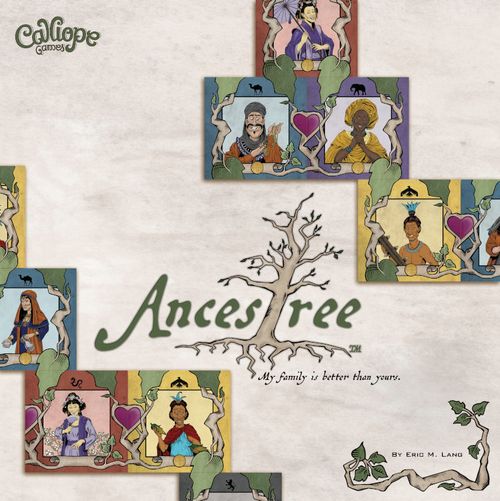
Ancestree
Ancestree Rulebook
Table of Contents
Table of Contents
Contents
- 110 Ancestor tiles
- 6 Scoreboards
- 96 Dynasty tokens (valued I, II, or III)
- 110 Gold tokens (in denominations of 1, 5, or 10)
Setup
Each player gets a Scoreboard. Shuffle all Ancestor tiles face down into a large pile that is easily accessible to all players. (If table space is limited, we suggest placing the tiles into the box lid for easy access.) Each player should have a large open space on the table in front of them where they will build their family tree.
Ancestor Tiles
Each Ancestor tile has four unique features: Heritage, Leaves, Hearts, and Coins.
The Heritage is shown by the border color and family icon. Each Ancestor tile belongs to one of five great lineages of the Old World: Gold Eagle, Blue Camel, Purple Elephant, Grey Lion, or Red Dragon.
Half Leaves connect up with other half Leaves to represent parents and forebears, or down to represent children and descendants.
Half Hearts represent potential marriages that ancestor may have in the course of their life. Two connected half Hearts represent a marriage between two ancestors.
Coins indicate the wealth the ancestor contributes to the family.
Game Play
The game takes place over three rounds. At the beginning of each round, all players randomly draw six Ancestor tiles from the pile to create their hand.
Each round, together, players will
- choose a tile from their hand,
- pass their unchosen tiles, and then
- simultaneously build their family tree.
1. Choose an Ancestor Tile
Everyone looks at their Ancestor tiles, chooses one, and places it face down in front of them.
2. Pass Unchosen Ancestor Tiles
Each player passes the remaining unchosen tiles in their hand face down to the player on their LEFT (clockwise) in Round 1 and Round 3, and to the player on their RIGHT (counterclockwise) in Round 2.
3. Build Your Family Tree
Everyone reveals their chosen Ancestor tile at the same time. If it's the first Ancestor tile of your tree, place it face up on the table in front of you. Future ancestors you add can only grow your family tree in one of two ways: A. Marriage (Heart) or B. Parent and Child (Leaf).
Once an Ancestor tile is added to a tree, it may not be moved for the remainder of the game. If you choose a tile that you cannot place anywhere in your tree, you must discard it from the game. That ancestor is lost to history!
A. Marriage
Place your chosen Ancestor tile directly to the left or right of a tile already in your family tree to complete a Heart. Depending on the number of completed Hearts, Ancestor tiles may have up to two Marriages to score at the end of the game. Ancestors of any Heritage or gender may marry.
B. Parent and Child
Place your chosen Ancestor above or below another tile already in your family tree, staggered left or right, to complete at least one Leaf. Tiles may not be squarely aligned above or below one another. Parents and children can be of any Heritage.
About Siblings and In-Laws
When you play a tile, you must establish one valid link via Leaf (parent or child) or Heart (spouse). Beyond that, it doesn't matter if there are unlinked symbols elsewhere on the touching tiles. These simply represent other relations, such as siblings or in-laws.
Continue choosing, passing, and adding Ancestor tiles to your family tree. This happens five times each round, until everyone is left with one Ancestor tile in their hand; this last tile is discarded from the game and not used. This action marks the end of the round.
End of Round
At the end of each of the three rounds, players score points by comparing Dynasties and gaining Coin tokens based on their family tree as described below; tokens are then placed onto their Scoreboard according to Heritage and round.
Compare Dynasties
A Dynasty is an unbroken generation (vertical) chain of touching Ancestor tiles of the same Heritage. It does not matter whether the tiles have a parent-child relationship, as long as the tiles touch vertically and have the same color edges. Horizontal (married) ancestors keep a Dynasty intact but only count as a single generation. Only your longest Dynasty in each Heritage counts for scoring purposes.
For example, in Louise's family, the Blue Camel Dynasty spans four generations. She also has a Grey Lion Dynasty of one generation (the other disconnected Grey Lion doesn't help).
Each player compares their family tree with the players sitting immediately to their left and right—also known as neighbors. Who has the longest Dynasties between neighbors? In each of the five Heritages, players gain one Dynasty token for each neighbor they beat. Players gain no tokens for ties.
In this example, Maurice and Louise are Gisèle's neighbors. Gisèle earns two tokens in Gold Eagle because her Gold Eagle Dynasty is longer than both neighbors. She earns one token in Purple Elephant for beating Maurice, but since she's tied for Purple Elephant with Louise, she earns no token there.
In round one, use the Dynasty tokens marked I. In round two, use the tokens marked II, and in round three, use those marked III. At the end of the game, each Dynasty token is worth points equal to the number printed on it, making the third round the most valuable at 3 points per token!
IMPORTANT: In a two-player game, when a player would normally collect one Dynasty token for a Heritage, that player collects two Dynasty tokens instead.
Gain Coin Tokens
At the end of each round, players also gain 1 Coin for each Coin icon currently visible in their tree. For example, a family tree containing 6 Coins earns the player one 5-point and one 1-point Coin tokens. (Always award Coin tokens in the largest increments possible.)
IMPORTANT: Ancestor tiles from previous rounds are cumulative; that is, they continue to contribute to the Coin tokens earned after each round.
End of Game and Marriage Bonus
After players compare Dynasties and gain Coins for the third round, final scoring begins. First, add up all the numbers on the Dynasty and Coin tokens earned during the game. These are victory points.
Then everyone receives a Marriage bonus. This bonus is based on the number of marriages across a family tree, and is calculated using the Heart scale shown at the bottom of each player's Scoreboard. The Marriage bonus adds to the existing victory points already counted from Dynasties and Coins.
For example, with eight marriages, this player earns 30 more victory points.
| Marriages | Points |
|---|---|
| 1 | 1 |
| 2 | 3 |
| 3 | 5 |
| 4 | 10 |
| 5 | 15 |
| 6 | 20 |
| 7 | 25 |
| 8 | 30 |
| 9 | 35 |
| 10 | 40 |
| 11 | 45 |
| 12 | 50 |
| Each Additional | +5 |
Winner
The player with the most victory points wins, and earns bragging rights for the greatest family tree in history!
In case of a tie, players share the victory.