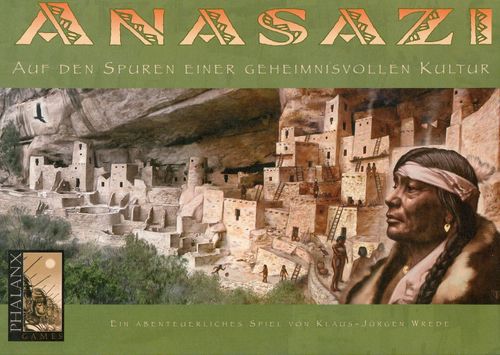
Anasazi: Lost Pueblos of the Ancients
Anasazi: Lost Pueblos of the Ancients Rulebook
Table of Contents
Table of Contents
2.0 Components
- 28 mesa tiles (the play area tiles)
- 1 score tile
- 54 expedition markers
- 8 objective cards
- 48 treasures (12 in each colour)
- 6 expedition base camps
- 28 base camp markers (7 in each colour)
- 16 wooden towers
- 1 sheet of colour stickers for the towers
- 1 rulebook
3.0 Game Setup
Note: Before your first game, stick a coloured sticker on the underside of each tower, to "make" 4 red towers, 4 blue towers, 4 white towers and 4 yellow towers. (The sticker sheet includes some spare stickers.)
Important: For the complete initial setup of the game, see the diagram on the back of the original rulebook.
-
First, place the tile with the large mesa in the centre of the play area. Then place the 12 mesa tiles that have a symbol on their back in a circle around the central mesa. Finally place the remaining 15 mesa tiles (those without a symbol on the back) in a second circle.
Important: Place all the mesas far enough apart that it is always possible to place a base camp between any two mesas. The play area represents the valleys and gorges between the mesas.
-
Place the 6 expedition base camps outside the outer circle of mesas. They should be placed in a circle, at roughly equal distances from one another. The distance between each base camp and a mesa must be smaller than the length of an expedition marker.
-
Place the 4 "bonus" treasures (one of each of the four colours) on the score tile, and all the expedition markers beside the play area.
-
Shuffle the 16 wooden towers, upright, so that the colour markings are underneath and kept secret. Then place one tower on each of the smaller sectors of all divided pueblos. Randomly place one treasure on each of the larger sectors of the divided pueblos and on each remaining pueblo with a single space.
Note: Each mesa tile has at least one "pueblo" space. Each pueblo has 1 or 2 sectors.
-
Choose a first player at random.
-
Each player receives the 7 base camp markers of one colour. Starting with the first player (and continuing clockwise), each player places a base camp anywhere in a valley between the mesas until each player has placed two base camps (see section 4.1 Building a Base Camp).
-
Shuffle the objective cards and give each player one card at random. You may examine your card at any time, but you must keep it hidden from the other players. Return the unused cards to the box. Your objective card doubles the value of the treasures you collect that match the colour shown on your card.
-
Starting with the first player (and continuing clockwise), each player secretly looks at the background colour of any three towers.
The complete initial setup should look like the diagram on the back of the original rulebook.
4.0 General Course of Play
Anasazi is played in turns, starting with the first player and continuing clockwise. During your turn you perform 2 actions of your choice. You may perform the same action twice, or each action once, during your turn:
- 4.1 Building a Base Camp
- 4.2 Leading an Expedition
4.1 Building a Base Camp
If you choose to build a base camp, take one of your own base camp markers and place it in any valley (directly on the play area) between any mesas, anywhere on the play area.
After building a base camp, you may secretly look at the background colour of any wooden tower anywhere on the play area. After having secretly examined it, return the tower to its pueblo.
Important: You must place your base camp entirely on the play area. You may not build a base camp on another base camp or on a mesa.
4.2 Leading an Expedition
If you choose to lead an expedition, take an expedition marker from the supply and place it at the end of any one of the expeditions of your choice.
Each expedition marker shows a small "explorer" near one end. The explorer always shows the current end of the expedition. When you add an expedition marker, you must place it so that it fully covers the explorer of the last marker of the expedition. The explorer on the new tile shows the new end of the expedition!
Each expedition starts from one of the 6 expedition base camp tiles on the edge of the play area. Only one expedition may start from each base camp. You may not place an expedition marker that hangs over the edge of the play area.
If you place an expedition marker that touches the border of a pueblo containing a treasure cube, you take the treasure and place it face up in front of you. If the pueblo contains a tower instead, remove the tower and place it on the first empty space of the corresponding colour track on the score tile.
Important: Pueblos with two sectors separated by a line are two separate spaces! To collect the treasure and remove the tower at the same time, the expedition marker must touch both sectors, not just one of them!
You may move an expedition in circles, even crossing its own path or the path of other expeditions. In the latter case, each of the crossing expeditions must have its own separate end. After placing an expedition marker, the explorer at the end of each expedition must be clearly visible!
Important: You may not try placing an expedition marker just "to see if it fits" or to test the distance, and then place it elsewhere! If it is clearly obvious that a marker will reach a pueblo, the treasure and/or tower must be removed first.
You may place expedition markers only over your own base camps. You may never place an expedition marker that covers (even partially) another player's base camp. The first time you place an expedition marker that covers any part of one of your base camps, you may immediately take any treasure of your choice from any other player and add it to your collection. You may do this each time one of your base camps is covered for the first time.
Translator's note: the French sentence above is read in the sense the Spanish translation gives it: markers may be placed over your own base camps, but not over other players' base camps.
If the end of an expedition marker sits on a base camp (that is, it has not fully crossed the base camp), any player (not only the owner of the base camp) may play a tile to continue that expedition.
Important: You may not place an expedition marker on a base camp on the turn in which you placed that base camp. You must wait at least until your next turn.
4.3 Looking at Towers
As a result of either of the two actions, it may be possible to look at the colour of a tower:
- Each time you choose to build a new base camp, you may look at any tower anywhere on the play area (see 4.1).
- Each time you lead an expedition onto a mesa, and if it is the first expedition marker placed on that mesa, you may look at any tower on that mesa (if there is still a tower on that mesa tile).
5.0 Winning the Game
The game ends immediately if:
- All expedition markers have been placed, or
- Each of the 4 towers of one colour has been moved to the score tile (so that only one empty space of that colour remains on the track).
5.1 Scoring
When the game is over, the "bonus" treasures on the score tile are distributed. For each colour, the player with the most treasure cubes of that colour takes the corresponding "bonus" treasure. If two or more players are tied for the majority in a given colour, nobody takes the "bonus" treasure.
Each treasure is worth a number of victory points equal to the number of empty spaces of its colour on the score tile. Any treasure you have that matches your objective card is worth double the normal number of victory points!
Example: During the game three white towers were placed on the score tile. This leaves 2 empty white spaces, so each white treasure is worth 2 victory points (or 4 points for a player with a white objective card).
The player with the most victory points wins the game! In case of a tie, the player among those tied with the most treasures is the winner.