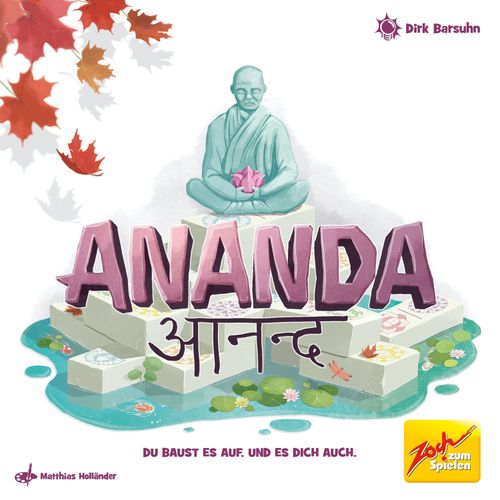
Ananda
Ananda Rulebook
Table of Contents
Table of Contents
Components
- 1 gameboard
- 63 building tiles
- 4 monk figures
- 108 meditation cards (with different backs)
- 2 overview cards
- 4 holding racks (see punch-out sheets for assembly)
Goal of the Game
Use your building tiles to erect a temple. In doing so, you strive to create areas as large as possible in one color. The larger the area is, the more meditation cards you may play in order to collect karma points. But foregoing some karma from time to time allows you to get more building tiles from the supply. Once you have used up all your building tiles, the game ends. The player who has been able to accumulate the most karma points by then wins.
Before the First Game
Put each holding rack together. For future games, you can leave them assembled in the box.
Setup
- Put the gameboard in the middle.
- Mix all building tiles face down and place them around the gameboard.
- Place one random building tile face up in the center of the gameboard. If both spaces on the tile show the same color, put it back and draw a new one until you find one with two different colors.
- Everybody gets one holding rack and 6 building tiles from the supply.
- In the three- or four-player game, remove the value 5 meditation cards and put them back into the box. Then each player gets 24 meditation cards with backs in one color, plus the corresponding monk figure. In the two-player game, each player gets the 30 meditation cards with blue or pink backs, respectively, and the corresponding monk figure.
- All players shuffle their pile of meditation cards and take 6 of them into their hand.
The player who has meditated the longest today begins.
Playing the Game
Players alternate turns. Your game turn consists of 5 phases that you carry out one after another.
1. Placing a Figure
Choose one color and place your monk figure on a space in this color. This indicates that you want to build on this area on the current game turn. An area contains all spaces of the same color that are horizontally or vertically adjacent to each other. In this context, it doesn't matter whether the spaces are at the same level. You may not place your monk figure on an area where
- another monk figure is standing.
- the figure was standing at the beginning of the turn.
If there is no unoccupied area left for your figure, you place your figure next to the gameboard, take a building tile from the supply and end your turn.
Example: It is Faye's turn. She looks for an unoccupied area for her monk figure. The yellow area and the large purple area are already taken. The red area isn't possible either, since Faye has started her turn there. Faye chooses the small purple area, since she has suitable building tiles for that.
2. Building a Temple
Connect any number of building tiles, one after another, to the area where your figure is standing. Every tile you place has to abut on your area with the chosen color. You may put tiles either on the foundation (i.e., directly on the gameboard) or covering exactly two tiles that are at the same level – even on tiles that you have just placed on this turn. You may not overbuild any space with a monk figure.
Even though you are not allowed to place your figure on an already-occupied area, you can connect your area with such an area if you build cleverly. If you are not willing or able to connect any more tiles, you count the spaces that belong to your area. This is your area value.
If you are not able or willing to connect any tiles at all to your chosen area, you take your figure off the gameboard, take a building tile from the supply and do not carry out your game turn.
Example: Faye has 2 building tiles that she can connect to her area. Although she was not allowed to place her monk on the large purple area, Faye can nevertheless use her second tile to connect the two areas. On this turn, she has an area value of 8.
3. Meditating
Play cards from your hand that match the color of the area you have just formed. The total value of the just-played cards is your meditation value. This value has to be lower than or equal to your area value. Put all cards played in front of you as your karma points.
If you are not able or willing to play any hand card, continue directly with step 4, "Refilling building tiles."
Example: Faye has three purple cards in her hand. With an area value of 8, she can play up to two of them and add them to her pile of karma points. She chooses to play the two lower cards, so that she'll get more building tiles in phase 4. On this turn, her meditation value is 5.
4. Refilling Building Tiles
Subtract your meditation value from your area value, take the difference in building tiles from the supply and add them to your rack.
Area value – meditation value = building tiles
If your area value and your meditation value are equal, you get no new building tiles. (If you have not played any cards in phase 3, your meditation value is 0. Draw building tiles according to your area value.)
Your rack has space for up to eight building tiles. If you have 8 tiles on your rack already, you don't draw any more tiles.
If the supply of building tiles has been depleted, you draw meditation cards from your draw pile instead. For each tile you would draw in this case, you get one card. Hand cards also have a limit of 8 cards.
Example: Faye's area value is 8, and her meditation value is 5. Consequently, she is allowed to take 3 new building tiles from the supply.
5. Maintaining a Balance
Compare the number of tiles on your rack to the number of your hand cards. If you have more tiles than hand cards, you draw meditation cards from your draw pile until the number of your cards is equal to the number of your building tiles. If you have as many or more hand cards than building tiles, you draw no cards.
Example: After refilling her building tiles, Faye has 6 tiles on her rack and 4 hand cards. She draws 2 cards from her draw pile and ends her turn.
After that, it's the next player's turn.
End of the Game
The game ends once one player has placed his last building tile and there are no more tiles available. Now each player adds up the values of all the cards in his karma pile. The player with the highest total score wins. In case of a tie, the tied player with fewer building tiles on his rack wins. If there is still a tie, tear the temple down and start again from scratch… or share the victory.