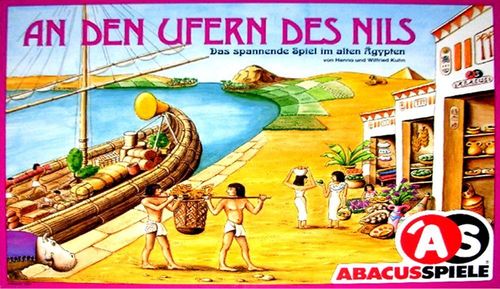
An den Ufern des Nils
An den Ufern des Nils Rulebook
Table of Contents
Table of Contents
Contents
- 1 Board
- 30 Desert Cards (Yellow)
- 45 Water Cards (Blue)
- 75 Fruit Markers in 5 colours, per colour:
- 5 x Flax
- 4 x Grain
- 3 x Grapes
- 2 x Onions
- 1 x Aubergine
- 5 Reference Cards showing the various phases of each Turn
- 5 Player Markers
- 3 Covering strips for games with less than 5 Players
- 1 Obelisk
- 1 Marker Stone for Ebb and Flood
- 1 Hippopotamus marker to show the starting player for each Round
Goal of the Game
The players attempt to grow fruits and vegetables in the fields, despite the constant changes due to the ebb and flow of the river. By selling the ripened products, they gain victory points. The player with the greatest number of victory points at the end of the game is the winner.
The Board
The board shows a short part of the River Nile along with the bordering land. The large Boat on the right hand side of the river serves as a store for the fruit that has been sold. New seed can also be bought from it. The other end of the river includes a space for discarded water cards. The circle, divided into three portions, shows the state of the river, ebb or flood. On each side of the river are the fields, each side having 4 rows, one of 2 fields, one of 3, one of 4 and one of 5. On the upper side of the river are the 4 market stalls, one with 3 spaces, two with 4 and one with 5 spaces for fruit markers. At the top of the board is the score track, with 30 spaces. At the bottom of the board are two spaces for discarded desert cards.
Preparation
- The board is placed in the centre of the table. Depending on the number of players, the covering strips are used to block out a number of the fields.
- With 2 Players, 2 rows of 2 fields and one row of 3 are covered over.
- With 3 Players, 2 rows of 2 fields are covered over.
- With 4 Players, 1 row of 2 fields is covered over.
- With 5 Players, all rows of fields are used.
-
Each player receives a reference card, the 15 fruit markers in their chosen colour, and the player marker of the same colour. The Fruit markers are double sided. One side shows the seeds of the fruit, the other the ripe fruits.
-
All player markers are put on the first space of the scoring track. The Obelisk is put on the space at the other end of the track. The small marker is placed onto the Flood (Flut) portion of the circle marker.
-
The 30 desert cards are shuffled face down. Three random fields bordering the desert area, (with 1 or 2 palms), are covered with a face down desert card. Each player receives two desert cards which they can use during the game as Jokers, (see under Jokers); the remaining desert cards are placed face down onto the desert card space.
-
The 45 water cards are shuffled and the whole pack is dealt equally, face down, to the players (the wave symbols face up). With 2 or 4 players there are tiles remaining; these are removed from the game. Players may not look at their own water cards. They should divide the cards into two equal piles, placed face down in front of them. Warning! All water cards must be placed so that all players can see them throughout the game. Players may only look at the two uppermost cards at any time. They may not look at any cards lying deeper in the piles.
-
The oldest player becomes the starting player for the first round and takes the Hippopotamus marker to show this.
Before the First Round
Each player in turn, starting with the holder of the hippo, places two of their fruit markers onto the boat in the river. Then, each in turn lays one water card from their own stock onto one of the fields. It is important when laying water cards that two principles are followed. Firstly, water cards must always be laid outwards from the river; i.e., no field can ever lie between the river and a water card. Secondly, the wave symbols on the card must match either the symbol in the river for the first card in a row, or the symbol on the card next to it for any subsequent cards in that row. So a single wave must always have another single wave next to it, or a double wave, a double. Cards with no wave symbol on one side block that row. No further cards can be laid next to them and hence the remaining fields in that row are safe from flooding during that cycle. Cards must be laid with their long sides parallel to the river banks. Only one card may be laid per field.
Once all players have placed a water card, each in turn, again starting with the holder of the Hippo, places two fruit markers onto the fields, one seed side upwards, and one turned to the ripe fruit side. Take note that fields covered with a desert or a water card may not have fruit markers placed on them. A maximum of two markers may be placed in each field. No player may ever have more than one of their own markers in a field.
Course of Play
The game is played over several rounds, each of which is divided into four phases as shown on the reference cards.
Rundenablauf - Play of a Round:
The starting player for that round (Hippo Holder) plays water/desert cards and may consequently have to move the Ebb/Flood (Ebbe Flut) marker.
All Players have 3 Action Points (APs) per Player to use as wished. One extra AP is available per Joker played.
Startspielerwechsel. Change of starting player for the Round (Hippo is passed to the Player to the Left).
- Wertung. Sale of goods from market if one or more rows are full, movement of player markers.
Action Points
- Sowing seeds (placing seed from hand onto a field): 1 point (2 if field already has a marker on it).
- Growing seeds (marker is turned from seed side to ripe side): 1 point (2 if field has another marker on it).
- Harvesting (moving ripe fruit marker from field to market): 1 point (2 if another marker in field).
- Buying seed (taking marker from Boat into hand): 1 point.
- Buying Joker: 1 point.
Phase 1, Ebb or Flood
Phase 1 is always carried out by the current starting player for the round; i.e., the player with the Hippo. Depending on the position of the Ebb/Flood marker water cards are laid or removed from the board. At the start of the game the marker is on the Flood section of the circle.
Flood: If the marker is on the Flood section of the circle then the starting player must lay two water cards onto the fields, following the rules for laying water cards; i.e., the number of waves must match between the edges of adjacent cards. The player has only three possible cards to lay in this phase, the two uppermost cards on their two stacks of cards plus the card revealed after laying their first card. Any fruit markers on fields covered with water cards are washed away into the boat in the river. It can happen that the starting player has to flood their own fruit markers.
If a water card is placed onto a field covered with a desert card, then the desert card is turned over and the consequent action determined as referred to in the section "The Cards". Once the action has been carried out, the player may retain the desert card in their hand to be used as a joker later in the game.
The Flood phase ends as soon as a player is unable to lay two water cards onto fields. The Ebb/Flood marker is moved on one section to the Ebb1 section. If the player has managed to lay one water card before running out of possibilities, then they play no further cards; if they haven't laid any cards however, then the marker is moved onto Ebb and the player plays on as per the Ebb phase.
Ebb: If the Ebb/Flood marker is on the Ebb1 or Ebb2 section then the starting player for the Round must remove two water cards from the fields. Each card removed is turned over and the result shown on the other side is carried out. (See under "The Cards".) Once finished the card is laid on the discard pile. If the card has an arrow on it, then in addition to the normal action of the card, the Ebb/Flood marker is moved on one section, either from Ebb1 to Ebb2, or from Ebb2 to Flood.
The Ebb phase ends either when a player is unable to remove any more water cards, or when the marker reaches the flood section through the operation of cards with arrows on them. If a player is unable to remove any cards at all, then the marker is moved straight to Flood and the player plays their turn as per the Flood rules; if, however, they have managed to remove one card, then the marker is moved but the starting player does not lay any cards. The overriding principle is that a starting player may only play Flood or Ebb, never both in the same turn.
Phase 2, The Player's Actions
In this phase each player in turn has 3 Action Points, (APs) that they can use freely. In addition, he or she may play desert cards as Jokers and so gain one extra Action Point per card. Each player uses all their APs before the next player takes their turn. Actions may be carried out in any order, a player need not use all 3 APs per Round if they don't wish to.
Fruit markers: Each fruit marker may only be active once per Round. It is, for example, not possible to sow fruit (move a Fruit Marker from hand to field), and to grow it (change it from seed side to ripe side), in the same Round.
Sowing: A fruit marker is taken from the Player's stock in hand and placed onto one of the fields, seed side uppermost. This costs 1 AP if the field is empty, but 2 APs if another player already has a marker in the field. A player may not have two of their own markers in the same field.
Fruit markers may not be placed onto fields that have Water or Desert cards on them. Only two markers may be placed in any field.
Growing: A player turns a Fruit marker from the seed side to the ripe side. This costs 1 AP, or if there is another marker in the field, 2 APs.
Harvesting: Harvesting means that a player removes a ripe Fruit marker (ripe side uppermost) from a field, and places it onto an empty market stall space. This costs 1 AP or 2 APs if there is another Fruit marker in the field. The number of Palms in the field is a measure of the quality of the fruit. Fruit from a field with four palms may be placed onto any of the market stalls. Fruit from a field with three palms may only be placed onto a row with three or less palms; fruit from a field with two palms may only be placed on a row with two or less palms; and fruit from the fields with one palm may only be placed onto stalls in the longest row, that with one palm above it.
Rows of market stalls are always filled from the wall end outwards towards the river, without any gaps. A fruit marker must be of a different type to the last two markers placed in that row. Looking at the diagram (not reproduced here), we have a grape marker by the wall, a grain marker next to it and an aubergine marker next to that. The next fruit marker in this row will be placed next to the aubergine. It may not be an aubergine nor a grain, but might be a grape marker or an onion or a flax.
Buying seed: For 1 AP a player may buy a fruit marker from the stock in the boat and add it to their stock in hand, ready to be sown in a later Round.
Jokers: Desert cards may be used as Jokers. For 1 AP a player may buy a Desert card from the stack and add it to their hand. Only one Desert card may be bought per Round. During a player's turn they may use 1 extra AP for every Joker played; i.e., every Desert card put onto the discard pile. The symbols on the reverse of the cards have no effect in this case. A player may play as many Jokers per Round as they wish.
Phase 3, Startspielerwechsel. Change of Starting Player
Once all players have had their turn, the Hippo is passed one place to the left. The player now holding the Hippo is the starting player for the next round.
Phase 4: Wertung, Valuation of Fruit
The new starting player for the round checks whether any row of market stalls has been filled; i.e. if there is a fruit marker on every space of a row. If so, then a valuation takes place as follows:
Firstly, all fruit markers on the boat in the Nile are removed from the game. For every colour represented (not for every marker!), the obelisk is moved one space down the Scoring Track. Thus with five players the obelisk can move up to 5 spaces down the track.
Every full row of market stalls is now valued. For each row, there are 6 points to be won. If all the fruit markers in a row belong to one player then that player receives all 6 points, their marker is moved six spaces along the score track. If the fruit markers in a row belong to two players then the player with the most markers receives 4 points and the other player 2 points. If the markers come from 3 or more players then the points are divided: 3 to the player with most markers, 2 to the second place player and one to the third place player. If two players have the same number of markers, then the win goes to the one who last placed a fruit marker in that row, and so has supplied the freshest fruit.
An example of valuing: Imagine that a row of market stalls contains Fruit markers in the following colours and arrangement:
Red - Blue - Red - Blue - Green
The Blue player would receive 3 points, the Red player 2 and the Green player one since they only have one marker in the row, this is beaten by two markers, even though it is fresher.
Another example:
Red - Green - Yellow - Blue - White
Here all players have an equal number of markers, one, so the points are decided purely by freshness. White would get 3 points, Blue 2 and Yellow 1. Red and Green receive nothing.
Every spoiled fruit marker, (see under "The Cards") in a row reduces the points scored by that player by one. If the player scores no points in the normal valuation, then no points are deducted.
Each point gained allows the player to move their marker one space up the score track. The fruit markers, once valued, are removed from the market and put onto the boat in the Nile from whence they may be rebought as seed stock.
Game End and Victory
The game ends when the Obelisk and a Player marker meet or pass one another. The winner is the player whose marker has moved furthest up the track. All full rows are valued before the game ends, even though the Obelisk may have passed a player marker previously during the valuation. The valuation must always be continued to completion.
The Cards
Both Water and Desert cards have pictures on their obverse sides, the meanings and results of these are as follows (some cards have an arrow on them; this causes the Ebb/Flow marker to move on one segment):
Palms: If the card shows one or more palms, it has the result that on one row of market stalls some fruit may go off. The row affected is indicated by the number of palms. With four palms, the player drawing the card may choose from any of the four rows; with three palms they have the choice of rows 1, 2 or 3 etc. Two fruit markers are affected, the player choosing which two. If a row has only one marker in it then it is immune. Fruit markers with their ripe side uppermost are turned over to the seed side. Markers that are already on their seed side are turned through 45 degrees and are "spoiled". Spoiled fruit counts minus one point against any points otherwise scored for that row. The starting player must always choose a market row if possible, even if this results in his own fruit markers being affected.
Desert: If the card shows a desert card then a desert card is drawn from the pile and placed onto the row of fields from which the water card has been removed, but at the other end naturally enough. If the affected field has fruit markers on it, they are removed and placed in the boat.
Hippopotamus: A picture of a hippo means that the "hands" variant is played. If this variant is not being used in the game then the card is ignored.
Variants
"Hands": If a hippo card is turned over, then a further phase is played giving the players a chance to win a further 3 APs. Each player picks a number of fruit markers and hides them in their closed fist. All players then open their fists simultaneously, and the number of markers in the hand is added to the number of markers that that player already has in the boat. The player with the highest total of markers wins the extra 3 APs which must be used immediately. If two players have an equal total then the player with the greater number of markers in the boat wins the extra APs. If the totals are still equal then no one wins. The player who has won the APs must put all the fruit markers that they have shown in their hand into the boat. Then, once the winning player has used their 3 APs, the starting player resumes their turn.
Choosing a Starting Player: As an alternative method of choosing a starting player at the beginning of the game, the players can choose a number of fruit markers and hold them in their closed fists. All fists are opened simultaneously and the player with the largest number of markers in their hand places them into the boat and starts the game. If no one player chooses a greater number of markers than the others then the players roll a die to determine who starts.
Buying Seeds: One variant is to allow players to buy the fruit markers of other players. The cost is 2 APs per player. The player may not use the fruit markers so purchased, but playing this variant allows players to influence the movement of the obelisk along the track and so to delay the end of the game.
Jokers, an alternative use: Players may agree that a Joker may also be used to "revive" fruit markers; i.e., a fruit marker that has been turned to its seed side can be turned back to ripe. Once spoiled, fruit markers can no longer be revived.