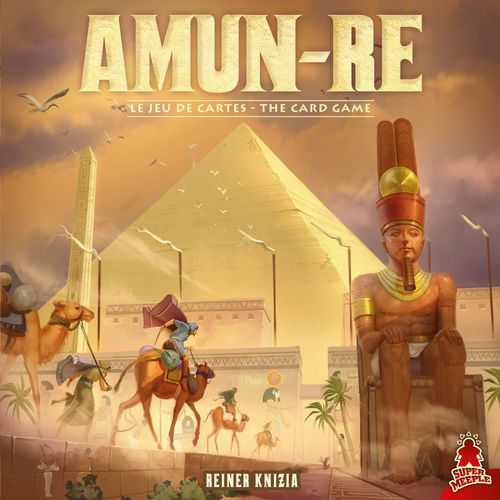
Amun-Re: The Card Game
Amun-Re: The Card Game Rulebook
Table of Contents
Table of Contents
Contents
- 45 Province cards (15 per Kingdom)
- 45 Gold cards (9 per player, numbered 0 – 8)
- 5 Player Aid cards
- 76 Pyramid tokens
- 40 Victory Point tokens (20× 1 VP, 14× 5 VP, and 6× 10 VP)
- 5 wooden markers (1 per player)
- 1 Ankh token (1st player)
- 1 Offering token
- 1 Offering table and Revenue track on the back of the box
Setup
- Group the Province cards according to their backs. The different backs represent the 3 Kingdoms.
For each Kingdom, draw a number of random cards according to the number of players:
- 2-player game: Draw 6 cards per Kingdom.
- 3-player game: Draw 9 cards per Kingdom.
- 4-player game: Draw 12 cards per Kingdom.
- 5-player game: Play with all the cards, which is 15 cards per Kingdom.
Return any remaining cards to the box without looking at them.
- Shuffle the cards from each Kingdom separately, then form 3 decks, one from each Kingdom's cards. Then place the 3 decks near the play area, in the order of the Kingdoms: 1st – 2nd – 3rd.
- Place the Pyramid and Victory Point tokens within reach of all players.
- Each player chooses a color, takes the corresponding Gold cards and wooden marker, as well as a Player Aid card. Return any remaining cards and markers to the box.
- Keep the Offering and Ankh tokens handy.
- Close the box, then flip it over so the Offering table and the Revenue track are visible. Everyone places their markers on the "0" space of the Revenue track.
How to Play
The game plays over 3 rounds, which correspond to the 3 Kingdoms. During the 1st Kingdom, each player will acquire 3 Province cards, which they must develop during the following 2 Kingdoms.
Each round is divided into 4 Phases:
-
A. Auction (3 consecutive auctions).
-
B. Offerings and Favors (simultaneous).
-
C. Revenue and Construction (in turn order).
-
D. Victory Points (in turn order).
-
Randomly determine the 1st player and give that player the Ankh token, showing that this player is the Pharaoh.
The Pharaoh is always the 1st player, and the turn order is always clockwise.
Ties are always broken in turn order, starting with the Pharaoh.
- To begin, the player who is Pharaoh chooses a number of her Gold cards (which must include the 0 Gold card), the total sum of which must be precisely 14, and places them face up in front of her.
- Then, in clockwise order, the other players do the same thing. The number of cards each player chooses can vary, but the total must always be precisely 14 for each player (and must include the 0 Gold card).
- Each player discards the cards she didn't select into a personal, face-down discard pile nearby.
Note: Each player starts the game with a display that totals 14 Gold (and includes the 0 Gold card). The choice of cards may be different or exactly the same from player to player, but it will always equal 14 at the start of the game.
Examples of opening displays: 0 + 1 + 2 + 4 + 7 = 14; 0 + 1 + 2 + 5 + 6 = 14; 0 + 1 + 5 + 8 = 14.
Anatomy of a Province Card
- Pyramids already present in the Province: Pyramids enable you to earn Victory Points.
- Number of Ankhs granted by the Province as long as they are not covered. The player with the most Ankhs will become Pharaoh.
- Number of Fields in the Province.
- Caravan: Fields and Caravans will provide you with Revenue according to the flood level of the Nile.
- The color indicates the Kingdom: 1st Kingdom, 2nd Kingdom, 3rd Kingdom.
A. Auction
3 auctions are carried out. In each auction, each player will acquire precisely one Province card. Thus, each player acquires 3 Province cards in total during this Auction phase, and 9 Province cards in total during the game.
- To set up the auction, the Pharaoh draws and lays out a face-up row of a number of Province cards equal to the number of players.
The Pharaoh always starts the auction. She places precisely one of her Gold cards face up in front of a Province card of her choice. The other players do the same in turn order.
When it's your turn to play, if you have no Gold card in play:
- Either you place a Gold card in front of a Province card for which no one has bid,
- Or you place a Gold card in front of a Province with an opponent's card, but your card must be higher in value. Your opponent takes her Gold card back, and places it in front of her.
If you already have a Gold card in play:
- You must pass your turn, and it is the next player's turn to bid. You can neither retrieve your Gold card that is in play, nor move it to another Province.
Note: If another player outbid your Gold card, you are allowed to outbid her again for that same Province.
The auction ends when each player has a Gold card in front of a different Province.
- Collect the Province card you purchased, and place it face up in front of you, then discard the Gold card you used, unless it was the 0 Gold card, which is always available to you, and must return to you face up. You will thus always have at least one Gold card available for the auction.
- The player with the most Ankhs visible on her Province cards becomes the new Pharaoh and takes the Ankh token.
Note: Turn order always breaks ties. The first tied player in turn order, starting with the Pharaoh, wins. This player becomes the new Pharaoh and takes the Ankh token.
Auction Example
It is Blue's turn. Blue places a Gold card in front of the second Province card — a Gold card that is higher than the card Red had played there before. Red returns his Gold card to his display.
Example of 2nd and 3rd Auctions
Purple has 7 Ankhs at the end of the 2nd Auction. Because this is more than the other players, she becomes 1st player.
Purple has 8 Ankhs at the end of the 3rd Auction. She still has the most, so she remains the 1st player.
B. Offerings and Favors
1. Offerings
Give each player enough time to study the Gold cards remaining in all players' displays. Then each player gathers the Gold cards remaining in her display into her hand, and secretly chooses one or more of these cards (possibly including the 0 Gold card) to make an Offering at the temple of Amun-Re, hoping to influence the Nile flood level favorably. When everyone is ready, simultaneously reveal your Offerings.
- Flood level: Total the card values of everyone's Offerings, and place the Offering token on the corresponding Flood space of the Offering Table (0–5, 6–10, 11–15, 16+) according to the total value.
2. Favors
Players receive a number of Pyramids that depends on their Offering relative to the other players' Offerings. Place these Pyramids directly on your Province cards, trying to balance the number of Pyramids in your Provinces.
- The player who has made the greatest Offering receives 3 Pyramids; second receives 2 Pyramids; and everyone else who has offered at least 1 Gold receives 1 Pyramid. As usual, ties are resolved according to the Pharaoh (i.e. in turn order).
- Players who offered 0 Gold receive nothing.
Discard the cards of the Offerings face down onto your discard pile. Place your remaining Gold cards face up in front of you.
2-Player Game
The player with the greatest Offering receives 3 Pyramids, and second receives 1 Pyramid if that player offered at least 1 Gold.
Offerings Example
The total of the Offerings is: (4) + (2) + (0 + 2) + (1) = 9. Place the Offering token on the corresponding space (6–10).
Favors Example
Purple has made the greatest Offering and receives 3 Pyramids.
Red and Yellow have made the same Offering, but Yellow is earlier in the turn order, and receives 2 Pyramids.
Red and Blue each receive 1 Pyramid.
Anatomy of the Offering Table
Each column of the Offering Table shows, from top to bottom:
- Range of the Offering total.
- Nile flood level.
- Revenue earned per Field you own.
- Revenue earned per Caravan you own (only if the total Offerings are from 0 to 10).
| Offering total | Revenue per Field | Revenue per Caravan |
|---|---|---|
| 0–5 | 1 Gold | 10 Gold |
| 6–10 | 2 Gold | 10 Gold |
| 11–15 | 3 Gold | — |
| 16+ | 4 Gold | — |
C. Revenue and Construction
In turn order, starting with the Pharaoh, each player does all 3 of the following steps before the next player's turn:
1. Revenue
The Nile flood level determines the gold your Fields and Caravans earn.
- Add up the number of Fields visible on your 3 Provinces, and multiply that total by the level of the current flood (×1 to ×4).
- If the flood is weak (Revenue per Field is 1 or 2), add 10 gold for each Caravan visible on your Province cards.
- Finally, total the value of the Gold cards remaining in front of you, and place your marker on the space on the Revenue track corresponding to the total.
- Now discard the Gold cards remaining in front of you face down onto your discard pile.
2. Construction
You may now construct Pyramids by paying the construction cost indicated on your Player Aid card. Move your marker back the number of spaces equal to the cost of your purchase.
- Then place all of the purchased Pyramid tokens on your Province cards. Distribute Pyramids (tokens and pre-printed) as evenly as possible among your 3 Provinces. Once a Pyramid has been placed, it cannot be moved.
Note: To make it easier to calculate Victory Points later, we recommend that you place your Pyramid tokens such that they complete rows of Pyramids in your Provinces; each complete row will have 3 Pyramids.
Construction cost (Player Aid card):
| Pyramids | Cost in Gold |
|---|---|
| ×1 | 3 |
| ×2 | 6 |
| ×3 | 10 |
| ×4 | 15 |
| ×5 | 21 |
| ×6 | 28 |
| ×7 | 36 |
| ×8 | 45 |
| ×9 | 55 |
3. Preparation
Retrieve all your Gold cards and select a number of these cards (which must include the 0 Gold card) whose total must be precisely equal to your remaining Revenue after your purchases, as indicated on the Revenue track. Place these Gold cards face up in front of you, and discard the other cards face down as your discard pile again. Move your marker to 0 on the Revenue track.
Note: You and your opponents will not necessarily start the next Kingdom with the same amount of Gold for the auction.
- After everyone has taken a turn performing these 3 steps and has returned their marker to 0 on the Revenue track, it is time to calculate the Victory Points for this Kingdom.
Example of Revenue and Construction
Revenue. The Offerings total 9: Yellow's Fields earn her 2 Gold each (6 × 2 = 12), her Caravan earns her 10, and she has 5 Gold on her remaining Gold card. Her current Revenue is: 12 + 10 + 5 = 27 Gold.
Construction. Yellow decides to spend 15 Gold to buy 4 Pyramids, which she distributes evenly among her 2 Provinces that have no Pyramids.
Preparation. Yellow still has 27 − 15 = 12 Gold for her next display of Gold cards. She decides to form that display out of Gold cards 0, 2, 4, and 6 for the next Kingdom.
D. Victory Points
Finally, each player calculates her Victory Points.
-
+1 VP for each Pyramid (token or pre-printed) on your Province card that has the fewest Pyramids.
-
+1 VP if you have 9 or more Fields visible among your 3 Province cards from this round.
-
+1 VP if you are Pharaoh (you are the player with the most Ankhs visible among your 3 Province cards from this round).
-
−1 VP if you are the player with the fewest Ankhs visible among your 3 Province cards from this round. (If your score for the round is negative, it is 0 instead.)
-
When everyone has collected their Victory Point tokens for the round, continue to the next Kingdom.
Example of Victory Points
- Purple player: Pyramids: +3 VP; Pharaoh: +1 VP; = 4 VP
- Blue player (2nd): Pyramids: +2 VP; 9 Fields: +1 VP; = 3 VP
- Yellow player (3rd): Pyramids: +2 VP; = 2 VP
- Red player (4th): Pyramids: +2 VP; 9 Fields: +1 VP; fewest Ankhs*: −1 VP; = 2 VP
*Blue and Red have the same number of Ankhs, but Blue is earlier in the turn order, so he wins the tie, and thus Red loses the Victory Point.
2nd and 3rd Kingdoms
For the 2nd and 3rd Kingdoms, the game plays out in the same manner, except that at the end of each auction, everyone decides which Province they wish to extend. You place each new Province card you acquire overlapping one of the cards you acquired in the previous Kingdom (that has not yet been covered during this Kingdom), so that it covers the Ankhs, Fields, and Caravans of the preceding Province card, but leaves the Pyramids visible.
- The Pharaoh is determined by only the Ankhs that are still visible. Once Ankhs have been covered, they no longer count.
- Your Revenue will be determined by only the cards of the current Kingdom (Fields, Caravans, and unused Gold cards).
- You can place Pyramids you construct or earn on any cards of your Extended Provinces, even those of previous Kingdoms, but always respecting the balance between the 3 Extended Provinces.
- The Victory Points for the Pyramids are calculated based on all of the Pyramids of the Extended Province that has the fewest Pyramids.
- In the third Kingdom, during the Construction phase, spend as much of your Gold as you can to obtain as many Pyramids as possible. Remaining Gold cards are worthless at the end of the game.
Example of an Extended Province: the set formed by the 2 or 3 overlapping cards is called the Extended Province.
Example Over All 3 Kingdoms
End of the 1st Kingdom. Purple has the most Ankhs (8) at the end of the 1st Kingdom. She becomes Pharaoh (first player). She has 3 Fields. She has 3 Pyramids on her Province that has the fewest. She thus earns 1 VP (for being Pharaoh) and 3 VP (for the Pyramids) = 4 VP.
End of the 2nd Kingdom. Purple has 8 Ankhs at the end of the 2nd Kingdom, and remains 1st player. She has 10 Fields. She has 5 Pyramids on her Province that has the fewest. She thus earns 1 VP (for being Pharaoh), 1 VP (for 9+ fields), and 5 VP (for the Pyramids) = 7 VP.
End of the 3rd Kingdom. Purple has 3 Ankhs at the end of the 3rd Kingdom, but is no longer 1st player because she has the fewest Ankhs among all players. She has 7 Fields. She has 12 Pyramids on her Province that has the fewest. She thus earns: −1 VP (for fewest Ankhs), and 12 VP (for the Pyramids) = 11 VP.
Game End and Winning
The game ends after collecting the Victory Points for the third Kingdom. The player with the most Victory Points wins the game, and her name will be engraved on the walls of the Pyramids.
In the event of a tie for most Victory Points:
- The tied player with the greatest total of Pyramids (tokens and pre-printed) on her 3 Extended Provinces wins.
- If there is still a tie, the tied player earlier in the turn order wins.