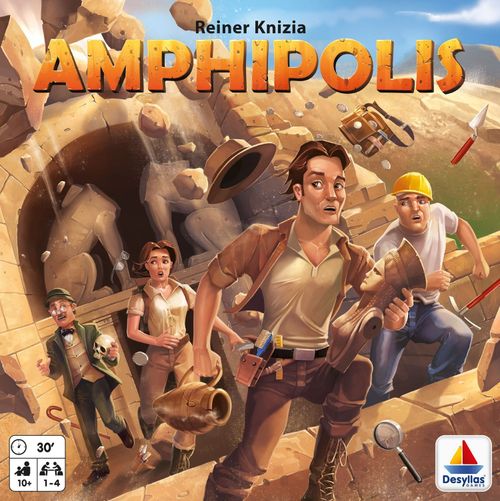
Amphipolis
Amphipolis Rulebook
Table of Contents
Table of Contents
Contents
- 1 Game Board with the archaeological site of Amphipolis
- 135 tiles: 12 Caryatids, 12 Sphinxes, 24 Landslides, 27 Mosaics, 30 Skeletons, 30 Amphoras
- 20 Cards: 16 Character Cards in 4 colors, 4 Player Aids (Greek-English-German-French)
- 9 Replacement Tiles: You will find 9 replacement tiles that have the "AMPHIPOLIS" logo on both sides. These tiles can be used as replacements in case a regular tile is lost or damaged.
- 1 Bag
- 1 Rulebook
Game Setup
- Place the Game Board at the center of the table so that everyone has easy access to it.
- Depending on the number of players you may have to remove a few Landslide tiles. When playing with 3 players remove 3 such tiles and in a 4-player game, remove 8 of them. These tiles are returned to the box, they are not going to be used.
- Put all the remaining tiles within the bag and place it next to the board.
- Each player chooses a color, takes the 4 corresponding Character cards and places them face up in front of him.
- Draw a random tile from the bag and place it on its corresponding area of the board (if it is a Landslide tile, return it in the bag). Repeat this process until each sorting area on the board has exactly one tile on it (if you draw a tile belonging to an area that already has one, return it in the bag).
The player who most recently visited an archaeological site or a museum plays first.
The board has four sorting areas: Mosaics, Marble Statues, Amphoras and Skeletons, plus the Entrance spaces.
Game Overview
On your turn, perform the following actions, in sequence:
Draw new Tiles: Draw 4 random tiles from the bag and place each one on its corresponding sorting area on the board. If you draw a Landslide tile, cover with it one of the empty Entrance spaces on the board.
Take Tiles: Choose up to 2 tiles from any ONE sorting area and place them in front of you, face-up. The other players must be able to see them at all times.
Use Character (optional): You may optionally use the ability of one of your characters. Each character can only be used once in the game - turn its card face-down after the use as a reminder.
The characters' abilities are the following:
- Assistant: Take 1 tile from any one sorting area.
- Archaeologist: Take up to 2 tiles from any sorting area other than the one you chose earlier in your turn.
- Digger: Take up to 2 tiles from the sorting area you chose earlier in your turn.
- Professor: Take 1 tile from each sorting area other than the one you chose earlier in your turn.
After you complete your actions, it's the turn of the player to your left.
Game End
The game ends immediately when all 16 Entrance spaces are covered with Landslide tiles. The player who drew the last Landslide tile does not get any tiles this turn.
You then calculate your victory points based on the findings you have in front of you:
Mosaics
Each set of 4 Mosaic tiles forms a complete mosaic. Single-color mosaics score 4 victory points while multi-color ones score 2 points. Mosaics that are not complete do not score any points.
Skeletons
There are two types of skeletons: The large ones that belong to adults and the slightly smaller ones that belong to children. A complete skeleton consists of 2 corresponding tiles (upper body and lower body). Each family, made up of two complete large skeletons and one complete small skeleton, scores 6 victory points. A complete skeleton, that is not part of a family, scores 1 point on its own (whether large or small). Incomplete skeletons do not score any points.
Amphoras
The Amphora tiles are scored in groups of different colors as seen below. You may score several groups, but you may use each tile only once.
| Amphoras of different color | Victory Points |
|---|---|
| 6 | 6 points |
| 5 | 4 points |
| 4 | 2 points |
| 3 | 1 points |
Note that any combination of colors will score, not only the ones shown above.
Marble Statues
There are two types of marble statues (Caryatids and Sphinxes) that are scored independently. The players with the most statues of one type score 6 points. The players with the fewest statues of one type score 0 points. The rest of the players score 3 points.
Example of 3 Players Game
| Players | Marble Statues | Victory Points |
|---|---|---|
| Player 1 | 5 Caryatids | 6 points |
| Player 1 | 3 Sphinxes | 3 points |
| Player 2 | 3 Caryatids | 3 points |
| Player 2 | 2 Sphinxes | 0 points |
| Player 3 | 2 Caryatids | 0 points |
| Player 3 | 4 Sphinxes | 6 points |
In a 2-player game, as an exception, the player with the fewest tiles of one type gains 3 points, as long as the number of tiles he has, is at least equal to half the number of the other player's tiles (of that type).
The player with the most victory points is the winner! In case of a tie between 2 or more players, the winner is the player who gained the most points from a single sorting area. If there is still a tie, the winner among them is the player who played last.
Scoring Example
The game is over and John is calculating his score. He starts by checking his Mosaics. He has a total of 5 red tiles, 3 green and 2 yellow. This means he can complete 1 red mosaic and 1 more with multi-colored tiles. The 2 remaining tiles do not complete a mosaic so they do not score any points. In total he scores 6 victory points from the mosaics.
Next he checks his skeletons. He didn't manage to complete a family but he has one complete adult skeleton, so he scores 1 point.
Then he looks at the Amphoras. He has one group of 5 differently colored Amphoras and another one of 3 Amphoras (also differently colored). Thus he scores 4 victory points from the first group and another 1 from the second group, for a total of 5 points.
Finally, he checks his marble statues. He has gathered 2 Caryatids and 4 Sphinxes. To see if he scores any points out of them he must compare their numbers to those of the other players. Mike has gathered no Caryatids and 3 Sphinxes while Lisa has 6 Caryatids and 1 Sphinx. Thus, he scores 3 victory points from the Caryatids (he has neither the most nor the fewest of them) and 6 points from the Sphinxes (he has the most of them).
John's total score is 21 victory points.
Solo Game
Amphipolis can also be played by someone on his own with the following changes to the rules:
During the game's setup, place 8 Landslide tiles on 8 Entrance spaces - these are already covered when the game starts. In addition to that, remove 4 Landslide tiles from the bag and return them to the box.
Play the game as normal, taking one turn after the other. However, there is now a grave robber in the loose, trying to steal as many findings as he can. If during a turn, you draw any Landslide tokens, place them over the Entrance spaces as normal, place the rest of the tiles on their corresponding sorting areas, and end your turn immediately. The grave robber then strikes and collects all the tiles from all sorting areas - place them somewhere next to the board face-up so you can see them. You then play the next turn as normal.
As usual, the game is over when all 16 Entrance tiles are covered, with the grave robber still getting all the remaining tiles in the 4 sorting areas.
Score your tiles and then score the grave robber's. If you have more points you win!
Write down your score and next time try to beat not only the grave robber's but your previous highest score as well!