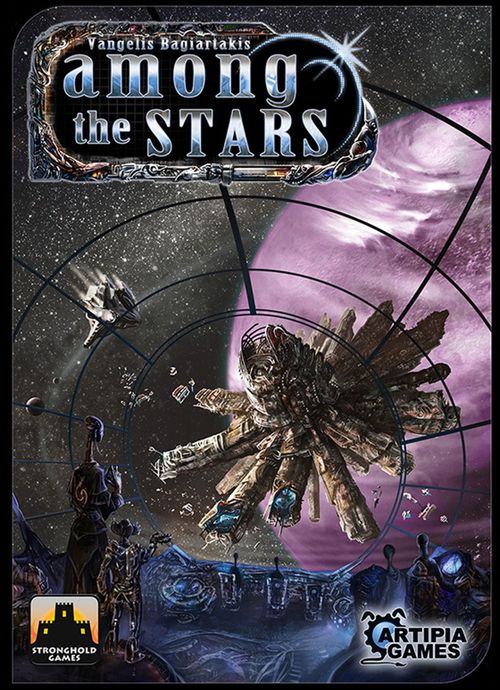
Among the Stars
Among the Stars Rulebook
Table of Contents
Table of Contents
1. Overview
In Among the Stars, each player takes on the role of an alien race trying to build a space station for the newly-formed intergalactic Alliance. They accomplish this goal by drafting Location Cards to be placed in their play area in the best possible way. The player with the most efficient space station after 4 years is the winner.
2. Contents
- 4 Main Reactor Cards
- 72 Basic Location Cards
- 44 Special Location Cards
- 16 Power Reactor Cards
- 8 Objective Cards
- 12 Conflict Cards
- 4 Player Aid Cards
- 1 Score Board
- 4 Player Markers
- 1 Turn Marker
- 32 1-Credit Tokens
- 16 5-Credit Tokens
- 20 Energy Cubes
- 8 Race Tiles
- Rulebook
3. Setup
The game can be played in two modes: Aggressive and Non-Aggressive. The core game is the Non-Aggressive Mode. The Aggressive Mode is for players who want more direct confrontation in their game. What follows are the rules for the Non-Aggressive Mode. It is suggested you play a few Non-Aggressive games before trying the Aggressive one.
Before beginning to play, separate all the Basic Location Cards from the Special Location Cards (Special Location Cards have a symbol in their lower, right-hand corner). If you are playing a 3-player game, remove the Basic Location Cards with the number "4" written in the lower, right-hand corner and place them back in the box. These are only used in the 4-player game (for a 2-player game, see the appropriate section near the end of the rules).
Power Reactor Cards should be separated as well to form a new deck.
Without looking at the Cards, draw 6 Special Location Cards per player and add them to the Basic Location Cards, (so in a 3 player game you should add 18 Special Location Cards and in a 4-player game, you should have 24). These cards (the Basic and the Special Location Cards) form the Location Deck that will be used for the game.
Each player takes a Player Marker and puts it on the Score Board at 0. Every turn, these markers will be moved according to the points gained or lost by the players. Put the Score Board somewhere on the table where it can be easily seen by all players. We recommend having one of the players be responsible for keeping track of everyone's points.
Each player takes a Main Reactor Card and puts it on the table in front of him with 2 Energy Cubes on it. Put the remaining Credits and Energy Cubes at the center of the table where every player can reach them. This will be called the Supply.
If this is the first time you are playing the game, you can skip the rest of the game setup. You can add the Racial Abilities and the Objectives after you have some experience with the game.
Each player chooses a race to play and takes the tile with its Racial Ability. The choice can either be random or by agreement. Finally, shuffle the Objective Cards and randomly draw as many Objectives as the number of players. Put these cards face up on the table where everyone can see them.
You are now ready to start playing!
4. Round Overview
The game is played over a period of 4 years, each of them represented by a single round.
At the beginning of every round, each player should:
- Take 10 credits and put them in their play area.
- Draw 6 cards from the Location Deck. These form their hand and are kept secret from the other players.
The player responsible for tracking the score moves the Turn Marker to the correct year. The symbol around each year shows the direction in which the cards are going to be handed from player to player (clockwise or counter-clockwise) and the Turn Marker should be flipped accordingly. Every round consists of 6 turns. During these turns, all players play simultaneously.
Turn Overview
Every turn, each player selects a card from his hand and puts it face down in front of him. After everyone has done so and then passed their remaining cards to the next player (as determined by the year, as noted above), they simultaneously reveal their selected card and choose one of these actions to perform:
- Build Location
- Build Power Reactor
- Discard and Gain 3 Credits
Build Location
Location Cards may only be built adjacent to other Location Cards (see example below). At the beginning of the game, the only location in your Station is the Main Reactor, so any Location Card you build must be adjacent to it.
The Location Cards in the game belong in some categories and are color-coded accordingly:
- Administrative – Blue
- Business – Yellow
- Military – Red
- Recreational – Purple
- Diplomatic – Green
Two locations are considered adjacent if they are placed next to each other orthogonally. If they are placed diagonally from each other, they are NOT considered adjacent.
In order to build a location, you have to cover its cost. Every location has its cost in credits in the upper, right-hand corner of the card. Some also list an energy requirement directly below the credit requirement. This energy requirement must be paid by a location in your Space Station with Energy Cubes on it and within 2 distance of the location you are attempting to build. Distance is counted through built locations, orthogonally, with each location counting as a distance of 1.
There are 2 Energy-providing locations in the game: The Main Reactor (the card with which each player started the game) and the Power Reactor. They both come into play with 2 Energy Cubes on them.
After you pay the cost and build the location by placing it adjacent to a previously-built location in your Space Station, you gain the amount of Victory Points listed on the lower, left-hand corner of the card. However, you should also check the ability written on it. If it is written within a white box, then you immediately follow its instructions and check if you gain anything (usually more Victory Points). If, on the other hand, it is written within a yellow box, then you don't do anything else at the moment. You will check it again at the end of the game.
Example: It is the 3rd turn of the 1st round. Sandra's Station has several locations built. The card she has selected is "Holographic Display Area", and she wants to build it. In order to do so, she must pay the cost and place it adjacent to one existing location.
The cost for "Holographic Display Area" is 2 credits. Sandra takes 2 of her credits and returns them to the Supply. She then removes 1 Energy Cube from her Main Reactor (since it is within 2 distance of "Holographic Display Area", she can use an Energy Cube on it to pay the energy requirement of her new location) and returns it to the Supply as well. She can now place the card in her Station.
Next, she calculates the Victory Points (VPs) she gains. The card lists 2 VP in the lower, left-hand corner, so she gains 2 VPs. However, she also reads the ability on the card, which states that it gives +1 VP for every adjacent location. Since there are 2 adjacent locations to her newly-placed "Holographic Display Area", she gets +2 VPs for a total of 4 VPs. Sandra moves her Player Marker 4 places forward on the Score Board.
If the ability was written in a yellow frame, then Sandra would only get the 2 points listed on the card when building the location. She would check the ability to see how many extra points she gains only at the end of the game.
If a player selects a card but is unable to pay its cost, then he cannot build the location and must select another action instead.
Build Power Reactor
You will need to build Power Reactors in order to pay the energy requirement for other locations. In order to build a Power Reactor, discard your selected card (after revealing it simultaneously with the other players), pay its cost (1 credit), take a Power Reactor card from the Power Reactor Deck, and build it anywhere in your Space Station adjacent to an already-built location. You also put 2 Energy Cubes on it, representing the Energy it provides. Keep in mind that these Energy Cubes may only be used for locations built within 2 distance of this Power Reactor.
Reactors count as locations but do not have a location type of their own.
In the rare occasion where there are no Power Reactor Cards available (or if a player has no credits left), this action may not be taken.
Discard and Gain 3 Credits
Discard your selected card (after revealing it simultaneously with the other players) and immediately gain 3 credits.
Keep in mind that all discarded cards are placed face up in the discard pile, available for all players to see.
5. Round End
After 6 turns, the players are left with no cards in hand and the round ends. Before beginning the next round, it is recommended that every player takes a look at the Space Station of another player to check for errors (such as building 2 locations with the MAX: 1 limit). If such an error is spotted, the player who built the rule-breaking Space Station must remove as many locations as needed in order to have a valid Station (for example, if he has 2 identical locations with a MAX: 1, he must remove 1 of them). The player also loses the VPs he gained when he built the cards just removed, but he does NOT get any credits back. If for some reason the VPs cannot be calculated, the player loses the amount listed on the card, plus 3.
In the rare event where the removal of a location due to the above reason causes a station to "split" in two, put in its place a Power Reactor, face-down, as a placeholder. When counting the number of locations in your station, do not count this one.
6. Game End
When the 4th round ends, the game is over. To calculate his final score, every player should do the following:
- Check if any Objectives are met, and gain the bonus VPs they provide (only if you play with Objectives).
- Check all the cards in his Space Station with abilities in yellow boxes for any VPs gained.
- Gain 1 VP for every Power Reactor that DOES NOT contain any Energy Cubes.
- Gain 1 VP for every 3 credits remaining.
Each Objective can only be claimed by 1 player unless stated otherwise. If 2 or more players are tied for any Objective, no bonus is given.
Example: The 4th Round has just ended, and George must calculate his final score. So far, he has gathered 63 VPs on the Score Board. He has 3 locations with abilities in yellow boxes, so he checks if he gets any more VPs from them. The first one gives +4 VPs, the second one +2 VPs, and the third one +1 VP. So in total he gets +7 VPs from the cards' abilities.
During the game, George built 3 Power Reactors. He also has his starting Main Reactor (which counts as a Power Reactor). However, one of them still has 1 Energy Cube on it. Thus, he gets +3 VPs. He then counts his remaining credits. He has 5 credits, so he gets 1 more VP.
Finally, George looks at the Objectives. There is one granting +5 VPs to the player with the most Military locations. He has 6, while his opponents have 5, 4, and 2, respectively. He claims the Objective and earns 5 VPs. There is also an Objective granting +5 VPs to the player with the most credits at the end. No one has more credits than George, but another player ties him - they each have 5 credits. No one earns the VPs for that Objective. In total, George gets 16 extra VPs, setting his final score to 79 Victory Points.
The player with the most Victory Points is the winner. In case of a tie, the winner is the player with the most locations in his Station (excluding any Power Reactors). If there are still tied players, the winner is the one with the most remaining credits. If there is still a tie, all tied players share the victory.
7. Aggressive Mode
For the Aggressive Mode, you will need the 12 Conflict Cards. Play the 1st round the same as in the Non-Aggressive Mode. Then, before drawing any cards for the 2nd round, shuffle as many Conflict Cards as 3 times the number of players into the Location Deck (e.g. 9 in a 3-player game, randomly chosen; all 12 in a 4-player game). For each of the next 3 rounds, every player will draw an extra card from the Location Deck (for a total of 7 cards per player). The turns are carried out the same way as in the Non-Aggressive Mode with one exception: When a player selects a Conflict Card, he cannot "build it" since it is not a Location Card. Instead, he applies its effect by paying 1 credit. The other two actions can be taken as normal.
8. 2-Player Rules
In order for 2 players to play the game, they follow the same setup rules as the 4-player game. The 2 players sit opposite each other, and 2 more "virtual" players sit between them, one on each side. These 2 virtual players do not choose a race, do not place a Main Reactor, do not receive any credits, and do not place a Player Marker on the Score Board. Also, since only 2 actual players are playing, only 2 Objective Cards are drawn.
At the beginning of every year, both players draw a hand of 6 cards. For each of the virtual players, also draw 6 cards (without looking at them) and place them on a pile where the player is supposed to be on the table.
Example: 2-Player setup: the two actual players sit opposite each other, with a virtual player's card pile placed at each of the two remaining sides of the table.
Every turn, after a player selects his card, he "gives" the remaining cards to the virtual player next to him, placing them next to where his pile of cards is. He then takes that pile (the virtual player's current hand), shuffles it, and removes one card at random. That card is not placed in the discard pile, but instead on a separate face-up pile, which the players may examine whenever they want. He then gives the remaining cards to his opponent. If done correctly, all the players (both actual and virtual) should have the same number of cards in front of them each turn.
Any racial ability that allows a player to interact with the hands of the other players may be used on the virtual players' hands as well. However, any location abilities or Objective cards that refer to locations in other players' stations may only be used on the actual player's locations, currently in play (the removed cards from the virtual players' hands are not considered to be in play).
The rest of the game plays as normal. Experienced players may choose to play a more tactical version of the 2-player game by not having the virtual players' "plays" be random. Instead, whenever they give their cards to a virtual player, they choose the card to be removed (i.e. it's not random, as in the less tactical version). This makes the game more competitive, but it will end up lasting longer due to the extra decisions that need to be taken. We do not recommend it for beginners.
9. Variants
These are a couple of variants that we have thought of which you can try in your games.
All-in Variant
Instead of the normal setup, take all the Location Cards (both basic and special) and shuffle them together. This will be the Location Deck from which you will draw. Take the bottom 20 cards from that Deck (without looking at them) and set them aside. These will play the role of the unused Special Locations. This speeds up the setup process, but it makes the game less predictable since nobody will know how many copies of each Basic Location Card will appear.
Limited Space Variant
Normally, you have unlimited room to build your Space Station. So if you realize that you cannot physically place a card (for example because your station has reached the edge of the table), you just shift all of your cards and move your Station so the new location fits. With this variant, you are not allowed to do so – you are limited by the surface on which you play. If the side of a location card is near the edge of a table, then you can't play a location next to it. Moreover, if the locations built from one player get near another player's Station, neither player can expand in that direction.
To maximize this variant's effect, just choose a smaller playing surface than usual!
10. Location Cards
Each Location Card shows: the Card's Name; the Location Type Symbol and Location Type Colour; the Credit Cost and Energy Cost (upper right); the Distance within which a Special Location applies and the number of players with which this card is used; the maximum number of Victory Points you may gain by the card's ability and the maximum number of times this card can be built in your Station (MAX); the Victory Points Scored (lower left corner); and the Card's Ability text. The Ability's background color shows its Ability Resolution: a white background is resolved right away, while a yellow background is resolved at the end of the game.
Playing Order
Most of the players' actions in the game are performed simultaneously. However, there are cases where timing issues arise.
Whenever a location's ability asks the player to do something regarding another player (for example, take credits from him), that action is carried out after all other players' actions are completed (build a location, discard for credits, build a Reactor) unless specifically stated otherwise. The same applies when Conflict Cards are played: Their effect resolves after the other players have played their card for the turn.
Whenever 2 or more players want to do something at the same time (for example, use their Racial Abilities or play Conflict Cards), they do it in the order their Player Markers are on the Score Board. The player with the highest score goes first, then the player with the second highest score, and so on. If both players are on the same spot, then the one with the most credits goes first. If they have the same amount of credits, then the order is chosen randomly.
11. FAQ
Can I pay the cost in Energy using Energy Cubes from more than one Power Reactor? Yes, you can. As long as the cost is paid and all the Reactors are within range, it doesn't matter where the Energy Cubes came from.
In the setup shown in this diagram, what is the distance between locations A and B? 2 or 4? Since there is no location directly between them, the distance is considered to be 4. So if location A had an ability granting extra VPs when built within 2 distance of location B, the player would not get them.
Card / Race Specific Questions
School of Alien Cultures: How exactly is this card played? When someone builds this location, all the other players may secretly put a credit token in their hand. They all reveal their hands at the same time. Those who reveal a credit use it to pay for the card. Those who reveal an empty hand lose 2 VPs.
What happens if a player has less VPs than he is required to lose? He loses as much as he can, going to 0 VP. A player may never have less than 0 VP.
Communications Beacon: If another location is the same distance from the Main Reactor as the Communications Beacon, do you get the bonus? Yes, the bonus is given as long as there is no card farther from the Communications Beacon (so one player could get the bonus from 2 Communications Beacons if their distance from the Main Reactor is the same).
Sports Arena: Do you count the current year when calculating the bonus? No. You count only the remaining years. For example, if you play the card during the 2nd year of the game, you will get a bonus of +2.
Restaurant: Does it count itself as a Recreational location for the bonus it gives? Yes, it does.
Humareen: If I don't build any locations of one type, will I get only 1 VP at the end? No, you gain VPs based on a count of location types you've actually built.
Qualeen: If I draw the "Accelerated Construction" Objective, do I still reveal it at the end of the game? That particular Objective may be revealed the moment it is fulfilled – you don't have to wait until the end of the game to do so.
12. Story
A Path Among the Stars
by Anastasios Grigoriadis
A galaxy divided. War, chaos, and destruction found in every corner. No being, no race, no planet could escape the vortex of annihilation pushing all life forms towards obliteration. Remnants of a glorious past were fading away, as the end drew near…
100 years ago, the Qualeen decided that the Galaxy should be unified under one rule to serve the purposes of Oneness. Thus, the Order of Qual was created.
The human race and the Minireen homeworlds, located nearest to the Qualeen, were quickly conquered.
On the other side of the galaxy, a new coalition was formed between the Sheptas and the Sisssaurians. Their goal was to create a strong trading union that would serve their needs and protect the trading fleets from the attacks of Garrn'Athak'Nok. They called it the Merchant Union.
The First Intergalactic War was inevitable...
Ten years after the creation of the Merchant Union, the Order of Qual arrived at the doorstep of their sphere of influence and demanded their surrender. Having no way to defend their territory, the Union asked the Garrn'Athak'Nok to join them in return for financial support. They accepted, and the war began.
The Garrn'Athak'Nok, using resources gained from recently-conquered Zehuti and their payment from the Union, created an enormous fleet. The Order, surprised by the show of force, was stopped.
During the next 50 years, there were several neutral races that tried in vain to stop the war. It was at the end of the 51st year that the two opposing sides decided to fight for the last time. The winner of the battle would also be the winner of the war. Two fleets gathered at the second ring of the galaxy. It should have been the biggest battle the galaxy had ever known... but it didn't last for more than a few seconds.
The unexpected happened...
Tenebrous ships arrived out of nowhere. Using technology of unknown origin and tremendous power, the mysterious ships mercilessly destroyed both fleets. Reports came from all over the galaxy describing the complete annihilation of fleets and core worlds, regardless of affiliation. No one could stop them. There was no escape. No one even managed to record their ships! There was a complete absence of light and other transmissions where they were. Practically, they were both invisible and invulnerable.
And as they had appeared out of nowhere, they vanished the same way, leaving only ashes and unanswered questions. Some said they were the Makers; others were whispering about a superior, extra-dimensional race whose true nature and agenda were unknown. Those seconds of chaos would be remembered as the Purge Incident because nothing was left untouched. The ships would be known as "the Harbingers" since most believed that something even worse would follow, and this was just the beginning.
Working for something greater...
Five years passed since the Purge Incident. During that time, the major races gathered often to discuss and negotiate for the future. Even the Vak, who were neutral and remote, came to discuss the future. The gathered races all recognized that their galaxy was unprotected from an enemy so powerful it placed their continued existence at stake. Divisions would have to be abandoned; there was a need for new ideas. There was a need for hope. That hope became known as the Alliance.
The Alliance was to protect its members, create a free exchange of technologies, solve cultural differences, and advance their understanding of the universe. In order to strengthen its presence, the Alliance needed a physical symbol, something that would become a beacon of hope for all the races of the galaxy. The first eight races that created the Alliance were named "The Founders". During the 15th Table of Founders, the Qualeen suggested that each race build a Space Station to serve as that beacon, representing the ideas of the Alliance while protecting its members. Two years later, the first blueprints were ready.
The Alliance held its first open intergalactic meeting on the home planet of the Zehuti. The Qualeen ambassador forfeited the presidential position, declaring that the Order of Qual would serve as soldiers, keeping safe their agreed-upon ideals. He nominated the ambassador from the Sheptas to become the next President of the Alliance. Under the pressure of the unanimous council vote and a crowd roaring its approval, Ambassador Egar Korr accepted the honorable position with this declaration:
"The Purge Incident reset the way we were living and came as a shock to our philosophy. We may have achieved space travel and conquered other planets, but we are still at the beginning of our journey. The arrival of the Harbingers made it clear that we need to work together. It is my duty to call on all of you out there to join our cause and to share our dreams! It is my honour and privilege to assign to the members of the Alliance the construction of the first Space Stations. They will light our way, and they will become our beacons of hope. Those stations will protect our worlds, and help bring peace among the stars!"
The Races
Qualeen The Qualeen were the most powerful and vicious nation in the known universe until the Purge Incident. Today, they are the defenders of peace and loyal soldiers of the Alliance. Due to their intent mystical life and the fact that they started the First Intergalactic War, many distrust their motives and believe they know more than they share. Whether they are true to the Alliance or to themselves, they are more than meets the eye.
Minireen The Minireen are considered the most skillful engineers in the galaxy. They can put to good use anything they find. They prefer to communicate with a minimum of words and show no emotion. Despite their compact and rough physiology, they inspire calmness and trust. Their home world was destroyed during the Purge Incident.
Humareen The human race never managed to shine in the known universe as they were conquered by Qualeen long before the Purge Incident. Today, the Humareen are equal members of the Alliance, valued for their social skills. What makes them unique, however, are their survival skills, adaptability and versatility. The Humareen are proof that every race is valuable to the Alliance as long they want to contribute to its causes.
Zehuti Their home planet is one of the richest in the known universe. However, due to their narrow way of thinking and their plentiful resources, the Zehuti never had the need to ally with any alien race. As a result, no one came to their defense when the Garrn'Athak'Nok launched their attack. After the Purge Incident, they were freed and allowed to join the Alliance. They are inexperienced in trade, but their vast resources make them a very valuable member of the Alliance.
Sisssaurians Their behaviour has always been viewed as enigmatic and chaotic. Other races consider them gamblers and opportunists who don't take anything seriously. Yet the record of their actions before and after the Purge Incident shows that their "chaotic" choices were not, in fact, random but probably well planned. Whether gamblers or plotters, the Sisssaurians play a major role in the Alliance and its future.
Sheptas They were the founders of and major financial contributors to the Merchant Union. The Sheptas are considered the greatest traders in the Galaxy due to their flexibility and swiftness in decision making. Their motto is "Life is a bargain! For the right price, everything is for sale!". Thanks to the support of the Qualeen, the Sheptas are leading the Alliance council, for now.
Vak Before the Purge Incident, the Vak were considered a strange and potentially dangerous race. After the incident, the Vak approached the Alliance in order to serve the new idea. Their body physiology is different than the rest of the known races as they are not carbon-based. Their technology is organic and is used on all their ships and stations, creating more stable, effective, and friendly environments for them.
Garrn'Athak'nok Before the Purge Incident, they were becoming stronger by conquering others and taking by force whatever could be used for their own gain. Today, although they try to adapt to the new reality, they are still not to be trusted. Whenever they think it is necessary, they "borrow" others' things in order to accomplish their goals, reminding everyone that some things might never change. Nonetheless, the speed and power of their military are important assets to the Alliance.
14. Acknowledgements
We would like to thank our playtesters: Panagiotis Zinoviadis, Lefteris Patetsinis, Christos Sdralis, Constantis Lavrentiadis, Vasilis Zitros, Stalikas Grigoris, Mantzoukas Stefanos, Vasilis Vasileiou, Evelina Zisiou, Giorgos Gakoudis, Lefteris Giraleas, Thanasis Patsios, Dimitris Glistras, Thetis Gouliou, Haris Patsios, Chris Chrysanthopoulos, Alexander Sozos, Tony Cimino, Manos Velivassakis, Vangelis Velles, Sotiris Tsantilas, Anastasios Grigoriadis, Konstantinos Kokkinis, Sandra Biniari, Nikos Chondropoulos, Thanos Bisbikopoulos, Vasilis Foukarakis, Dimitris Letsos, Giorgos Stratakis, Elsa Maravgaki
We would like to thank our supporters. Thank you notes for all our Indiegogo supporters can be found in the online version of this rulebook at www.artipiagames.com
Vangelis Bagiartakis: "I would like to dedicate this game to my wife Evangelia and my children Nick and Helen. They are the stars among which I exist... I would also like to specially thank Konstantinos Kokkinis for believing in my game and for putting up with me during its development, Tasos Grigoriadis for his invaluable contribution in many aspects of the game, Panagiotis Zinoviadis and Thanasis Patsios for their extreme playtesting and all the members of boardgamegeek's Greek Guild for their support and enthusiasm!"
Konstantinos Kokkinis: Konstantinos would like to dedicate this game to his wife Sandra and his daughter Eirika. "Your love and understanding keeps me going."
Note: Among the Stars is a product of fiction. Any relation to actual names or characters is purely coincidental.
Should you have any comments or questions, please contact us at [email protected]
© 2011 Vangelis Bagiartakis © 2012 Artipia Games. All rights reserved.