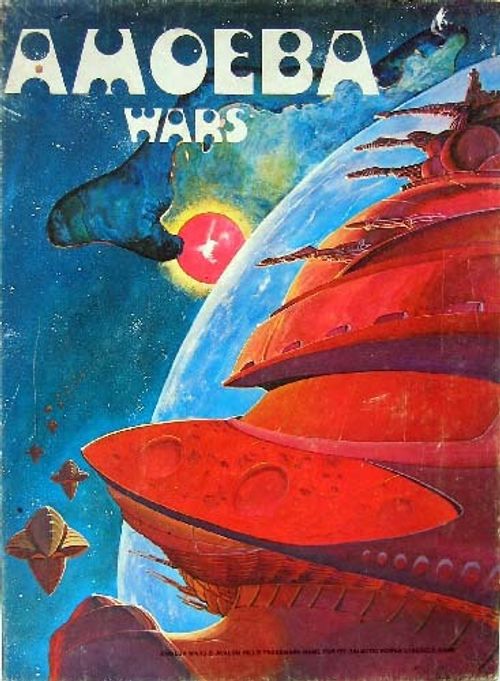
Amoeba Wars
Amoeba Wars Rulebook
Table of Contents
Table of Contents
- II. Equipment
- III. Object of Play
- IV. Set-Up
- V. Amoeba Attack Campaign
- VI. Summary of Play
- VII. Power Play
- VIII. Production of New Spaceships
- IX. Placement of New Spaceships
- X. Attack Campaigns
- XI. Free Move
- XII. Monitors
- XIII. Doomsday Machines
- XIV. Limited Resources
- XV. Home Solar Systems
- XVI. New Deal
- XVII. Going for the Win
- XVIII. Special Rules for Two Player Games
- XIX. Special Rules for Three Player Games
- XX. Special Rules for Four Player Games
- XXI. Special Rules for Five and Six Player Games
- XXII. Optional Player Powers
- Power Card Reference
- #0 Use Only Own Cards
- #1 Use Only Own Cards
- #2 Use Only Own Cards
- #3, #4, #5 Acquire 2 Dreadnoughts
- #6, #7, #8 Acquire 2 Cruisers
- #9, #10, #11, #12 Acquire 1 Dreadnought
- #13, #14, #15, #16, #17 Acquire 1 Cruiser
- #18 Hyperjump 4 Points, #19 Hyperjump 5 Points, #20 Hyperjump 6 Points, #21 Hyperjump 7 Points
- #22, #23, #24, #25 Nova Beam Attack!
- #26, #27 Zap an Amoeba
- #28, #29, #30 Amoeba Ambush
II. Equipment
A. Inventory
- One playing board
- One deck of forty-five Power cards
- One deck of eight Special Power cards
- Forty-two Amoeba counters
- Two Doomsday Machine counters
- Nine Amoeba attack markers
- Six colored sets of sixty spaceships of the following classes: a. Fifteen Scouts b. Fifteen Cruisers c. Fifteen Dreadnoughts d. Nine Battlestars e. Six Monitors
- Six player aid cards
- Instruction folder
- Two dice (one colored, one white)
B. Playing Board
The playing board is a simplified representation of a map of the galaxy. The galaxy comprises forty-three Solar Systems, each shown in its own hexagonal space. All Solar Systems are color-coded for ease of identification. For example, Solar Systems which contain six planets are shown with yellow planets. The five-planet Solar Systems are shown with green planets, and so on. All heavenly bodies in a Solar System will be referred to as planets for ease of description, even though some of them look like suns or moons rather than planets. In the very center of the galaxy is the great one-planet Solar System, Saestor. This planet and the six Solar Systems surrounding it combine to form the seven Central Solar Systems of the Empire. The seven Central Solar Systems are set apart from the rest of the galaxy by an asteroid belt. At the edge of the galaxy are the six Home Solar Systems. These resemble large space stations and are the starting locations of the Space Lords (players). Every Home Solar System contains four planets.
Many of the Solar Systems also contain a number. These Solar Systems are special resource Systems and the numbers indicate the production value of that Solar System. Resource Systems aid in producing new spaceships.
C. Spaceships
Printed on each spaceship counter are two important pieces of information. The number in the upper right corner indicates the ship's value. All ships in the same class have the same value (i.e., all Scouts are worth 1, all Cruisers are worth 2, all Dreadnoughts are worth 3, etc.). A ship's value is used in producing new ships. The number of dots inside the ship illustration (from 0 to 4) represents the spaceship's fighting Strength in battles against enemy spaceships or the Doomsday Machine.
III. Object of Play
The first player to occupy Saestor wins the game. However, before a player can even attempt to occupy Saestor, he must also occupy a minimum number of the other six Central Solar Systems, depending upon the number of players.
A. Two or three players: at least five Central Solar Systems. B. Four players: at least four Central Solar Systems. C. Five or six players: at least three Central Solar Systems.
IV. Set-Up
A. Each player tosses one die. The player with high toss has first turn. Turns then pass to the left.
B. Starting with the first player, each player, in turn, selects a colored set of spaceship counters and an empty Home Solar System. Into his Home System, he places one Monitor, two Dreadnoughts, two Cruisers and two Scouts. Therefore, each player begins the game occupying one Home Solar System with seven spaceships.
C. One Doomsday Machine is placed in Saestor.
D. One Amoeba counter is placed in each of the seven Central Solar Systems. Then, four Amoeba Attack Campaigns are instituted and resolved. The procedure of the attack campaign is explained in the next section. This determines the Amoeba positions at the start of play.
E. The first player shuffles the Power deck and deals three cards, facedown, one at a time, to each player. The game is ready to begin.
NOTE: The Special Power deck is set aside for now. It should not be used until players have played the game a few times. Its use is explained in XXII. Optional Player Powers.
V. Amoeba Attack Campaign
Amoebas are an alien species (at least for this galaxy) of giant one-celled animals. One suddenly appeared in Saestor and has generated into all the Central Solar Systems. Amoebas have an amazing ability to multiply and can quickly spread throughout the galaxy without warning. The Amoebas are triggered in four attack campaigns during the set-up of play. They can also be triggered to attack during the course of play as a result of the Power cards.
A single Amoeba attack campaign is executed in two stages.
The first stage determines which Amoebas will attack in the campaign. The second stage determines the results of the attacks. In the first stage, the player tosses one die and searches for every Amoeba-occupied Solar System with the same number of planets. In each of these Solar Systems he places one Amoeba attack marker. (These markers should be selected randomly with no attention paid to their numbers.) These Amoebas will make attacks.
In the second stage, the attacks of the marked Amoebas will be resolved. The Amoeba with the highest marker attacks first, then the Amoeba with the next-highest marker will attack next, and so on, until all designated Amoebas have attacked. In its attack, a Space Amoeba attacks every Solar System adjacent to the one it is in.
Remember that the attack of one Amoeba may result in the capture of several adjacent Solar Systems by Amoebas.
Note, too, that when a Space Amoeba captures a Solar System, the Amoeba counter never moves in, but a new one is always added to the board into the newly captured Solar System. If, in the first stage of an attack campaign, there are no Amoeba occupied Solar Systems corresponding to the die toss, no Amoebas attack.
VI. Summary of Play
At the start of the first turn, the first player selects one of the Power cards dealt to him and places it face-up in front of him. The player to his immediate left then selects one of his power cards and places it face-up in front of him. This play is continued to the left until each player has placed a card face-up in front of him.
The forty-five Power cards in the deck are numbered from the lowest to highest, 0 to 44. The player who played the highest card resolves his Power Play and attack campaign first. He wins the use of his own card and all other cards in play. The player follows the directions of each card, using the highest first, then the next highest, and so on, down to the lowest card played. After using the cards, the player discards only his own card. This constitutes his Power Play.
The player next builds new ships within his production capacity and places these on the board. He then may attack Solar Systems adjacent to those his ships occupy. If successful, he moves ships into captured Solar Systems.
The player may continue his attacks until he is unable or unwilling to continue. This constitutes his attack campaign and completes his turn. When the high card player has finished his turn, the second highest card player makes his Power Play and attack campaign. He wins the use of his own card and all cards in play with a lower rank than his. The player uses the cards in order from highest to lowest, discards his card, produces new spaceships, and makes his attack campaign.
This procedure is followed until all players have taken their turn. Upon completion of the low card player's turn, each player is dealt another card from the deck to restore his hand to three cards. If the player occupies one or more of the central Solar Systems, he receives an additional fourth card. The player who had played the highest card becomes the first player and leads a card from his hand to start the next turn.
Sequence of Play (Player Aid)
- In clockwise order, each player selects a Power card from his hand and places it in the Power Plays window, face up. Player with highest-numbered card goes first for the turn.
- Power Play: Player who played the highest-numbered card can use his own card and all other cards in play. Follow directions on each card, highest first, then next highest, and so on. After use, player discards his own Power card.
- Build: Player builds and places new ships based on production capacity.
- Attack Campaign: Player can attack adjacent solar systems until unwilling or unable to continue.
- Free Move: Player can make a free move from one system to an adjacent one.
- When high card player completes his turn, second-highest card player makes his Power Play, Build and Attack Campaign. Repeat for all players.
- All players draw a Power card to bring their total back to 3. (Players who occupy a central Solar System get an additional 4th card.)
- New turn begins. Player who played highest-numbered card last turn plays first card on the new turn, continuing clockwise.
VII. Power Play
During his Power Play, a player is eligible to use his own and all lower-valued power cards played that turn. These cards must be used in the exact order from highest to lowest. A description of each card and its use is presented on the Player Aid Card. For most cards, a player is not required to follow its directions but may skip to the next lower card in value if he so wishes. The seven highest cards, numbers 38 through 44, cannot be ignored and must be used when encountered in each Power Play. A player cannot combine two or more cards together. The directions of the card being used must be completed before the next highest card can be used. For example, if the hyperjump cards, numbered 21 and 20, have been played, a player must complete the 21 hyperjump before he can begin the 20 hyperjump. He cannot combine the two together into one super hyperjump.
VIII. Production of New Spaceships
After his Power Play, but before he begins his attack campaign, a player may produce new spaceships to add to his forces on the board. He must first determine his production capacity for the turn. He locates all friendly resource Solar Systems and totals their production points. (A Solar System is friendly if it's occupied by at least one of the player's spaceships. At the start of the game, only his own Home System is friendly.) The player can then purchase any combination of spaceships whose total value does not exceed his production capacity. For example, a player controls three Solar Systems all of which are resource Systems, his Home System worth two production points, one central Solar System worth two production points, and one Solar System next to the Central Solar System worth one production point. This gives him a total production capacity of five for this turn. With this, he can produce five Scouts, or two Cruisers and a Scout, or a Battlestar and a Scout, or a Cruiser and a Dreadnought, or a Monitor, or any other combination of spaceships whose total value does not exceed five.
IX. Placement of New Spaceships
Each time a player receives new spaceships, either during his Power Play or by production, he must immediately place them on the board before he can proceed with his turn. New spaceships can only be placed in Solar Systems that comply with the following two conditions:
A. The Solar Systems must be friendly.
B. The Solar Systems either must be Home Solar Systems or connected to any friendly Home Solar System by an unbroken chain of other friendly Solar Systems. The friendly Home Solar System does not have to be the one selected at the start of play but can be one captured by the player during the game.
New spaceships may be placed all in one friendly Solar System or be divided among two or more friendly Solar Systems, as the player wishes. If a player no longer has any friendly Home Solar Systems, he will be unable to receive any new ships until he reoccupies a Home Solar System. To continue the previous example, the player has decided to produce five Scouts this turn. He has only three Solar Systems that he controls on the board: his Home Solar System, the Central Solar System and the one-point production System adjacent to the Central System. He can place the Scouts only in his Home Solar System. The new ships cannot be placed in his other two Solar Systems because they are not connected to his Home Solar System.
X. Attack Campaigns
The object of an attack campaign is to capture adjacent Solar Systems. A player is never forced to begin an attack campaign, and after producing and placing any new ships, he may end his turn. If he chooses to make an attack, the player must choose from which friendly Solar System he is launching his attack (the attacking Solar System) and against which adjacent Solar System he is directing his attack (the defending Solar System). An attack can be permitted only if there is at least one spaceship in the attacking Solar System able to move in and occupy the defending Solar System. Since a player may never voluntarily leave a friendly Solar System unoccupied, attacks can only be launched from Solar Systems containing at least two spaceships.
There are two different methods of resolving attacks depending upon the type of force in the defending Solar System.
A. Attacks Against Amoeba-Occupied or Empty Solar Systems
In attacks against Amoebas or empty Solar Systems the number of spaceships, not their class, is the important consideration for victory. The player counts the total number of spaceships of all classes (except Monitors) in the attacking Solar System. Any total greater than five must be reduced to five as this is the maximum number of ships that can attack at any one time. The player adds a die toss to the number of attacking ships (up to five) to determine his attack strength. The defense strength is determined by adding the number of planets in the defending Solar System to a die toss. The attack strength is compared to the defense strength, and the higher total wins. In this and all other kinds of attacks in which the defender is not another player, the player to the attacker's left should make all the defender's die tosses.
If the attacker wins, he must capture the defending Solar System by moving in at least one of the attacking spaceships. Any Amoeba in the Solar System is removed. Amoebas can never occupy the same Solar Systems as spaceships. The player may move any number of additional spaceships (except Monitors) from the attacking Solar System into the captured Solar System provided he leaves at least one spaceship behind.
If the attacker loses, there are two possible results. He removes one attacking ship of his choice, if the defending Solar System is empty; but removes two attacking ships of his choice if the defending Solar System contains a Space Amoeba. Note that Amoebas do not influence the defense strength. The possible loss of a second spaceship is the only difference between attacking a Space Amoeba and an unoccupied Solar System. In the case of a tie, the attacker still loses the appropriate number of ships but also captures the defending Solar System, provided he still has at least one ship to move in and at least one ship to leave behind. Any Amoeba in the defending Solar System is removed whether the attacker can move in or not.
B. Attacks Against Solar Systems Containing Enemy Space Ships or the Doomsday Machine
In attacks against enemy spaceships or the Doomsday Machine, the class of spaceships, not their numbers, is the important consideration for victory. The player selects one ship in the attacking Solar System and places it in the adjacent Solar System under attack. The defender selects one spaceship or the Doomsday Machine in the same Solar System to defend against the attacking ship. Each player then tosses one die and adds the amount of his toss to the number of dots in his ship. The player with the lower total removes his spaceship from the board. In case of a tie, both ships are removed. Note that Scout ships have no dots and thus add nothing to the die toss. Whether the attacker wins or loses in the attack, he is free to attack again and again if he wishes. However, if the attacker has only one spaceship remaining in the attacking Solar System, he can no longer attack from that Solar System, although he may continue the attack from another adjacent friendly Solar System. If the attacker successfully removes all spaceships or Doomsday Machines from the defending Solar System, the attacking ship must remain in the newly captured Solar System. The player may move any number of additional spaceships (except Monitors) from the attacking Solar System into the captured Solar System provided he leaves at least one ship behind. A player who at any time finds that he has only one spaceship in each of his Solar Systems and cannot place any new ships because he no longer occupies a Home Solar System is out of the game. His spaceships remain on the board until removed because of other attacks.
C. Continuing the Attacks
During a player's attack campaign, he may attack one or more times from one Solar System, shift his attack to another Solar System and still return to attack from the original Solar System, if he wishes. He may use ships from the same Solar System to attack different Solar Systems. He may attack, capture a Solar System and then launch an attack from the newly captured Solar System. The player may make as many attacks as he wishes during his attack campaign and is free to stop at any time. An attack can be launched from only one Solar System at a time. Spaceships from different Solar Systems cannot combine in the same attack.
XI. Free Move
After his attack campaign, a player can make one free move. On this move, he may, if he wishes, move one or more of his spaceships except Monitors from just one Solar System to any one adjacent Solar System which his ships occupy. The free move must be from one System to one adjacent System. The player cannot split his move into two or more Solar Systems, nor can the move jump over Solar Systems. Remember, too, the player must leave at least one spaceship behind. No Solar System can ever be voluntarily left unoccupied.
XII. Monitors
Monitors are spaceships with special features. Monitors cannot move. Once placed in a Solar System, a Monitor must remain there. Hence, the Monitor received at the start of play can never leave the Home Solar System. Since Monitors cannot move, they cannot participate in any kinds of attacks; they can only defend. Two or more Monitors cannot occupy the same Solar System. Only one Monitor can be in a Solar System at any one time. Monitors are vulnerable to all types of attacks except those made by Amoebas. Monitors cannot be destroyed by Amoebas, although all other types of spaceships in the same Solar System can be destroyed by the Amoebas. Since Monitors cannot be destroyed by Amoebas, the Solar Systems they occupy can never be captured by the Amoebas.
XIII. Doomsday Machines
Doomsday Machines move only by the instruction of the Power cards. Doomsday Machines cannot coexist with spaceships and, if moved into the same Solar System, will fight to the death. Doomsday Machines can coexist with each other and Amoebas. If a player wishes to capture a Solar System containing both Doomsday Machines or a Doomsday Machine and a Space Amoeba during his attack campaign, he must defeat both occupants. The player can choose which to attack first.
XIV. Limited Resources
A player cannot acquire or purchase a spaceship of a given class if all ships of that class are already on the board. Every player is limited to the number of ships of his color provided in the game. As a result, a player may not get all the ships he would normally be entitled to during his Power Play if his supply is low, or depleted.
XV. Home Solar Systems
Although a player can capture and utilize other Home Solar Systems for production and ship placement, he still should remember the location of his own Home Solar System which he selected at the start of play. Any time he has been driven out of his own Home System, he may re-enter or hyperjump into it, if empty, without attack. If it is occupied, he must still eliminate the occupants to reenter.
XVI. New Deal
At the end of a turn, after all players have made their Power Play and attack campaign, each player must fill his hand back to three Power cards. Any players who occupy one or more Central Solar Systems have an added advantage. They can increase their hand to four Power cards. If, in a subsequent deal, a player no longer occupies a Central Solar System, he must return his hand back to three cards and, therefore, receives no Power cards that deal. If he can regain at least one Central Solar System at a later time, he can again increase his hand to four Power cards.
XVII. Going for the Win
During a player's attack campaign, if his spaceships occupy the required number of Central Solar Systems, he may attack Saestor for the win. If he can capture and occupy Saestor, he wins immediately and the game is over. Although Saestor is a single-planet Solar System, it is so powerful that its defending strength is six plus a die toss.
XVIII. Special Rules for Two Player Games
- The first player places one Monitor, one Dreadnought, one Cruiser and one Scout in a Home Solar System. He then places the same number and types of ships in the Home Solar System on the opposite side of the board so that he starts the game with two Home Solar Systems with four ships each at opposite ends of the galaxy. Likewise, the second player selects and fills with the same number and type of ships two Home Solar Systems at opposite ends of the galaxy.
- The hands are increased from three to six cards. The first player leads a card, then the other player plays a card. But now the first player plays an additional card and so does the other player so that there are four cards in play. Then the high card player wins the use of all four cards and has first turn. Then the other player takes his turn with only his high card and the two cards ranking below it.
- Discard the '0' Power card. It will not be used in the game.
- The number of friendly Central Solar Systems needed to attack Saestor is at least five.
XIX. Special Rules for Three Player Games
- Discard the '0' Power card. It will not be used in the game.
- The number of friendly Central Solar Systems needed to attack Saestor is at least five.
XX. Special Rules for Four Player Games
- Discard the '0' Power card.
- The number of friendly Central Solar Systems needed to attack Saestor is at least four.
XXI. Special Rules for Five and Six Player Games
- The '0' Power card is included in the game.
- The number of friendly Central Solar Systems needed to attack Saestor is at least three.
XXII. Optional Player Powers
This rule should be used only if all players agree upon it. During the setup of play immediately after all Home Solar Systems have been selected, each player draws one Special Power card face-down from the Special Power deck and places it face-up beside him. This card provides him with a special Power that he can use throughout the game.
HYPERJUMP THREE SPACESHIPS EACH TURN: You may move any three of your spaceships on the board to any Solar Systems using the procedure explained in Hyperjump on the Player Aid card. You may choose to hyperjump any classes of ships except Monitors. This hyperjump can be combined with any hyperjump card in your Power Play. If you wish to make a special hyperjump and are unable or unwilling to combine it with a hyperjump card, you must use it as the first play of your Power Play before using any Power card.
AMOEBAS EAT ONLY ONE OF YOUR SHIPS IN BATTLE: Any time you are to lose spaceships in a battle against a Space Amoeba, whether as attacker or defender, you lose only one ship rather than the normal two.
SEND SHIPS LOST IN BATTLE TO TIME WARP: All enemy spaceships that are removed from the board either during your Power Play or in combat against your spaceships are not returned to the players but are put into the Time Warp instead. It will cost a player the ship's value plus an additional production point to return that ship from the Time Warp to the board. For example, to return a Scout from the Time Warp to the board costs two production points. A player can return his spaceships from the Time Warp to the board only as part of his ship production. A ship cannot be produced until all of the same class have been removed from the Time Warp. For example, if a player has four production points available and wishes to produce Scouts, he normally could place four new Scouts in friendly Solar Systems. If he has three of his Scouts in the Time Warp, though, he must return all three to the board before he can produce any new Scouts. His four production points permit only two Scouts to be placed on the board this turn. Next turn, if he loses no additional Scouts to the Time Warp, the player can remove the last Scout at a cost of two production points, leaving him with two points left to produce two Scouts or a Cruiser. Spaceships in the Time Warp don't restrict the acquisition and placement of ships from Power cards.
NEW SHIPS MAY BE PLACED IN ANY FRIENDLY SOLAR SYSTEM: You may place the spaceships you acquire in your Power Play and production phase in any of your friendly Solar Systems. They do not have to connect to a friendly Home Solar System. Since you will always be able to place new ships whether you control a Home Solar System or not, you can only be removed from the game if all of your spaceships are eliminated from the board.
YOU MAY USE UP TO SIX SPACESHIPS TO ATTACK SPACE AMOEBAS AND EMPTY SOLAR SYSTEMS: Normally five spaceships are the maximum which can attack Amoebas and empty Solar Systems. You can increase yours to six.
YOU MAY PLACE YOUR POWER CARD DOWN AT ANY TIME: You may choose to skip your turn to play a Power card. Instead you may reveal your Power card at any time that you wish--in most cases, after all other cards have been revealed. If, as a result of the '44' Power card, all players are required to reveal their cards at the same time, you must do so also. This is the only situation in which this special Power can be canceled.
YOU HAVE SPECIAL MONITORS: Your Monitors can move and attack just like the other classes of spaceships. Any number of your Monitors may occupy the same Solar System.
Power Card Reference
Card texts as reproduced in the VASSAL module's card images (the printed Player Aid card was not available).
Cards numbered 38 through 44 are marked "MUST BE USED WHEN ENCOUNTERED IN A POWER PLAY."
#0 Use Only Own Cards
During this power play, each player may use only the power card he played. Players cannot use any of the lower valued cards they normally would be able to use. In addition, you acquire 1 Monitor, which may be placed in any friendly solar system, even if you already have a Monitor in that solar system.
#1 Use Only Own Cards
During this power play, each player may use only the power card he played. Players cannot use any of the lower valued cards they normally would be able to use. In addition, you acquire 2 new Battlestars. Place them in one or more of your Solar Systems.
#2 Use Only Own Cards
During this power play, each player may use only the power card he played. Players cannot use any of the lower valued cards they normally would be able to use. In addition, you acquire 1 new Battlestar and 1 new Dreadnought. Place them in one or more of your solar systems.
#3, #4, #5 Acquire 2 Dreadnoughts
Receive 2 new Dreadnoughts and place them in one or more of your Solar Systems.
#6, #7, #8 Acquire 2 Cruisers
Receive 2 new Cruisers and place them in 1 or more of your Solar Systems.
#9, #10, #11, #12 Acquire 1 Dreadnought
Receive 1 new Dreadnought and place it in one of your Solar Systems.
#13, #14, #15, #16, #17 Acquire 1 Cruiser
Receive 1 new Cruiser and place it in one of your Solar Systems.
#18 Hyperjump 4 Points, #19 Hyperjump 5 Points, #20 Hyperjump 6 Points, #21 Hyperjump 7 Points
Select the stated number of points worth of spaceships (except monitors). You may move them into one or more Solar Systems of your choice (except Saestor) anywhere in the galaxy. Each spaceship must be moved 1 at a time and no solar system may be left unoccupied.
Once all hyperjump movement is completed, spaceships which have hyperjumped into non-friendly solar systems must immediately attack there. They must continue to attack until they capture the solar system or are wiped out in the attempt. These attacks must be completed before the next card may be used.
#22, #23, #24, #25 Nova Beam Attack!
Select any one enemy spaceship or Doomsday Machine on the board as the target. The attack strength is a die roll plus 2. The opponent defends at the target ship strength plus a die roll. Remove the target if the Nova Beam attack roll is equal to or higher than the defense roll. Otherwise, the ship remains in play.
#26, #27 Zap an Amoeba
Select 1 Space Amoeba not in a central solar system and remove it from the board.
#28, #29, #30 Amoeba Ambush
Select an empty solar system or one occupied by Doomsday Machines or 1 space ship. Place a Space Amoeba there. If a spaceship was in the solar system, remove it from the board.
#31, #32, #33, #34 Activate Doomsday Machine!
Select a Doomsday Machine to activate. (If the machine is not on the board, place it in Saestor. There can be a maximum of 2 Machines on the board at once.) Activate it by moving it into any adjacent solar system of your choice. If the solar system is not occupied by spaceships, the Machine ends its turn there. If the solar system contains 1 or more ships, the Doomsday Machine will attack them one at a time, with its strength of 4, until either all ships are removed or until the Machine is destroyed. The controlling player decides which of his ships will defend for each attack. When the Doomsday Machine removes the last spaceship, it ends its turn in the captured solar system.
#35, #36, #37 Provoke an Amoeba
Select a Space Amoeba on the board. You provoke it to attack adjacent solar systems. Resolve the attack with a die roll in the same manner as the second stage of an Amoeba attack campaign.
#38, #39, #40, #41 Amoeba Attack!
MUST BE USED WHEN ENCOUNTERED IN A POWER PLAY. You initiate an Amoeba attack campaign, as described in the rules.
#42 Berserk Doomsday Machine
MUST BE USED WHEN ENCOUNTERED IN A POWER PLAY. Select a Doomsday Machine to go berserk. (If the machine is not on the board, place it in Saestor. There can be a maximum of 2 Machines on the board at once.) Place one of the first six amoeba attack markers in each adjacent solar system. The Doomsday Machine attacks the solar system with the corresponding marker. If the solar system contains 1 or more ships, the Doomsday Machine will attack them one at a time, with its strength of 4, until either all ships are removed or until the Machine is destroyed. The controlling player decides which of his ships will defend for each attack. If the Machine survives the first move, it will move into a second solar system and attack any ships there.
#43 Amoeba Attack!
MUST BE USED WHEN ENCOUNTERED IN A POWER PLAY. You initiate two Amoeba attack campaigns, as described in the rules.
#44 On Strike
MUST BE USED WHEN ENCOUNTERED IN A POWER PLAY. You cannot produce any new ships this turn, although you can still acquire ships from Power cards. In addition, the next time Power cards are played, all players must reveal them simultaneously. In this way, no player is aware of what the others will play until all power cards are revealed at the same time.