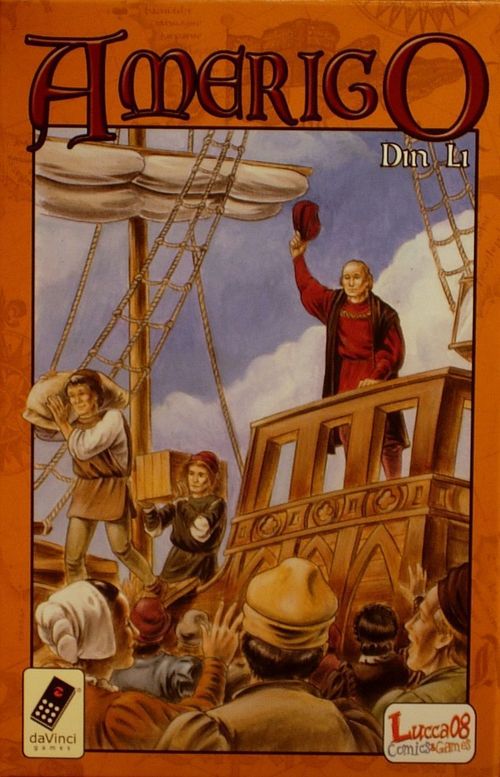
Amerigo (2008)
Amerigo (2008) Rulebook
Table of Contents
Table of Contents
Contents
The game contains:
- 108 ships carrying goods: 15 gems, 18 cloth, 21 antiques, 24 spices, 30 coffee;
- These rules.
Card diagram (rules page 1) labels: good; summary icons; rudders (1-3); doubloon (1); rudders (3).
Aim of the Game and Preparation
In Amerigo, you are a brave navigator who sails distant seas looking for precious goods. You will sell these goods in your home country to earn doubloons and recognition from the King and the Merchant Companies. The goal of the game is to collect the most doubloons.
The owner of the game chooses a starting player, or just choose at random.
Shuffle all the cards and deal out:
- 4 each to the first and second player;
- 5 each to the other players.
Keep your cards hidden in your hand so the other players cannot see them.
Place the draw deck in the middle; leave room for a discard pile.
If you do not have any cards with 3 rudders in your starting hand, you can show your cards to the other players, and turn one of these cards (your choice) into a doubloon: turn it over and add it to your treasure pile.
The maximum number of cards you can have in your hand is 12. If at any time during play you are supposed to draw cards exceeding this limit, stop drawing when your hand has 12 cards. Any excess cards are lost.
The Game
The game is played in turns, with play passing to the left.
During your turn, depending on the actions you choose to perform, you can either be at home or sailing. Whether you are at home or sailing determines which actions you may take. At the start of the game you are at home.
During your turn, you must choose and perform one of the following actions:
- Sail (at home or sailing)
- Explore (sailing)
- Exhibit (at home)
- Sell (at home)
Your Turn in Detail
1. Sail
You can choose to sail whether you are at home or sailing.
The outward journey - sailing away!
If you are at home and choose to sail, you start your outward journey. Play one card from your hand face up in front of you and turn it 90 degrees clockwise (i.e. with the bow pointing to your right). Your journey to rich unexplored lands has begun!
Once you start your outward journey you are no longer at home, you are now sailing.
During later turns, you can continue sailing outward, adding more cards (one each turn) to the cards you already played. Overlap the cards slightly so that the total number of rudders can easily be seen. The total number of rudders in your outward journey is your "travel distance."
Note: while sailing, the goods shown on your cards have no effect; you only count the rudders.
Example: During your first turn, you choose to sail, and play a card with 2 rudders to start your outward journey. During your second turn, you keep sailing and play another card with 3 rudders, and on your third turn, you play one more card with 2. At the end of your third turn, your travel distance is 2+3+2=7.
The return journey - sailing home!
When you decide to return home (usually after a turn of exploration, see 2. Explore), you sail on your return journey. During the return journey you play one card per turn as before, but this time turn them 90 degrees counter clockwise (i.e. with the bow pointing left). Your return journey requires at least the same number of rudders as your outward journey. However, since you are now familiar with the route, each rudder on the return journey counts double.
Note: if you play more rudders than required to get home, any extra rudders are simply ignored.
Once you set sail on your return journey, it must be completed; you can't choose any other actions to perform. Once you play the last card of your return journey you are again at home.
Example: At the end of your third turn, you have sailed a travel distance of 7 away from home. On your fourth turn, you choose to explore (this action is not shown; see below). On your fifth turn you must head home and begin your return journey by playing a card with 3 rudders. On your sixth turn you play a card with 1 rudder. Since each rudder counts double during the return journey, you have sailed a total distance of (3+1) x 2 = 8, which is greater than 7 and enough to bring you home!
Once you return home, you could receive an award from the King! If your travel distance is:
- 6 rudders or less, you do not receive any award;
- 7 rudders, you receive one doubloon;
- 8 rudders, you receive two doubloons;
- 9 rudders or more, you receive three doubloons.
Also, as soon as you return home, check if the travel distance of your journey is the longest on the table. If it is, the Merchant Companies award you one doubloon. (The maximum award you can earn is 4 doubloons: 3 for a journey of nine rudders or more, and 1 for having the longest journey).
To add these doubloons to your treasure pile, choose an equal number of cards used for the journey and turn them over into your treasure pile. Afterwards, discard any other cards used for your journey.
Example: Your journey was 7 rudders long, so you receive one doubloon from the King. When you returned home, Daniel also had a journey of 7 rudders in front of him, so your journey is not currently the longest on the table, and the Merchant Companies do not award you any doubloons.
Note: If you choose to sail, you may spend one doubloon from your treasure pile instead of playing a card from your hand. If you do, play the doubloon face down: it is worth 3 rudders (6 if returning home).
2. Explore
You can choose to explore only if you are sailing on your outward journey.
When you choose to explore, your outward journey ends. Show this by turning the last card played on your outward journey so that the bow of the ship points towards you. Then, draw a number of cards from the deck equal to twice your travel distance. (Remember: your hand size limit is 12!)
After a turn of exploration, you must start your return journey on your next turn.
Note: you are not required to explore before returning home. However, this action is usually recommended, because you can draw many cards by performing it.
Example: After your 7-rudder outward journey, you are left with one card in your hand. You choose to Explore, and are entitled to draw up to 7 × 2 = 14 cards. However, since the hand limit is 12, you only draw 11 cards.
3. Exhibit
You can choose to exhibit only if you are at home.
This action allows you to exhibit goods you have collected to the market. Play any number of cards from your hand face up in front of you (so that the bow of the ships point away from you); you can never have more than 12 cards in your exhibition.
Cards in your exhibition do not count against your hand limit.
When you exhibit cards to the market, only the type of good is important (gems, cloth, antiques, spices, or coffee). Each card is worth one good of that type; the number of rudders has no importance.
4. Sell
You can choose to sell only while you are at home.
You can only sell if all five types of goods are exhibited in the market (check all goods exhibited by all players). If all five goods are not in the market, you cannot choose to sell.
When you choose to sell, all other players who are at home (i.e., not sailing) must choose whether they also want to sell or not (even though it is not their turn). All players who choose to sell must sell all of their goods in the market.
Exception to this rule: you are not forced to sell goods that are not worth any doubloons.
How much are your goods worth?
During the game, the value of goods may vary, and must be calculated during each selling phase.
Count all goods in the market, including goods of any players who didn't choose to sell:
- the type of good with the lowest quantity is rare: each card with this good is worth one doubloon (as usual, turn the card face down and add it to your treasure pile);
- the type of good with the highest quantity is popular: two cards with this good are worth one doubloon (in this case, discard one card and add the other one to your treasure pile);
- all other goods are common: three cards are worth one doubloon (add one to your treasure pile, discard the other two). Unlike rare and popular goods, the type of common goods has no importance: you can (and must) combine different common goods to sell them.
If there is a tie when determining rare or popular goods, there will be no rare or popular goods for that selling phase.
Example: You, Bea, and Daniel are at home; Carla is sailing.
All five different types of goods are in the market (3 gems, 6 coffee, 5 cloth, 5 antiques, and 3 spices), so you can choose the sell action. Coffee is the popular good and can be sold 2 to 1. There is no rare good (3 gems and 3 spices tie for the lowest amount): so gems, cloth, antiques, and spices are all common (sold 3 to 1).
Bea chooses to participate in the sale. Carla is sailing and can't choose to. Daniel chooses not to sell, saving his goods for later. You and Bea are the only players selling in this phase.
You sell 4 coffee and gain 2 doubloons; you are left with 1 coffee, 1 gem, and 1 cloth.
Bea sells 5 antiques and 1 cloth and gains 2 doubloons; she is left with 1 coffee.
A Special Situation
In the rare event that you can't choose any of the four possible actions, draw one card from the deck and your turn is over.
This may happen, for instance, if you exhibited all of your cards, it is not possible to sell them, and you have no cards in hand nor doubloons left to start a new journey.
End of the Game
When the deck runs out the first time, shuffle the discard pile to form a new draw deck.
Once you begin play with the reshuffled deck, the game can end if:
- the deck runs out for the second time; or
- all players are at home at the same time.
When the game ends, calculate the value of all goods in the market (as if a sell action were taken). However, if all five types of good are not present in the market, all goods are considered to be common (1 doubloon every 3 cards). All players must now sell all their goods. Once this final sale is over, any cards left in your hand or in your exhibition are sold for 1 doubloon every 4 cards, in any combination.
The player with the most doubloons is the winner!
In case of a tie, the tied player who has the most cards left in hand and in the exhibition after the final sale is the winner.
Variant for 5 to 8 Players
You can play Amerigo with 5 to 8 players by combining two copies of the game. The rules are the same as the normal game with the following changes:
- at the start of the game, shuffle both decks together;
- as a starting hand, deal 4 cards to the first and second player; 5 to the third and fourth; 6 to the fifth and sixth, and 7 to the seventh and eighth;
- when playing through the reshuffled deck, the game also ends if there is only one player sailing.