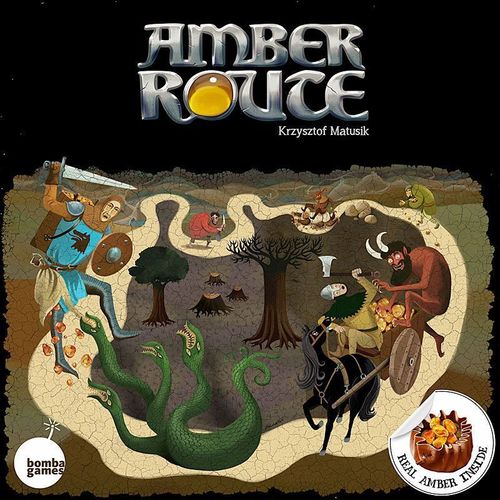
Amber Route
Amber Route Rulebook
Table of Contents
Table of Contents
Contents of the Box
- 5 D6 dice
- 4 player tokens
- 42 light cards
- 60 darkness cards
- 4 reference cards
- 4 player cards
- 40 amber
- 1 bag
- 30 guard markers
- 1 rulebook
- 26 game board puzzles
Game Objective
The aim of the players is to deliver the biggest number of amber from the Baltic Sea to the castle located inland. The journey is very dangerous. There are many threats from common robbers through fiends and demons to the wrath of the ancient Slavic gods. The player who delivers the biggest number of amber wins the game.
Game Preparation
Each player gets a player card and a matching player token. Then players also receive 3 guard markers and 1 amber. The game board needs to be assembled from the game board puzzles from the box. For your first game we suggest setting it up this way:
Advanced version: After assembling the game board, prepare the rest of the game elements. Take all the divine grace cards (see below) from the darkness cards deck and give each of the players one grace card. Put the rest of divine grace cards into the box. Shuffle the rest of the darkness cards deck and put it beside the board face down. Shuffle the light cards deck and put it beside the board face down. All players draw 3 light cards and keep them hidden in their hands. They will use these cards during the game. Put the other elements: guard markers, ambers and dice somewhere convenient for all the players to reach. All the players put their player tokens on the first game board puzzle (sea shore). Then they choose the first player at random (eg. by rolling a die).
Family version: After assembling the game board, prepare the rest of the game elements. Shuffle the darkness cards deck and the light cards deck, and then put both decks beside the board face down. All players draw 5 light cards and keep them hidden in their hands. They will use these cards during the game. Put the other elements: guard markers, ambers and dice somewhere convenient for all the players to reach. All the players put their player tokens on the first game board puzzle (sea shore). Then they choose the first player at random (eg. by rolling a die).
Setup diagrams show the advanced game for two players (3 light cards per player, a divine grace card each, and the darkness and light decks beside the board) and the family game for two players (5 light cards per player).
Game Flow
The game is divided into turns. During each turn players perform one of the actions available to them. The game runs clockwise. The player who is currently performing his action is called the active player.
Amber
During the game players will gain and lose amber. When a player gains an amber he takes it from the common pool beside the board and places it next to his player card. When a player has 3 amber, he puts one of these amber on his player card and the others to the common pool beside the board. Amber on the player card are secured: they cannot be lost as a result of a lost fight with a monster or another player, or while escaping a ghost. Amber lying next to the player card may be used during the game (eg. to buy cards or an extra die).
The Turn
Advanced version: A player may perform only ONE of the following actions during his turn:
a) recruit guards, b) draw light cards, c) move forward and face challenges, d) play a divine grace card.
Family version: A player's turn has two phases: a draw phase and an action phase. Both these phases are obligatory, and their sequence cannot be changed: first you draw a card, and then you perform an action.
- Draw phase: The player decides whether to draw an extra light card or gain an extra guard marker. If he chose to draw a light card, he draws the top card from the light deck and puts it into his hand. If he chose an extra guard card, he takes a guard marker from the common pool and puts it with the guard markers he already possesses.
- Action phase: A player may perform only ONE of the following actions: a) recruit guards, b) draw light cards, c) move forward and face challenges.
Actions
a) Recruiting Guards
Guards are very important during the game. They help the player move forward and face the challenges. A player cannot have more than 6 guard markers at one time. To recruit guards, the player takes a guard marker from the common pool and puts it with the guard markers he already possesses. If he is recruiting guards in a village, he gains 2 guard markers.
b) Drawing Light Cards
Good and friendly creatures inhabiting Amber Route are represented by light cards. They help the players during their dangerous journey. To draw a light card the player needs to pay one unsecured amber. After putting the amber back to the common pool, the player takes two light cards from the light cards deck. No player can have more than 7 light cards at one time. If, as a result of some action, the player gains light cards in excess of 7, he decides which light cards to discard.
Each light card contains two pieces of information: the value of the card (from 1 to 3) and the type of terrain where it can be used (mountains, forest, swamp, or wasteland). But some light cards are not limited to specific types of terrain and can be used on any field on the board.
c) Moving Forward and Facing Challenges
During the game players travel through the dangerous lands of Amber Route. They can only move in the direction marked by the arrow on the starting game board puzzle. During this action each player can move by 1 or 2 fields. Moving 1 field forward is free, moving 2 fields forward costs one guard marker (it needs to be put back to the common pool).
After performing the movement and paying the extra cost (if that is the case) the player needs to follow the instructions of the field he stops on. If he stops in the forest, the swamp, the mountains or the wasteland, he draws a darkness card and follows its instructions. If he manages to overcome the challenge, he may attack the player who stopped on the same field. If a player enters a village he gets an additional guard marker. If he enters a city, he receives 1 amber.
Field symbols: Draw 1 darkness card; Gain 1 guard marker; Gain 1 amber.
d) Playing a Divine Grace Card (Advanced Version Only)
A player may play a divine grace card during his turn. After playing and resolving the card he puts it back into the box. It will not be used in this game again. Every player may perform this action only ONCE during the whole game.
To resolve a divine grace card the active player rolls as many dice as there are players in the game. He then chooses one of these dice and gains a gift printed next to that die roll result (see below). The other players choose from among the rest of the dice clockwise and also receive the gifts.
Divine grace card gifts: Gain 1 light card; Gain 2 light cards; Gain 2 guard markers; Gain 1 guard marker; Move 2 fields forward; Gain 1 amber.
Darkness Cards
During the game players will reveal darkness cards and fight the encountered monsters, escape ghosts or avoid traps. Each darkness card informs about: the terrain it is related to (forest, swamp, mountains or wasteland) and the type of challenge (monster, ghost, or trap).
Rewards from the card may be used in two ways depending on the symbol in the bottom right corner. The symbol of lightning means that the reward must be used immediately, and the symbol of an hourglass means that the player can keep the card and use it anytime later in the game. Resolved darkness cards, after the reward has been used, are placed face up next to the darkness cards deck. If during the game the darkness cards deck runs out of cards, the resolved cards need to be shuffled and placed face down as the new darkness cards deck.
Resolving Darkness Cards
After drawing a darkness card the player needs to check how many symbols on the card match the symbols on the field he is actually on. If none of the symbols match, then the player faces an easy challenge (level I). If one symbol is the same, the challenge is difficult (level II), and if both symbols are the same, the challenge is legendary (level III).
What is more, in the family version, there are divine grace cards in the darkness cards deck. If a player draws a divine grace card he needs to resolve it immediately. To do it, he needs to roll a number of dice equal to the number of players. He then chooses one of these dice and gains a gift printed next to that die roll result (the gifts are listed on the card). The other players choose from among the rest of the dice clockwise and also receive the gifts.
General Rules for All Challenges
Whenever a player needs to face a challenge, he may play any number of light cards matching the terrain he is on, to increase his chances.
The player may also use his guard markers to modify results of his dice rolls – by putting a guard marker back into the common pool, the player may modify the result on one die by 1 up or down, but he cannot modify the result of a die roll of 6 this way.
What is more, during a challenge, after the dice roll the player may pay one amber to modify the die roll result to any result he chooses.
Darkness card layout: a random darkness card shows a terrain symbol (type of challenge) and a reward. The reward is used immediately or kept for later depending on the symbol. The challenge is easy with no matching symbols, difficult with 1 matching symbol, or legendary with 2 matching symbols.
Depending on the type of challenge the player faces (monster, ghost or trap), he needs to take appropriate steps.
Fighting Monsters
Each monster has its hit points, strength, damage and reward. Values of each of these statistics depend on the type of challenge.
Advanced version:
| Type of challenge | Monster hit points | Monster strength (number of dice) | Die roll results which deal damage | Reward |
|---|---|---|---|---|
| I. Easy | 3 | 2 | 5–6 | 1 amber |
| II. Difficult | 4 | 3 | 4–6 | 1 amber, plus 1 guard marker or 1 light card |
| III. Legendary | 5 | 4 | 3–6 | 2 amber, plus 1 guard marker or 1 light card |
Family version:
| Type of challenge | Monster hit points | Monster strength (number of dice) | Die roll results which deal damage | Reward |
|---|---|---|---|---|
| I. Easy | 2 | 1 | 5–6 | 1 amber |
| II. Difficult | 3 | 2 | 4–6 | 1 amber, plus 1 guard marker or 1 light card |
| III. Legendary | 4 | 3 | 3–6 | 2 amber, plus 1 guard marker or 1 light card |
Before the fight the player may choose to discard light cards to receive extra support during this fight. The discarded card needs to match the terrain where the fight will take place. The player receives support equal to the number on the card. Then the player takes the number of dice equal to the value of his support plus 1. All the dice he has are used during the whole fight regardless of the number of rounds.
Each round of fight has 4 steps:
- Player attack;
- Counting monster damage. The player may deal damage to the monster by rolling 4-6 on his die;
- Monster attack. The player on the active player's left-hand side rolls the dice;
- Counting player damage. The monster deals damage to the player depending on the type of challenge: easy on a roll of 5-6, difficult 4-6, and legendary 3-6. The player loses one guard marker for each die with which the monster deals damage to him.
The fight continues until one side wins. If during the fight the monster's hit points are reduced to zero, the player wins and the fight finishes. If during the fight the number of the player's guards is reduced to zero, the player loses and he needs to give one unsecured amber to the monster. If the player wins, he receives the reward according to the type of fight. If the player does not have unsecured amber, he has to give two light cards instead.
Example (from the rulebook): A difficult challenge (level II), because the card and the terrain have a matching terrain symbol. The player on the left rolls 2 dice for the monster, since the monster's strength is 2. The player attacks with 3 dice (1+2 from the cards he played), dealing damage only when he rolls 4-6. The player deals 2 damage on the first round and the monster is left with one hit point. The monster deals 1 damage to the player, so the player loses one guard marker. The player attacks again with 3 dice (1+2 from the cards he played) and deals one damage to the monster and kills it. The player wins the fight and receives a reward: 1 amber, 1 guard marker or 1 light card, and the reward from the card: two guard markers.
Escaping Ghosts
Depending on the type of challenge with the ghost (easy, difficult, legendary) the player needs to roll a specific value on the dice. If he wants to increase his chances, he may discard light cards and gain extra dice. The player can modify the result of the roll by using guard markers: one marker for one pip on the die.
Advanced version:
| Type of challenge | Minimum result on the dice | Punishment for losing | Reward |
|---|---|---|---|
| I. Easy | 7 | you lose 2 cards | 1 amber |
| II. Difficult | 11 | you lose 3 cards | 1 amber, plus 1 guard marker or 1 light card |
| III. Legendary | 15 | you lose 4 cards | 2 amber, plus 1 guard marker or 1 light card |
Family version:
| Type of challenge | Minimum result on the dice | Punishment for losing | Reward |
|---|---|---|---|
| I. Easy | 5 | you lose 2 cards | 1 amber |
| II. Difficult | 9 | you lose 3 cards | 1 amber, plus 1 guard marker or 1 light card |
| III. Legendary | 12 | you lose 4 cards | 2 amber, plus 1 guard marker or 1 light card |
When a player escapes a ghost, he receives a specific reward. If he fails, he needs to be punished and discard a specific number of light cards. A player who does not have enough cards needs to discard all the cards that he has, and additionally he loses 1 unsecured amber.
Example (from the rulebook): Drawing a random darkness card, the player plays a light card and rolls 2 dice (1+1 from the cards he played). The challenge is difficult (level II), because the card and the terrain share the terrain symbol. The sum of the roll results on the dice is 8, which is too little to escape the ghost (9 is needed). The player modifies the roll result on one die to 5 by using his guard markers; after modification the value is 9. The player escapes the ghost and receives his reward: 1 amber, 1 guard marker or one light card, and the reward from the card: two light cards.
Avoiding Traps
Depending on the type of trap the player receives a specific number of dice (easy trap – 2 dice, difficult – 3 dice, legendary – 4 dice), and needs to roll the same values on these dice. Once again, he may choose to increase his chances by discarding light cards (this way he will roll more dice). For each die which does not match the values he needs to roll, he misses a turn. If the player manages to avoid the trap, he receives a reward depending on the difficulty of the challenge. The player may modify the result of his die roll by using guard markers: one guard marker for one pip on the die.
| Type of challenge | Number of dice with the same values | Reward |
|---|---|---|
| I. Easy | 2 | 1 amber |
| II. Difficult | 3 | 1 amber, plus 1 guard marker or 1 light card |
| III. Legendary | 4 | 2 amber, plus 1 guard marker or 1 light card |
Example (from the rulebook): The player receives 4 dice and needs to roll them so that all 4 dice have the same result. The player plays a light card, which gives him 1 die, and uses the reward he got before to reroll 2 dice. The results of the roll are 1, 1, 3, 6, 4, so only two dice match. The player rerolls dice with values 4 and 6. The player modifies the result on die 2 by one by discarding one guard marker to get the value 1. The player uses one amber to modify the result of one die roll to any value; in this case he modifies 5 to 1. The player escapes the trap and receives the reward: 2 amber, 1 guard marker or 1 light card, and he keeps the card (with the defeated monster) with its reward.
Rewards for Facing Challenges
If a player overcomes a challenge, he receives a reward. The reward depends on the difficulty of the challenge. There is also an extra reward on the card with the challenge. If there is a symbol of lightning next to the reward, the player must use the reward immediately. If there is a symbol of an hourglass, the player keeps the card, places it face up on the table in front of him, and may use it later during the game.
Reward symbols on darkness cards: Gain 1 light card; Gain 2 light cards; Look at 2 top light cards and take 1 of them; Reroll 1 die; Reroll 2 dice; Gain 1 guard marker; Gain 2 guard markers; Move 2 fields forward; Get 1 extra die in the wastelands; Get 1 extra die in the forest; Get 1 extra die in the mountains; Get 1 extra die in the swamp; Damage dealt to the monster 3-6; Gain 1 amber.
Fighting Another Player
Advanced version:
If a player overcomes a challenge, he may attack another player who is on the same field. During the fight both players receive one die which stands for one hit point. The attacking player and the defending player may discard up to 2 light cards (regardless of the terrain and value) to gain extra dice – extra hit points (one card = one die). The attacking player discards his cards first. After choosing and discarding the cards the player cannot discard any more cards. The number of dice determines how much damage needs to be dealt to win the fight.
After determining how many dice each player will roll, the fight begins. The attacking and the defending player roll all dice (maximum 3 dice for each player). The players put their dice in order from the highest to the lowest value and compare the values. Each time the die has a greater value it deals one damage to the player with the die with the lower value. In the case of draw the defending player's die is counted as a die with a higher value. If one of the players rolls more dice (eg. the attacking player rolls 2 dice and the defending player rolls 3 dice) then the die which has no pair deals damage on the result of 4-6. For example, after the roll the attacker has two dice with values 6 and 5, and the defender has three dice with values 5, 4, and 4. In this case the attacker deals 2 damage and the defender deals 1 damage.
Both players begin another round of fight (if it is necessary) with the number of dice lowered by the damage the players received. In this example both players roll one die each. The fight continues until one of the players loses all his dice (hit points).
The fight finishes automatically and the winner takes 1 unsecured amber, or 2 light cards, or 2 guard markers from the defeated player. Rewards do not combine eg. the winner cannot choose to take 1 light card and 1 guard marker from the defeated player.
During a fight between players guard markers cannot be used to modify die roll results.
Example (from the rulebook): The attacking player discards one light card and rolls 2 dice, dealing two damage. The defending player discards two light cards and rolls 3 dice, dealing one damage in each of the following two rounds. The attacked player defended himself and takes 1 unsecured amber, or 2 light cards, or 2 guard markers from the attacking player.
Family version:
If a player overcomes a challenge, he may attack another player who is on the same field. The attacking player has to play a card with a terrain symbol matching the field where the fight will take place. This card is placed face up in front of the attacking player. Then both players draw a card from the light cards deck and add it to the cards in their hands.
The defending player may choose any number of light cards with the matching terrain symbol and put them in front of him. The attacking player may add more cards to the card lying in front of him, as long as they match the terrain symbol. From this moment the players cannot add any other cards till the end of the fight.
Then the attacking player receives as many dice as the number of light cards he used plus one more die (but he cannot have more than 5 dice). He rolls them and the result he gets is the strength of his attack. The defending player counts his strength of defense the same way. If the strength of the attack is higher than the strength of defense, the attacking player wins and takes one amber from the defending player. If the strength of defense is higher or equal to the strength of the attack, the defending player wins.
Watch out! During the fight the players may use their guard markers to modify the results of their rolls just as in the case of challenges.
Example (from the rulebook): The attacking and defending player draw 1 light card each. The defending player plays his cards. The attacking player adds a card. The attacking player rolls 3 dice for a total of 9; the defending player rolls 4 dice for a total of 11. The defending player wins.
The Ending of the Game
The game ends when one of the players reaches the last field of the game board (the castle). When it happens all other players may take one more turn and then all points are counted.
- first in the castle: +3 points
- each secured amber: +6 points
- each unused reward from the card: +1 point
- each unsecured amber: +1 point