Ambagibus
Ambagibus Rulebook
Table of Contents
Table of Contents
The basics
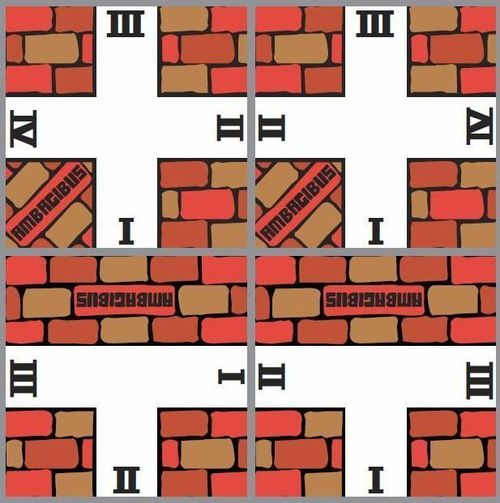
This is a print-and-play game, which means you have to assemble your own copy of the deck. It's on the last two pages of this file. Although the cards have red bricks on them, the colour doesn't actually have any game effect — the game is the same if you decide to print in a black and white. You can print the cards to cardstock, print on paper and paste onto cardstock, or just play with a paper deck.
The deck consists of 36 tunnel cards, 2 Bombs, and 2 Cave-ins. For your first few games, you might want to leave out the Bombs and Cave-ins.
Game play
To begin, take the top card from the deck. If it is a Bomb or Cave-in, put it at the bottom of the deck and draw again. Otherwise, place the card face up in the middle of the table.
An 'open passage' is a tunnel opening at the edge of a card which does not lead directly into an opening on an adjacent card. Each open passage has a priority: I, II, III, or IV. The object of the game is to close all of the open passages.
Draw the top card from your deck and play it so that it connects to one of the open passages, subject to two restrictions:
[ #1 ] You cannot play so as to block an open passage. That is, you cannot make a dead end by failing to connect to an open passage. If there are no possible plays with the card you have drawn, put the card at the bottom of your deck and draw another.
[ #2 ] You must play onto the lowest numbered open passage. For instance, you cannot play onto a IV if there is a I, II, or III open. If there are multiple open passages with the same lowest number, you may decide which to connect to.
Rule #1 takes priority over the Rule #2. For example: You may play next to a II if there is no way to play the card you drew onto any of the open I's.
Bombs and Cave-ins have their own special rules; see below.
Victory and scoring
The basic game: The game ends either when there are no open passages or when you have played all the cards. If you play all the cards without closing maze, total the priorities of the open passages. This is your score. Low scores are better than high scores; a closed maze means victory and has a score of zero.
The advanced game: After the maze closes, set the cards in the maze aside rather than returning them to the deck and reshuffling. Begin a new maze with the remainder of the deck. Continue in this way until you have used all the cards.
The objective is to complete the greatest number of mazes before the deck is exhausted.
Use score on the final maze to break any ties. For example, a game in which you complete 2 mazes and have a score of 6 on the final, unfinished maze is better than a game in which you complete 2 mazes but have a score of 15 on the final maze.
Special cards
The usual rules for placement do not apply to Bombs and Cave-ins. Instead, you play them on top of tunnel cards that you have already played.
The Bomb: You can play the Bomb on any card in the maze, regardless of priority. That space is then reopened. Passages that connected to the Bombed tunnel become open passages, and on subsequent turns you may play tunnel cards onto that space as if no tunnel had ever been there. You may play the Bomb in such a way as to cut the maze into two or more sections, if you desire.
If you have no cards on the table, put the Bomb at the bottom of your deck. But you must play the Bomb if you can, even if doing so will disturb your carefully laid plans.
The Cave-in: You can play the Cave-in only on a card that have one or more open passages. After the Cave-in, all the tunnels leading in the caved-in area are considered closed. On future turns, however, you may not play cards that would direct tunnels into the Cave-in.
If you have no cards on the table, put the Cave-in at the bottom of the deck.
Note that it is possible to Bomb a caved-in area, but it is not possible to Cave-in a Bombed area.
The table edge
Sometimes tunnels will move off towards the edges of the table. There are two ways to treat the table edge. Although either makes for a fun game, you should decide before playing which you will use.
The infinite table: The table edge is no different than any other space. If you place a tunnel card off the edge of the table, accommodate it either by shifting over all of the cards or by playing the new tunnel somewhere else and keeping in mind the connection. This option means that the table edge has no tactical significance in the game, but it can be inconvenient.
The hard edge: Any space which would overlap the table edge is considered closed. Thus, you may not play a tunnel card so that it points off the edge of the table.