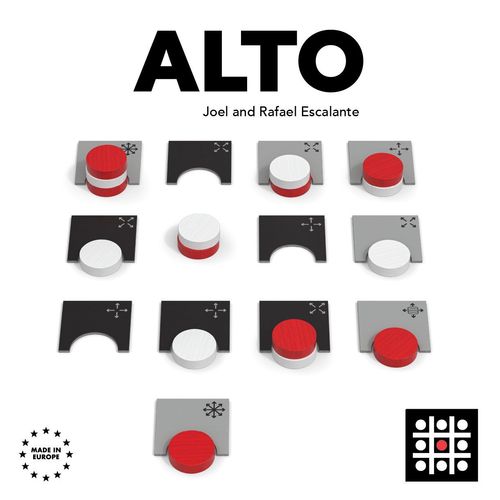
Alto
Alto Rulebook
Table of Contents
Table of Contents
Components
- 18 wooden discs (9x red, 9x white)
- 16 tiles (double-sided)
Goal of the Game
Level up your discs for more points! The tiles guide your path but beware: they gradually disappear.
Setup
- Each player chooses a color for their discs.
- Shuffle the tiles, place them randomly in a 4x4 grid with the bright side facing up, and align all movement symbols to the same corner.
- Players take turns alternately placing their discs into the cutouts of the tiles on the grid. Keep the remaining disc in front of you as a reminder of your color.
Note: Not sure how to place the discs? Check the setup in the picture.
How to Play
The youngest player starts, then players take turns alternately. On your turn, you can move any disc, either your own or your opponent's. However, you must follow the movement symbol shown on the tile beneath the disc:
- Symbol (4x on the tiles): Move the top disc to any adjacent space, either at right angles or diagonally.
- Symbol (12x on the tiles): Move the top disc to an adjacent space above, below, to the left or to the right.
- Symbol (12x on the tiles): Move the top disc to an adjacent diagonal space.
- Symbol (4x on the tiles): Move the complete stack of discs to an adjacent space at a right angle. If there is only one disc, then move that one.
If there is already a disc or stack on the tile you moved to, place the new disc or stack on top.
You cannot move any discs outside the grid. However, you can move them to any empty space within the grid, including spaces where a tile has been removed.
After moving a disc, you must do the following:
- If the tile you moved from was on its bright side, flip it to the black side. All discs on the tile stay in place.
- If the tile you moved from was on its black side, put it back in the box. All discs on the tile remain in the now empty space.
Example: Move a disc and flip a tile
Tim moves a white disc from a tile with the diagonal-move symbol (A) and places it on top of the red disc in a diagonal direction (B). Then, he flips the tile he used for the move to its black side (C).
Example: Move and remove
Tim moves a white disc from a black tile (A) and places it on top of the white stack on the left (B). Then, he removes the black tile he just used for his move (C).
Example: Move to an empty space
Tim moves his white stack from a tile with the stack-move symbol (A) and places it in the empty space on the right (B). Then, he flips the tile he used for the move to its black side (C).
End of the Game
The game ends when no valid moves remain. At that point, some tiles will be empty, and the discs are piled in stacks of varying sizes on those empty spaces.
Scoring
Score the discs of your color depending on the level of each disc. For level 1 (bottom), you score 1 point; for level 2, you score 2 points, and so on.
The player with the most victory points wins.
In case of a tie, the player with the most discs at the highest level wins. If there is still a tie then the winner is the player with the most discs at the second highest level and so on.
Example
Tim scores a total of 17 points for his white discs:
- 3 points for his 3 discs at level 1 (bottom)
- 6 points for his 3 discs at level 2
- 3 points for his disc at level 3
- 5 points for his disc at level 5
Anna scores a total of 20 points for her red discs:
- 3 points for her 3 discs at level 1
- 4 points for her 2 discs at level 2
- 3 points for her disc at level 3
- 4 points for her disc at level 4
- 6 points for her disc at level 6