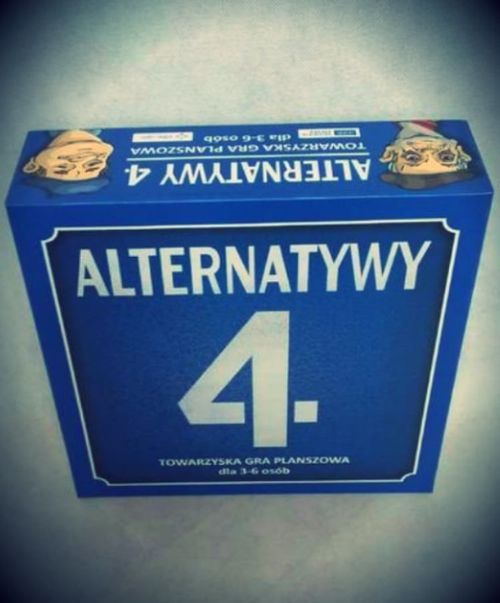
Alternatywy 4
Alternatywy 4 Rulebook
Table of Contents
Table of Contents
Components
- Character cards and cardboard figures (6 cards and 6 cardboard figures). The five Tenant Characters are Zygmunt Kotek (crane operator), Józef Balcerek (pigeon breeder), Elżbieta Kolińska (singer), Zenobiusz Furman (docent) and Ryszard Dąb-Rozwadowski (professor). The Landlord Character is Stanisław Anioł (building landlord).
- Set of Tenant Trait cards (6 cards for each Tenant).
- Set of Landlord Trait cards (5 cards, for the Landlord only).
- Social Work cards.
- Tenant cards and Landlord cards.
- Board.
- Player aid sheets: one for the Landlord and one for the Tenants.
- Victory Point (VP) tokens (one for each player).
- Social Work tokens (one for each Tenant player).
- Location tokens (6 sets of 5 tokens, one set for each player). The five Locations are Tenants' Flats, Staircase, At the Landlord's, Tenants' Club and Courtyard.
- Denunciation tokens (3 tokens for each Tenant, with values 1 to 6).
- Priority token, Time token and Breakdown tokens.
- Shop Goods tokens (front and back).
- Trash tokens and the Littering marker.
Setup
a) Preparing the Board
- Place the Time token on the first space of the Elapsing Time Track. This is where the passage of Rounds is marked with the Time token.
- Place the stack of Tenant cards on the Tenants' Flats space.
- Place the stack of Social Work cards on the Staircase space. Immediately reveal the top card.
- Place the stack of Landlord cards on the At the Landlord's space.
- Place the Shop Goods tokens on the Courtyard space. From them take as many Shop Goods tokens as there are players taking part in the game, and arrange them on the door of the Courtyard Location. Only these goods will be available in the coming Stage.
- Place the Trash token on the Courtyard space, in the special place marked with the "trash bin" symbol. A trash bin is found only in three Locations, which are the places where Tenants will be able to litter during the game.
b) Preparing the Players
- At the start of the game each player chooses one of the available Characters to play. The order in which Characters are chosen is decided by the players. One of the players must choose the Character of the Building Landlord.
Preparing a Tenant player
- The Tenant player takes: a) one cardboard figure and the Character card assigned to it; b) a Trait of the Character, chosen from the set of 6 Tenant Trait cards. The Tenant must remember that each Trait card can be used only once per game; c) 5 Location tokens; d) 1 VP token; e) 1 Social Work token; f) two cards from the stack of Tenant cards; g) the aid sheet, on the side showing the picture of the Character (Zygmunt Kotek in the printed example).
Preparing the Landlord player
- The Landlord player takes: a) one cardboard figure and the Character card assigned to it; b) a Trait, chosen from the Landlord's set of 5 Trait cards. The Landlord must remember that each Trait card can be used only once per game; c) 5 Location tokens; d) 1 VP token; e) the Landlord draws from the stack of Landlord cards as many cards as there are Tenants taking part in the game; f) the aid sheet, on the side showing the picture of the Landlord Character.
c) General preparation
- The players choose the first player at random.
- On the Victory Points Track each player places their VP token on the space with the value 9 (first variant of the game; see the variants at the end of the rulebook).
- The remaining tokens: Trash, Denunciations and Breakdowns, are placed near the Board so that they are freely accessible.
Description of Game Elements
Action
An Action is a player's activity consisting of using one of the possibilities assigned to the Locations on the Board (see the player aid sheet), or using a Tenant card or Landlord card of the type Additional Action. This activity may be taken only during the player's own Round.
Note: Tenant players use only the Actions listed on the aid sheet with the picture of Zygmunt Kotek. The Landlord player uses only the Actions listed on the aid sheet with the picture of Stanisław Anioł.
Example: the Actions available to Tenants and to the Landlord in the Tenants' Flats Location. (The actions highlighted in blue on the aid sheet are not Actions, but additional actions which become available to players after they have taken an Action.)
Tenants' Flats, Tenant side: 1. If you have fewer VP than other players and do not meet another player, you immediately receive 1 VP. 2. Draw 2 Tenant cards. 3. Repair a Breakdown.
Tenants' Flats, Landlord side: 1. Take one Denunciation on a chosen Tenant. 2. Repair a Breakdown. Additional: each Tenant you meet must discard 1 Tenant card.
Actions from the Board
An Action from the Board is a player's activity consisting of using one of the possibilities assigned to the Locations (described on the player aid sheet). A player who finds themselves in a given Location may use one of the Actions assigned to it; then they may perform:
- the Additional Action from a card;
- additional actions.
Note: When a Location contains 3 Trash points, it becomes partly unavailable to the Landlord. The Landlord may not carry out any Actions on its ground.
Cards
1) Tenant cards
The Tenant card deck is placed on the board in the Tenants' Flats Location, face down so that players cannot see what they hide. During the game Tenants will often use Tenant cards. Each Tenant starts the game with 2 Tenant cards.
Tenant cards are a tool for Tenants to:
- obtain additional VP,
- hinder the other Tenants,
- hinder the Landlord.
Note: The Landlord cannot obtain Tenant cards, and Tenants cannot obtain Landlord cards.
Tenant cards may be played only at strictly defined moments, depending on the card type:
- ADDITIONAL ACTION: this card may be played only during the player's own Round. It may be played even if the player has passed or cannot perform the Action assigned to the given Location.
- REACTION: this card may be played at the moment the conditions described on the card are met, or whenever playing the card may produce any effect in the game (it does not have to take place during the Round of the player playing the card).
Example of a Tenant card, "NIC Z TEGO" ("Nothing Came of It"): "Cancel the effect of playing a Tenant card or a Landlord card." The card's printed flavour text reads that the doctor really cannot do anything.
2) Landlord cards
The Landlord card deck is placed on the board in the At the Landlord's Location, face down so that players cannot see what they hide. The Landlord starts the game with one Landlord card for each Tenant taking part in the game (if 4 Tenants take part, the Landlord starts with 4 Landlord cards). During the game the Landlord may draw new Landlord cards by performing the Action available in the At the Landlord's Location or in the Tenants' Club.
Landlord cards are a tool for the Landlord to:
- obtain additional VP,
- hinder the Tenants.
The Landlord may play Landlord cards only at strictly defined moments, depending on the card type:
- ADDITIONAL ACTION: this card may be played only during the player's own Round. It may be played even if the player has passed or cannot perform the Action assigned to the given Location.
- REACTION: this card may be played at the moment the conditions described on the card are met, or whenever playing the card may produce any effect in the game (it does not have to take place during the Round of the Landlord).
Example of a Landlord card, "ABRAHAM POSPRZĄTA" ("Abraham Cleans Up"): "Remove up to 3 Trash points from a Location of your choice." The card's flavour text reads: "Here is the bucket, here is the brush and here is the cloth. No, no, no, no. For others I have a much less responsible job. I trust you."
Note: No player may hold more than 4 cards in hand. When this happens (for example after drawing cards from a Location on the Board, or at the start of a Stage), the player must discard the surplus cards without applying their effects. The 4-card hand limit applies to the Landlord also in a six-player game.
3) Trait cards
Tenants and the Landlord have Trait cards (Tenants have 6 Trait cards, the Landlord has 5). At the start of each Stage every player (Tenants and Landlord) must choose, in secret from the others, one Trait card which they will use throughout the coming Stage. A Trait is revealed only when the situation described on it arises, i.e. a chance to gain VP or to use the extra benefit assigned to the Trait card. From that moment the player's Trait card is public.
Note: Beginner players may use, in the first Stage of the game, the Trait of the Character shown on their Character card.
When choosing a Trait card, players should remember that they may choose any card, but each of them may be used during the game only once.
All Trait cards contain the following information:
A) The name of the Trait.
B) An extra benefit assigned to the Trait card. This is usually an additional action which allows the Character to perform an activity against the general rules of the game. Example: Asocial Unit (Jednostka Aspołeczna): "You may litter during a meeting with other Tenants." Thanks to this option a player may (against the rule on littering) litter in a given Location even though other Tenants are present.
C) Ways of obtaining Victory Points (VP). There are two basic ways of obtaining VP. As soon as the situation listed on the Trait card occurs, both the Tenant and the Landlord must announce it and mark the gain or loss of VP on the Victory Points Track.
D) An additional way of obtaining VP at the end of the Stage. This is usually the possibility of receiving 1 VP at the end of the Stage if the situation described on the Trait card has occurred.
Detailed rule for the Trait Cwaniaczek (Hustler): If the Hustler meets several Tenants and each of them gains VP in a given Round, the Hustler receives only 1 VP, not 1 VP for each scoring Tenant.
The Trait cards are reproduced below in the order in which they appear in the printed set. Trait names are given where the printed name is legible; for the others the rule text is the only identification available in the scan.
Tenant Trait cards (6):
-
Cwaniaczek (Hustler):
- Once per Day, during your Round, you may change your choice of Location, but you do not play an Action then.
- 1 VP when: a Tenant you meet gains VP (even not in its own Round).
- 1 VP for: cleaning up 1 point of Trash during a meeting with the Landlord.
- 1 VP when: at the end of the Day you have more VP than each of the other Tenants.
-
Jednostka Aspołeczna (Asocial Unit):
- You may litter during a meeting with other Tenants.
- 1 VP for: littering during a meeting with another Tenant.
- 1 VP for: avoiding a Social Work, or taking it from the last place on the List.
- 1 VP when: at the end of the Day Trash is found in: the Courtyard, the Staircase and the Tenants' Club.
-
(name not legible in the scan):
- When you meet the Landlord you file two Denunciations, not one.
- 1 VP for: filing a Denunciation against a Tenant indicated by the Landlord.
- 1 VP for: meeting a Tenant who has already littered on that Day.
- 1 VP when: at the end of the Day the Landlord holds the fewest Denunciations against you among the other Tenants.
-
(name not legible in the scan):
- You may avoid a Social Work even though you are entered on the List of Social Work.
- 1 VP for: introduction of a Social Work by the Landlord.
Landlord Trait cards (5):
-
(name not legible in the scan):
- When you meet a Tenant, you may play your Round first.
- 1 VP for: each Tenant who avoids a Social Work.
- 1 VP for: meeting at least two Tenants.
- 1 VP when: at the end of the Day the Tenant with the most VP is entered on the List of Social Work.
-
Materialista (Materialist):
- You may hold one Shop Goods token.
- 1 VP when: you meet a Tenant, you take one of the Shop Goods tokens that Tenant holds, chosen at random (if you already hold one and take a second Shop Goods token, you keep the one of higher value).
- At the end of the Day you receive as many VP as the value of the Shop Goods token you hold.
-
(name not legible in the scan):
- You do not lose VP when a Tenant visits the Housing Co-operative Chairman.
- 1 VP for: meeting a Tenant with VP equal to or greater than yours.
- 1 VP for: meeting a Tenant with fewer VP than yours, and discarding all Denunciations held against that Tenant (minimum 2).
- 1 VP when: you have not introduced any Social Work into play by the end of the Day.
-
(name not legible in the scan):
- Social Work brings you an extra 1 VP (minimum 1).
- 1 VP for: no Trash on the Board.
- 1 VP for: cleaning up point(s) of Trash in the presence of a Tenant.
4) Social Work cards
The Social Work deck is placed on the board in the Staircase Location, face down so that players cannot see what they hide. At the start of each Stage the Landlord reveals the top card. The revealed Social Work may be introduced into play by the Landlord, in a Round in which the Landlord is present at the At the Landlord's Location and uses the additional action (see the Landlord aid sheet). The Tenants do not know the Round in which the Landlord will introduce the revealed Social Work. Sometimes the Landlord may not decide to use it at all. In that case at the end of that Stage the card is removed from the game, and at the start of the next Stage the next card is revealed. The decision not to introduce a Social Work belongs only to the Landlord. This does not apply to the following Social Work cards: WITAMY MIŁYCH GOŚCI (Welcome Guests), WSPANIAŁA INICJATYWA (Wonderful Initiative) and NAPISZMY DO PREZESA (Let's Write to the Chairman).
Note: Before a Social Work can be introduced into play, at least one Tenant must be entered on the List of Social Work. After a Social Work has been carried out by the Tenants taking part in it, all Social Work tokens are removed from the List.
Information on a Social Work card:
A) The name of the Social Work (PS).
B) The effect of introducing the Social Work for the Tenants. The effect is placed in the field with the Tenant's picture. It describes various consequences of the Social Work for the Tenants (usually only for the Tenants entered on the List of Social Work).
C) The effect of introducing the Social Work for the Landlord. The effect is placed in the field with the Landlord's picture. It describes the ways in which the Landlord obtains VP.
D) The place where the Social Work is carried out. This is shown by an abbreviation: (KL) Tenants' Club, (KS) Staircase, (P) Courtyard. After the Social Work is introduced, if at least one Tenant takes part in it, the Landlord immediately removes all Trash points from the Location indicated by the abbreviation. If a Social Work card has no place description, the Landlord removes no Trash point.
Note: The Landlord may introduce a Social Work only once per Stage. The exception to this rule is after playing the Landlord card WIDZĘ WAS JUTRO ("See You Tomorrow"). After playing it, the Landlord reveals a new Social Work card and may introduce it into play still in the same Stage (provided that the Landlord manages to enter Tenants on the List of Social Work).
Example of a Social Work card, "PANI NAM ZAGRA" ("The Lady Will Play For Us"): "Tenants entered on the List: 1. You lose 1 VP and 1 Round. The other Tenants lose 1 Round. KL: the Landlord gains 1 VP for each Tenant who littered on that Day, or who litters."
5) Shop Goods
Shop Goods tokens are placed on the Board in the Courtyard Location, on the shop area, face up so that players cannot see what they hide. Tenants may obtain them by visiting the Courtyard and choosing the appropriate Action. The Shop Goods obtained are gathered by the Tenants at their Character cards, without revealing them, so that they may take part in the auction at the end of the Stage. At the start of each Stage only a limited number of Shop Goods is available. On the shop doors on the Board place as many Shop Goods tokens as there are players taking part in the game. When the available Shop Goods tokens of a Stage run out, new goods may be obtained only in the next Stage.
The following groups of Shop Goods exist: Food (Żywność), Stimulants (Używki), Chemicals (Chemia), Household appliances (sprzęt AGD/RTV), and Remanent (stock-take).
The reverse of a Shop Goods token shows its illustration, its colour assignment to a group of Shop Goods and its point value. (Remanent is a token worth 0 points.) On the Character cards of individual Tenants the Premium Goods which they seek are listed. Each such good has a value 1 higher for them.
Example: Premium Goods from the Character card of Elżbieta Kolińska.
Note: The Landlord does not obtain Shop Goods, unless he chooses the Trait card Materialista and, during the game, manages to take a good from the Tenants.
6) Character cards
Both Tenants and the Landlord are Characters who take part in the game. Their cards contain the following information:
A) The name and surname of the Character together with the Character's occupation in the series.
B) The picture of the Character.
C) A quotation from the series.
D) The Character's Bonus, which has an effect on the game.
E) The Character's Trait. Beginner players, during the first Stage of the game, may choose the Trait card indicated on the Character card.
F) The Premium Shop Goods. During the auction, a Shop Goods token of the given type has a value 1 higher for that Character.
Example: Elżbieta Kolińska, singer. Bonus: "You start the game with an additional Tenant card. Whenever during the game you meet Tenants in the Tenants' Flats, each of them must immediately discard 1 Tenant card. You may keep the discarded cards, respecting the hand limit."
Stages and Rounds
The game consists of Stages, and each Stage consists of Rounds (one dial of the clock is one Round). A Round is divided into three Phases.
Phase I – Preparation
Step 1. Before a Round begins, all players (Tenants and Landlord) choose in secret one of the five Location tokens, each naming the place they wish to go to in the coming Round: Tenants' Flats, Staircase, At the Landlord's, Tenants' Club or Courtyard.
Step 2. Players simultaneously reveal their chosen tokens and place their Character figures in the chosen Location on the Board.
Step 3. If Tenant players have met the Landlord player in their chosen Location, they immediately file Denunciations.
Denunciations: Each time, after the Character figures have been placed on the Board, a Tenant who is in the same Location as the Landlord must file a Denunciation. The Tenant indicates another Tenant taking part in the game, and the Landlord takes a Denunciation token, or updates the number of Denunciations already held, by taking from the pool the token showing the picture of that Tenant. If the Landlord meets several Tenants at the same moment, they file their Denunciations in the order set by the Landlord.
Note: The Landlord may use the Denunciations held when performing the appropriate Actions while in the At the Landlord's Location.
Phase II – Actions
The Action Phase is begun by the player holding the Priority token.
Step 1. The player may perform one Action assigned to the given Location.
Step 2. If the player holds a suitable card (a Tenant card or Landlord card), they may additionally play an Additional Action card.
Step 3. Tenant players may (but need not) leave or clean up one point of Trash in chosen places on the Board, regardless of the Actions they have performed. The Landlord may (but need not) clean up one point of Trash. Trash may be left and cleaned up only in the place where the Character controlled by the player is currently located, and only in Locations with the trash bin symbol (Courtyard, Staircase, Tenants' Club).
Littering is an additional action of Tenants which aims to hinder the Landlord's game, and it is also one of the ways of obtaining VP. A Tenant who is alone in the Staircase, the Tenants' Club or the Courtyard may leave 1 point of Trash (marked by the corresponding token). The Tenant then places a Littering marker at their Character card, to show that they littered in this Stage. Cleaning up (1 point) may take place in the presence of other Tenants.
Some Trait cards reward littering (Asocial Unit), while others (Modest Citizen, Chairman of the Block Committee and Hustler) give VP for cleaning up in specific situations.
Note: In a Location where there are 3 points of Trash, the Landlord may not use any Action assigned to that Location. First the Landlord must clean up the Trash. The Landlord may, at the cost of losing the possibility of performing the Action in the Location where they are, clean up 2 points of Trash.
Note: Cleaning up Trash, like littering, is an additional action which does not require the use of an Action.
Step 4. The Round of the player holding the Priority token ends. After it, in clockwise order, the other players perform their Rounds. When all players taking part in the game have finished their Rounds, the Time token is moved one space to the right on the Elapsing Time Track, each figure is removed from the Board, and the Priority token passes to the player on the right. If this is not the last Round of the Stage, Phase I and Phase II are performed again.
Phase III – End of the Stage
When the fifth Round is finished for all players, the Stage ends, and the following end-of-Stage steps are performed:
a) Auction of Shop Goods. At the end of the Stage, during the last action, each Tenant who holds at least one Shop Goods token may announce that they wish to take part in an Auction. The other Tenants may then join the competition or pass.
If more than one Tenant takes part in the Auction, each of them secretly chooses the Shop Goods they want to auction. Then all players simultaneously reveal their tokens. The one who obtains the greatest total point value of Shop Goods (remembering Premium Goods) gains 1 VP. In case of a tie, the Landlord gains 1 VP. At the end of the Auction all auctioned Shop Goods are removed from the game.
If only one Tenant announces an interest in the Auction, that Tenant must discard at least one Shop Goods token held (this may even be a Remanent) and receive 1 VP in exchange.
b) Adding Victory Points resulting from performing the additional tasks of the Trait card. Players add the VP resulting from the additional tasks of their Trait cards (the entries D described under Trait cards above).
c) Choosing a new Trait card (Landlord and Tenants). Every player chooses a new Trait card for the next Stage.
d) Moving the Round marker to the first space of the Elapsing Time Track.
Variants and Victory
Whichever of the variants below is chosen, the winner of Alternatywy 4 is the player (Tenant or Landlord) who, under the specified conditions and within the time of the game, achieves the most Victory Points.
A. Standard variant
- Duration: 3 Stages.
- Starting VP: all players begin with 9 VP.
- Choosing this variant ensures that the whole game is played smoothly (about 90 minutes). No player will manage to use all of their Trait cards, so their choice is especially important.
- Suggestion: in a game with two Tenants, it is recommended not to choose Professor Dąb-Rozwadowski, because the bonus of this Character makes the game considerably harder for the other players.
B. Longer game variant
- Duration: 4 or 5 Stages.
- Starting VP: 6 VP or 3 VP (as printed: "6 PZ lub 3 PZ"; the rulebook does not say which to choose here).
- Choosing this variant means a longer game (about 120–150 minutes). It gives players full opportunity to use their Trait cards.
C. Sudden-end variant (tournament)
- Duration: not fixed.
- Starting VP: the players agree on a starting VP level together (for example 13 or 18 VP).
- The first player who reaches 30 VP immediately wins the game.
Player Aid Sheets
The two printed aid sheets list what each side may do in the game. Tenant players use the Tenant sheet only and the Landlord player uses the Landlord sheet only. Items printed in blue on the sheets are additional actions, which become available after an Action has been performed.
Tenant aid sheet (Arkusz Podpowiedzi dla Lokatorów)
At the start of the Stage a) Draw 2 Tenant cards. b) Choose a Trait card for the whole Stage (5 Rounds).
Order of actions in the Round
- Choose a Location token and reveal it simultaneously with the other players.
- Place your Character on the chosen space on the Board.
- After meeting the Landlord, file a Denunciation.
Playing the Round 4. Perform an Action: using an ACTION-type card, or a Board action. 5. Now you may play an ACTION ADDITIONAL-type card. 6. You may litter in Locations with the trash bin symbol. 7. End the Round.
End of the Stage 8. After the Round (18.00–21.00) the Stage ends. 9. If you have a Shop Goods token, you may take part in the Auction. 10. Check whether you receive the bonus 1 VP. 11. Remove your Character from the Board.
Tenants' Flats (Mieszkania Lokatorów)
- If you have fewer VP than the other players and you do not meet another player, you immediately receive 1 VP.
- Draw 2 Tenant cards.
- Repair a Breakdown.
Staircase (Klatka Schodowa)
- If you do not meet another Tenant, choose one of the options:
- enter any Tenant on the List;
- change the order on the List.
- You and all Tenants you meet lose a Round. Then discard the current Social Work card and replace it with a new one from the Social Work deck.
- If you meet the Landlord, you receive 1 VP if:
- you enter yourself on the List, or
- you are already entered and you move yourself 1 place up the List.
At the Landlord's (U Gospodarza)
- You file a Denunciation (whether you meet the Landlord or not) against another Tenant. If this is the 7th Denunciation against that Tenant, you receive 1 VP.
- You file a Denunciation (whether you meet the Landlord or not) against another Tenant. If this is the 5th or 6th Denunciation, the Landlord must discard the Denunciations held and subtract 1 VP from that Tenant.
- If you meet the Landlord, he must discard 1 Landlord card, and you draw 1 Tenant card.
Additional: You may report a Breakdown of another Tenant (no later than 15:00).
Tenants' Club (Klub Lokatorski)
- The first Tenant who, in the whole Stage, visits the Club and at the same time does not meet another player, immediately receives 1 VP.
- The Landlord must discard the 2 Denunciations held against you. Then you yourself file 2 Denunciations against another Tenant.
Additional: You may avoid a Social Work even though you are entered on the List, except for the Social Works carried out in the Tenants' Club.
Courtyard (Podwórko)
- Acquire 1 Shop Goods token.
- Visit the Chairman of the Housing Co-operative (Wizyta u Prezesa Spółdzielni). If there is Trash in the Courtyard, the Staircase and the Tenants' Club, the Landlord loses 1 VP and you receive 1 VP.
Landlord aid sheet (Arkusz Podpowiedzi dla Gospodarza)
At the start of the Stage a) Draw 2 Landlord cards. b) After the Tenants have performed their start-of-Stage actions a) and b), reveal a Social Work card. c) Choose a Trait card for the whole Stage (5 Rounds). d) Replenish the pool of Shop Goods tokens.
Order of actions in the Round
- Choose a Location token and reveal it simultaneously with the other players.
- Place your Character on the chosen space on the Board.
- Collect Denunciations from the Tenants you meet.
Playing the Round 4. Perform an Action: using an ACTION-type card, or a Board action, or clean up 2 points of Trash. 5. Now you may play an ACTION ADDITIONAL-type card. 6. If you did not clean up in this Round, remove 1 point of Trash. 7. End the Round.
End of the Stage 8. After the Round (18.00–21.00) the Stage ends. 9. Check whether you receive the bonus 1 VP. 10. Remove your Character from the Board.
Tenants' Flats (Mieszkania Lokatorów)
- Take one Denunciation on a chosen Tenant.
- Repair a Breakdown.
Additional: Each Tenant you meet must discard 1 Tenant card.
Staircase (Klatka Schodowa) Make one of the available changes to the Social Work List:
- enter a Tenant;
- change the order;
- strike out a Tenant.
At the Landlord's (U Gospodarza)
- You may change the Denunciations you hold on a Tenant as follows:
- discard 5 Denunciations to subtract 1 VP from that Tenant;
- discard 7 Denunciations to gain 1 VP yourself.
- Draw 2 Landlord cards.
Additional: You may introduce a Social Work into play.
Tenants' Club (Klub Lokatorski)
- Introduce a Social Work into play, if it takes place in the Tenants' Club.
- Draw 1 Landlord card.
- A Tenant you meet must in the next Round go to the Location you indicate. To do this, you secretly choose from the Tenant's available Location tokens.
Additional: Draw 1 Landlord card.
Courtyard (Podwórko) You perform no Actions, but in the next Round you make your decision about choosing a Location knowing the choices of the Tenants.
Remember (Pamiętaj) You introduce a Social Work into play only during your own Round, provided that you are: At the Landlord's, and, under favourable conditions, in the Tenants' Club. At the end of your Round you may always clean up 1 point of Trash in the Location where you are.