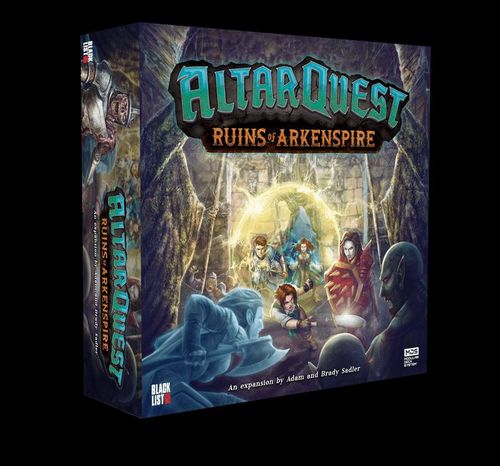
Altar Quest: Ruins of Arkenspire
Altar Quest: Ruins of Arkenspire Rulebook
Table of Contents
Table of Contents
Expansion Overview
Ruins of Arkenspire is an expansion for Altar Quest that takes heroes to the cursed tower that was once the seat of the Death Girl Szera's power in Aridika. In the heart of Aridika, the region of Nethermoor is entirely under the control of the Desecrated—a legion of undead abominations that serve their necromancer lords. When the Desecrated begin to threaten the provinces surrounding Nethermoor, brave heroes are needed to push back the undead attack!
This expansion includes a large amount of content to add to your game, including a new way of playing the game with encounters.
Expansion Contents
- 1 Story Guide
- 2 Double-Sided Encounter Tiles
- 18 Miniatures
- 15 Minions
- 1 Villain
- 2 Features
- 142 Cards
- 21 Threat Cards
- 10 Villain Cards
- 20 Adventure Cards
- 60 Encounter Cards (4 decks of 15 cards each)
- 4 Encounter Turn Cards
- 2 Feature Cards
- 3 Lurker Cards
- 12 Story Cards
- 10 Equipment Cards
- 8 Card Dividers
- 2 Secret Boxes
Expansion Icon
Each card in the Ruins of Arkenspire expansion is identified with this expansion icon.
Secret Boxes
This expansion includes part of the game content that has been stored separately in secret boxes. This content is designed to be unlocked while playing through the Ruins of Arkenspire story guide. The story guide will tell players when to open each of the secret boxes.
Encounters
Encounters are a new way to play a game of Altar Quest. Although encounters use many of the same rules as adventures, they are played on a single encounter tile from the chosen encounter deck, rather than on the game board. In addition, encounters can usually be played in less time than it would take to play a normal adventure. Some stories, such as the one included in this expansion, will give players specific instructions to play an encounter between adventures. Encounters are also a wonderful way to introduce new players to Altar Quest.
Encounter Setup
The following setup details how players should prepare each encounter. Players must perform each of the following steps in order.
- Choose an Encounter and Place the Tile: The players choose an encounter tile and place it in the center of the play area.
- Choose and Prepare the Heroes: Each player chooses a hero deck and follows the usual setup steps described in the Altar Quest rules, with one exception: each player places an Encounter Turn card on top of their hero deck instead of a normal Turn card.
- Prepare the Encounter Deck: The players find the encounter deck that corresponds to the chosen encounter tile and perform the following steps to prepare that encounter:
- Create the encounter area next to the game board by removing the Adventure Setup/Rules card from the encounter deck and placing it along the edge of the encounter tile, leaving space to its right for additional cards that will be added to the encounter area during play. Place the adventure tokens next to the encounter area.
- Read the Setup card and resolve its encounter setup effect. Then shuffle the encounter deck and place it to the left of the encounter area, leaving space for a discard pile.
- Prepare the Altar Pool: Roll the altar dice and place them in an area next to the encounter tile to create the altar pool.
- Choose Threat Deck & Prepare Figures: The players collectively choose a threat deck and follow the usual setup described in the Altar Quest rules.
- Choose Villain Deck: The players collectively choose a villain deck and follow the usual setup described in the Altar Quest rules.
- Prepare Tokens: Create separate token pools for armor tokens, progress and damage tokens, focus tokens, supply tokens, and search tokens.
- Prepare the Search Deck: Shuffle the search cards and place them next to the encounter tile.
Note: Lurker cards and Feature cards are not used in an encounter unless specified otherwise.
Encounter Tiles
Each encounter deck is associated with a specific tile on which the encounter takes place. Each encounter tile has drawn hero starting spaces and shadow spaces. In addition, each encounter tile has one or more unique icons drawn in various places. These unique icons are described on the Encounter Rules card of the corresponding encounter deck.
- Hero Starting Space
- Shadow Space
Encounter Rules
An encounter is played over a series of rounds until the heroes win or lose. The heroes win the game if they defeat the villain. The heroes lose the game if any hero is defeated or if a game effect specifies an additional loss condition. Each round of the encounter is divided into four turns:
- Hero Turn: Each hero resolves an action phase, performing 3 actions.
- Threat Turn: Each hero resolves a reaction phase, resolving the Activate effect of each card in their threat area, from left to right. If a hero does not activate a Threat card in their threat area during this turn, that hero draws 1 Lurker card.
- Villain Turn: The heroes must resolve the Activate effect of each card in the villain area, from left to right. Then they draw and resolve 1 villain card.
- Encounter Turn: The heroes must resolve the Activate effect of each card in the encounter area, from left to right. Then they draw and resolve 1 encounter card.
Encounters are played using the game rules as if playing an adventure, with the following exceptions:
- Encounter Turn card: Players use the Encounter Turn card. Remember that the Adventure Turn card is replaced by the Encounter Turn card.
- Encounter tile as a room: The encounter tile is considered entirely one room for the purposes of card effects. Each figure on this tile is considered to be in the same room.
- Shadow spaces: Each encounter tile has one or more shadow spaces (see "Encounter Tiles"). When a minion figure appears, it is placed on the shadow space nearest the active hero. If that shadow space is occupied, the figure appears in the empty space nearest to that shadow space.
- Lurker cards: Lurker cards are not used during an encounter. If a card effect tells players to draw a Lurker card, they draw a Threat card instead.
- Trap cards: When a Trap Threat card is drawn, the trap token is placed in a space adjacent to the hero who drew that card and as close as possible to the greatest number of characters.
- Feature card: Each encounter has its own Feature card. Whenever a hero places a search token on the Feature card in their room, they place it on the encounter's Feature card instead.
- Reshuffling the encounter deck: When the last card of the encounter deck is drawn, the players shuffle the discarded encounter cards and place them facedown to create a new encounter deck.
If the heroes defeat the villain, they win the encounter.