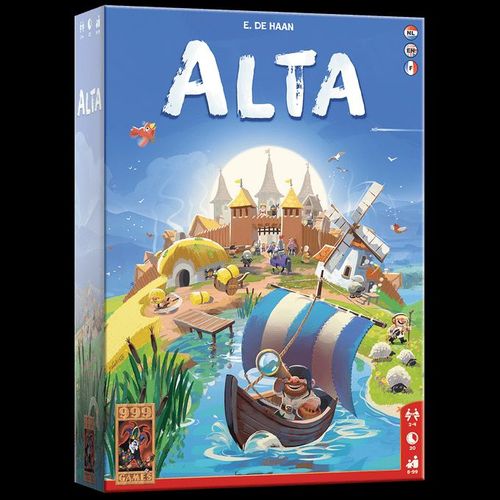
Alta
Alta Rulebook
Table of Contents
Table of Contents
Game Components
81 island cards, 9 of each type: Farmer's Hut, Wheat Field, Tavern, Settlement, Farmer, Mill, Fishing Harbour, Tower, Market (the back of each island card is the same).
9 merchant cards (the back of each merchant card is the same).
4 player aids (cheat sheets).
Notepad and pencil.
A scoresheet is also available to download from the publisher's website (gry.nk.com.pl).
Setup
- Each player takes 1 player aid. Return the remaining player aids to the box.
- Shuffle the island cards thoroughly. Deal 2 island cards to each player. Hold them so that rivals cannot see what is on them.
- Make a face-down stack from the remaining island cards and place it in the middle of the table. This stack is called the island deck.
- Reveal 2 cards from the top of the island deck and place them face up next to it. These cards are called the face-up island cards.
- Shuffle the merchant cards thoroughly. Make a face-down stack from them and place it to the side of the table. This stack is called the merchant deck.
- Reveal 1 card from the top of the merchant deck and place it face up next to it. This card is called the face-up merchant card.
Leave the notepad and pencil in the box. They will be needed at the end of the game.
Setup for 3 players: the rulebook shows a diagram of this layout around players A, B and C, with the island deck, face-up island cards, merchant deck and face-up merchant card placed between them. The diagram is not reproduced here.
Goal of the Game
You are settlers searching for new lands. You have just discovered uninhabited islands! Each player takes control of one of them. It is up to you in which direction your islands will develop and how you will develop them.
The better you plan your island's development, the more points you will score – each type of card gives you points for something different. You will earn additional points if merchants visit your island. The player with the most points wins.
Card Descriptions
Coin symbols indicate the points players score.
- Island card: the points at the top of the card are the points you get if this card is on your island.
- Merchant card: the same layout applies; the points at the top are fixed, and the points at the bottom depend on a condition.
The points at the top of a card are certain: you simply need to have the card on your island. The points at the bottom of a card are not certain: to score them you must meet the condition printed there.
Gameplay
The game lasts 8 rounds. The player who has most recently been on an island begins. The other players then take their turns in clockwise order.
On your turn, perform the following 2 actions:
- Choose 1 of the 2 cards in your hand and add it to your island (following the ISLAND BUILDING RULES on page 8).
- Choose 1 of the 2 face-up island cards and add it to your island (following the ISLAND BUILDING RULES on page 8). If the 2 face-up island cards are identical, you may (but do not have to) put them into the box and reveal 2 new cards from the top of the island deck. You must then choose 1 of them (even if both are again identical).
After performing the 2 actions above, refill the cards:
- Refill the empty space left by the face-up island card you took – place there the card you are holding in your hand, so that 2 face-up island cards are again lying there.
- Refill your hand – draw 2 new cards from the top of the island deck.
In short:
- Add 1 card from your hand to your island.
- Add 1 of the face-up island cards to your island.
- Refill the empty face-up island card space with the card from your hand.
- Refill your hand with 2 cards from the top of the island deck.
If you added a Market to your island (whether with action 1 or action 2), take 1 merchant card (from the merchant deck or the face-up merchant card) and place it beside your island. This card may give you extra points at the end of the game, so it is worth keeping it hidden from your rivals.
Your turn ends. The player sitting to your left begins their turn.
Building Your Island
Each player's island must consist of 16 cards and form a square measuring 4 × 4 (4 columns and 4 rows). As you add cards, your island may grow in any direction. At the end of the game, however, every column and every row must consist of 4 cards.
- The first island card is placed in front of the player. Each subsequent card must be placed so that it shares an edge (vertically or horizontally) with at least 1 card already on your island.
- A card once placed may not be moved.
- There are no restrictions on adjacency – every type of card may be adjacent to every other type.
Cards that share an edge are called adjacent (neighbouring) cards. Cards that touch only at a corner are not adjacent.
End of the Game
The game ends after the 8th round, that is, when all players have islands consisting of 16 cards. Each player then counts the points for each card on their island (the card descriptions are given in the following sections).
Record the points you score on the notepad. The player with the most points wins.
- Points at the top of a card are certain – you simply need to have the card on your island.
- Points at the bottom of a card are not certain – to score them you must meet the condition given on the card.
Tie-breaker: in the event of a tie, the player with the most Fishing Harbours wins. If the tie remains, the tied players share the victory.
To make counting points easier, the publisher has prepared a special calculator, available at gry.nk.com.pl/pierwsza-osada.
Card Scoring
The examples below refer to the diagrams in the rulebook, which are not reproduced here.
Farmer
A farmer needs work (a field) and a market, where they can buy a scythe.
- Each farmer = 1 point for being on the island.
- Additionally, each farmer gives 1 point for each adjacent Wheat Field and/or Market.
Example: A farmer in the top row scores 3 points: 1 for being on the island, plus 2 points (1 + 1) for 1 adjacent Wheat Field and 1 Market. The second farmer also scores 3 points: 1 for being on the island, plus 2 points (1 + 1) for 2 adjacent Markets.
Settlement
Settlers need bread (a Mill) and fish (a Fishing Harbour).
- Each settlement = 1 point for being on the island.
- Additionally, each settlement gives 2 points for each adjacent Mill and/or Fishing Harbour.
Example: A settlement in the second row from the top (on the previous page) scores 7 points: 1 for being on the island, plus 6 points (2 + 2 + 2) for 2 adjacent Fishing Harbours and 1 Mill. The second settlement scores 5 points: 1 for being on the island, plus 4 points (2 + 2) for 2 adjacent Mills.
Tavern
An innkeeper needs fish (a Fishing Harbour) and a market, where they buy food for their guests.
- Each tavern = 2 points for being on the island.
- Additionally, each tavern gives 2 points for each of a maximum of 2 adjacent cards: Fishing Harbour and/or Market.
Example: A tavern in the top row scores 6 points: 2 for being on the island, plus 4 points (2 + 2) for 2 adjacent Fishing Harbours. It scores no points for an adjacent Market, because a tavern scores for a maximum of 2 adjacent cards (the Market is the third card). The second tavern also scores 6 points: 2 for being on the island, plus 4 points (2 + 2) for an adjacent Market and Fishing Harbour.
Farmer's Hut
The hut is small and can hold only 1 farmer.
- Each Farmer's Hut = 2 points for being on the island.
- Additionally, each Farmer's Hut gives 3 points if it is adjacent to exactly 1 farmer. If it is adjacent to more farmers, it gives no points for any of them.
Example: A Farmer's Hut in the top row scores 5 points: 2 for being on the island, plus 3 for being adjacent to 1 farmer. The second Farmer's Hut scores 2 points for being on the island. It scores nothing extra, because it is adjacent to 2 farmers.
Mill
Millers in our game do not yet know the benefits of competition – they sign long-term contracts with only 1 grain supplier.
- Each Mill = 3 points for being on the island.
- Additionally, each Mill gives 2 points if it is adjacent to exactly 1 farmer. If it is adjacent to more farmers, it gives no points for any of them.
Example: A Mill in the second row from the bottom scores 5 points: 3 for being on the island, plus 2 for being adjacent to 1 farmer. The second Mill scores 3 points for being on the island. It scores nothing extra, because it is not adjacent to exactly 1 farmer.
Wheat Field
Nothing moves without grain. Everyone wants access to it.
The more different kinds of cards (other than Wheat Fields!) are adjacent to a Wheat Field, the more points the player scores:
| Number of card types | 1 | 2 | 3 | 4 |
|---|---|---|---|---|
| Points | 1 | 3 | 5 | 8 |
Example: A Wheat Field in the second row from the top is adjacent to 3 card types (Farmer, Tower and Fishing Harbour), so it scores 5 points. The second Wheat Field is adjacent to 2 card types (Market and Fishing Harbour), so it scores 3 points.
Fishing Harbour
For farmers, access to the harbour is a treasure – this is where they load grain onto ships and, along the way, enjoy a little fish.
- Each Fishing Harbour scores points only if it is on the shore of the island (that is, it has access to the sea).
- If it has sea access, each Fishing Harbour gives 2 points for each adjacent Wheat Field and 3 points for each adjacent Farmer's Hut.
- A Fishing Harbour without sea access = 0 points. It does not matter that it is adjacent to Farmer's Huts and/or Wheat Fields.
Note! Even though a Fishing Harbour without sea access scores no points, it still counts when scoring other card types (for example Wheat Fields, Taverns or Settlements).
Example: A Fishing Harbour in the second row from the top scores no points, because it has no sea access (it still counts for the adjacent Wheat Field). The second Fishing Harbour scores 8 points (3 + 3 + 2), because it has sea access and is adjacent to 2 Farmer's Huts and 1 Wheat Field.
Tower
Good communication between the guards ensures safety. Towers must be built so that they can see each other over a distance.
- Each Tower = 1 point for being on the island.
- Additionally, each Tower gives 3 points for each other Tower in the same column and/or row, but only if there is at least 1 card of a different type between them.
Example: Tower A scores 1 point for being on the island, plus 6 points (3 + 3) for Tower B in the same row and Tower D in the same column. Tower B scores 1 point for being on the island, plus 3 points for Tower A in the same row. Tower C scores 1 point for being on the island, plus 3 points for Tower A in the same row. Tower D scores 1 point for being on the island, plus 3 points for Tower A in the same column.
Market
A market attracts merchants from overseas, which means hard currency!
Each time a player adds a Market to their island, they take 1 merchant card – from the top of the merchant deck or the face-up merchant card. If they take the face-up merchant card, they immediately refill the empty space by revealing the top card of the merchant deck.
Keep the merchant card you have taken in front of you, so that your rivals cannot see what is on it.
Merchant
The more merchants, the bigger the business.
Each merchant gives points for each pair of cards shown on it:
- each pair of adjacent cards shown = 5 points;
- each pair of non-adjacent cards shown = 3 points.
Note! Each island card may be used by more than 1 merchant.
Example: Adding a Market led the player to take a merchant card showing a Farmer's Hut and a Wheat Field. The island has 2 sets of such cards. The Hut and Field that are adjacent to each other score 5 points, and the Hut and Field that are not adjacent score 3 points. The third Farmer's Hut scores nothing, because there is no third Wheat Field to form another set. In total, the merchant card scores 8 points.
Keep the merchant card you have taken hidden from your rivals.