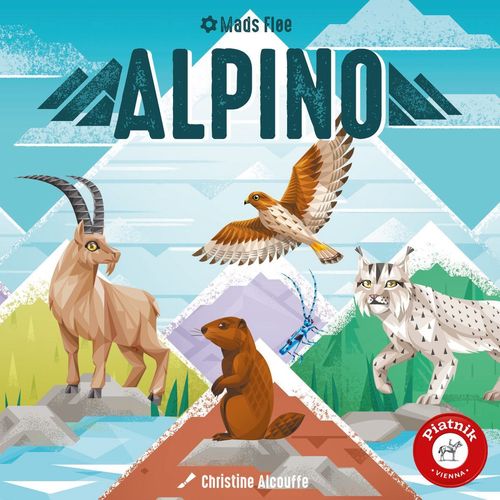
Alpino
Alpino Rulebook
Table of Contents
Table of Contents
Components
- 40 Alpino tiles
- 10 secret tiles
- 6 scoring tiles (Punkteplättchen)
- 1 starting tile (Startplättchen)
- 1 rulebook
Object of the Game
Through tactical selection and skilful placement of the Alpino tiles, build the largest groups of animal species that will be worth the most at the end of the game.
Setup
Before the first game, carefully push the parts out of the punch boards.
-
Place the 6 scoring tiles side by side in the middle of the table, in this order from left to right:
Ibex (Steinbock) – Lynx (Luchs) – Buzzard (Bussard) – Marmot (Murmeltier) – Alpine buck (Alpenbock) – Water source (Wasserstelle)
-
Shuffle the 10 secret tiles face down. Each player takes 1 of them and places it face down in front of them. You may look at your secret tile at any time, but you must keep it hidden from the other players until the end of the game. Return the remaining secret tiles to the box without looking at them; you will not need them in this game.
-
Shuffle the 40 Alpino tiles face down. Depending on the number of players, return a certain number of tiles to the box without looking at them:
- 2 players: return 8 tiles
- 3 players: return 4 tiles
- 4 players: return 0 tiles
From the remaining Alpino tiles, form several face-down stacks. Depending on the number of players, turn over a certain number of tiles and place them face up in the middle of the table as the display (Auslage):
- 2 or 3 players: 4 tiles
- 4 players: 5 tiles
-
Decide which player starts. That player receives the starting tile.
Gameplay
The players play clockwise. The game is played over several rounds. Each round is divided into 3 phases and always follows the same sequence:
- Phase 1: Expand your area
- Phase 2: Increase the animal population
- Phase 3: Prepare the next round
Phase 1: Expand Your Area
The player holding the starting tile begins the round.
When it is your turn, choose 1 Alpino tile from the display and place it in front of you. This is the habitat for your animals. Over the course of the game you will expand it by adding new Alpino tiles orthogonally (horizontally or vertically) adjacent to tiles already placed in your area.
Important: When placing a tile, at least one landscape type on the new Alpino tile must match at least one adjacent landscape type in your area.
If you cannot or do not want to place the chosen Alpino tile in your area, turn it over to its back side and place it at any position in your area. The water sources depicted on the tiles are "jokers" and may be placed next to any landscape type.
Some examples are shown on the printed rules sheet.
After you, the next player in clockwise order chooses 1 Alpino tile from the display and places it in the same way, and so on, until every player has had exactly one turn.
Phase 2: Increase the Animal Population
Once every player has chosen 1 Alpino tile and placed it, the player holding the starting tile takes the remaining tile or one of the remaining tiles from the display. They slide it under one of the scoring tiles showing an animal that is depicted on the Alpino tile. If two different animal species are depicted on the Alpino tile, they may choose one of them.
Slide the Alpino tile under the scoring tile so that the same animal is visible twice on the stack.
Important: In this case, it is not allowed to turn the Alpino tile over to its back side.
Example: Ingo holds the starting tile and must now slide one of the remaining Alpino tiles under a scoring tile. He decides on the marmot.
Phase 3: Prepare the Next Round
- Remove any Alpino tiles still left in the display; you will not need them for the rest of the game.
- Then draw as many new Alpino tiles from any of the face-down stacks as the setup specifies, and place them face up in the middle of the table as the new display.
- Pass the starting tile to the next player clockwise.
End of the Game
The game ends when, in Phase 3, you can no longer place new Alpino tiles into the display.
The player holding the starting tile reveals their secret tile first and places it at any position in their area. All other players do the same, one after another in clockwise order. Then scoring takes place.
Scoring
Check separately for each animal species and for the water source which player has the largest contiguous group of it. A contiguous group consists of all animals of the same kind that are connected horizontally or vertically, regardless of the landscape on which they are depicted.
The player with the largest group of a given animal (or of the water source) scores points equal to the number of Alpino tiles stacked under the corresponding scoring tile. The scoring tile itself also counts. If several players are tied for the largest group, all tied players receive the full points.
The player with the most points in total wins. In case of a tie, the player with the largest group of ibex wins. If that is still tied, the player with the largest group of lynx wins, and so on, following the order of the scoring tiles from left to right: Ibex > Lynx > Buzzard > Marmot > Alpine buck > Water source.
Scoring Example
Lotte and Severin each have the largest contiguous group of ibex and each receive 2 points. Ingo has the largest group of lynx and receives 3 points. Olivia has the largest group of buzzards and receives 2 points. Lotte, Severin and Ingo each have the largest group of marmots and each receive 3 points. Lotte and Severin each have the largest group of Alpine bucks and each receive 2 points. Lotte has the largest group of water sources and receives 2 points.
The final scores are: Lotte 9 points, Severin 7 points, Ingo 6 points, Olivia 2 points.