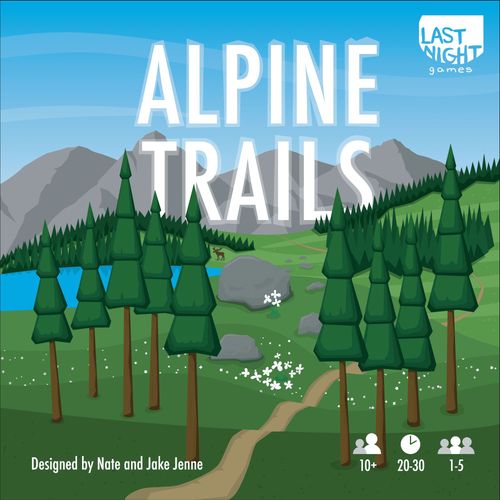
Alpine Trails
Alpine Trails Rulebook
Table of Contents
Table of Contents
Game Overview
Players will draw trail tiles and add them to their own collection (referred to as a map). Trail tiles will interconnect to create loops as well as out-and-back paths. Along the way you will add wildlife, campgrounds and waterfalls to enhance your map and earn more points. Creating large habitats of the same terrain type will also add to your score. In the end the player who has accumulated the most points wins.
Game Contents
- 132 Trail Tiles
- 36 Campsite/Lake Tiles
- 36 Waterfall/Lake Tiles
- 8 Base Camp Tiles
- 20 Personal Goal Cards
- 25 Tent Tokens
- 12 Sign Tokens
- 5 Mountain Goat Tokens
- 5 Moose Tokens
- 5 Bear Tokens
- 5 Wolf Tokens
Game Setup
- Place the animal card in the center of the table with the wooden animal pieces on it within reach of all players.
- Place all the wooden tent and sign pieces on the table within reach of all players.
- Place all of the campground and waterfall tiles in stacks on the table within reach. Note that both campground and waterfall tiles have a lake on the reverse side. Be sure the stack them lake-side down.
- Mix the trail tiles together and count out the number of tiles based on the number of players according to the chart and put them in the cloth bag. Place the bag on the table within reach. Put the remaining trail tiles back in the box. They will not be used for the remainder of this game.
- Randomly assign each player a base camp tile and a personal bonus card. Place your base camp tile on the table in front of you. All your paths and habitats will build off of this base camp. Players may look at their bonus card but are not required to show it to the other players.
| Player count | Tiles used |
|---|---|
| 1 player | See solo rules |
| 2 players | 64 tiles |
| 3 players | 96 tiles |
| 4 players | 112 tiles |
| 5 players | 130 tiles |
Game Play
Turns are taken simultaneously. Players draw two tiles at random from the bag and determine where to place them on their map. Once all players have placed (or discarded) both their tiles and have resolved any events triggered by their placement, the process is repeated by drawing two new tiles. Players continue in this manner until all the tiles in the bag have been drawn and placed. The game ends when all tiles from the bag have been placed.
Rules of Tile Placement
Each trail tile has two sides. One side has a trail with a terrain type while the other side only shows a terrain type (with two icons). You may choose which side to play face up as you add each tile to your map. Tiles may be rotated any way you choose. The two tiles you place on each turn must be orthogonally adjacent to any other tile(s) on your map, however, they do not need to be adjacent to each other.
When placing a tile with the trail side up, the path must connect to base camp, a campsite, or another trail. Trails may not be placed in a way that leaves them disconnected and every trail must continue from one tile to the next. You may not place the tile in a way that causes a trail to end by running into another tile. Each trail has a distance on it (1, 2 or 3 miles). These distances will play a significant role in the game and will be discussed in a later section.
When placing a tile with the terrain side up, the terrain does not need to match its surrounding tiles. Any terrain may be placed next to any other tile so long as it does not cause an existing trail to end. Placing tiles of the same terrain type next to each other will score points and this will be explained further in the scoring section.
Your starting base camp tile can be used to connect trails, but can also have terrain placed next to it. In this way the base camp (and other campsites which will be discussed later) act as both a trail and terrain without restriction.
Examples of valid tile placement:
- Both trail and terrain edges may connect to base camp.
- Any terrain type may be adjacent to any other type.
Examples of invalid tile placement:
- Trail tiles must always connect back to base camp somehow.
- Trail tiles may not terminate in the habitat side of another tile.
Forks
Some tiles have a forked trail on them. When you place a fork tile on your map (with the trail side up), collect a sign post and place it on top of the intersection. Announce to the other players that you have placed a fork and which terrain type it is. All other players may then collect the animal token associated with that terrain type if they do not already have one.
Animals
When any opponent plays a forked trail tile, you should take an animal token matching the habitat of the fork tile played (unless you already have that animal). The animal card indicates which animal belongs in each terrain type. In order to score points you will need to place the animal token on a terrain-only tile of the matching terrain type (animals cannot be placed on tiles that are trail side up). You may save the animal for later if you don't have a valid tile to place it on, but it will only score at the end if it has been placed. Each player may only score each of the four animal types once.
Loops/Waterfalls
If placing a trail tile completes a loop, you earn a waterfall. Take a waterfall tile from the supply and immediately add it to your map orthogonally adjacent to any other tile on your map. The only restriction when placing a waterfall tile is that you may not block the end of any trail. Each waterfall will score a point for every tile surrounding it up to 8 points, so plan ahead and place your waterfalls in areas that will be easy to build around.
Campsites
During any round you may discard one of the two tiles drawn to play a campsite instead, provided you have a valid location to place one. Campsites must be placed at the end of an existing trail tile at least 6 miles away from any other campsite (including base camp). While the campsite must be connected to a trail on at least one side, the other sides may be used to extend new trails or to border terrain tiles. Note that the requirement of being six miles from any other campsite only applies at the time the campsites are placed (e.g. two existing campsites may be connected later on with trails adding up to fewer than 6 miles). When you choose to play a campsite, place one of your two tiles back in the box (out of play) and take a campsite tile. Immediately place your campsite tile in a valid location on your map. Then take a wooden tent token and place it on the campsite. Each tent will earn significant points at the end of the game.
End of Game
Once all the tiles in the bag have been used the game ends. At this time all players will place a lake at the end of any unfinished trail. Lakes tiles are found on the reverse side of campgrounds and waterfalls left in the supply. All players should freely take as many lakes as needed to finish any trails left incomplete. Note that campgrounds and base camp do not count as trails by themselves and therefore are not incomplete and do not need a lake placed by them. You will score for every lake on your map, so if you have no other options on your last turn you can always start another trail just to earn a lake. It is possible to have a map with more than one trail leading to a single lake. Lakes may end up connected to trails on multiple sides. However, when this happens players do not consider this a loop and do not collect a waterfall tile.
After all players have placed lakes on their maps, use the provided score sheets to tally the final score.
Scoring
Use a provided score sheet to tally scores for each player for each of the following categories.
Habitats
Any group of orthogonally adjacent tiles of the same terrain is considered a habitat. For each of the four terrain types, find your largest habitat and score a point for each terrain icon found in that habitat. Only count your largest habitat for each terrain type.
Example: The largest meadow (flower) habitat scores 8. The single meadow tile on the right is not connected to the rest of the meadow tiles. The largest rock habitat scores 2 points. It's made up of the two rock icons found on the base camp tile. The largest forest habitat scores 2, and the wetland habitat of just one tile only scores 1 point.
Waterfalls
For each waterfall on your map, earn one point for every tile surrounding it (both orthogonally and diagonally). For example, if a waterfall is completely surrounded by eight tiles, it scores eight points. Count each waterfall separately even if that means some tiles score points for multiple waterfalls. All tiles: trails, campgrounds, base camp, lakes and even other waterfalls count as a point each when they surround a waterfall. And yes, each square of base camp counts as its own point.
Example: The waterfall on the left scores 8 points. It's surrounded on all four sides and all four diagonals which count for one point each. The waterfall on the right scores 6 points because it's only surrounded by six tiles (three sides and three diagonals).
Lakes
Score 2 points for every lake on your map. Be sure you followed the steps mentioned in the End of Game section to add lakes to the end of every open trail on your map.
Campsites/Tents
Score 8 points for every tent placed on your map. Every campsite you placed should have a tent on it.
Animals
Score 2 points for every animal placed on your map. You are only allowed to have one of each type, so your maximum score for animals is 8 points. Animals that you have saved for later and have not yet placed on your map do not count.
Longest Path
Score a point for every mile in your longest out-and-back trail (which should end in a lake). If a trail has a fork or campsite on it, you may only count the distance from the lake to the closest fork/campsite.
Example: The longest path is the one along the top with a total distance of 10 miles. The path on the far right can only be counted from the fork to the lake for a total of 7 miles. There is a short 1 mile path also extending from the same fork. Finally, the path along the bottom is only counted from the last campsite for a distance of 5 miles.
Personal Objective
Finally, score points according to your own personal objective. Some clarifications are highlighted here.
- +1 per [terrain icon] in your largest [terrain] habitat (example card: forest). Each icon in your largest habitat of the specified terrain type earns you one additional point.
- +1 per [terrain icon] on your longest path. Each icon of this terrain type on a trail tile that is part of your longest path counts as an extra point (whether it's scored as a habitat or not).
- +1 per [terrain icon] next to a tent. Each icon adjacent to a tent orthogonally or diagonally, earns a point. Icons are only counted once, even if they are next to multiple tents.
- +1 per [terrain icon] next to a waterfall. Each icon adjacent to a waterfall orthogonally or diagonally, earns a point. Icons are only counted once, even if they are next to multiple waterfalls.
- Longest path bonus: If your longest path is at least 15 miles long, score 5 bonus points. If your longest path is at least 20 miles long, score 10 bonus points.
Scoring Example
In this finished game, Maddie scored 109 points. Her habitat scores were 11 for forest, 9 for rock, 7 for meadow, and 6 for wetland. She scores 23 points for surrounding waterfalls and 10 points for lakes. Her two campsites/tents gain 16 more points. She placed a bear and wolf and scores 4 points for animals. Her longest path scores 16 points (one point per mile). Finally, her personal objective scores her one extra point per tree along her longest path for a bonus of 7 more points.
Solo Mode
Place 32 random tiles in the bag. On each turn draw 2 tiles as in the regular game. Play continues until all tiles have been played from the bag.
The solo mode has one rule alteration. When placing a fork tile, it may be played in 3 different ways:
- As a fork in the trail, the player may still place a sign post but as there are no other players, no one will receive an animal token corresponding to the terrain of the tile.
- Played as a habitat. All normal rules apply.
- Discard it and receive 1 animal token corresponding to the terrain type of that tile. In solo mode, the player is allowed to collect multiple of the same type of animal. In order to score the typical 2 points for each animal collected it must be placed on its own habitat tile similar to the regular game play rules for animal tokens.
All other rules play the same as the regular game.
After playing a solo round, compare your score with the table below to see how you rank.
| Score | Rank |
|---|---|
| 85 - 94 | Weekend Wanderer |
| 95 - 104 | Pathfinder |
| 105 - 114 | Trailblazer |
| 115 - 124 | Peak Bagger |
| 125+ | Mountain G.O.A.T. |