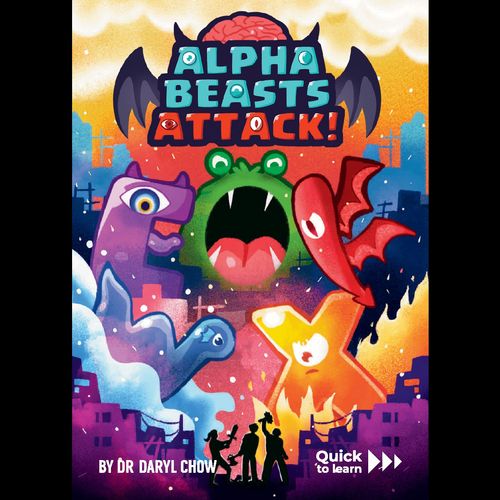
Alphabeasts Attack!
Alphabeasts Attack! Rulebook
Table of Contents
Table of Contents
Game Components
- 40 Player cards in 5 colours
- 5 Player Guide cards
- 90 Alphabeast cards
- Defence Status card
How To Set Up
A. Give each player 8 Player cards plus 1 Player Guide card in their chosen colour. Each player places their Player Guide card in the middle of their own playing area.
B. Place the 2 starting Item cards (marked with a shield on the back) face-up to the left of their Player Guide card. Then shuffle the remaining 6 Player cards face-down to form their Scavenge deck, face-down to the right of their Player Guide card.
C. Shuffle the Alphabeast cards face-down to form a deck. Place the deck in the middle of the playing area with room for a discard pile.
D. Place the Defence Status card in view of all players.
E. Get ready for the onslaught of the Alphabeasts!
We suggest Word Warrior for your first game. For a simpler game, remove the cards as shown before forming the deck:
| Difficulty level (Harder to Easier) | Word Boss | Word Master | Word Warrior | Kid Friendly |
|---|---|---|---|---|
| Remove | Do not remove any cards | Remove 1 copy of Z, Q, J, X, V | Remove 2 copies of Z, Q, J, X, V | Remove all Z, Q, J, X, V and all Alphabosses |
Illustrated: the Alphabeast cards that can be removed (Z, Q, J, X, V and the Alphabosses) and the Alphaboss example conditions "Same letter used start and end", "Only 1 syllable", "No repeat letters", "Vowels >= consonants" and "1 consecutive letter pair".
Objective Of The Game
Players win the game together if they are able to harvest enough brains from the Alphabeasts, forcing them to retreat. Make haste though, because if the Alphabeasts inflict too many scars upon Earth, the players will lose the game immediately!
Flow Of A Round
Alphabeasts Attack! takes place in rounds. There are no player turns, and all players may play simultaneously. Each round, the following 4 phases will be carried out in sequence:
- Alphabeasts Attack!
- Plan your Defence
- Reveal your Word
- Scavenge (optional)
Each of these steps is explained in detail below.
1. Alphabeasts Attack!
Deal each player 3 Alphabeasts cards face-up in front of them, plus X cards to the middle of the playing area, where X is equal to the number of players (see Box A). These are the Alphabeasts attacking the players this round. If there are insufficient cards, shuffle the discard pile to form a new deck.
Box A (illustrated): In a 3 player game, everyone gets 3 cards each, with 3 cards in the middle.
2. Defence Planning
Each player should defend against the Alphabeasts by thinking of a word containing as many of the Alphabeast letters attacking them (see Box B). Alphabeasts in the middle can be dealt with by any player (i.e. any player can incorporate them into their word), and players should discuss which Alphabeasts each player is able to handle. In general, players with easier letters should take more letters from the middle. Players with more challenging Alphabeasts can concentrate on their own 3 letters.
When you have thought of a word, wait for all other players before revealing it together in phase 3.
Players may not explicitly help other players with their word. They may however say that such a word exists without giving any other hints.
The only exception to this rule is by using a Help Hammer which allows players to say/tell the word to another player so that they may use that word in phase 3.
Box B: Plan Your Defence (illustrated)
- Mei can form R I B or B R I C K to defeat all 3 of her Alphabeasts.
- She considers taking the "F" to form B R I E F ...
- ...or taking the "N" to form B R A I N.
- Mei also considers what words to use to defend against the additional Alphaboss from the middle:
- ✓ RIBBON
- ✓ BROODING
- ✗ BERIBERI
Alphabosses
Alphabosses are special Alphabeasts that are harder to defeat. They may only be defeated if the player's word fulfills the condition as stated on the Alphaboss card (see examples of defeating Alphabosses in Boxes C and D). If you have multiples of the same Alphabosses, fulfilling the condition will only defeat one Alphaboss. If you have contradictions such as "1 consecutive letter pair" and "No repeat letters", it will be impossible to defeat both.
Box C: Dealing With Alphabosses (illustrated)
Shows how a word is checked against an Alphaboss condition, using the "1 consecutive letter pair" Alphaboss card as the example.
Box D: Other Alphaboss Examples (illustrated)
- "Vowels >= consonants": ✓ BRIE
- "Only 1 syllable": ✓ BRIGHT
- "No repeat letters": ✓ ORBIT
- "Same letter used start and end": ✓ DRIBBLED
3. Reveal Your Word
Once all players have thought of a word, everyone declares their word for that round in any order (see Box E). Alphabeasts are defeated if the word contains its letter or meets its conditions. Place the defeated Alphabeast cards below the player's Player Guide card. Players may scavenge using these Alphabeast cards in phase 4.
Box E: Reveal Your Word (illustrated)
Examples of declared words for Didi ("Handiwork"), Omar ("Yogurt", no "F") and Mei ("Ribbon"). Defeated Alphabeasts are placed below the Player Guide card.
All Alphabeasts that are not defeated will attack Earth, resulting in a scar. Place these Alphabeast cards face-down below the Defence Status card so that the scars on the card back are shown (see Box F).
Players LOSE immediately if there are X times 2 scars under the Defence Status card, where X is the number of players. For example, in a 3 player game, players will lose immediately if there are 6 or more scars under the Defence Status card.
If players successfully survive phase 3, they proceed to phase 4.
Box F: Update Scars (illustrated)
The players failed to defend against the Alphabeast "F", resulting in a scar. Place scars face-down underneath the Defence Status card.
4. Scavenge (optional)
In order to win, players will need to harvest brains from the carcasses of defeated Alphabeasts by scrounging through their Scavenge deck.
To do so, players may trade in (place on the discard pile) Alphabeasts of 5 different colours OR 4 Alphabeasts of the same colour to flip over the top card of their Scavenge deck (see Box G).
Note: Children or players who struggle with word games may trade in 4 different and 3 of the same colour instead.
Once players trade in the appropriate number of cards, they draw the top card of their Scavenge deck and place it face-up to the left of their Player Guide card. If it is an Item, keep it on the left of the player card (see pages 12 and 13). If it is a Brain, they place the Brain card face-up under the top half of the Defence Status card so that each Brain is clearly showing (see Box H).
Players WIN the game immediately if there are X times 2 Brains above the Defence Status card, where X is the number of players. For example, in a 3 player game, players win the game immediately if there are 6 or more Brains above the Defence Status card.
Box G: Scavenge (illustrated)
Three examples of trading in Alphabeasts: five Alphabeasts of five different colours; a mix of Alphabeasts and Alphaboss cards (Alphabosses are wild for Scavenging); and four Alphabeasts of the same colour.
Box H: Brains And Items (illustrated)
Scavenged Items are stored on the left of the Player Guide card. Brains are stored under the top half of the Defence Status card.
How To Use Items
Players start with 2 Help Hammers and may acquire more items that they may use to assist them during the course of the game from their Scavenge deck. Items may be used at the appropriate times as described on the Item card. Items may only be used once per game. Once used, they are flipped face-down and may not be used again.
Help Hammer
Help Hammer can be used in two ways; to tell another player a word that they may use in phase 3, or to move one of your Alphabeasts to the middle (so another player can defeat it).
Saviour Sword
Flip a Saviour Sword to discard one Alphabeast anywhere on the table (including Alphabosses). That Alphabeast will go straight to the discard pile.
Assist Axe
Flip an Assist Axe to discard 2 Alphabeasts anywhere on the table. Draw 2 new Alphabeasts to replace where they were discarded from.
Box I: Items (illustrated)
Examples of Help Hammer, Saviour Sword and Assist Axe in use on the table. The example word shown is "Try R I B B O N?".
End Of The Game
The game ends immediately in a win if there are X times 2 Brains under the Defence Status card, where X is the number of players.
The game ends immediately in a loss if there are X times 2 scars under the Defence Status card, where X is the number of players.
A "Skip the Rule Book" callout on the last page points to a video how-to-play resource.