AlmaTafl
AlmaTafl Rulebook
Table of Contents
Table of Contents
Escape spots
The escape spots are the dotted marks on the peripheral of the board and can be occupied only by the King.
Throne
The throne is the dotted mark at the centre of the board and can be occupied only by the King. However, the King can be stacked by an invader (Black) while being on the throne.
Setup phase
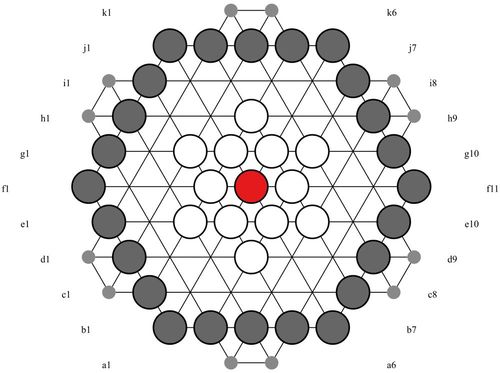
The discs are placed on the board just like in the picture provided below.
(The original rules show this as a diagram. In words, the setup is as follows.)
- Black (invaders), 24 discs: placed around the outer edge of the star-shaped board, with 5 discs along the top edge, 5 along the bottom edge, and 7 along each of the left and right sides (including the points at the left and right tips).
- White (defenders), 12 discs plus the King: placed in the central area. Twelve plain White discs form a diamond around the centre, with one disc at the top point, four in the row below, two flanking the centre in the middle row, four in the row below that, and one at the bottom point. The King (a White disc marked with a red disc) occupies the centre of the board, which is the throne.
- Escape spots: the 12 grey dotted marks on the outer edge of the board (two at each of the six corners of the star) are the escape spots. They are left empty at setup.
Stacks
A stack can either consist of a single (1) disc, 2 discs or 3 discs on top of each other despite the colours or the variation of colours in the stack. The number of the discs which form the stack dictates the height of the stack. E.g a single disc is a height-1 stack. Two discs on top of each other form a height-2 stack. Three discs on top of each other form a height-3 stack. The topmost disc is "active", while the ones underneath it are "non-active". A single disc is also considered to be "active".
"Non-active" discs cannot move.
Only "active" discs can perform a move.
The total height of a stack should not exceed 3 discs in total.
The King cannot be stacked by its own army (White), meaning that the King cannot become "Non-active" by its own army (White) throughout the entire game.
The King can be stacked by an invader (Black) which in this case it is a win for the invaders (Black).
Discs can land on other discs, despite their colour, only if at the beginning of their turn are at least on the same height as the disc they intent to land on. E.g a disc on a height-1 stack cannot land on a height-2 stack. It can only land on top of another single disc. Whereas the topmost disc on a height-2 stack can land on top of a single disc or even on top of a height-2 stack.
Movement
Starting with Black (invaders), players alternate turns moving 1 of their "active" discs following the rules provided below.
A disc can move in any direction, always in a straight line and always covering a distance equal to the height of the stack which the disc begins its turn, being the total number of discs which make up the stack. E.g 1 disc should move 1 space, where in essence the disc will simply move to an adjacent hex. The topmost disc in a stack (the "active" one) of 2 discs in total, will move 2 spaces. The topmost disc in a stack (the "active" one) of 3 discs in total, will move 3 spaces.
A disc can finish its move on either an empty point, or on top of another disc, despite its colour. Spaces and discs in between them are not affected.
(The original shows an example diagram here: a black disc coming from a height-2 stack lands on top of a white disc.)
In the example provided above, a black disc coming from a height-2 stack, lands on top of a white disc.
Remember, the total height of a stack should not exceed 3 discs in total.
No disc can exit the board.
Passing is not allowed.
Bounce
The King can perform a "bounce" action as long as he lands on an invader (Black), either being an "active" single disc, or an "active" (topmost) part of a height-2 stack.
The King can either land and remain on spot, or perform a "bounce", being a subsequent leap following the rules provided above concerning the distance to be covered, rules concerning the landing on another stack, as well as the maximum height of stacks, provided that the King lands on an invader (Black).
The King can bounce as many times as the player wants, given that the King lands on an invader (Black).
(The original shows an example diagram here.)
In the example provided above, the King, coming from a height-3 stack, lands on a height-2 stack, thus forming a height-3 stack. Then he performs a bounce, according to the rules provided for a height-3 stack and lands on a height-2 stack, with a white disc on top, thus forming a height-3 stack. Due to the King has landed on a white disc he cannot perform another bounce.
Winning conditions
Defenders (White) win the game once the King reaches any escape spot.
Invaders (Black) win the game once the King is stacked and becomes "non-active".
Invaders (Black) can also win the game, if the defending army (White) has no "active" disc left, apart from the King.
(The original shows an example diagram here.)
In the example provided above, the King manages to reach an escape spot resulting in a win for White.
Advanced Winning conditions
Players can choose to play with the rules provided above, or use the following winning conditions which make things harder for the defenders (White). In this version, the King can be stacked by the invaders (Black) even while he is on an escape spot. The average playing time increases to 45 minutes.
Defenders win the game when they begin their turn with the King on any escape spot.
Invaders (Black) win the game once the King is stacked and becomes "non-active".
Invaders (Black) can also win the game, if the defending army (White) has no "active" disc left, apart from the King.