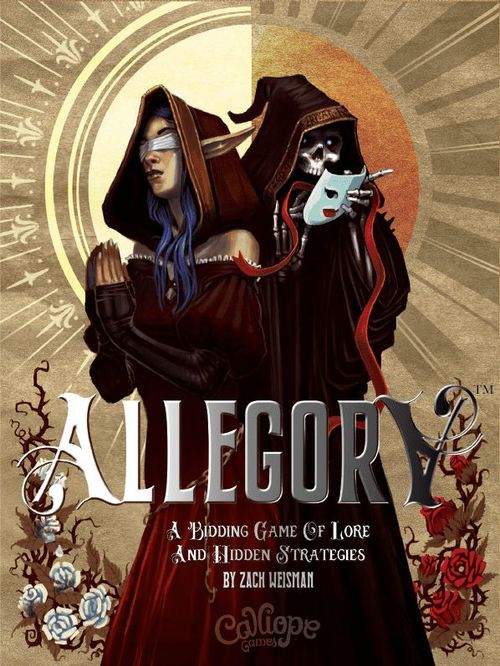
Allegory
Allegory Rulebook
Table of Contents
Table of Contents
Object
Bid on and collect Theme cards to craft your three Tales (Nature, Energy, and Spirit). In the end, you score only the Tale with the lowest total value. Enhance your score by including sets of Themes throughout your Trilogy. Earn bonus points for including your Moral into each Tale. The player with most points has scribed a classic Tale and mastered the Allegory!
Contents
- 63 Theme cards
- 18 Moral cards
- 90 Lore chips
- 6 Rest markers
- Rulebook
Setup
IMPORTANT: If playing with 2 or 3 players, first remove from the Theme and Moral decks all cards featuring the "glowing" icon in the top right and bottom left corners; return these cards to the box. If playing with 4 or more players, all the Theme and Moral cards are used.
Shuffle the Moral cards and deal one face down to each player. You should look at the Moral card you were dealt, but keep it hidden from other players until the end of the game. All Moral cards not dealt to players are returned to the box. NOTE: For a less competitive game, return one copy of each Moral card to the box before performing this action.
Shuffle the Theme deck and lay out a number of Theme cards face up in a line in the center of the table equal to the number of players; this line of cards is the Inspiration Pool. In a two player game, lay out three cards instead of two. Place the remaining cards beside the Inspiration Pool as the draw deck. Give each player 15 Lore chips and a Rest marker, which they keep in front of them. During the game, Lore chips must be visible, but players are not required to tell others how many they have. Return any unused Lore chips and Rest markers to the box.
Each player should leave room directly in front of them to display a tableau of cards that will be separated into three columns; one column for each Tale—Nature, Energy, and Spirit. Tales are indicated in the top left and bottom right designs of the Theme cards.
Card Breakdown
Theme card and Moral card (see the card diagrams in the rulebook):
- a The Value a card adds to or subtracts from its Tale
- b The icon showing the card's Theme
- c The marking indicating the Tale to which the card belongs.
Cards may be played in either orientation with no effect on gameplay:
- Nature
- Energy
- Spirit
All cards with glowing icons should be removed in games with less than 4 players.
The Prologue: Initial Round
The youngest player begins the first round, called the Prologue, bidding any number of their Lore chips for the opportunity to claim one Theme card from those available in the Inspiration Pool. Lore chips are not assigned to any specific card – they are placed on the table in front of the player for everyone to see. Going clockwise, players must take turns choosing to either:
a) Outbid the previous player by placing at least one more Lore chip in front of themselves than the previous bid; or
b) Rest and immediately take back all their Lore chips from previous bids. When resting, place your Rest marker clearly out in front of your position to indicate that you are out for the round.
Play continues until all but one player has Rested.
The sole remaining player has won the bid and takes any one Theme card from the Inspiration Pool, then places it face up in their tableau to begin one of their three Tales. Immediately thereafter, they replenish the Inspiration Pool with the next card from the top of the draw deck.
The winner then takes all the Lore chips they bid to win the auction and distributes them across the cards in the Inspiration Pool any way they wish, splitting them up or loading up one card as they choose.
Example: In the example in the rulebook, Zach has won the bid with 5 Lore chips. After taking a card, he chooses to place three of them on the -2 card, one on the -1 card, and one on the 2 card.
TIP: Focusing only on one Tale is not beneficial. It is important to balance the cards in your tableau across all three Tales. At game's end, only your Tale with the lowest total value will be scored and you cannot win unless you have at least one card in each Tale.
The Story: Subsequent Rounds
The game continues over several subsequent rounds of bidding, taking Theme cards, adding them to your Tales, and distributing Lore chips. These are referred to as Story rounds. Each Story round starts with the player to the left of the previous round's winner. Turns are the same as in the first round, with players either choosing to Outbid the others or Rest. However, in Story rounds, whenever a player Rests, they have the option to claim the card from the Inspiration Pool that currently has the most Lore chips on it. A player may never take a Theme card with no chips on it when they Rest. If more than one card is tied for the most chips, the player may choose any one of the tied Theme cards. Once a player Rests, they place their Rest marker clearly out in front of their position to indicate that they are out for the round; they will then take it back at the start of the next Story Round.
Example: In the example in the rulebook, the player who Rests could claim the card in the second position. Though the -2 value may hurt their score, they gain four Lore chips. The next player who Rests may claim either the first or last card, since they are tied for the most chips.
Any time a card is taken, immediately replace it with the next Theme card from the deck.
Crafting Tales: Your Tableau
Each author is responsible for crafting a trilogy of three Tales—a Tale of Nature, a Tale of Energy, and a Tale of Spirit. When you claim a new Theme card, place it in your tableau to either begin or continue the corresponding Tale. The Tale to which a Theme card belongs is indicated by its markings in the upper left and lower right corners. All Theme cards featuring the same Tale designs are displayed together in three separate columns with the values and Theme icons at the top of each card showing.
NOTE: The slight graphical differences in Tale designs shown in opposite corners of a Theme card have no effect on gameplay.
Epilogue: Game's End
The game ends at the conclusion of the round in which a player takes their tenth Theme card. The Tales are complete and players then determine their score by combining these three values:
Tale Score
Succinct Tales capture the imagination. Each player adds up the total value for each Tale, then scores only the Tale that has the lowest total value. If a player does not have at least one card in each Tale, they are ineligible to win the game.
Theme Bonus
An echoed theme conjures narrative magic. For every set of three Theme cards featuring the same icon within the trilogy earns a player 2 bonus points. The three matching Theme cards may be in the same or different Tales.
Hidden Moral Bonus
Weaving a moral throughout Tales opens the eyes of the audience. Players reveal Moral cards dealt to them during setup, and gain 1 bonus point for each Tale that contains at least one card featuring that hidden Moral; thus, a player may score a maximum of 3 bonus points for hidden Morals.
Example: In the example in the rulebook, you score 2 points for your lowest valued Tale, which is Energy. You also have a set of four Theme cards across your Tales, so you gain a 2-point bonus. Finally, you reveal your hidden Moral card to be the one shown, providing you 1 point for your single Tale (Nature) featuring a matching card. Your final score is 5.
The player with the highest score wins, and becomes the acclaimed author of a legendary Tale, proving they have mastered the art of the Allegory.
Tiebreaker: If there is a tie, the tied player with the most remaining Lore chips wins. If there is still a tie, the tied players share the victory and tell an epic tale together.