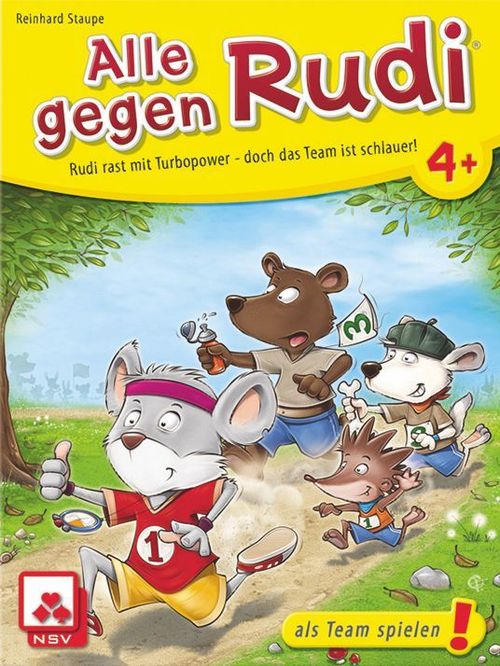
Alle gegen Rudi
Alle gegen Rudi Rulebook
Table of Contents
Table of Contents
Material
- 4 Animals: Hedgehog, Dog, Bear and Rudi
- 2 Dice
- 26 Cards: 24 Path cards, 1 Start card and 1 Finish card
Game set-up
Set the race track out as a semi-circle on the table. First the Start card, then the 24 Path cards, and finally the Finish card.
The members of the team (Hedgehog, Dog and Bear) and Rudi must be placed on the Start card. Place both dice next to the race track.
Playing the game
The youngest player starts (= active player), and then the other players take turns one after the other, going in a clockwise direction.
The active player takes both dice and rolls. The active player must then move the animals according to what they roll (each Path card counts as one field).
- The Hedgehog and Rudi always move forwards by one field.
- The Dog moves forwards 2 fields.
- The Bear moves forwards 3 fields.
(The number of fields that the animals can move is written on their torso.)
The animals must always be placed on the corresponding Path card. There may be several animals on one card at the same time.
Examples from the rulebook:
- Sarah rolls Rudi and the Bear. She moves Rudi forwards 1 field and moves the Bear forwards by 3 fields.
- Linus rolls Rudi twice. He moves Rudi forwards 1 field twice, so a total of 2 fields.
- Tim rolls the Hedgehog and the Dog. He moves the Hedgehog forwards 1 field and the Dog 2 fields.
Attention: The pair of hedgehogs
There is just one rolling result that gives the team the opportunity to do a special action. If the player rolls a pair of hedgehogs (so two Hedgehogs), they are free to choose between:
- moving the Hedgehog forwards two spaces, as normal, or
- moving the Dog forwards (2 fields) once, or
- moving the Bear forwards (3 fields).
Note: When they roll a pair of hedgehogs, the player should carefully consider where the team's animals are at that moment and should decide which animal has the best chance of winning. Of course, the player should ask for advice – they are part of a team after all! However, the final decision ultimately rests with the active player.
Example: Sarah rolls a pair of hedgehogs. She can now either move the Hedgehog forward by 2 fields, the Dog by 2 fields or the Bear by 3 fields. She chooses the Bear and moves it forwards 3 fields.
Remember: If you roll a pair of dogs (so two Dogs), there is no special action. The Dog is just moved forwards 2 fields as usual.
The players take it in turns to be the active player as described above. They each roll both dice and move the animals along the race track depending on what they rolled.
Ending a race
The race ends as soon as an animal reaches or passes the Finish.
- If Rudi reaches the Finish first, then Rudi wins the race.
- If a member of the team (it doesn't matter who!) reaches the Finish first, then the team wins the race.
- If Rudi and one of the members of the team reach the Finish at the same time, then the round ends in a tie.
New race & ending the game
Now a new race is started. The set-up and process of playing the game stay the same. The first to win two races, either Rudi or the team, wins the game.