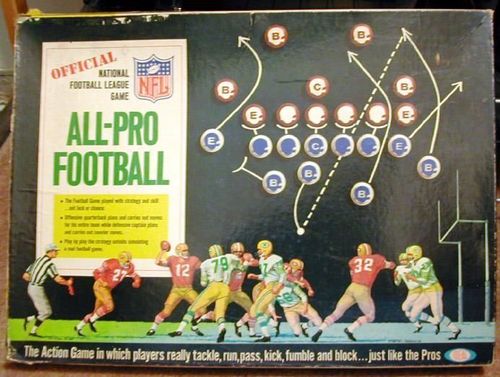
All-Pro Football
All-Pro Football Rulebook
Table of Contents
Table of Contents
Materials and Preparation
Materials: Playing Board, Ball Marker Football, Pair of Dice, 10 Yard Marker, Scrimmage Tray, Scoreboard, 2 Teams consisting of 11 men each.
Preparation: Each player selects a team and takes the 11 men of one color. Each team is composed of 4 Backs (B), 2 Ends (E), 4 Interior Linemen (blank) and one Center (C).
Scoreboard
The scoreboard registers the score of each team. It keeps a record of the quarters, indicates the number of downs and records the number of plays. Time is kept by the number of plays. There are ten plays per quarter. At the end of twenty plays the half is over and a new kick-off ensues. The game is over after 40 plays have been completed. A play is registered only after each down or when a team scores. At the start of the game, all dials are set at zero.
The Game Board
The game board represents an actual football field. It is divided into 100 yards with a white stripe indicating each 5 yards. The field is further divided into a series of light and dark squares. These are the squares on which the men move.
The Scrimmage Tray
The plastic scrimmage tray is used for convenience. To see how the tray works place the tray on the playing field with the line on the center of the tray over any of the white yard stripes. You will notice that each circle on the tray falls directly over a square on the playing field. The center line of the tray is the line of scrimmage. The linemen of both teams are lined up on each side of the line of scrimmage. The Backs are positioned behind the line. The Backs do not have to be positioned on the tray, but may be as far behind the line as you wish. (SEE DIAGRAM #1 FOR ONE TYPICAL LINEUP).
Diagram 1: Typical "T" Formation.
How the Men Move
How the offensive men move: All Backs and Ends can move in any direction: forward, backward, sideways or diagonally. Interior Linemen (Guards, Tackles and the Center) can move forward, backward and sideways but never diagonally.
How the defensive men move: All defensive men (Backs, Ends, Center and Linemen) can move forward, backward, sideways and diagonally.
How moves are made: On his turn, the offensive player has three moves. He can move one man three spaces, or one man one space and another man two spaces, or he can move any three men one space each.
After the offense has moved, the defensive captain now has three moves. He can also move one man three spaces, one man one space and another man two spaces, or three men one space each. After the defense moves, the offense has three more moves and then the defense has three more moves. Play continues in this manner with each team having three moves alternately until one of the following happens:
- The ball carrier is tackled, or
- A score is made, or
- An incomplete pass is thrown.
Diagram 1 (continued): see the typical formation above.
A player can only move his own men, never his opponent's men. The men do not have to be moved in any particular order, that is, a lineman may be moved before a back and vice-versa. A player cannot move any of his men over any of his other men or over any of his opponent's men unless he has blocked an opponent's man.
Blocking
In order to block, a player must land one of his men directly on top of one of his opponent's men. Both men are out of the play and neither can be moved again during that play. No other man can land on top of the blocker after he has made his block. Any offensive player can block any defensive player. Any defensive player can block any offensive player with one exception. Once an offensive End or Back has advanced one or more spaces beyond the line of scrimmage he cannot be blocked unless he returns behind the line of scrimmage.
Moving over a blocked man: A player who has blocked an opponent's man (by placing one of his own men on top of the opponent's man) may move any of his own men over his own blocker. He counts the move onto the blocker as one move, and off the blocker another. He cannot end his move on top of his blocker. A player can never move over an opponent's blocker.
Tackling
In order to tackle the ball carrier, a player must land one of his men on the square occupied by the ball carrier.
Playing the Game
Kick-off
Toss a coin to see which team kicks off. The kicking team lines up on its own 40 yard line. The ball is placed on the square in front of the man closest to the center of the playing field.
The receiving team lines up the linemen on its own 40 yard line with the Backs dispersed behind the line in any formation the player chooses. See diagram of a typical kick-off formation. A little experience will show you the best formation for your Backs. (DIAGRAM #2)
The kicking team rolls both dice. The total of both dice shows the distance the ball has traveled.
Example: The total of the dice is 11. This means the ball has traveled 11 spaces or 55 yards forward. The ball is then moved in a straight line to the receiving team's 5 yard line. If the receiving team has a man on that square, he has caught the ball. The ball is placed directly on top of the man. If no man is on the square, the ball is placed on the empty square.
After the ball is in position, the kicking team moves as many men as he chooses three spaces forward. He may move all 11 men if he chooses. This is the only time more than 3 men can be moved at one time.
Diagram 2: Kick-off.
Return of Kick-off
If the ball has landed directly on one of the receiving team's men, the man and the ball are moved in accordance with the rules on "How the Offensive Men Move" and "How Moves Are Made."
If the ball has landed on an empty space, the receiving team has three moves in which to pick up the ball. The men must move in accordance with the rule on "How Moves Are Made." When a receiving team man lands on the space with the ball, the player picks up the ball and places it on top of the man. If the man lands on the space with the ball on his first move, the player still has two moves left and can move the ball carrier or any of his other men in accordance with the rule on "How Moves Are Made."
If the man lands on the space on his second move, the player still has one move left after placing the ball on the man. After the receiving team has made its three moves, the defensive team has three moves. The men must be moved in accordance with the rules on "How the Defensive Men Move" and "How Moves Are Made."
After the defense has made its three moves, the offense moves again and then the defense. Play continues in this manner until the ball carrier is tackled or the offensive team scores. When the ball carrier is tackled, the play is over and the next play starts from scrimmage. The scrimmage line is the line touching the front of the ball carrier.
"Tip" for the receiving team on kick-off: Do not be in too much of a hurry to move your ball carrier, remember you have Linemen and Backs who can block. (See rule on blocking.)
Plays From Scrimmage
Running Play
The plastic scrimmage tray is used to line up offense and defense on all scrimmage plays. The tray merely facilitates the line up and shows the original line of scrimmage for each play. Place the center line of the tray directly over the white line which was touched by the front part of the tackled ball carrier on the preceding play.
The offensive team lines up first. They are allowed to use any legal formation used in professional football: i.e. balanced line, unbalanced line, tight end, split end, "T" formation, "A" formation, etc. The ball is placed on top of the Center. The defense now sets up its men, using any legal formation, such as 7-2-2, 5-4-2, etc. The defense can even have an 11 man line if it chooses (but this would be an unwise defense). (SEE DIAGRAM #1 FOR A TYPICAL FORMATION.)
The first down marker is placed 10 yards forward of the ball (on the sidelines).
When both teams are set, play begins. All moves are made in accordance with the rules on "How the Offensive Men Move," "How the Defensive Men Move" and "How Moves are Made."
Offense gets the first three moves. The ball is taken from the Center and placed on the Quarterback, who must be in a direct line behind the Center. The snap of the ball counts as one move for the offense. The offense now makes two more moves. Then the defense takes its three moves. If the ball carrier has not been tackled, the offense takes three moves more and then the defense. Play continues until the runner is tackled or a score is made.
When the runner is tackled the down is over and 1 play is registered on the scoreboard.
The scrimmage tray is set up on the new line of scrimmage, the players are lined up again and the next down begins.
Hand-off
A ball carrier may hand off to another man, providing the man the ball is to be handed to, is on a space immediately adjacent to the ball carrier. If the ball carrier is beyond the line of scrimmage, he can only hand off to a man directly alongside or behind him. (SEE DIAGRAM #3). On a hand-off, the ball is taken from the ball carrier and placed on the other man. This counts as one move in the series of three.
Diagram 3: Hand-off. Quarterback has taken ball from Center, faded back 1 space and can now hand off to any of the Backs on an adjacent space.
Fumbles
Anytime the ball falls off the ball carrier, it is a fumble.
How the offense recovers a fumble: If the ball falls off on the player's first move, he has two more moves to reach the square the ball is on, and recover the fumble.
Should the ball fall off on his second move, he has one move left to recover the fumble. If the ball falls off on the third move, he cannot recover the fumble.
How the defense recovers a fumble: If the ball should fall off the runner after he has completed his third move, the defense can try to recover the fumble. The defense must have a man close enough to the space the ball lands on, to reach that space and pick up the ball within three moves. If he can pick up the ball on his first move, he can run with it for two more moves. If he picks the ball up on his second move, he can run with it one more move. Should he reach the ball on his third move, he cannot run with it on that turn.
If the defense cannot recover the ball within three moves, the offense can again try to recover the fumble within three moves. The fumble recovery is not a dead ball and play only stops when a tackle has been made or the team scores.
Downs
The play is over and a down is registered each time the ball carrier is tackled or an incomplete pass is thrown and 1 play is registered on the scoreboard.
First Downs
The offensive team has 4 downs in which to advance the ball 10 yards for a first down. Since the ball must move past the first down marker in order to be a first down, the runner must advance the ball 5 yards beyond the first down marker. If he advances the ball just to the line of the marker it is not a first down but is considered "inches to go." (SEE DIAGRAM #4.)
Diagram 4: First downs.
Forward Passing
Forward Pass
The plastic scrimmage tray is used and the teams are lined up in the same order as for a running play. The ball is snapped and play continues the same as for a running play. The offensive player can call "pass" after completing any of his series of three moves, providing his passer has not run past the line of scrimmage, he has no ineligible receivers down field, and he has an eligible receiver open.
Ineligible Receiver
A Guard, Tackle, or Center is an ineligible receiver. If a player calls "pass" and any of these men are more than one space past the line of scrimmage, he incurs a penalty. (SEE PENALTIES.)
Eligible Receiver
Any offensive Back or End is an eligible receiver.
Passing
When the offensive Quarterback calls "pass," (remember he must have completed any of his series of three moves in order to call "pass") the defense gets three moves.
If the defense can tackle the passer during those three moves, the ball is considered not to be in the air and the passer can be smeared. If the defense cannot reach the passer in three moves, the ball is considered to be "in the air" and the defense cannot block an eligible receiver during these three moves, even though he is behind the line of scrimmage. (The defense can never block an eligible receiver once he is past the line of scrimmage.)
Completing a Short Pass
In order to complete a pass, an eligible receiver (Back or End) must Bug on a space which is an even number of spaces away (2, 4 or 6) and in a direct line with the passer (either straight ahead or diagonally). [Source prints "Bug" here; the sense is clearly "land on," as used throughout the rules.] After the defense has completed its three moves, the offensive player rolls one die. If any even number comes up on the die, the pass is complete. The receiver does not have to be on the exact space of the number rolled.
Example: The receiver is 6 spaces from the passer and the passer throws a 2 on the die, the pass is complete. If there is more than one eligible receiver open, the player, before he rolls the die, must announce to which receiver he is passing. (SEE DIAGRAM #5.)
Diagram 5: Short pass. Passer could throw a pass to Left End, Right End or to Back over the middle. He could not throw a pass to the Back on the left since he is 5 spaces away from the Passer. In order to be eligible he must be an even number of spaces away from Passer. After announcing to which player he is passing, die is rolled. A number 2, 4 or 6 on the die would complete the pass.
Completing a Long Pass
A long pass is completed the same as a short pass except that the receiver must be on a space 8, 10 or 12 spaces away from, and in a direct line with the passer. Both dice are used. If both dice come up even, the pass is complete.
Example: The receiver is 10 spaces away from the passer. The passer throws both dice and a 2 comes up on one die and a 6 comes up on the other die, the pass is complete. Each die must show an even number for the pass to be complete. Remember, it is not the total of both dice that must be even, but an even number must come up on each die. A pass cannot be completed if the receiver is more than 12 spaces from the passer. (SEE DIAGRAM #6.)
Diagram 6: Long pass. Pass could be thrown to Left End or Right End. It could not be thrown to the Back since he is not in a straight line from Passer. Both dice are thrown and an even number must come up on each die for pass to be complete.
How the Pass Is Thrown
After the player throws the die for a short pass, or both dice for a long pass, and the die or dice show the pass is complete, he takes the ball from the passer and places it on the receiver. This counts as one move. He now has two more moves left to complete his series of three moves. He can, of course, move any man or men on his other two moves. The defense now gets three moves and play continues normally until the receiver is tackled or scores.
Incomplete Pass
On a short pass, if any odd number comes up on the die, the pass is incomplete. On a long pass, if an odd number comes up on either die, the pass is incomplete.
Interception
When a defensive man is in a direct line between the passer and receiver and an even number of spaces away from the passer, he can intercept a pass.
Diagram 7: Short pass interception. Passer is throwing to his Right End. He must throw a 6 on die to complete. If he throws a 4 Defensive End will intercept. If he throws a 2 Defensive Back will intercept.
Diagram 8: Long pass interception. Passer is passing to his Right End. Pass will be complete if any even number comes up on each die. However, if a 2 comes up on each die, the pass is intercepted by the Defensive Back who is 4 spaces (2 + 2 = 4) away from the Passer. If a 3 comes up on 1 die and a 1 comes up on the other, although the total is 4, the pass is incomplete, since an even number must come up on each die for the pass to be complete or intercepted. If the Passer was passing to his Left End and a 4 comes up on each die (4 + 4 = 8) or a 2 and a 6 comes up (2 + 6 = 8) the Defensive Back who is 8 spaces away from the Passer intercepts. Any other 2 even numbers, the pass would be complete.
On a short pass, if the number thrown on the die is even and equals the number of spaces the defensive man is from the passer, the pass is intercepted. On a long pass, if the numbers on both dice are even and the total of both dice equals the number of spaces the defensive man is from the passer, the pass is intercepted. (SEE DIAGRAMS #7 and 8.) The intercepting team becomes the offensive team. The ball is placed on the intercepting man at the spot of interception and he takes his three moves immediately (running back the interception). Play continues until the man is tackled or scores. If the defensive man is on a space an odd number of spaces away from the passer, and that exact number is thrown on the die or dice, it is still an incomplete pass. Remember, odd numbers are always incomplete!
Lateral Pass
A lateral pass is made the same as a short pass with the following exceptions:
- The passer does not have to be behind the line of scrimmage.
- The pass may be caught by any man. (He does not have to be an End or Back.)
- The receiver can never be on any space ahead of the passer.
Kicking
Punt
In order to punt, the men are lined up in the normal manner with the kicker positioned 10 or more yards behind the Center. Play begins as in a regular play from scrimmage. The ball is snapped from the Center to the kicker. (There can be no player between the Center and the kicker.) This counts as one move, the offense then gets two more moves. Then the defense gets three moves. The kicker can either run or kick the ball from his position, however, once he moves with the ball he can no longer kick on that play. The kicker does not have to kick on his first series of three moves; he can wait until his men get down field to cover the kick. (Don't wait too long because your kick may be blocked.)
After the kicking team has completed any of its series of three moves, the player calls "punt." The ball is placed one space in front of the kicker. The defense now has three moves. If a defensive man can reach the space with the ball on it within those three moves, the kick is blocked and the defense takes over on that spot. If the defense does not reach the ball within three moves, the offense rolls both dice and the ball is moved forward in a straight line the number of spaces shown on the dice.
Punt Return
Follow the same rules as "Return of Kick-off."
Scoring
Field Goal
A field goal may be attempted by a team when it has the ball on, or inside, the opponent's 45 yard line. Follow all the rules on "Punts." To score, the ball must go far enough to cross the goal line. A field goal scores 3 points.
If the ball does not travel far enough to cross the goal line, it may be run back as in the rule under "Punt Returns."
Touchdown
When the ball is carried over or caught over the goal line, a touchdown is scored. In order to score, the ball must be past the goal line stripe. A touchdown scores 6 points.
Point After Touchdown
After scoring a touchdown, the scoring team rolls one die. If the number "one" comes up, the try is unsuccessful. If any other number comes up, the try is successful and scores 1 point.
Safety
Anytime a ball carrier is tackled behind his own goal line, the opposing team scores 2 points. The team scored upon puts the ball in play from its own 20 yard line by either a "kick-off" or a "punt."
In either case, the opposing team lines up on the kicking team's 30 yard line. Follow all rules on either "Kick-off" or "Punt," depending on which is chosen by the kicking team.
Touchback
When the ball is kicked into a team's end zone or a team intercepts a pass in its own end zone and does not, in either case, choose to run the ball out of the end zone, it is a touchback. A touchback scores no points. The team in possession puts the ball in play from scrimmage on its own 20 yard line.
Penalties
Illegal Formation
The offense can never have less than 7 men on the line. If, after the ball is snapped, the defense notices the offense has less than 7 men on the line, he calls penalty. Play is stopped and the offensive team is penalized 5 yards for illegal formation.
Intentional Grounding of Pass
If the offensive player calls "pass" and finds he does not have an eligible receiver on a legal space (2, 4 or 6 spaces on a short pass; 8, 10 or 12 spaces on a long pass) he has intentionally grounded the ball. Penalty is 15 yards from line of scrimmage and loss of down.
Ineligible Receiver
If the offensive player throws a pass to an ineligible receiver (Guard, Center or Tackle) it is an illegal pass. Penalty is 15 yards from line of scrimmage.
Pass Interference
If the defense blocks any eligible pass receiver after he has crossed the line of scrimmage, it is considered pass interference. Penalty is first down for the passing team from the spot of foul. If the spot of foul occurs in the defending team's end zone, it is first down for the passing team on the defensive team's goal line.
Illegal Use of Hands
Since an offensive lineman (except Ends) may not move diagonally, it is considered illegal use of hands if any interior lineman is moved diagonally by the offense. Penalty is 15 yards from line of scrimmage.
Personal Foul
This is one of the most important rules in the N. F. L. ALL PRO FOOTBALL GAME and should be watched for very carefully. Since each player is allowed three moves at a time, it is very important to make sure he does not take more than his three moves. If a player takes more than three moves on his turn, it is considered a personal foul. Once a player has moved a man, even though he has not removed his hand from the man, he cannot recall that move without counting each space moved over as a move.
Example: Defensive player's turn to go. He moves his safety man two spaces forward and then decides he has made a mistake. Since he only has one move left, he cannot move his safety man back two spaces; if he does so he has moved 4 spaces which is illegal. If he had moved his safety man one space forward and returned him to his original position, this would have been two moves, and he still has one legal move left. Anytime a player moves a man, it is counted as a move, and the move can only be retracted if it can be done within the three legal moves.
Penalty for taking more than three legal moves: Offense: 15 yards from line of scrimmage and loss of down. Defense: 15 yards from line of scrimmage.
Penalties Within 15 Yard Line
If a team is on its own 10 or 15 yard line and is penalized 15 yards, the ball is moved to its 5 yard line.
Penalties Within 5 Yard Line
If a team is on its own 5 yard line and is penalized 5 or 15 yards, the ball is placed on its goal line.
Special Rules
Punt From Own End Zone
When a team is forced to line up in its own end zone and wants to kick out, the kicker obviously cannot line up 10 or more yards behind the Center. The rule on punts is changed as follows:
Play begins as in a regular play from scrimmage except that the offensive player must call "kick" before the ball is snapped. The ball is then snapped (which counts as one move). The offense gets 2 more moves and then rolls both dice. The ball is moved downfield the total of both dice. The defense then gets three moves and returns the kick in the normal manner as in the rules on "Punt Returns."
N. F. L. Football Rules
In all instances, unless the rules are specifically spelled out in these instructions, the rules for professional football as played in the National Football League shall apply.