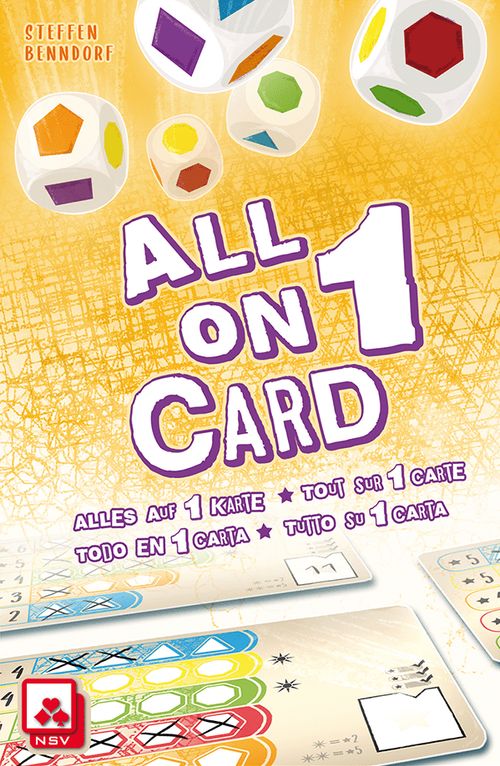
All on 1 Card
All on 1 Card Rulebook
Table of Contents
Table of Contents
Components
- 5 colored dice
- 4 markers
- 30 cards (erasable)
The cards show victory points, bonus points, score reminders, and a score space.
Note: the symbols on the dice are only used to differentiate the colors and serve no other purpose in the game.
Warning: the 30 cards are only erasable on their front side, not on their back!
Setup
- Shuffle the 30 cards and place them in a face-down deck in the middle of the table.
- Determine a starting player, who receives the 5 colored dice.
- Each player draws 2 cards from the deck and places them face up in front of them.
- Each player receives 1 marker.
Important! All of your cards must be visible to the other players at all times!
How to Play
The starting player is the first active player, and rolls the 5 dice. After a roll, this player may decide to reroll any number of dice (0-5). They may do so up to two times: after the 3rd roll, their result is final. In order to maintain a better overview, we advise you to group the dice by color.
Now, all players may use the result of the roll to cross off spaces on one of their cards. Crossing off spaces happens in turn order, and you must keep the following rules in mind:
- Each player must choose one of their cards on which they would like to cross off the result of the roll. You are not allowed to divide the result of the roll and use it on multiple cards.
- The spaces of the colored rows must be crossed off from left to right.
- You may only choose a certain color if you are able to use all dice of that color to cross off spaces on your card. Under no circumstances are you allowed to only use some of the dice of a certain color and ignore the rest!
- You are not forced to cross off spaces. However, if you do choose to cross off spaces, you must use all the dice you can legally activate.
Example: crossing off a roll
Simon crosses off the 2 purple and the 2 yellow dice on his card. He cannot use the orange die, because that color is not on his card.
Later on, Simon wants to use this roll. He is able to cross off purple, but his card only shows 1 available yellow space. He is not allowed to cross off yellow, because to do that he must be able to use both yellow dice!
Scoring a Card
If after using the dice at least 3 rows on your card are completely filled, that card is scored.
Count up your points and write the total in the card's score space. Each row that is completely filled scores the points depicted next to it. If you complete a row with a sun symbol, you score 2 bonus points. If you manage to complete both rows with a sun symbol, you score 5 bonus points.
By planning wisely and with a bit of luck, it is possible to score more than 3 rows on a single card, if you manage to fill them at the same time as your 3rd row. This way, you can score up to 25 points on each card!
Example: scoring cards
Simon used these dice to complete his card. He cannot use the purple die, because he had previously completed his purple row. Because he completed 3 rows, he must now score his card. He does not score any points for blue, because he did not complete the blue row. He receives 5 points for purple, 3 for yellow and 2 for green. Simon also scores 2 bonus points because the yellow row has a sun symbol next to it. 5+3+2+2 = 12
Simon used these dice to complete his other card. On a previous turn, he managed to fill his orange row, which means 4 of his rows are now completed and he must score his card. Simon does not score any points for his purple row. His red, orange, blue and green rows score him 4 points each. He managed to fill both rows with a sun symbol (red and blue), which scores him 5 bonus points. 4+4+4+4+5 = 21
After you scored a card, place it to the side for all players to see. You are no longer allowed to cross off spaces on this card!
Finally, draw a new card from the deck. If multiple players manage to complete a card during the same turn, they draw new cards from the deck in turn order.
Once all players have crossed off spaces and potentially scored their card, the next player in clockwise order receives the dice. That player is now the active player and starts the next round as described above.
End of the Game and Final Scoring
The game ends immediately after the turn in which a player has scored their 4th card.
All players now check whether they still receive points for cards they did not complete.
For each completely filled row, you score the points to the left of it. However, you do not receive bonus points for sun symbols!
The players now count up the points on all their cards. The player with the most points is the winner!
Example: incomplete card
Only 2 rows have been filled in on this card, which means Simon does not score it in the normal way. At the end of the game, he scores 6 points for yellow and 3 points for purple. Even though the yellow row has a sun symbol, he does not score any points for it. The other rows do not score him any points either. 6+3 = 9
Advanced Variant
Once you have played the game a few times and would like to add some tactical possibilities, feel free to use the following variant.
Each player plays with 3 cards on which they can cross off the results of rolls.
At the start of the game, each player receives 5 cards from the deck and chooses 3 to keep. The other 2 cards are shuffled back into the deck.
Additionally, 3 cards from the deck are flipped face up. As soon as you complete a card, choose one of the 3 face-up cards as your new card and then immediately refill the supply to 3 cards.
All other rules of the game remain unchanged.