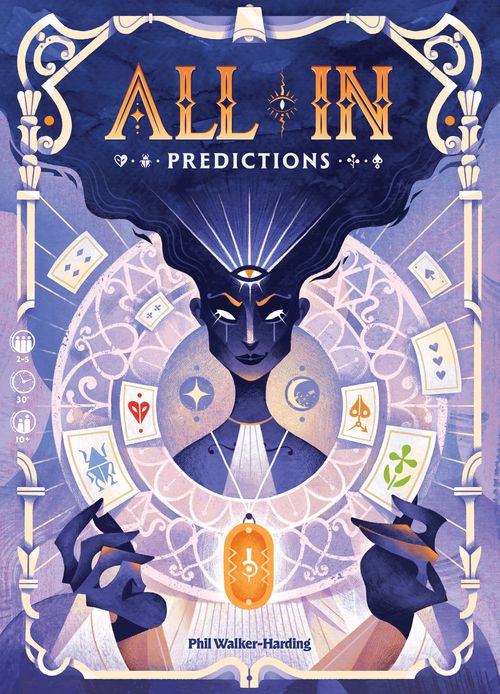
All In: Predictions
All In: Predictions Rulebook
Table of Contents
Table of Contents
Object of the Game
Play your cards and use your mind-bending skills to build the best hand. At the end of each round, players earn Runes based on the rank of their hand, and from the pot if they successfully predict who has the highest-ranked hand.
After 3 rounds, the player with the most Runes wins the game.
Contents
- 54 cards: 2 to Ace in four suits — Clock, Mask, Scarab, and Tree — and 2 Rune cards
- 50 Runes: 29 with a 1 value, 14 with a 5 value, 7 with a 10 value
- 5 double-sided Player Aid cards
- 5 Prediction tokens
- 4 frame pieces
Setup
- Assemble the display using the frame pieces based on the number of players. Return any remaining frame pieces to the box.
- Give each player a set of matching Prediction token and Player Aid card. Return the rest to the box. All Player Aid cards must show the same side. For your first games, use side A. Once you are familiar with the game, you can try side B.
- Shuffle all cards and deal 5 to each player. Note: Side A uses the conventional poker hand ranks. Side B uses modified poker hand ranks.
- Place the remaining cards as a facedown deck above the display. Leave a space to its right for the discard pile.
- Begin the display by revealing 2 cards from the deck and placing them face up on the 2 leftmost spaces.
- Create the pot by placing 4 Runes with a 1 value close to the deck. Put all remaining Runes nearby as a supply. With 2 players, place only 2 Runes.
- The player to the left of the dealer is the starting player of the first round.
Display layout by player count:
- 2 players: 2 rows of 4 cards
- 3 players: 2 rows of 5 cards
- 4-5 players: 2 rows of 6 cards
Gameplay
The game is played over 3 rounds. The first player starts each round, followed in clockwise order by the other players until the Prediction phase is triggered. After resolving the Prediction and Scoring phases, a new round begins.
On your turn, you must choose 1 of these 3 actions: Play a card from your hand, Pass, or Go All In.
Play a Card From Your Hand
Choose any card from your hand and play it face up in front of you. Perform that card's effects from top to bottom. The effect with a star is mandatory; all other effects are optional. (See Card Effects on page 12.)
If you have more than 5 cards in hand after resolving your card's effects, choose and discard the excess card(s) and place them in the order of your choice on top of the discard pile. When you discard more than 1 card, show all players which cards you discard. Discarded cards are placed face up in the discard pile, but you cannot look through the discard pile once the cards have been discarded.
Finally, add the card you just played to the display. See Adding Cards to the Display below.
Note: If the deck runs out, shuffle the discard pile to create a new deck.
Adding Cards to the Display
Whenever a card is added to the display, it must always be placed face up on the leftmost available space. This will either be to the right of a card or on an available space (created if you took a card from the display during your turn).
When the first row is full, start a second row following the same rules. Cards added to the second row are splayed on top of the first row. Cards under another card are considered locked and may not be taken as long as they are covered.
Pass
Add the top card of the deck face up to the display. Passing does not take you out of the round; you can choose a different action on your next turn.
Go All In
Put your hand of cards face down in front of you and add 2 cards from the top of the deck face up to the display.
Until the end of a round, the player that went All In cannot be targeted by the Hypnosis and All-Seeing Eye effects (see Card Effects).
In addition, once you have gone All In, you automatically pass on each of your following turns, adding 1 card from the deck face up to the display each time.
Only one player can Go All In each round.
After performing 1 of the 3 actions, check to see if the display has reached its card limit. If it has, proceed to the Prediction phase; otherwise play continues with the player to your left.
Example: Alice chooses to play the Jack of Mask. First, she takes a card from the display, and then she draws the top card from the deck. Because she has 6 cards in hand, she must discard a card. She discards the Rune card. Finally, she places the Jack of Mask on the leftmost space in the display.
Prediction Phase
When the display limit is reached at the end of a player's turn, the Prediction phase begins.
Starting with the player who is next in turn order (i.e., after the last one to have added a card to the display), each player must predict who they think has the highest rank. Place your Prediction token in front of the player who you think has the highest rank (this can be yourself). Continue in turn order until all players have placed their Prediction token.
2-Player Game: See the 2-Player Version (Prediction) section for the adapted 2-player Prediction phase.
The Unfolding – Scoring the Pot and Hands
During the Unfolding, players reveal their hand in turn order and determine who has the highest rank. The ranks are shown on the Rank Chart (below) and Player Aids and are similar to the classic game of poker.
After Scoring, prepare for the next round. After round 3, proceed to Game End.
Important: The ranking varies based on which side of the Player Aid is used. The example in this rulebook assumes side A.
Scoring the Pot
Players who correctly predicted who has the highest hand split the pot among themselves as equally as possible, with remaining Runes set aside and added to the next round's pot. If a single player predicted correctly, they get all Runes; if no predictions were correct, all Runes are added to the next round's pot.
Scoring Hands
After Scoring the Pot, each player earns Runes from the supply according to their hand's rank (see Rank Chart and Player Aid).
Rune Cards
Players earn 2 additional Runes from the supply for each Rune card in their hand. Rune cards are never counted as part of a hand's rank.
Rank Chart
When Scoring Hands, refer to this chart (reflecting side A of the Player Aids).
| Rank | Hand | Description |
|---|---|---|
| 7 | Straight Flush | 5 cards of the same suit in sequence |
| 6 | Four-of-a-Kind | 4 cards of the same value |
| 5 | Full House | 3 cards of the same value + 2 cards of one other value |
| 4 | Flush | 5 cards of the same suit regardless of value |
| 3 | Straight | 5 cards in numerical order regardless of suit |
| 2 | Three-of-a-Kind | 3 cards of the same value |
| 1 (2 pairs) | 2 Pairs | 2 cards of the same value + 2 cards of one other value |
| 1 (1 pair) | 1 Pair |
Note: Exceptionally, an Ace can be used as 1 in an A-2-3-4-5 straight. It can also be used as per its strength, in a 10-J-Q-K-A straight. It cannot be used as both 1 and A.
Side B: The rank orders are different if you are playing with Side B of the Player Aid. The Straight is rank 6 and the Full House is rank 4.
Breaking Ties
If two or more players have the highest rank, ties are broken in favor of the highest value card in the ranked group of cards. If the values are tied, follow the suit ranking below.
Full house: When full houses are tied, players compare the three-of-a-kind.
The card values are as follows: A > K > Q > J > 10 > 9 > 8 > 7 > 6 > 5 > 4 > 3 > 2 > 1
If two or more players are still tied for the highest card, break ties as per the suit ranking shown on the Player Aid.
Round Scoring Example – 3-Player Game
Scoring the Pot: It is time to determine the highest-ranked hand. Both Alice and Dan have a straight. Since Alice's 4-to-8 straight is stronger than Dan's A-to-5, she has the strongest hand. All players who predicted Alice to have the strongest hand share the pot. Here, both Dan and Phil share the pot equally. The remaining Runes are set aside.
- Alice – Straight (Rank 4): 4 5 6 7 8 — Alice has 5 consecutive cards, forming a straight.
- Dan – Straight (Rank 4): A 2 3 4 5 — Dan also has 5 consecutive cards, forming a straight.
- Phil – Three-of-a-Kind (Rank 3): K K K J 9
Main pot: 7 Runes. The remaining Runes are set aside for the next round.
Scoring Hands: Both Alice and Dan earn 4 Runes for their straight. Phil earns 3 Runes for his three-of-a-kind.
Preparing the Next Round
- Shuffle all cards and prepare the round as you did previously by dealing 5 cards to each player and adding 2 cards face up into the display.
- All players take back their Prediction token.
- Add Runes to those left in the pot (if any) as follows:
| 2 Players | 3+ Players | |
|---|---|---|
| Round 2 | 4 Runes | 6 Runes |
| Round 3 | 6 Runes | 8 Runes |
You are now ready to start the next round. The player with the fewest Runes is the starting player. In case of a tie, the player who had the worst hand in the previous round starts.
Game End
After 3 rounds, the game is over. The player who has the most Runes is the winner. In case of a tie, the tied player with the highest rank at the end of the last round is the winner.
Heirs of the Foretellers Tiebreaker Variant: In case of a tie, play another round adding 10 Runes to the pot. In case of a tie after this additional round, no player wins as none were able to predict the future correctly.
2-Player Version (Prediction)
The rules for the 2-player version are the same as the base game, except for the Prediction phase, which happens simultaneously with two players.
During the Prediction phase, both players take their Prediction token in one hand and present their fists. On the count of three, players open:
- Their hand with their token to predict on themselves,
- Their empty hand to predict on their opponent.
Continue with Scoring as normal.
Discard Pile Variants
Bending the Discard Pile
If you want more interaction with the discard pile, try this variant.
- When setting up for each round, start the discard pile by drawing a card and placing it face up.
- When performing the exchange or take effects, you may choose to interact with the top card of the discard pile, or an uncovered card from the display. Remember that you cannot look through the discard pile.
Closed Mind's Eye
If you want no interaction with the discard pile, try this variant instead.
Play the game as usual with these 2 exceptions:
- Discarded cards are placed face down in the discard pile without showing them to the other players. (Suggestion: Rotate the discard pile 90 degrees.)
- When using the 3, 4, and 5 card effects, do not reveal the drawn cards to the other players. Keep these cards to yourself, choose 1 to add to your hand, then discard the rest.
Important Rules and Card Effects
You must have exactly 5 cards in hand at the end of your turn, discarding any excess cards, should you have any.
Card effects must be applied from top to bottom. Card effects with a star are mandatory. All other effects on a card are optional.
Effects with the variant icon are applied differently when playing with a variant (see Discard Pile Variants).
- Take: Take an uncovered card from the display.
- Exchange: Exchange 1 card from your hand with an uncovered card from the display.
- Draw: Draw the top card from the deck.
- Reveal (3, 4, or 5): Reveal the indicated number of cards from the top of the deck for all players to see. Choose 1 to add to your hand. Place the remaining cards face up in the discard pile.
- Earn Rune: Earn 1 Rune from the supply.
- All-Seeing Eye: Ask an opponent to say out loud their current hand's highest rank. The player who went All In cannot be targeted by this effect. If you do not have at least 1 pair (rank 1), say "Nothing."
- Hypnosis (4): Ask an opponent to show you, and only you, 4 cards of their choice from their hand. The player who went All In cannot be targeted by this effect.
Biography
Phil Walker-Harding is a game designer from Sydney, Australia, who makes games that are simple to learn and socially engaging to play. He has been designing for over fifteen years and loves to see people all around the world enjoy his games.
Dan Gartman — Illustrator, DM, vinyl collector, workout geek. Horrible bass player. "Being always close to gamedev, I love board games for using the most powerful GPU - our imagination. That's why I try to immerse a player in the game using traditional art techniques in my artworks."