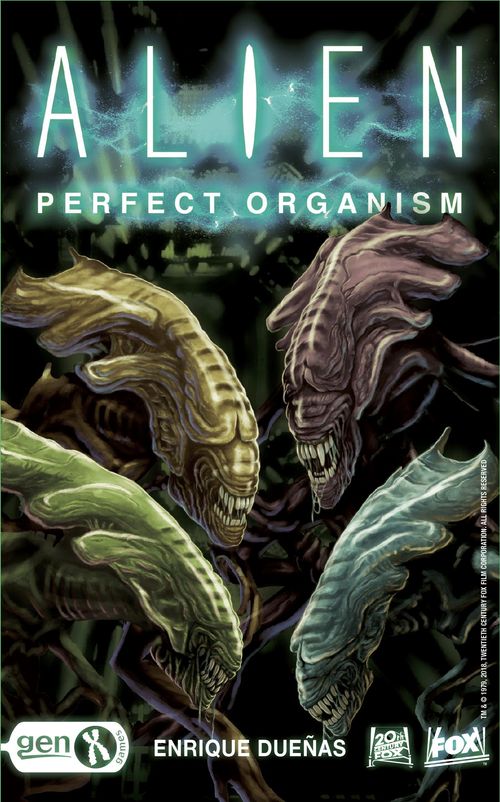
Alien: Perfect Organism
Alien: Perfect Organism Rulebook
Table of Contents
Table of Contents
The Components
- 1 Ripley card
- 1 Experience marker
Aliens
- 40 Alien cards
- 8 Eggs
- 16 Facehuggers
- 16 Xenomorphs
- 12 Tunnels
- 4 Expansions
- 4 Alien Queen boards
- 44 Wound tokens
Colony
- 24 Human cards
- 15 Colonists
- 6 Marines
- 3 Elites
- 4 Expansions
- 3 Laboratories
- 2 Canals
- 4 Newt cards
- 6 Furious Ripley cards
The Objective
In Alien: Perfect Organism you have to increase the size of your hive until it is big enough to hold 2 Expansion cards. For that you need enough space for 4 Xenomorphs in your hive and your tunnels. You can also win the game by eliminating the other Queens, but for that you will also need a good troop of Xenomorphs. Don't forget to protect yourself from the attacks of the others while you are planning how to be the Queen supreme on LV-426.
Aliens
Alien Cards
The Alien cards show the following information:
- Name: This is the name of the creature which can be Xenomorph, Egg, or Facehugger.
- Conditions: To place certain cards (Xenomorphs, Facehuggers) in your hive, it has to contain what the conditions state. Example: To place a Xenomorph in your hive, it has to contain a Facehugger and a Human.
- Strength: This number indicates the creature's strength when attacking or counterattacking during a fight. Only Xenomorphs and Queens can leave the hive for a fight; Facehugger can fight in a counterattack in their hive.
- Life: Alien creatures can endure some damage which is very useful in a fight. The amount of damage they can take before they are eliminated is indicated by this number.
Types of Alien Creatures
- Xenomorphs: have 4 life points and a strength value of 2. To place them in your hive, you need 1 Facehugger and 1 Human in your hive (they can be in different tunnels). A Xenomorph covers 2 spaces in the hive.
- Facehuggers: have 2 life points and a strength value of 1. They can only fight during a counterattack. To place them in your hive, you need 1 Egg in your hive. A Facehugger covers only 1 space in the hive.
- Eggs: have 1 life point and no strength value. You do not have to fulfil any conditions to place them in your hive, except for having 1 space.
Tunnel Cards
Tunnel cards are what your hive is made of. Each tunnel gives you 4 spaces which you will need to play other cards. Tunnel cards have neither strength values nor life points. They don't have any conditions to be played.
Expansion Cards
Expansion cards allow you to regain 5 life points of your Queen. When you play the second card you immediately win the game.
To play an Expansion card you have to have 2 Xenomorphs in your hive. The cards have neither strength values nor life points, and cover 1 space in the hive.
Alien Queen Boards
The boards represent the Queens fighting for supremacy on LV-426. Each player chooses one at the beginning of the game.
Queens have 12 life points and a strength value of 3.
If a Queen loses all her life points, the player controlling her is eliminated from the game. Queens have space for 4 cards (like a tunnel) and have 2 Egg tokens at the beginning.
Colony
The Colony consists of these cards:
Human Cards
These cards represent the Humans who can become victims to the Xenomorphs. They can be caught in the colony and brought to the hives to create more Xenomorphs.
The Human cards have the following characteristics:
- Name: This is the name of the card which can be Colonist, Marine or Elite.
- Conditions: There are no special conditions that have to be met to play a Human card, except for having space in your hive.
- Strength: This number is the Human's strength when it is attacked by Aliens.
- Life: Humans have 1 life point. Once in your hive, they can be sacrificed to absorb damage during an attack from another hive.
Expansion Cards (Colony)
The Expansion cards that can be found in the colony are equal to the ones among the Alien cards. They appear in both decks so each player has a chance of getting them.
Laboratory Cards
If you attack the laboratory in the colony, you can draw two cards from the Alien deck. After that the laboratory card is discarded.
Canal Cards
The canal cards stay on your hand until you decide to use them. You can use them for one of the following actions:
- Choose a discarded Alien card and add to your hand. Shuffle the discarded cards after that.
- Pass the Newt card to the player to your right.
After using the canal, the card has to be discarded.
Newt Cards
If Newt appears in the colony during your turn, you have to take her and put her next to your hive. She does not take up any space in the hive. It is very risky to have Newt because when Furious Ripley shows up, she will attack you.
There can only be one Newt on the table. This means that if you have Newt and another player draws another one, you can discard yours.
Furious Ripley Cards
When a Furious Ripley appears in the colony and a player has a Newt card, Ripley attacks that player. Her strength is indicated on the experience track of the Ripley card.
The Ripley Card and the Experience Track
The experience track indicates how much strength Ripley has when she attacks. Raise the experience track for one step after each time she attacks.
The Set-Up
Each player takes one Alien Queen board and two Egg tokens and places them in front of them. This now makes up their hive.
Separate the Alien and the Colony cards. Shuffle the Colony cards and place them in a face-down deck in the center of the table. Open the first 3 cards from the deck and place them next to it. These cards of the colony are now available. If you opened a Newt or Furious Ripley card replace them with new cards, and shuffle the other ones back into the deck.
Place the Ripley card open next to the Colony deck. Put the experience marker on the lowest position of the track.
Shuffle the Alien cards and place them in a face-down deck close to the Colony deck.
Chose a starting player. That can be any player or the youngest player.
Deal 2 Alien cards to the starting player, 3 to the second player in clockwise direction, 4 to the third player and 5 to the fourth player.
Discarded Cards
Leave some space in the center of the table to form two discard decks: One for the Colony cards and one for the Alien cards. The two decks shouldn't be mixed.
How to Play
The game is played in an undetermined amount of rounds. A round ends when all players have played their turn. It is played in clockwise direction.
Each turn consists of two phases:
- Growth
- Fight
Growth Phase
During the Growth phase you can do up to three actions:
- Draw a card from the Alien deck.
- Play a hand card to your hive.
- Discard any amount of hand cards.
You can have a maximum of 8 hand cards. If the limit is reached, you have to discard cards first before you can draw new ones.
When playing a card to your hive, make sure you have enough space. Don't forget that some cards have conditions that have to be met when you can to play them. If you want to play a tunnel to expand your hive, you can just place it on the table from your hand.
Example: You want to play a Xenomorph card. For that you need to have 1 Human and one Facehugger in your hive. Discard the Human and the Facehugger and place the Xenomorph on two empty spaces.
You can perform the actions of the Growth phase in any order you want and none of them is obligatory. Once you do an action you can decide to repeat it at that moment. You cannot repeat a former action after another action.
You may rearrange your hive at any time, for example to create two adjacent spaces for a Xenomorph.
Fight Phase
The Fight phase is optional. During this phase you can attack one of the following places once:
- The Hive of another player
- The Colony
Only Queens and Xenomorphs can leave the hive to attack. You cannot attack with Facehuggers, Eggs or Humans, but they can absorb damage when you get attacked.
You cannot attack with any hand cards, but only with cards that are already in the hive.
When you want to attack, you first have to decide with which creatures you are going to attack. You can mark these by sliding them up slightly in your player zone.
After the attack you may receive damage, too. Only your creatures that performed the attack can take damage now.
Attack Another Player's Hive
When you decide to attack another hive, choose the creatures you want to attack with and sum up their strength. The sum is the total damage you can make to the other hive. The player of the other hive can distribute the damage on all the creatures and Humans in there. For each strength point from the total damage they take, they place a Wound token on the cards in their hive. If any creature or Human receives as much damage as it has life points, it is eliminated and the card goes to the discard pile.
After that, the defending hive can make a counterattack: Sum up all strength points of your Queen and all your Xenomorphs plus one. That is the total damage you can make in your counterattack. The other player can distribute the damage only between the creatures that attacked the hive in the first place.
Example: Christina decides to attack Enrique with 3 Xenomorphs and her Queen. Her strength points sum up to 9. Enrique distributes these 9 points between 2 Eggs, 1 Human and reparts the remaining 6 points between his Xenomorphs and his Queen. He has to discard the 2 Eggs and the Human from his hive. Now he adds up his strength points for his counterattack: 4 (from 2 Xenomorphs) plus 3 (of his Queen) plus 1 (for the counterattack). The total sum is 8. Christina has to distribute these 8 points between her 3 Xenomorphs and her Queen.
Attack the Colony
Attacking the colony is necessary during the game, as it is the only way to get Humans and create more Xenomorphs.
The attack is similar to attacking another hive. Choose the creatures you want to attack with and the card from the three open Colony cards which you want to attack. Depending on the card the following things happen:
- Human Cards: Some Humans (Marines and Elites) counterattack. When you choose one of them as your target, they attack you, too, even if you are strong enough to kill them. So before taking the card in your hand, you have to distribute the damage they make among your attacking creatures.
- Expansion Cards: If you choose this card, take it to your hand cards. You can play it in a following turn if you meet the conditions (you have to have 2 Xenomorphs already in your hive). Remember that playing the second Expansion card means you win the game. They occupy only 1 space in your hive and they allow you to heal 5 damage points of your Queen.
- Laboratory Cards: If you chose a Laboratory, simply discard it and draw 2 Alien cards from the deck. Keep them in your hand cards. You cannot perform this action, if you already have 8 cards in your hand.
- Canal Cards: If you chose a Canal, add it to your hand cards. You can play it during your turn, instead of another action.
After the attack is over, refill the Colony cards up to three. Nothing happens, as long as you don't open a Newt or Furious Ripley card. If you do open one of them, enact the following steps:
- If you open a Newt card, you have to place it in your player zone, next to your Queen.
- If there was already another Newt card on the table, that Newt is discarded. There can only be one Newt at any time.
- If you open a Furious Ripley card, the player who has Newt is attacked, even if it is not that player's turn. They have to distribute the damage Ripley makes between their creatures in their hive (see Furious Ripley below). After that Furious Ripley and Newt are discarded.
Refill the open Colony cards, as now there is still an open space on the table.
- If you have opened a Newt card while refilling the colony you still have to refill it up to three cards. If now you open a Furious Ripley, she attacks like described above.
- If you open a second Newt card, she is discarded and you open another Colony card until you open a card that is neither Newt nor Furious Ripley.
- If you have opened Furious Ripley, and she shows up again, she does not attack again. You can discard her and open a new card from the Colony deck until there are three.
After that your turn is over and the next player plays their turn.
The Life Cycle
At the beginning of the game, you only have one Queen. Throughout the game your hive will grow.
To win the game you need Xenomorphs. To get Xenomorphs you have to follow these steps:
- You need 1 Egg. You have 2 at the beginning of the game.
- After that you discard 1 Egg token or card from your hive to get a Facehugger which simulates the hatching of the Egg.
- To finally place a Xenomorph in your hive, you need 1 Facehugger and 1 Human in your hive. Discard those two, and replace them with the Xenomorph.
You can find all cards you need in the Alien deck, except for the Humans. To get them you have to attack the colony.
Furious Ripley
Ripley is going through the colony to find Newt. She can show up, while you are refilling the Colony cards. If that happens, the player who currently has Newt is attacked.
The damage Ripley deals is determined by the position of the Experience marker on the Ripley card. The marker is moved up, every time she shows up and attacks a player (not if she is discarded without any effect). Players cannot counterattack or avoid the damage Ripley is making.
Her total strength is always 2 more than indicated on the track. So the first player to be attacked receives 2 + 2 damage (4 in total). Then the token is moved up one space. The next player receives 3 + 2 damage (5 in total), and so on and so forth.
In the example on the image the player who is attacked by Ripley receives 3 + 2 = 5 damage, and can distribute the damage between all their creatures in their hive.
If Ripley shows up during the set-up, the card is returned to the Colony deck and replaced by another card. Shuffle the Colony deck again.
If Furious Ripley shows up and no player has Newt, Furious Ripley is discarded and another Colony card is opened.
If Furious Ripley shows up twice during the same turn of one player who already received damage, she is discarded and a new Colony card is opened.
The Experience token is only moved upwards if Ripley attacked a player.
End of the Game
The game ends if one of the two things happen:
- There is only one Queen standing.
- One player placed the second Expansion card in their hive.
The game ends immediately when any of the two things happen and the Queen of the winning player rules over LV-426. Long live the Queen!