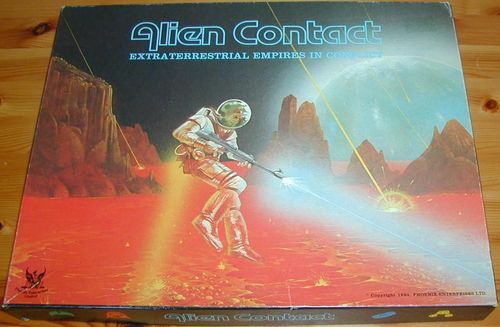
Alien Contact: Extraterrestrial Empires in Conflict
Alien Contact: Extraterrestrial Empires in Conflict Rulebook
Table of Contents
Table of Contents
Introduction
After many millenia of costly and exhausting warfare over the exploration and exploitation of the uncharted star sectors of the universe, the six most powerful races of star travellers negotiated an armistice to resolve those issues at the conference table which they had been unable to settle by force of arms. These negotiations, conducted on the planet Diaspora, resulted in a treaty which created a Council of Six empowered to formulate equitable procedures governing all future exploration and exploitation activities of the six powers.
The deliberations of the Council of Six were successful in drafting the Articles of Conquest which would govern the activities of the six races in the unexplored regions of the Universe.
Articles of Conquest
Article 1
Each new area of conquest will be divided into quadrants for the purpose of determining the Council Chancellor. The Chancellor's race enjoys certain advantages in the contests waged during his tenure in office.
Article 2
Based on their respective status at the conclusion of the first four contests, each of the six races will be awarded council votes to be cast for the election of a Chancellor of the Council (see Victory Conditions). The Chancellor of the Council will be of the race controlling the largest number of council votes at the conclusion of each term of four contests, and will hold office during the next term (of four contests).
Article 3
All participating races will begin each contest with equal numbers of star bases, star ships and space marines and like technology levels.
Article 4
All participating races will start each of the first term of four contests (during which there is no Chancellor) by random placement of their starting forces in the quadrant to be explored.
Article 5
5.1) When a Chancellor has been determined, his race may choose its starting position after all of the other participating races have been randomly placed for any one contest of the four occurring during the term of his Chancellorship. In the remaining three contests of that term, the Chancellor's race will be randomly located with the other participating races.
5.2) If a Chancellor is chosen from the same race for two consecutive terms, the Chancellor's race may choose its starting position following the random placement of all other participating races in two of the four contests during the Chancellor's second term.
5.3) When a representative of the same race is selected for a third consecutive term he is immediately given Chancellor Emeritus status and retires from office. The entire selection process then begins anew (see Article 2).
Article 6
These articles are mutually binding among all of the signatories to the Treaty of Diaspora and are to be implemented in accordance with the rules governing exploration, exploitation and all other activities in the unexplored regions of the universe including Alien Contact!
Components
2.1) Description of Units
- Space Marine
- Environmentally Protected Space Marine (EPSM)
- Pirate
- Space Ship (shown by Technology Level, T.L.)
- Space Station (shown by Technology Level, T.L.)
2.2) Unit Capabilities
2.21) Space Ships - Space ships are used for the protection of space stations, transportation of diplomats and space marines, and to combat alien fleets or space stations. Space ships may be of Technology Levels 1, 2, or 3.
2.22) Diplomats - Diplomacy occurs in the Resource segment of every third term. Diplomats conduct all negotiations between players including such things as the exchange of resources, star colonies, etc., and all alliances or other agreements between players.
2.23) Space Marines - Space marines conquer, occupy, exploit, and defend star areas with breathable atmospheres to secure resources for the owning player. They may have combat with hostile space marines only.
2.24) Environmentally Protected Space Marines (EPSM) - EPSM's have the same functions as regular space marines, but also have the additional capability of functioning in star areas with unbreathable atmospheres.
2.25) Space Stations - Space stations control the air space of the area in which they are located and are the sole sources of production. Space stations have no movement capability, but may engage in combat with hostile space ships. Space stations may be of Technology Levels 1, 2, or 3.
2.26) Pirates - Pirates are privateer space ships which prey upon the shipping lanes, primarily, but not exclusively, of alien empires much as did Drake, Hawkins, and other English sea dogs of the 17th century.
2.27) Double Star - This counter represents the second star which may, under certain conditions, be placed in a star area to increase production resources (See Explanation of Cards, Card # 11).
2.28) Color Indicator Mark - Each player receives one counter for each star color on the map to be used on the resource point track. To record by color the current numbers of stars controlled.
2.29) Player Aid Card - A Player Aid Card for the player representing each color in the game is included in the game equipment presenting in convenient tabular form the following data:
a) Resource Point values of each star color - these point values are used in the computation of resource point totals available to the player.
b) Numbers of stars of each color necessary for that player to build at each technology level.
2.30) 0, 00, 000 Counters - See 8.33.
Set-up and Preparation for Play
3.1) Each player rolls a die. Then in sequence from the high number to the lowest, the players select a color representing their respective races.
3.2) All players begin the game with Level 1 acquired technology and the following equipment:
- 1 pirate
- 1 Tech Level 1 space station
- 5 Tech Level 1 space ships
- 5 regular space marines
- 1 player aid card in the color representing the player's race.
3.3) Place all Resource Point Track markers at zero and the Acquired Technology Level marker at one (1). Shuffle the deck of random event cards and place face down on the table.
3.4) To determine their respective starting positions, each player will make 2 die rolls, the first roll representing increments of ten and the second roll to be read as ones (i.e. The Blue player rolls a "7" followed by a "1". His starting location would be Area 71). Players should now place their playing pieces on the appropriate area on the map. No two players may ever start a contest in the same area. Any player who rolls the number of an area already occupied by another player must continue to roll until the number of an unoccupied area is obtained.
3.41) If the campaign scenario is being played, the Chancellor may choose his starting position (see Article 5.1, 5.2).
3.5) To determine the order in which the players will move, each player will roll a die. The highest number moves first with player turns proceeding clockwise around the table from the starting point.
Sequence of Play
4.) Sequence of Play
TURN SEQUENCE
- Pirates
- Movement
- Combat
- Resource Phase*
- (a) Draw Card
- (b) Diplomacy
- (c) Collect Resources
- (d) Build
*Resource Phase every third turn only.
Pirates
5.1) Each player controls the pirate of his own color. The pirate is basically a privateer/free-booter type who preys on any target of opportunity including ships of his own race.
5.2) Starting locations for pirates are determined as in 3.4, however no pirate may begin play or subsequently enter any area containing a space station of any color.
5.3) Pirates may move up to one area per turn, at the beginning of his race's phase of the game turn before any other pieces of his color are moved.
5.4) Upon completion of the pirate's movement phase, he may attack any one space ship of his choice in the area he occupies. The pirate will always make one attack whenever he moves into an area containing another ship of any color, including his own. The pirate is not subject to any return of fire at this time.
5.5) Pirates may be attacked and defend themselves as other ships do during the combat phase of any player's game turn.
5.6) Pirates destroyed in combat may be rebuilt at a cost of 10 production points during the build phase of any subsequent turn of the controlling player's color. The pirate is then located in any unoccupied area of the owning player's choice during the build phase of the turn in which he is built.
Movement
6.1) During each player's phase of the game turn, the phasing player may move all, some, or none of his playing pieces up to the full movement allowance of each piece.
6.2) Space marines and diplomats move from one area to another only via space ship.
6.21) To load a space ship, place the counter to be transported on a space ship counter in the area containing them. The transporting space ship need not start or end its movement in the area in which it loads or unloads, needing only to enter the area containing the counter to be transported.
6.22) Loading and unloading incurs no cost to the movement of either the space ship or the counter transported.
6.23) Units are off loaded at their destination by moving the space ship transporting them into the destination area and placing the units on the destination star or space station. The space ship may then continue to move after unloading if it has any unexpended movement allowance remaining.
6.24) Space marines and diplomats are assumed to be aboard the space ship as long as their counters are stacked on the space ship counter.
6.25) Space marines and diplomats may be offloaded only in areas containing a star or a space station.
6.26) Transfers between space ships may be performed when the ships involved are in the same area at the end of the movement phase.
6.3) The movement allowance of space ships is one area per Technology Level of the ship.
6.31) Pirates may move up to one area per turn.
Combat
7.1) Combat occurs only when space fleets or marines of different races are in the same space area at the conclusion of the phasing player's movement phase. Combat is always voluntary at the option of any player owning units in the area capable of combat. Combat may occur between opposing space ships, or space ships and space stations, or opposing space marines only. Space marines may engage in combat only on stars.
7.11) Battles are resolved one at a time in any order desired by the moving player. Combat may consist of one or more rounds with results assessed simultaneously at the conclusion of each round.
7.12) Round of Combat and Combat Resolution:
7.121) To begin each round of combat, each player places all of his units in that space area in opposing lines of battle in any desired order. Both players then select the enemy ships to be fired upon and designate which units are to fire at each target indicated prior to any firing. Fire may not be shifted to a different target during that round after firing commences. Fire effects are determined by rolling a die and cross-referencing the resulting number with the firing unit type and target type. Fire effects are assessed after all firing by both players is completed for the round. One hit destroys the target, misses have no effect. Any retreats after combat may then be affected, also any desired unloading or loading provided no hostile space ships remain in the area.
7.122) Following all combat involving space ships, any desired land combat is resolved in the same manner as for space ships. Space marines landed following space ship combat may participate in combat on the turn they land. Retreats after combat may be made to ships of their own color by space marines at the conclusion of any round of land combat.
7.123) Space Station Modifier - When a space station fires at a space ship, a modifier of minus one (-1) is applied to its die roll.
7.2) Retreat after Combat - Either player may elect to retreat after any round of combat subject to certain conditions.
7.21) Space ships may retreat following any round of combat to any one adjacent space area in accordance with the following priorities:
a) An area containing other units of his color only.
b) Any vacant area.
c) An area containing units of any other color.
If a player elects to retreat, he must move all of his space ships out of the area being evacuated.
7.22) Space marines may retreat after combat only if there are space ships of their color available in that space area with sufficient capacity to transport the entire force to be evacuated. Either all marines must be evacuated or they must all remain and fight until they can all be evacuated at the conclusion of a combat round.
7.23) If a player retreats into an area containing space ships or a space station of another color, the other player may either allow the retreating player to enter freely or attack immediately.
7.3) Combat Involving Transports - Any combat to be fought in a given space area always precedes any unloading of space marines or diplomats in the contested area.
7.31) Space marines aboard space ships are destroyed if the ship is lost while they are in transit.
7.32) If a ship containing a diplomat is destroyed:
a) by a hostile player, the diplomat is captured and held for ransom.
b) by pirates or a meteor shower, the diplomat is destroyed and may be replaced during the Build Phase of any subsequent turn at a cost of 25 resource points.
7.33) Ransom - If a diplomat is captured, he must be ransomed by the owning player during the next Diplomacy phase by payment of resource points to the capturing player. To determine the amount of the ransom, roll a die and multiply the result by five (5). This quantity of resource points must be paid to the captor prior to any other expenditure if available. If the full amount of the ransom is not available, all available resource points must be paid to the captor on the first Diplomacy phase and the balance paid in any manner mutually agreeable to the captor and the owning player.
7.4) Combat versus Pirates
7.41) Pirates will make one attack on any one ship in the space area in which they end their movement without taking any return fire at that time (see 5.4).
7.42) During the Combat phase of each turn, the phasing player may, at his option, fight one round of combat with any pirate ship of any other color using any of his ships in the area. The pirate may return fire against any one of his attackers. There is no retreat after combat for either the phasing player (attacker) or the pirate.
7.43) Pirates attack at Technology Level 1 and defend at Technology Level 3.
Resources
The Resources phase will occur on every third turn, beginning with Game Turn 3 (then 6, 9, 12, etc.).
8.1) Draw and Play Cards - Included in the game is a deck of 72 cards describing events which may affect any player's game situation either favorably or adversely. These cards are to be shuffled and placed face down in a convenient place on the game table prior to beginning play.
8.12) At the beginning of the Resources phase of any turn containing one, the phasing player will draw one card.
8.13) Card numbers 1 through 7 must be played and the results applied immediately as described on the card.
8.14) Card numbers 8 through 12 may either be played immediately or saved by the drawing player to be played and applied during the Draw and Play Cards segment of any subsequent turn.
8.2) Diplomacy - All negotiations between players, except ransom terms, must be conducted only during the Diplomacy segment of those game turns containing a Resources phase.
8.21) Diplomatic negotiations are performed only through the Diplomats representing each color. Diplomats of the color of each player desiring to conduct diplomacy must be physically on the same star or space station at the start of the Diplomacy segment of the turn. Any desired negotiations may then be conducted.
8.22) Diplomatic agreements may cover the following subjects:
a) non-aggression pacts
b) offensive and/or defensive alliances
c) transfers of resource points and stars
d) transfers of Save cards (card numbers 8, 9, 10, 11, and 12)
e) building marines, space ships, and/or space stations for another player
Existing space stations, space ships, and marines may not be transferred from one player to another.
8.23) Each player will receive one Diplomat at the beginning of the Diplomacy segment of Game Turn 3. A second Diplomat is received as soon as the resource points are paid to acquire T.L. 2.
8.3) Resource Collection - Resource collection occurs only in game turns containing a Resources phase from stars controlled by the phasing player at the beginning of the Resource phase of that turn.
8.31) Control of Stars - Control of a star is established by garrisoning it with at least one space marine able to survive in that star's environment and controlling the "air" space in that star area. Control is interdicted by the presence of pirates or space ships of any other color in the star area unless otherwise agreed by every player owning ships in the area in question during a preceding Diplomacy segment. (Pirates always interdict control regardless of any diplomatic agreements).
8.32) Resource Point Level Determination - The phasing player determines the number of stars of each color under his control, and then applies the point values given for each star color on his Player Aid Card as a multiplier (i.e. Blue owns 2 blue stars worth 2 points each and 2 white stars worth 7 points each. His resource point total is 18. The resource point total consists of the combined total points yielded by all controlled stars regardless of color.)
8.33) The resource point total is indicated on the player's Resource Point Track on the margin of the map board using the 0 (for values 1 through 9), 00 (for values 10 through 90), and 000 (for values 100 through 900) counters thus:
- 0 counter at 3 = 3
- 00 counter at 6 = 60
- 000 counter at 2 = 200
Total: 263 resource points
8.34) Star colors represent different types of resources and technological capabilities. To attain a given technology level, each Player Aid Card indicates a mixture of star colors by quantity which must be controlled by that player to attain and maintain a given technology level. Each player's acquired technology level is indicated on the Tech. Level Acquired table on the game map board.
8.4) Build - In the Build segment of the Resources phase of any turn containing one, a player may apply his accumulated resource points to build any of those items covered in the Cost to Build table below (see 8.42) or to acquire a higher technology level.
8.41) Limits on Building - All building capabilities are determined by the number and technology levels of the space stations and number and color of stars controlled by each player. If a player owns no space stations, he may not build, however he may negotiate with another player (during a Diplomacy segment) to build the things he requires for him.
8.411) The number of stars of each color controlled by each race (player) coupled with the number of resource points accumulated determines the race's (player's) production capabilities as to both quantity and technology level (see Player Aid Cards).
8.412) Building may be done only by space stations already in existence at the beginning of that game turn (Exception: new space stations acquired from playing random events card #8 may be used for building as soon as placed on the map). Space stations have building capacities according to their technology levels. This capacity is the maximum number of points which may be built at that station in any turn (NOTE: new space stations, pirates, and diplomats must be paid for from available resource points but are not charged against the building capacity of any space station).
8.421) Technology Levels 2 and 3 may be paid for in resource points (R.P.) during any Build segment and the appropriate Diplomats received, but space ships and stations of higher technology levels may not be built until the player controls the appropriate stars as shown on the Player Aid Cards.
8.43) Location of Newly Built Pieces
8.431) New space stations may be placed in any area controlled by the owning player.
8.432) Newly built space ships and space marines must start from the star area in which the producing space station is located.
8.433) Diplomats are initially placed on the board at any space station of the owning player.
8.434) Pirates, when rebuilt, are placed in any vacant area on the map, at the building player's option.
8.42) Cost to Build & Production Capacity
| Item | R.P. Cost to Build | Production Capacity |
|---|---|---|
| Space station T.L. 1 | 7 | 7 |
| Space station T.L. 2 | 12 | 12 |
| Space station T.L. 3 | 17 | 17 |
| Space ship T.L. 1 | 5 | — |
| Space ship T.L. 2 | 10 | — |
| Space ship T.L. 3 | 15 | — |
| Space marine | 1 | — |
| Environmentally protected space marine | 2 | — |
| Pirate |
8.44) Modifiers to Building Capabilities
8.441) Resource points are received only from stars controlled by each player as defined in 8.31.
8.422) To build any given technology level, the player must first acquire the technology by paying the cost in resource points: 20 for T.L. 2 and 40 to acquire T.L. 3 (These costs are paid once only for each technology level), and control the appropriate numbers and colors of stars per the Player Aid Cards. If the player does not control the stars necessary to T.L. (technology level) 1 he may build only marines. Once a higher technology has been acquired it is never lost or paid for again, even though he may not control the appropriate star mixture needed to build.
8.443) If a Diplomat is captured, the payment of the ransom must be made before any resource points are spent for any other purpose.
8.444) The limits as to numbers and kinds of pieces which may be built is established by the counters of each color available on the counter sheet.
Victory Determination
9.1) Victory is achieved by the player gaining the highest total of victory points in each contest. Victory point values are assigned to each star color for each player in the reverse order of their resource point values as shown on the Player Aid Cards.
Example: Green
| Star Color | Resource Points | Victory Points |
|---|---|---|
| Green | 2 | 7 |
| Yellow | 3 | 6 |
| White | 4 | 5 |
| Blue | 5 | 4 |
| Red | 6 | 3 |
| Orange | 7 | 2 |
To determine victory point totals, multiply the point values by the number of stars of each color controlled at the end of the contest and add these results to obtain a grand total.
9.2) Council votes are awarded to the players at the conclusion of each contest and accumulated for the 4 contests of each term to be applied in voting for a new Chancellor for the next term of the campaign as follows:
| Order of Finish | Number of Votes |
|---|---|
| 1st | 6 |
| 2nd | 5 |
| 3rd | 4 |
| 4th | 3 |
| 5th | 2 |
| 6th | 1 |
Thus, for example, a player who finishes the term with 2 first place and 2 third place finishes would earn 20 votes to be cast for Chancellor in the elections for the next term.
Player Aid Cards
Each Player Aid Card lists, for its color, the point value of each star color (Breathable Atmospheres and Unbreathable Atmospheres) and the number of stars of each color needed to build at each technology level (T.L. 1, T.L. 2, T.L. 3). A dash (—) means that the star color is not needed at that technology level.
Green Player Aid Card
| Star Color | Atmosphere | Point Value |
|---|---|---|
| Green | Breathable | 2 |
| Yellow | Breathable | 3 |
| White | Breathable | 4 |
| Blue | Unbreathable | 5 |
| Red | Unbreathable | 6 |
| Orange | Unbreathable | 7 |
| Stars needed to build | T.L. 1 | T.L. 2 | T.L. 3 |
|---|---|---|---|
| Green | 1 | 2 | 3 |
| Yellow | 1 | 1 | 2 |
| White | 1 | 1 | 2 |
| Blue | — | 1 | 1 |
| Red | — | 1 | 1 |
| Orange | — | — | 1 |
Red Player Aid Card
| Star Color | Atmosphere | Point Value |
|---|---|---|
| Red | Breathable | 2 |
| Blue | Breathable | 3 |
| Orange | Breathable | 4 |
| Green | Unbreathable | 5 |
| White | Unbreathable | 6 |
| Yellow | Unbreathable | 7 |
| Stars needed to build | T.L. 1 | T.L. 2 | T.L. 3 |
|---|---|---|---|
| Red | 1 | 2 | 3 |
| Blue | 1 | 1 | 2 |
| Orange | 1 | 1 | 2 |
| Green | — | 1 | 1 |
| White | — | 1 | 1 |
| Yellow | — | — | 1 |
Yellow Player Aid Card
| Star Color | Atmosphere | Point Value |
|---|---|---|
| Yellow | Breathable | 2 |
| White | Breathable | 3 |
| Green | Breathable | 4 |
| Orange | Unbreathable | 5 |
| Blue | Unbreathable | 6 |
| Red | Unbreathable | 7 |
| Stars needed to build | T.L. 1 | T.L. 2 | T.L. 3 |
|---|---|---|---|
| Yellow | 1 | 2 | 3 |
| White | 1 | 1 | 2 |
| Green | 1 | 1 | 2 |
| Orange | — | 1 | 1 |
| Blue | — | 1 | 1 |
| Red | — | — | 1 |
White Player Aid Card
| Star Color | Atmosphere | Point Value |
|---|---|---|
| White | Breathable | 2 |
| Green | Breathable | 3 |
| Yellow | Breathable | 4 |
| Red | Unbreathable | 5 |
| Orange | Unbreathable | 6 |
| Blue | Unbreathable | 7 |
| Stars needed to build | T.L. 1 | T.L. 2 | T.L. 3 |
|---|---|---|---|
| White | 1 | 2 | 3 |
| Green | 1 | 1 | 2 |
| Yellow | 1 | 1 | 2 |
| Red | — | 1 | 1 |
| Orange | — | 1 | 1 |
| Blue | — | — | 1 |
Blue Player Aid Card
| Star Color | Atmosphere | Point Value |
|---|---|---|
| Blue | Breathable | 2 |
| Orange | Breathable | 3 |
| Red | Breathable | 4 |
| Yellow | Unbreathable | 5 |
| Green | Unbreathable | 6 |
| White | Unbreathable | 7 |
| Stars needed to build | T.L. 1 | T.L. 2 | T.L. 3 |
|---|---|---|---|
| Blue | 1 | 2 | 3 |
| Orange | 1 | 1 | 2 |
| Red | 1 | 1 | 2 |
| Yellow | — | 1 | 1 |
| Green | — | 1 | 1 |
| White | — | — | 1 |
Orange Player Aid Card
| Star Color | Atmosphere | Point Value |
|---|---|---|
| Orange | Breathable | 2 |
| Red | Breathable | 3 |
| Blue | Breathable | 4 |
| White | Unbreathable | 5 |
| Yellow | Unbreathable | 6 |
| Green | Unbreathable | 7 |
| Stars needed to build | T.L. 1 | T.L. 2 | T.L. 3 |
|---|---|---|---|
| Orange | 1 | 2 | 3 |
| Red | 1 | 1 | 2 |
| Blue | 1 | 1 | 2 |
| White | — | 1 | 1 |
| Yellow | — | 1 | 1 |
| Green | — | — | 1 |
Card Explanations
Card 1. Meteor Shower - The player drawing this card rolls the die once for tens and once for ones; this will locate the area in which the meteor shower will occur. If there are any ships in the area the die is rolled once for each ship in the area. On a roll of 1 - 5 the ship is destroyed. A roll of 6 - 10 will have no effect.
Card 2. Black Hole - When this card is drawn roll the die twice for the location of the area the black hole appears. If any ships are in this area they will be relocated to a new area (if no ships are in the area the card has no effect). Roll the die twice to find the number of the new area.
Card 3. Magnetic Storms - All ships in an area will be dispersed (roll for location). If there are any ships in the area relocate each ship individually to a new area.
Card 4. Virus - The player drawing this card will have a virus appear on one of his stars of the color indicated by the card. If he has no stars of this color or he has environmentally protected marines on the star the card will have no effect. If he has any regular space marines on the star he has chosen they are eliminated.
Card 5. Alien Life Form - Any player drawing this card will have an alien life form destroy all of his marines on one of his stars of the color indicated by the card.
Card 6. Revolt - One of the stars that the drawing player controls will revolt (player's choice). All marines on the star will be replaced with like marines of the color indicated by the card. The new marines will then be controlled by the player using the color. When the new color indicated is not in use the marines are placed on the map anyway, and they will attack any player that lands on the star.
Card 7. New Production - Any player drawing this card increases his resource production track by 25 points immediately.
Card 8. Space Station - One free space station is placed in any area controlled by the drawing player. The player may not select a station of a higher tech level than he has acquired at the time the card is played.
Card 9. Gain Ship - One space ship of the tech level indicated by the card is placed in any area controlled by the drawing player, even if he has not acquired the technology for constructing the new ship.
Card 10. Marines - Five new marines of either type are placed on any space station or star the drawing player controls.
Card 11. Double Star - The drawing player places the star counter of the color indicated by the card on any star of the same color anywhere on the map. This will double the point value of that star for the remainder of the game regardless of the number of times the star may change hands.
Card 12. Assassination - An assassination attempt may be made on any diplomat of the player indicated by the card. This card may be saved and played at any time the drawing player chooses. If the drawing player draws his own color the card may be used to make an assassination attempt on any diplomat in the game (WILD CARD). When an assassination attempt is made a roll of 1 - 6 will eliminate the diplomat; a roll of 7 - 10 has no effect. If there are other diplomats on the same ship or star roll the die once for each of them. A roll of 1 - 3 will eliminate other diplomats. When a WILD CARD is played the owning player must choose the color he wishes to assassinate; the card is then used normally.
Errata
The green player has been inadvertently shorted two x2 EPSM's and has two extra x1 EPSM's. Please make the necessary corrections before starting play.