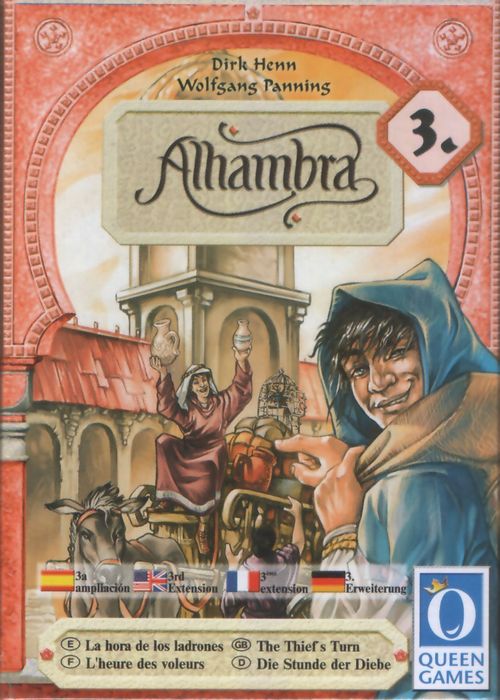
Alhambra: The Thief's Turn
Alhambra: The Thief's Turn Rulebook
Table of Contents
Table of Contents
The City Walls
The "City Walls" module enables players to add to, or close holes in, their city walls. There are 12 city-wall segments. However, to use a city-wall segment, the player first has to acquire the corresponding city-wall card.
Equipment
8 playing cards, each showing a particular segment of wall; 12 wooden city-wall segments which are added to the player's own Alhambra wall, according to the instructions on the respective city-wall card.
Getting Ready to Play
When the money cards in the original game are divided into five piles at the start of a game, two city-wall cards are inserted into the 2nd, 3rd, 4th and 5th pile. The wooden city-wall segments are placed ready next to the building market.
How Do the City-Wall Cards Enter the Game?
If the top card taken from the money pile is a city-wall card, it is placed face-up next to the board. (Several cards may be lying face-up next to the board at any one time.) A card is taken from the pile and added to the money cards next to the building market to make them up to 4 again.
From now on there is an additional move available: build a city wall.
This move is available in addition to the three possible moves from the original game: take some money, buy and position a building tile or redesign your own Alhambra.
Building a City Wall
A player may take any face-up city-wall card. The player now builds the walls on any of his tiles; he uses one or two of the wooden city-wall segments, as shown on the card.
It does not matter whether the tile has been newly bought, is in the Alhambra, or is in the reserve. Players are not allowed to build over the printed walls.
The new city wall(s) cannot be redesigned any more until the end of the game and, as with the printed walls, belong(s) to the building tile.
Notes
- Players can build city walls on any appropriate building tile of their Alhambra, including on the starting fountain.
- During scoring, the city walls count the same as the printed walls on the building tiles.
- After building a city wall, the Alhambra must still be built according to the building rules.
- During the building of a city wall, it does not matter whether the tile the wall is positioned on has a printed wall or not, as long as the player does not build over the walls depicted on the building tiles.
- Wooden city gates [2nd extension] can only be used to build over printed walls.
The Thieves
"The thieves" are twelve new playing cards which can be picked up. They enable players to pick up money cards of a certain currency when it is another player's turn. However, only one card can be taken no matter what value it is. After using the thief card, it is removed from the game.
Equipment
12 playing cards, 3 in each of the 4 currency colours. Each card shows a thief and the currency which he can steal.
Getting Ready to Play
The thieves are shuffled and dealt face-down to all players:
With 2 and 3 players each player receives 4 thieves; with 4 players each player receives 3 thieves; and with 5 and 6 players each player receives 2 thieves.
Thieves which have not been dealt out are removed, face-down, from the game.
How to Use the Thieves During the Game?
Every time a move is completely over, a player may interrupt the normal order of moves and, as a special move, use his thief by picking up one of the face-up money cards in the currency depicted. The thief that has been played is then removed from the game.
The only exception: A player cannot use a thief before his own go.
Notes
- A player may play several thieves at the same time. After each thief is used, the card he has taken is replaced so that there are 4 face-up money cards once more.
- A player may only take one money card for each thief he plays. Players are not allowed to take several money cards with a combined value of up to 5.
- If several players want to take a certain money card at the same time, the player who is first in the order of play has priority. (The player whose turn it is would be the first - the player who has just ended his go would be the last in this order of play. Note: the player whose turn it is may not play a thief.)
- If a player wants to play the Vizier [1st extension], and another wants to play a thief, the order of play decides in this case as well. (See above) But a player is allowed to first play a thief and then the vizier counter. (Note: the player whose turn it is may, however, only play the vizier counter.)
The Change
The "Change" module makes small change part of the game. If a player pays too much for a building, he now receives change. The player can buy buildings with the coins, just as with the money cards. They make it easier to pay the correct amount of money for buildings.
Equipment
24 coins in the 4 currencies, each with a value of 1; 1 bag.
Getting Ready to Play
The coins are put in the bag and the bag is placed in easy reach of all players.
Who Is Given Change?
If a player pays too much when buying a building, he is then entitled to change. For every two money units he pays in excess of what he had to pay, the player can take one coin from the bag.
Example: a player pays 17 of the blue currency for the tower although it only costs 10. He has paid 7 units too much. He can therefore take 3 coins from the bag.
The coins lie face-up in front of the players. They have a value of 1 and are used like notes of the corresponding currency. If a player uses coins to pay, the coins are returned to the bag once they have been used.
Notes
- The bag may be empty at some point during the game. In this case no change is given.
- It is permitted to deliberately pay far too much in order to obtain more coins.
- Players also receive change if they pay too much to obtain character cards or to buy a camp [2nd extension].
- Change is also given if too many diamonds are paid [2nd extension].
- When, at the end of the game, the building tiles remaining in the building market are distributed to the players who have the most money in the corresponding currency, the players include the coins when adding up their money.
The Street Trader
The "Street Traders" module means that citizens can gain entry to the buildings of the palace. Extra points are awarded for them during the scoring rounds. Skill in placing the trader tiles is required, as every time a street trader has to make way for a building, an citizen of the right colour can move in.
Equipment
42 wooden citizens, 7 in each of the 6 building colours; 6 circular trader tiles.
Getting Ready to Play
Before the building tiles are placed in the building market, each player is given a trader tile and an citizen of each colour. The player secretly chooses three of these citizens and places them on his trader tile. All other citizens go to form the general stock and are laid ready next to the building market. Each player places his trader tile with the three selected figures on any side of his starting fountain.
How Do the Citizens Gain Entry to the Buildings?
If a player builds a building where a trader tile has been placed (either new building work or if he is redesigning existing building work), the trader tile is first laid to one side. If the colour of the building matches the colour of an citizen on the trader tile, the player can place this citizen on the building tile.
Now he chooses a new citizen from the general stock and positions him on his trader tile. If the general stock has been used up, no new citizen can be taken.
If the colour of the building does not match any of the colours of the citizens on the trader tile, the player can exchange an citizen from the general stock for one of the citizens on his trader tile.
In both cases, the trader tile is, at the end of the move (after the building work) placed on a free square again next to any building tile of the player's own Alhambra.
Points for the Citizens
Points are awarded for all citizens on building tiles; the points differ depending on the series of different colours.
A series consists of:
- 1 colour = 1 point
- 2 colours = 3 points
- 3 colours = 6 points
- 4 colours = 10 points
- 5 colours = 15 points
- all 6 colours = 21 points
Example: a player has a total of 3 red, 2 white, 2 green and 1 blue citizen in his buildings. He therefore has three series, which bring the following points: 10 points are awarded for the "red-white-green-blue" series, which uses 4 different citizens; 6 points are awarded for "red-white-green", which uses 3 different citizens; and 1 point is awarded for "red", made up of one citizen. Overall the player is awarded 17 points.
Notes
- Several citizens of the same colour can be on the trader tile, but only one of these citizens may move into a building at any one time.
- A building can be built where a trader tile is positioned even if the colour of the citizens does not match the building colour. In this case, no citizen moves into the building.
- If a building with an citizen is dismantled, the citizen is returned to the general stock.
- When placing the trader tile, only one of the building rules of the basic game counts: the ban on building "diagonally".
- Citizens may not be placed on workers' huts [1st extension].