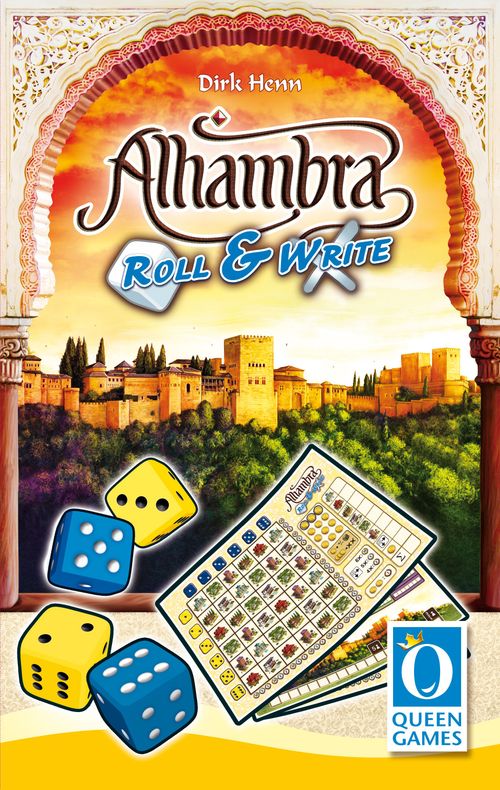
Alhambra: Roll & Write
Alhambra: Roll & Write Rulebook
Table of Contents
Table of Contents
Components
- 1 Game pad with player sheets – 100 double-sided pages
- 1 Score pad – 25 double-sided pages
- 12 Dice – 6 each of blue and yellow
- 1 rules booklet
Setup – for 3-5 players
-
Each player takes 1 sheet from the game pad, 1 blue and 1 yellow die, and a pen (not included).
-
Randomly choose a first player. That player takes one sheet from the score pad and writes down the names of the players in the first column of the player chart.
-
Starting with the first player and continuing clockwise, each player rolls both their dice, placing them on the dice spaces and crossing out the resulting intersection on their player sheet.
Note: Marking off a square will be referred to as "constructing" from here on.
As each player does so, the first player should indicate the type of building constructed by marking on the score sheet (filling boxes from left to right). This will make it easy for all players to see how many buildings have been built of each type, and by which players.
Repeat this process until each player has constructed three buildings on their player sheet; if a player would have to mark a building that has been crossed out already, they roll again until they get a building that has not yet been constructed.
Finally, each player rolls their dice again and places them on the corresponding dice spaces next to their grid: the yellow die to the left and the blue die on the top.
Changes in setup for a 1 or 2 player game; see the "Special rules for 1 or 2 players" section below.
The player sheet layout includes: dice spaces, a VP chart, constructed buildings, a round track, a supply of coins, spaces for special actions, VPs for rows & columns, VPs for coins, and the grid of buildings.
-
The first player takes one blue and one yellow die in addition to the ones they just placed, rolls them, and places them next to their grid on the appropriate spaces as well. If a space is occupied by a die already, the second die is placed on top of the first.
-
Players start the game with 3 coins, which come pre-marked on the player sheet. When a player uses a coin for a special action, they simply cross out a circled coin.
Any remaining dice are not used for this game and should be returned to the game box along with the player and score pads.
Playing the Game
Alhambra Roll & Write is played over a fixed number of rounds, the exact number depending on the player count.
| Number of players | 5 | 4 | 3, 2, 1 |
|---|---|---|---|
| Number of rounds | 12 | 15 | 18 |
During each game round, the first player begins, with the other players following in clockwise order. Each time the first player performs their turn, they cross off the current round of the round track on the points sheet.
On their turn, the active player must choose between two actions:
- Construct one building, or
- Gain coins
In addition to the chosen action the player may spend coins to perform a special action.
The active player's turn ends after completing their action, and the next player takes their turn. The game ends after the final round has been played, and play then proceeds to final scoring.
A Player's Turn in Detail
The player must choose to perform one of two possible actions:
Construct building
The player chooses one square that is the intersection of one blue and one yellow die — if all 4 dice are on different spaces, they will have 4 intersections to choose from.
A player is not allowed to choose an intersection where the building has already been constructed. If all possible intersections have been constructed already, the player must choose the action Gain coins.
The building on the chosen space is crossed out (constructed), and the first player marks the next empty box (from left to right) in the column for that building on the active player's row.
Example: Frank can choose between three buildings to mark this turn. One intersection already shows a marked building.
If a player constructs the last building of a type, which can be seen when the last building of that type is marked on the score sheet, they score the VPs indicated for 1st place (if available) for that building type at the end of the round. If more than one player constructs all of the buildings of one type in a round, add together the numbers for all tied places and divide equally among the players, rounding down. Any player finishing a building type in a later round would score for second place, then third place in the same manner. Scored VPs are indicated next to the corresponding building on the VP chart on their player sheet.
Note: Players should cross off this scoring on the score sheet to ensure it is not scored again at the end of the game.
Example: Patricia and Frank managed to cross off each box in the seraglios column in the same round. They now split the points for first and second place and each gain 13 victory points. (26 total, split two ways, 26:2 = 13 VPs each.)
Finally, the player removes the two dice from their player sheet that were used to construct the building.
The two remaining dice are passed to the next player clockwise, making sure to not change their number.
Example: Patricia gives her unused pair of dice to her left hand neighbor, Frank. Frank places the dice onto his dice spaces without changing the numbers shown.
The passed dice should be placed on the next player's sheet in the appropriate spaces. In case a space is occupied already, put the second die on top of the first.
The active player now rolls the dice they kept in front of them and places them on their respective dice spaces.
Play then passes to the next player (the only player with 4 dice on their player sheet).
Gain coins
The player looks at the intersection of all 4 dice and gains one coin for each building already constructed on these intersection points.
Note: If a constructed building falls on 2 or 4 intersections, the player will receive 2 or 4 coins.
The corresponding number of coins should be circled on the player sheet.
Once all coins have been circled, the player may earn no more coins.
Example: Patricia gains 3 coins since she has three marked buildings on intersection points.
Example: All dice combinations have the same two intersection points. Since the buildings on these points are marked, Patricia gains 4 coins.
Then, the player rolls all four of their dice. They must select one yellow and one blue die and place them on the corresponding dice spaces of their player sheet, and then pass the other dice pair to their left neighbor without changing the results. That player puts them on the corresponding spaces of their player sheet as usual.
Example: Patricia rolls all 4 dice and chooses one pair of dice to keep. The other pair is given to her left hand neighbor.
Play then passes to the next player.
Spending Coins for Special Actions
Players may spend their coins to perform special actions. When spending a coin, the player crosses out a circled coin of the coin supply on their player sheet.
If a player has no coins or not enough coins required for a special action, they cannot perform that special action.
1. Change die result
By spending one coin at the start of a turn the player may increase or decrease the result of one die by exactly one pip. The player may spend more coins to change the result of one die by more pips and/or change the results of more than one die, but it is not allowed to change a result from 6 to 1 or vice versa.
After changing the result, the player decides which of the two possible actions to perform (Construct building or Gain coins).
Example: Frank spends 3 coins to change the pips on the yellow die twice and the blue die once.
2. Construct two buildings
By spending three coins the player may, after constructing the first building on their grid at Construct building, construct a second building with their two unused dice. The first player marks off both buildings on the score pad.
Then, the player rolls all four of their dice. They must select one yellow and one blue die and place them on the corresponding dice spaces of their player sheet and then pass the other dice pair to their left neighbor without changing the results. That player puts them on the corresponding spaces of their player sheet as usual.
Example: Ani spends 3 coins in order to mark two towers on her turn.
Game End and Final Scoring
After the final game round (determined by player count), the game ends and final scoring takes place. Players record all VPs earned during the final scoring on the VP chart of their player sheet.
Final scoring
1. Type of buildings
First, VPs are awarded for each type of building. The players who have constructed the most, second most, and third most buildings of each type score VPs for the first, second, and third position, as shown on the VP summary of the score pad.
In case of a tie the points are shared among the tied players, rounded down.
Note: A player must have constructed at least one building of a type to be eligible to score points.
Example: Patricia is in first place and gains 18 VPs. Barbara and Dirk are tied and split the points for second and third place (rounded down). They each gain 6 VPs. Frank gets no points.
However, if VPs for a certain type of building were awarded already during the game, only the VPs for any remaining positions are awarded during the final scoring.
A player who has scored VPs for constructing all of one type during the game does not score that building type again.
Example: Ani does not score VPs for first place since she already received them during the game. Barbara scores 13 VPs for second and Dirk 6 VPs for third place.
2. Rows & columns
The players score VPs if they have marked at least 4 buildings in a row or column (they do not have to be contiguous). Each player counts the number of marked buildings in each row and each column of their player sheet and scores as follows:
| Number of marked buildings in a row / column | 4 | 5 | 6 |
|---|---|---|---|
| VPs gained | 2 | 5 | 10 |
Each player adds the VPs for their rows and columns and records the total in their VP chart.
Example: Dirk has managed to mark enough buildings in one row and two columns resulting in 17 VPs for him.
3. Coins
Finally, each 2 coins a player still owns (circled, but not crossed out) are worth 1 VP. Players record these in their VP chart as well.
Example: Dirk gains 1 VP for his three leftover coins.
The players total their VPs, and the player with the most VPs is the winner of the game.
In case of a tie the tied players share the victory.
Special Rules for 1 or 2 Players
One or two virtual players are introduced for the 2 player or solo game respectively (there should always be at least three players in the game). The virtual player(s) does not score any VPs, but each round a building is marked for them on a column of the game pad, affecting the positions and VPs scored during final scoring by the real player(s).
Changes in Set-up – 1 or 2 players
-
Take one pair of dice for all virtual players.
-
The first player writes down the virtual players in one row each, the same as a real players, and rolls the dice three times for each virtual player in order to mark their first three buildings in the columns of the game pad.
Since the virtual players do not mark buildings on a building grid, identical dice results will mark the next box in the appropriate column on the score pad.
Example setup for a 2 player game: with a real player named Ani, a virtual player "Virtual Dirk", and the first player being Barbara.
Changes in Game Play – 2 players
The players pass the pair of dice only between themselves; the virtual player never gets any dice from another player.
The virtual player takes their turn after both players have finished their turns. The start player rolls the pair of dice for the virtual player and marks off the resulting building on the score pad.
If a virtual player marks all boxes of one building type, they do not gain any points, but the points for that place can no longer be gained by another player.
If a box is to be marked off in a column that is already completed, the start player rolls again until they obtain another building type.
Example: The dice have to be rolled again, since the virtual player Dirk has already constructed all his pavilions.
The virtual player does not score any VPs during final scoring, but will affect the relative positioning of the real players.
Example: real players Barbara and Ani play against a virtual player.
Changes in Game Play – 1 player
The game is played the same as in a game with 2 players, except that the player must roll for both virtual players.
The player does not pass the unused pair of dice, but rather rerolls the used pair of dice and adds the dice to their sheet for their next turn.
The aim of the solo game is to score as many points as possible. The higher the score the better the player's performance.
Example: Barbara rolls her used pair of dice again and places them onto her dice spaces.
Solo Variant
For an even greater challenge, the player may decide to play against 3 or 4 virtual players.
Example for the solo game with 3 virtual players.
The number of rounds is adjusted accordingly.
Also, instead of competing for a high score, the player may play against the virtual players. In that case, the virtual players score all points for building majorities like a normal player, as well as the following bonus points to replace points for coins and rows/columns:
| Number of virtual players | Extra points each |
|---|---|
| 2 virtual players | 21 extra points each |
| 3 virtual players | 18 extra points each |
| 4 virtual players | 15 extra points each |