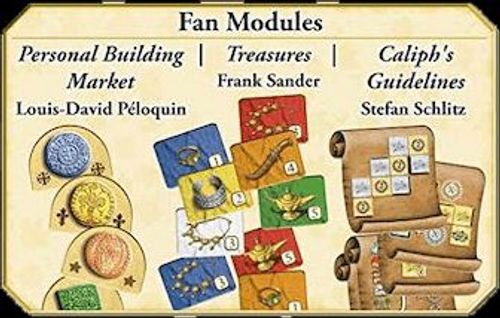
Alhambra: Designers' Expansion – The Personal Building Markets / Caliph's Guidlines / Treasures
Alhambra: Designers' Expansion – The Personal Building Markets / Caliph's Guidlines / Treasures Rulebook
Table of Contents
Table of Contents
Louis-David Péloquin: Personal Building Market
Turn your reserve into a marketplace.
Components
- 24 Market tiles (4 for each player)
Changes in setup
Instead of their usual reserve board each player takes one set of market tiles (4 different tiles), and places them in front of them.
Changes in game play
Whenever a player does not want or cannot add a tile they bought to their Alhambra, or removes a building from their Alhambra when redesigning, they place that building below one of their market tiles.
From then on, other players may buy this building during their turn as if it were on the market. They pay the price in the currency shown above that tile. The money is paid to the current owner.
As long as a tile is still on their personal market, the owner may add it to their Alhambra with a redesigning action, at which point it may no longer be purchased.
Buildings without a purchase price may be placed on the personal market, but nobody can buy them.
Each market space may contain 1 building only.
If all 4 spaces are occupied, the player may discard the new tile, or discard a tile from one space and put the new tile in its place.
Frank Sander: Treasures
If you lack cash, you may take treasures instead!
Components
- 30 Treasure tiles (6 sets in player colors, each set comprised of tiles valued 1 - 5)
Changes in setup
Each player takes the set of 5 treasures of their player color, and keeps it at their disposal.
Changes in game play
Whenever the player wants to buy a building and is short of money of any currency, they may bribe the market managers by giving them one of their treasures. The treasure tile reduces the cost of the item by the value of the treasure tile.
If a treasure tile is used, that reduces more than the amount needed, it is still considered matching (no matter what).
Example: A player wants to buy an arcade for a price of 9, but has only 7 money. The player has used their treasure worth 2 before, so now they give their treasure worth 3, still counting as paying the exact amount.
Changes in scoring
Any treasures still in a player's possession at the end of the game are worth as many points as their value.
Stefan Schiltz: Caliph's Guidelines
The caliph always has special requests - but grants high rewards for fulfilling them.
Components
- 9 Mission tiles
Changes in setup
Shuffle the mission tiles, and place 3 of them face up next to the building market. These are missions that all players may fulfill, thus gaining additional victory points at the end of the game.
The remaining mission tiles are not used for this game; return them to the game box.
Changes in scoring
At the end of the game, players may gain additional victory points if they have fulfilled one or more of the mission tiles.
The missions in detail
- 3 points for each row (horizontal) in a player's Alhambra with at least 3 consecutive buildings (no gaps, double-walls are allowed).
- 3 points for each column (vertical) in a player's Alhambra with at least 3 consecutive buildings (no gaps, double-walls are allowed).
- 3 points for each 2 buildings from the base game of the same type built adjacent to each other (side by side).
- A player's second longest wall scores as well (at the end of the game only!).
- 2 points for each building along the longest diagonal line. The Lion Fountain may be part of this line (but does not have to be). If it is, it scores 2 points as any other building.
- 3 points for each double-wall.
- 1 point for 2 different types of buildings, 3 points for 3 different types of buildings, 6 points for 4 different types of buildings, 10 points for 5 different types of buildings, 15 points for 6 different types of buildings.
- 1 point for each building along the path from the Lion Fountain to the furthest building (though the shortest possible path must be chosen).
- 2 points for each 2 x 2 grid. A tile may belong to more than 1 grid. Doublewalls in between are allowed.
Example: 3 x 2 = 6 points