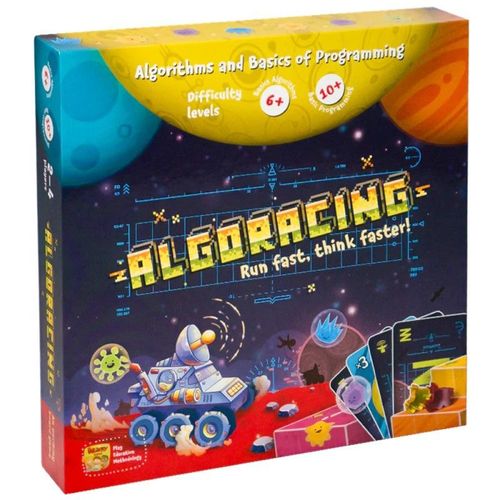
Algoracing
Algoracing Rulebook
Table of Contents
Table of Contents
Goal of the Game
Players take turns laying down algorithms made from the cards in their hands. The rovers of the players on the board carry out actions according to these algorithms. In this way, you must collect life-sample tokens and deliver them to the laboratories. For each token delivered to a laboratory, the player is awarded victory points. The player who first gathers the required number of points wins.
Basic Rules
Setup
- Place two hill blocks (with the large grid) on the 6x6 board (fig. 1). They may be placed anywhere you like.
Fig. 1. Examples of board layouts (for 6x6).
- Take 12 life-sample tokens, 3 of each type. Turn the tokens face down, shuffle them and place them on the special markers on the board (including on the blocks). Some markers may remain empty.
- Each player chooses a colour for their base and rover (the same colour) and the order of play. Then, starting with the player who will play last, each player chooses a corner of the board for their base and places the base token there with the four-coloured side up.
Fig. 2. Rover and token. Labels: nose of the rover; base and laboratory token.
- Each player places their rover on their base token. Rovers may face any direction, but not "into a wall".
- If 2 or 3 people are playing, the extra base tokens are also placed on the board in the free corners. All bases are needed in the game.
- Remove all cycle and teleport cards from the game deck, as they are not used in the basic rules. Deal five cards to each player. Players pick them up and do not show them to the other participants.
Fig. 3. Setup. Labels: player 1, player 2, player 3; draw deck; marker for placing a life sample on the board; life-sample token; wall on the board; base/laboratory token.
Command Cards
- Step forward. The rover moves one cell forward, if there is nothing in the way. Obstacles are: the edge of the board, the edge of a block, a stone wall, another rover, or the futility of the attempt.
- Forward until stopped. The rover goes forward until it meets an obstacle or a life sample. On meeting an obstacle, it stops on the cell in front of it. On meeting a life sample, it stops on the cell where the sample lies and takes the sample on board.
- Jump. The rover moves one cell forward. If there is a wall in front of it, it jumps over the wall. If it is at the edge of a block or in front of a block, it jumps down from or up onto the block. It is impossible to jump onto or down from a high ("two-storey") block.
- Turn, about-turn. The rover turns to the right or left, or turns around, while remaining on its current cell.
Moving Rovers and Collecting Life Samples
- A rover can only move forward. It cannot move sideways or backwards.
- Rovers are equipped with an intelligent self-preservation system: if an algorithm contains a command that cannot be carried out (for example, "step forward" when the rover is standing against a wall or at the edge of a drop), that command is skipped and the rover proceeds to the command after it.
- When a rover reaches a cell with a life-sample token, the player takes the token from the board and places it face down in front of them. The type of sample on the token can only be found out by delivering it to a laboratory.
- A rover may take on board, without going to a laboratory, no more than three life samples. This is the maximum load capacity of a rover.
- When a rover carrying samples on board reaches its own laboratory, the player turns over the tokens of the samples that are "on board", face up, and is awarded the victory points for them.
Fig. 5. Life-sample tokens.
- Execution of an algorithm is not interrupted if the rover takes a sample on board or reaches a laboratory. For example, it may collect two samples in one turn.
- If a rover (call it rover A) cannot carry out or complete a command of its algorithm because the cell it needs is occupied by an opposing rover (rover B), then it stops on the cell in front of that rover (exactly as if it were a wall) and, if possible, carries out all the remaining commands of the algorithm.
- Rover B gives rover A one life sample on board as compensation for the obstruction caused (provided that rover B has at least one sample on board at that moment and rover A has fewer than three samples on board). The token is passed face down.
- Rovers A and B may not receive such compensation from each other again until at least one of them moves to a different cell from the position in which they collided.
Player Actions During a Turn
- The player lays down from their hand one to three cards in a row.
- The player moves their rover across the board according to the algorithm they have laid down.
- The cards that were played are placed in the discard pile. The player draws from the draw deck until they have five cards. The turn passes to the next player.
- A player may also decline to act on their turn (say "pass"). In this case they may replace any number of cards in their hand (discard them and draw replacements from the draw deck).
Fig. 4. General view of the game (6x6 board, algorithm of 3 cards). Labels: draw deck; discard pile; player 1, 2, 3; delivered life samples in the laboratory; samples taken on board but not yet delivered to the laboratory; marker of the start of the algorithm; laid-out algorithm.
Ending the Game and Scoring
The sheet prints this block between the basic and full rules, without saying which variant it applies to. It is transcribed here in the position the sheet gives it.
The game ends when one of the players has collected 7 points (that player becomes the winner), or when all the life samples have been collected and delivered to a base (in this case, the player with the most points wins).
For each new type of sample delivered to a laboratory, the player receives 2 points; for each subsequent sample of the same type, 1 point. For example, if a player delivers 2 yellow samples and 1 blue sample, they receive 2 points (first yellow), plus 1 point (repeat, second yellow), plus 2 points (first blue).
If the draw deck runs out during the game, the cards in the discard pile are shuffled and placed back to form a new draw deck.
Fig. 8. Lifts. Labels: this lift does not work; upper platform of the lift; lower platform of the lift (the cell adjacent to the lift marking).
Full Rules
The overall game process is similar to the basic rules, but there are additional elements and options that make the game more varied and rich.
Command Cards
Cycle and teleport cards are added to the game deck.
Cycles x2 and x3. Placed on top of the cards of the main algorithm. A cycle card can be placed over a single card (vertically), meaning that the command will be repeated two or three times. Alternatively, it can be placed over two cards at once (horizontally), in which case those two cards will be repeated in sequence two or three times. For example, if a cycle x2 is placed over command A and command B, the rover must carry out A-B-A-B.
Teleport. With a teleport impulse, a player may move an opposing rover to its base, or pull life samples towards themselves. The teleport sends its impulse forward only. The impulse affects the first object it meets on its path: either another rover, or life samples. The impulse can pass through walls, but not through blocks. It spreads only in the plane where the rover is standing (it does not "jump" up or down blocks) (fig. 6).
Fig. 6. Teleport. Labels: incorrect and correct examples.
- If the impulse meets a rover on its path, that rover is teleported to its own base. After teleportation, the rover remains facing the same direction in which it stood on the board before teleportation.
- If the teleported rover had any life samples on board, all of them remain on the cell from which the rover was teleported to the base (the player places them on that cell of the board).
- If the base is occupied by another rover at that moment, the rover cannot be teleported there, and the teleport command has no effect.
- If the impulse meets a life sample on its path, the sample is teleported one cell closer, in the direction of the rover that sent the impulse.
- If several samples are on one cell, all of them are moved.
- Samples may be teleported through walls.
Fig. 9. Using this algorithm of 4 actions with two cycle cards, the rover travels this path: step forward → turn right → step forward → turn right → two steps forward → jump. Right image: how this path looks on the board.
Setup and Additional Board Elements
- Use the 9x9 board with three hill blocks (small grid).
- One of the hill blocks is two-storey. It is impossible to jump onto it "in one jump" from the lowest level: you must either jump from a one-storey block adjacent to it (when laying out the board, always place a one-storey block next to the two-storey block), or use a lift.
- Place all 20 life-sample tokens on the board, 5 of each type. To win, a player must collect 9 points (the points-counting mechanic is the same as in the basic version).
- Base tokens must be placed three-coloured side up: each token shows the base for a rover of one colour (from which it starts and to which it returns if teleported from the board) and the laboratories for the rovers of the two other colours. Therefore, having taken a sample on board, a player must bring it to the base token that has the laboratory of their own colour (fig. 7).
Fig. 7. Base/laboratory tokens.
- Blocks have lifts, with which rovers rise and descend from the blocks without the help of a jump card. The upper platform of a lift is indicated by arrows on the block; the lower platform is the cell adjacent to the lift.
- Rising and descending happen automatically, regardless of the player's wishes, if after carrying out an algorithm the rover finds itself on the lower or upper platform.
- If a lift is occupied (another rover is on its upper or lower platform), the lift does not operate. The rover that hinders the descent or ascent on the lift pays compensation for the obstruction caused (gives up 1 life sample), similarly to a collision. If the lift is freed by the player's next turn, the turn begins with the lift operating and moving the rover.
- When a rover is moved by a lift, it remains facing the same direction as it was when it was on the starting platform.
- Lifts that are turned "towards a wall" when the board is laid out are considered non-operational (fig. 8).
Creating Algorithms
- As in the basic rules, in their turn a player may use one to three cards from their hand, after which the rover on the board carries out the resulting algorithm. The difference is that players now not only lay down algorithms "from scratch", but also use an algorithm laid down before them, modifying it.
- The first player creates an algorithm "from scratch", and then the algorithm is modified and executed by other players until it reaches the maximum length of 5 cards (cycle cards are not counted). If a player, in their turn, adds cards to an algorithm so that it reaches five cards, the algorithm cannot be made any longer: the algorithm is executed, and afterwards all cards are placed in the discard pile. The next player begins a new algorithm "from scratch".
- When modifying an algorithm, cards may be placed before, after or between the cards already laid down, and may also cover the cards already laid down with other cards.
- You may not simply remove cards from an algorithm (except cycle cards, which may be removed at will).
- If a card, or one of the cards under a cycle card, is changed (shifted, covered, etc.), the cycle card is removed to the discard pile.
- A player may use the laid-down algorithm to move the rover without any changes.
- A player may also decline to act on their turn ("pass"). In that case they do not change the algorithm, do not move the rover, and may replace any number of cards in their hand.
Example of creating an algorithm by players (the sheet's unnumbered illustration):
- Player 1 lays down an algorithm.
- Player 2 adds three cards.
- Player 3 adds one card and removes a cycle card.
- Player 1 adds two cards.
- The algorithm reaches the maximum length; after it is executed, the cards are placed in the discard pile, and player C begins a new algorithm "from scratch".
Full Rules Target Score
The full-rules setup (see Setup and Additional Board Elements, point 3) gives the winning target as 9 points, and the points-counting mechanic is the same as in the basic version. The sheet prints the ending conditions once, in the section above, without restating them for the full rules; the 7-point target shown there is the sheet's only printed figure for ending the game.