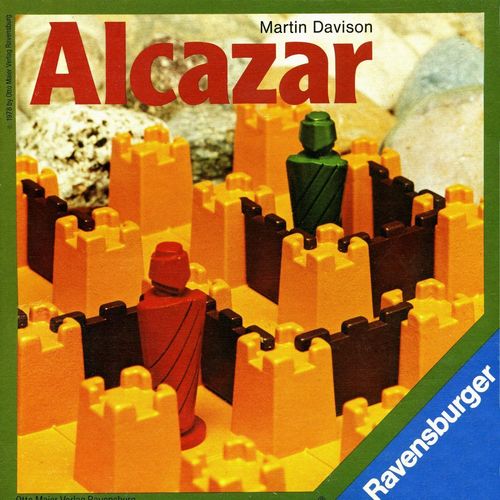
Alcazar (1978)
Alcazar (1978) Rulebook
Table of Contents
Table of Contents
Contents
1 Board, 2 Pawns, 8 Walls
Object of the Game
The goal of this game of skill is to immobilize your opponent's pawn or to occupy his/her starting space.
The Contents
The gameboard is divided into 16 squares. At each intersection is a tower. During the course of the game, walls, which belong to neither player, are placed between these towers. Each player has a pawn to move around the board.
Setup
At the beginning of the game, the two pawns and the eight walls are placed in the setup as shown by figure 1 (see page 13). The boxes created by the walls are the castles of the two players. (Translator's note: I don't believe there's anything special about this 3 square castle, only the starting square itself is important.)
Play of the Game
Play is in alternating turns. On his/her turn a player may perform ONE of the following:
- move his/her pawn.
- move a wall.
Moving a Pawn
Pawns may be moved horizontally or vertically, diagonal movement is not allowed (see figure 2). As well, the pawns must leave their starting square on or before their third turn and, once moved, they are not allowed to return there. The two pawns cannot occupy the same square.
Moving a Wall
Moving a wall is accomplished by rotating it either 1, 2 or 3 right angles around one of the two towers it is suspended on (see figure 3). A wall cannot be moved across a square occupied by a pawn nor may it jump over another wall. At the edge of the board a wall may be rotated through the empty space and placed between two towers as usual. (Translator's note: The actual rules state that it is rotated a half circle. It's unclear whether you may use this as part of a rotation or not.) When one of the players moves a wall, the other player may not move the same wall on his/her following turn.
Blocking an Opponent
An opponent's pawn is immobilized when it cannot move any more. There are three ways to immobilize a pawn:
- between four walls (see figure 4).
- between walls and the edge of the board (see figures 5 & 6).
- between walls and the opposing pawn (see figure 7).
A player cannot lose the game while still in the starting square or by blocking his/her own pawn. The winning move must be performed by the opponent.
Winning the Game
The winner is the player who manages either to reach the starting box of his/her opponent (the square marked with a cross) or to block his/her opponent's pawn so that it cannot move.