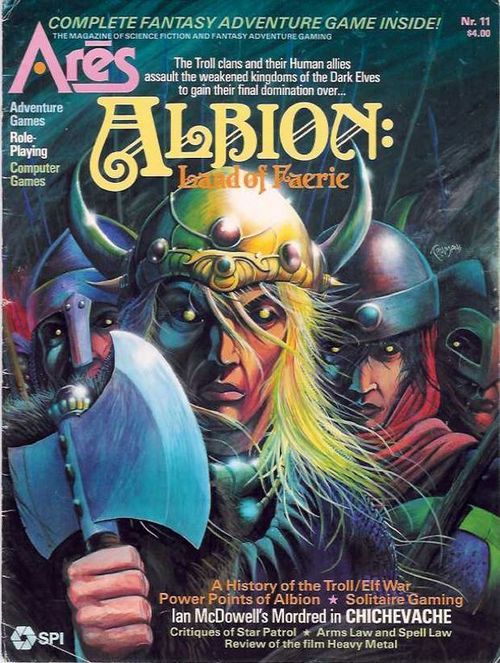
Albion: Land of Faerie
Albion: Land of Faerie Rulebook
Table of Contents
Table of Contents
- Rules Format
- [1.0] Introduction
- [2.0] Game Components
- [3.0] Game Terms
- [4.0] How to Start the Game
- [5.0] Course of Play
- [6.0] Weather
- [7.0] Removing Losses
- [8.0] Attrition
- [9.0] Recovery and Refit
- [10.0] Activation
- [11.0] How to Move Pieces
- [12.0] Special Movement
- [13.0] Reaction to Movement
- [14.0] Command Control
- [15.0] Initiating Combat
- [16.0] Resolving Combat
- [17.0] Fortresses
- [18.0] Evasion
- [19.0] Enchantment
- [20.0] Magic Items
- [21.0] Scenarios and Victory Conditions
- [22.0] Albion Alone
- [23.0] Faerie Twilight
- [7.8] Combat Strength Roster
- [7.9] Persons Summary
- [19.4] Enchantment Summary
- 01. Shake the Earth ★
- 02. Enchantment of Farcalling
- 03. Scrying Enchantment
- 04. Enchantment of the Elements
- 05. Enchantment of Storm Calling
- 06. Enchantment of Fimbulwinter ★
- 07. Enchantment of Rainmaking
- 08. Enchantment of Mental Attack
- 09. Enchantment of Vortex Creation
- 10. Enchantment of Mind Control
- 11. Enchantment of Dispelling Magic
- [20.6] Magic Item Summary
- [19.5] Places of Power
- Mapsheet Charts and Tables
Rules Format
The rules to Albion: Land of Faerie are organized by major topics arranged in the order in which they occur in the play of the game. Each such major topic is given a number and a name, below which is usually given a General Rule or description which summarizes the rules in that Section. This is, in most instances, followed by numbered paragraphs called Cases, which give the specifics of the rules. Note that the numbering of the Cases is a decimal form of the Section number. Players should examine the map and counters and then quickly read the rules, without trying to memorize them. Then the game should be set up and a "trial run" made.
[1.0] Introduction
Albion: Land of Faerie is a game of strategy for two players, set against the backdrop of the Third Fomorian War of 2680, which weakened the power of Faerie in the Enchanted Isles (present-day Ireland and England) and paved the way for the domination of men. One player (the Fomorian player) controls the Trolls (also called Fomorians) of the Confederation of the North (present-day Scotland), Connaught, Munster, and the Eastmarch, as well as the Trolls' allies, the Humans (called Mundanes) of The Borders, The Weald, and The Eastmarch. The other player (the Faerie player) controls the Elvish Kingdoms of Albion, Gwynedd, Ulster, and Leinster and the allied Gnomes of the Hearthstead of Curwyllan.
The players alternately move pieces representing the forces and persons under their control across a map of ancient Britain and Ireland and use these pieces to attack each other, to capture strategic objectives, and to otherwise fulfill their victory conditions in the scenario being played.
[2.0] Game Components
Each copy of Albion should include the following components:
- One 22" x 34" game map
- One section of 200 die-cut cardboard playing pieces
- One 16-page booklet of rules and support material
- Two six-sided dice (not included in Ares edition)
- One game box (not included in Ares edition)
CASES
[2.1] The map represents ancient Ireland and Britain, part of the European continent, and surrounding waters.
The hexagonal grid superimposed on the map terrain regulates movement and positioning of playing pieces. Each hexagon (hex) represents an area four leagues from side to side. The map is also divided into a number of kingdoms and sea zones, to allow players to visualize the relative strategic situation and execute the mechanics of play. Some hexes are color-coded to indicate the Magical Aspect of the hex (either mundane, normal, enchanted, or wild magic).
[2.2] The game includes various charts and tables, the uses of which are explained in appropriate rules Sections.
The charts and tables printed on the map include the Terrain Effects Chart, Combat Results Table, Casualty Table, Attrition Table, Discovery Table, and Activation Table. A Combat Rating Roster, printed in this rules booklet, is provided to help players record the status of persons under their control (this roster should be photocopied for repeated use). Four detailed summaries -- Enchantments, Magic Items, Places of Power, and Persons -- are also provided in this booklet.
[2.3] The playing pieces represent companies of troops, individual ships, and persons who fought in the Third Fomorian War.
Armies are represented by individual Combat Strength Points (CSP's) of a particular race and kingdom. Within the same color, these pieces are interchangeable, just as though they were denominations of money. Each CSP represents a company of 75 to 150 soldiers, depending on the race.
Each ship piece represents a single named warship at full strength (when face up) or damaged (when face down).
Each person playing piece represents one of the leading personalities who fought in the war. In most cases, the front face of the piece shows the person in the company of an escort of troops (equivalent to a single CSP), and the back face shows the person without his escort.
Various markers are also used in the game to represent magic items and destroyed fortresses, and to help players keep track of game activities.
Note: Some army pieces have the name of the fortress in which they are deployed on the front, and the number of that hex on the back, to help players set up the game. Other army playing pieces are distinguished only by kingdom. These pieces are printed with different Combat Strengths on the front and back to provide greater flexibility in breaking down armies. There is no difference among Combat Strength Points of the same kingdom, and they may be freely exchanged (like money) to break down or build up armies to reflect casualties or to assist in maneuver and deployment of those armies.
Altogether, there are four types of army pieces representing the four races depicted in the game: Elf, Mundane, Troll, and Gnome.
Note: Many persons in the game have special abilities that are depicted by the Person Symbol used on their playing pieces. The symbols are: Captain, Marshal, King, Enchanter, Hero, Swimmer, and Flyer. Some persons have more than one special ability. For a complete summary of Person Symbols, see the mapsheet.
Some person pieces show different persons on the front and back. In these cases, the person depicted on the back of the piece enters the game whenever the person depicted on the front is killed (for example, Callach on the front; Waff on the back).
Some person pieces have a magic item on the back. In these cases, the magic item is carried by the person depicted on the front until that person is killed. At that time, the piece is flipped over to reveal the magic item, which may be claimed and used by other persons (for example, Dunatis on the front; Staff of Dunatis on the back).
Other playing pieces: Artifact markers (front shows the name, e.g. "The Book of Gyres" and its number; back shows an artifact icon), Heirloom markers (e.g. Trollbane), Ruins markers, Enchantment markers, Refit markers, Vortex markers, and the Game-Turn marker.
[3.0] Game Terms
The terms enemy and friendly distinguish the playing pieces and actions of one player from those of the other. All pieces controlled by one player are friendly to one another and are enemies of all pieces controlled by the other player. Phases during which players may undertake certain activities (see Course of Play, 5.0) are also referred to as friendly or enemy (for example, a friendly Movement Phase). All friendly pieces occupying a single hex constitute a stack, sometimes referred to as a "force."
Playing pieces are distinguished by type (army, ship, or person); race (Elf, Mundane, Troll, or Gnome); and kingdom (Ulster, Leinster, Munster, Connaught, The Weald, Eastmarch, The Borders, Curwyllan, Mundania, Albion, Gwynedd, Strathclyde, Ochil, or Moray). The playing pieces also have various ratings printed on them:
Maximum Combat Strength. A piece's basic ability to engage in combat. Combat Strength is measured in Combat Strength Points (CSP's). Each army piece consists of the number of CSP's printed on it. Each escort consists of one CSP. Each person has a Maximum Combat Strength printed on his piece. This is the Combat Strength with which the person starts the game. As he suffers wounds, his Combat Strength will decrease to a new Current Combat Strength; as a result of healing, his Current Combat Strength can be increased to his Maximum Combat Strength again. Only enchantment or possession of a magic item can raise a person's Current Combat Strength higher than the Maximum printed on his piece. When involved in combat, a person always uses his Current Combat Strength.
Basic Magic Strength. A measure of a person's ability to perform magic. By adding the current Mana Level (which varies according to the Game-Turn in progress) to a person's Basic Magic Strength, the person's Current Magic Strength is determined. This Current Magic Strength helps determine the range at which an enchantment will be effective.
Command Rating. A measure of a person's ability to command friendly army CSP's.
Movement Allowance. The measure of a person's ability to move across the map. The Movement Allowance is expressed in terms of Movement Points, which are expended to enter a hex.
The magical quality of a particular hex is known as the hex's Aspect. A hex has either no Aspect, or has one of three distinct Aspects: mundane, enchanted, or wild magic.
[4.0] How to Start the Game
-
Select a scenario (see 22.0 and 23.0) and determine who will play each side.
-
Set up the active pieces in the hexes indicated as follows:
Note that the following playing pieces are designated by hex number (in bold), person, ship (in italic), by magic item, and by CSP's of army pieces (e.g., Troll x 4 means 4 CSP's of Trolls).
Clan Moray 2611: Barguest (Brguest). 2613: Fleetfoot (Fltfoot), Windrider (Windrdr), Stormcrow (Strmcrw), Redtooth (Rdtooth). 2714: Troll x 4. 2810: Rurik, Troll x 4. 3012: Imric, Troll x 8. 3105: Gairloch (Gairlch), Troll x 6. 3205: Oakheart (Oakhrt).
Clan Ochil 3118: Bogan, Gullfoot, Reefrider (Reefrdr), Moontop (Moontp), Troll x 6. 3314: Glastyn, Troll x 6.
Clan Cumrock of Strathclyde 2521: Troll x 4. 2920: Grogan, Callach, Troll x 4.
Men of the Eastmarch 3337: Dobie the Scryer. 3439: Magog, Troll x 4. 3639: Mad Ainsel, Mundane x 6. 3737: Bran Og, Mundane x 2.
Kingdom of the Borders 3218: Brian Mac Iver (MacIver), Seasnake (Seasnke), Mundane x 6. 3321: Mundane x 2.
Clan Connaught 0720: Irontooth (Irntooth), Seatang, Bluefish (Blufish). 1421: Connan, Troll x 6.
Clan Mac Ennis of Munster 0327: Fairwind (Fairwnd), Pelican, Troll x 4. 1026: Balor, Troll x 6.
Men of the Weald 2242: Seasong. 2340: Cormac, Mundane x 6. 2941: Dando, Mundane x 2. 3145: Sean, Mundane x 6. 3543: Mistwalker (Mstwlkr).
Kingdom of Albion 2339: Edric, Foamrider (Fmrider), Elf x 4. 3034: Elidor, Elf x 4. 3140: Colleran, Elf x 4. 3429: Dorwen, Elf x 2.
- The Faerie player sets up his inactive pieces in the hexes indicated as follows:
Kingdom of Leinster 1426: Dagda, Brigit, Elf x 6. 1525: Angus Mac Og (MacOg), Elf x 4.
Kingdom of Ulster 1318: Cluracan (Clracan), Elf x 4. 1922: Finvarra (Fnvarra), Morigu, Elf x 6, Trollbane (#12).
Kingdom of Gwynedd 1836: Midinhir (Midnhir), Seawitch (Seawtch), Elf x 6. 2030: Arwan, Mornstar (Mrnstar), Elf x 6. 2437: Branwen (Branwn), Elf x 4. 2630: Evenstar (Evnstar), Elf x 2.
The Gnomes of Curwyllan 1241: Trumpin (Trmpin), Gnome x 6. 1740: Erskine, Malekin, Gnome x 14, Lyme's Hammer (#11). 2240: Spriggan (Sprggan), Gnome x 8.
- The Faerie player sets up those inactive persons controlled by neither player in the hexes indicated as follows:
2034: Dunatis the White. 2608: Misha the Wise. 3433: Gerflax Haefay (Gerflax). 3705: The Worm of Mousa Stour.
- The Fomorian player deploys the 10 artifacts in the hexes indicated as follows:
1023: Dana's Torque (#05), Nuada's Helm (#09), The Red Cleaver (#10). 1323: The Book of Glamours (#01), The Book of Gyres (#02). 2128: The Mailcoat of Gofannon (#80). 2629: Colt Pixy (#04). 2634: Gwydion's Staff (#07), Finn's Rade (#06). 3705: Bran's Curse (#03).
-
The Faerie player places the Game-Turn marker in the first box of the Game-Turn Record Track on the mapsheet.
-
The Faerie player sets aside the pieces constituting Auberon's expedition for future use: Auberon, Ogme, Corin, Stoutheart, Galetop, Cloudkiss, Swancoat, and Silverpeak.
-
Markers and breakdown units are sorted for later use.
-
The game is now ready to begin. Play commences with the first Game-Turn, and proceeds for the number of Game-Turns specified in the scenario selected (see 22.0 and 23.0), at which time victory is evaluated.
Note: The player setting up each stack determines the order of pieces in the stack (i.e., which pieces are topmost and bottommost). All persons with escorts are deployed with their escorts attached. All ships are deployed at full strength.
[5.0] Course of Play
GENERAL RULE
Albion: Land of Faerie is played in increments called Game-Turns, during which players act according to a rigidly defined sequence of play. Each Game-Turn represents a fortnight (about 15 days). Each Game-Turn consists of three Segments and two Player-Turns, each of which is sub-divided into a number of Phases and Steps. Game activities may never be undertaken out of sequence. The player whose Player-Turn is in progress is referred to as the active player, and his opponent is the inactive player.
SEQUENCE OF PLAY
A. Weather Segment
Players consult the Game-Turn Record Track and note the Mana Level and the weather for the Game-Turn (6.0).
B. Enchantment Segment
-
Both players secretly note (on scrap paper) what enchantments the persons they control are casting during this Segment, listing the persons casting the enchantments, target hexes (where appropriate), and any other information necessary to determine the effects of the enchantments.
-
The players reveal the enchantments they will cast during the Segment and all pertinent details concerning them.
-
Each player independently determines whether each enchantment he is attempting to cast is effective (7.0).
-
Enchantments that are effective take immediate effect and remain in effect for the entire Game-Turn. In some cases, it will be necessary to place a marker to indicate this.
-
Each person who attempted to cast an enchantment (whether successful or not) is noted by placing an Enchantment marker on his piece.
C. Attrition Segment
-
The Fomorian player determines which of his army pieces, ships, and persons must undergo attrition as a result of lack of command, the presence of storms or other weather effects or enchantments, or the occupation mundane, enchanted, or wild magic hexes (8.0).
-
The Faerie player rolls two dice for each hex containing Fomorian pieces undergoing attrition.
-
The Faerie player modifies this dice roll according to the rules in 8.2 and consults the Attrition Table (see mapsheet) to determine the level of casualties inflicted on all Fomorian pieces undergoing attrition in each hex.
-
The Fomorian player consults the Casualty Table (see mapsheet) to determine the exact losses he suffers as a consequence of the result obtained in the preceding Step, and removes the indicated losses.
The two players reverse roles and repeat Steps 1 through 4 to determine the attrition losses suffered by the Faerie player.
D. Fomorian Player-Turn
- RECOVERY PHASE
a. The Fomorian player determines which of his persons occupy hexes which have automatic healing properties, and removes the appropriate number of wounds from those persons (9.0).
b. The Fomorian player removes all Refit markers from his ships and turns each ship that had a Refit marker face-up to reveal its undamaged side.
c. At his discretion, the Fomorian player may place Refit markers on any of his damaged ships which are eligible to initiate repairs during this Phase (9.0).
d. The Fomorian player determines which of his persons are eligible to have wounds healed during the Phase (including those healed in Step a).
e. The Fomorian player rolls one die for each person eligible in Step d. If the roll is less than or equal to the Current Combat Strength of the person, he recovers from a number of wounds equal to the roll. Otherwise, he recovers from no wounds.
- ACTIVATION PHASE
a. The Fomorian player consults the Activation Table (see mapsheet) to determine which friendly inactive pieces are eligible to become active. Note that only the Worm is friendly to the Fomorian player for purposes of this roll; numerous inactive persons and kingdoms are friendly to the Faerie player.
b. For each eligible inactive piece, the Fomorian player rolls two dice and modifies the result per 10.4.
c. In each case where the modified roll is less than or equal to the number for that piece (or kingdom), the piece (or all the pieces of the kingdom) becomes active under the Fomorian player's control. Otherwise, pieces remain inactive, and no new attempt to activate them is possible until the next Fomorian Activation Phase.
- MOVEMENT PHASE
a. The Fomorian player moves each of his pieces or stacks individually in any directions up to the limit of their individual Movement Allowances, splitting and/or combining stacks, adjusting the order in which pieces are stacked together, and conducting overruns and artifact searches as he wishes.
b. When the Fomorian player has moved all his pieces that he wishes to move by normal movement, he declares which of his pieces (if any) will attempt a forced march. Stacks that engage in forced march move again, using a number of Movement Points equaling the Command Rating of any one friendly person in the stack.
c. When all forced marches are completed, the Fomorian player rolls two dice for each stack that engaged in forced march, subtracting the Command Rating of any one person accompanying the stack. He then consults the Attrition Table (see mapsheet), using this total to determine the loss level suffered by the stack as a result of forced march (applied as in 8.0).
- REACTION PHASE
The Faerie player may move all his eligible stacks (13.0) a number of Movement Points equal to the Command Rating of one friendly person in their stack.
- COMBAT PHASE
a. The Fomorian player announces which of his pieces co-occupying a hex with enemy pieces will attack those enemy pieces in a battle or engagement.
b. The Faerie player states in each case listed in the previous Step the type of terrain (from those available in the hex) in which his pieces will defend.
c. The Fomorian player announces the hexes (from among those in which he is fighting battles and engagements) in which he also wishes to conduct challenge combat and specifies the type of challenge combat he wishes to initiate.
d. The Faerie player announces which of those challenge combats declared in the previous Step he will accept. He may also declare that he is initiating challenge combat in hexes in which, although a battle or engagement is taking place, the Fomorian has initiated no challenge combat (or only one type of challenge combat).
e. The Fomorian player announces which challenge combats he will accept from among those initiated by the Faerie player in the previous Step.
f. The Fomorian player announces which hexes containing only opposing persons (and possibly ships on which those persons are not embarked) will be sites of melee combat.
g. For each challenge combat and melee combat announced and accepted in Steps c, d, e, and f, the Fomorian player executes the combat resolution procedures discussed in 16.0, and both players remove losses as discussed in 7.0.
h. When all challenge and melee combats have been resolved, the players individually resolve all battles and engagements announced in Step a (15.0 and 16.0).
E. Faerie Player-Turn
The Faerie Player-Turn is conducted exactly as the Fomorian Player-Turn, except the Faerie player is the active player. Whenever "Fomorian" is mentioned in D, read "Faerie," and vice versa.
This sequence of play is repeated until the end of the last Game-Turn of the scenario being played. At the end of each full Game-Turn, the Game-Turn marker is advanced one box along the Game-Turn Record Track.
[6.0] Weather
GENERAL RULE
Weather affects the movement capabilities of pieces and may necessitate attrition for some pieces. The weather for the entire map for each Game-Turn is listed on the Game-Turn Record Track. The weather can be altered locally, or for the entire map, through enchantments or magic items. There are three types of weather: clear, rain, and snow.
CASES
[6.1] Clear weather has no effect on play.
[6.2] The following rules apply to each hex subjected to rain:
-
All ships that are bad sailers that begin an Attrition Segment at sea must undergo attrition during that Segment.
-
All ships pay one additional Movement Point to enter each hex.
-
All minor rivers that border only hexes in which there is rain are treated as major river hexsides. The effects of fords (but not ferries and bridges) on such hexsides are ignored.
-
The Movement Point cost to enter a clear hex or any hex by trail is increased by one.
-
Land pieces may leave (but not enter) marsh hexes.
[6.3] The following rules apply to each hex subjected to snow:
-
The Movement Point cost to enter a mountain hex and cross a mountain pass hexside is doubled. The cost to cross a mountain pass hexside is not doubled if only one of the hexes joined by that hexside is under the effects of snow, however.
-
Minor river hexsides that border only hexes in which the weather is snow are treated as clear hexsides.
-
Army CSP's occupying a snow hex must undergo attrition unless in a friendly fortress.
-
Ships occupying a coastal hex under the effects of snow may not depart that hex. Ships must cease movement upon entering such a hex.
-
Each ship designated a bad sailer that occupies an all-sea hex under the effects of snow during the Attrition Segment must undergo attrition during that Segment.
-
The Movement Point cost to enter clear, woods, forest, and rough hexes is increased by one. All marsh hexes are treated as clear.
[6.4] Snow can occur only as the result of an enchantment.
Note that there are no snow Game-Turns indicated on the Game-Turn Record Track.
[7.0] Removing Losses
GENERAL RULE
Persons may lose Combat Strength Points; ships may lose Steps, causing them to be damaged or destroyed; and army (and escort) Combat Strength Points may be removed from play.
PROCEDURE
Whenever a player is required to remove losses from army/escort pieces, each loss represents one Combat Strength Point (CSP) permanently removed from play. A CSP loss may be satisfied by removing an escort (invert the person piece to which the escort is attached to reveal the unescorted side) or by removing or inverting an army piece. Example: A 2-CSP army piece required to lose one CSP would be inverted to reveal its 1-CSP side. Remember that army CSP's are interchangeable within the same color (kingdom).
Ships take losses in terms of Steps rather than CSP's. Each ship has two Steps, represented by the ship piece's front, full-strength side and back, damaged side. To satisfy a one-Step loss, invert a full-strength ship to its damaged side, or remove a damaged ship from play. Removing a full-strength ship from play satisfies a two-Step loss. Ships removed from play never return to the game, but a ship that loses only one Step (damaged) may be repaired (9.0).
Damage to a person is recorded on the Combat Strength Roster. Each player should keep his own copy of this roster, upon which he secretly records the losses suffered by his persons. Losses to persons are represented by wounds which are marked in the boxes opposite the person's name as shown:
COMBAT STRENGTH ROSTER -- ALBION
| Person | Boxes |
|---|---|
| Auberon | [ ] [ ] |
| Colleran | [X] [X] [ ] [ ] [ ] |
| Corin | [X] [X] [X] |
In this example, Colleran has received two wounds; Corin has received three wounds -- his Maximum Combat Strength -- and has thus been killed. Auberon is unwounded.
When all of a person's boxes are marked off, the person's piece is removed from the map (if the person had an escort, a CSP of the appropriate kingdom should be put in the person's place). Persons who still have unmarked boxes remaining may be healed of their wounds (9.0). As wounds are healed, they are erased from the person's boxes.
CASES
[7.1] Losses as a result of combat and attrition are found on the Casualty Table.
In most cases, losses suffered by a piece will be inflicted by results derived from the Combat Results Table or Attrition Table (see mapsheet). The results on these two tables are expressed in terms of letters which are indexed, according to the size of the forces involved, on the Casualty Table. All results on this table apply to all pieces involved in the combat or attrition dice roll which resulted in casualties and which are part of the same friendly stack.
[7.2] The player who controls a stack determines how losses are distributed among the pieces in that stack.
So long as all losses are removed (see 7.3, however), the player may distribute them among eligible pieces as he sees fit. Exception: Certain results (indicated with a 1) on the Casualty Table require that all losses to a particular type of piece be removed from one piece of that type until the piece is destroyed, after which any remaining losses may be removed from any eligible pieces of that type.
[7.3] Excess losses are ignored.
If a player has insufficient pieces in a stack to satisfy a required class of loss, the balance of the loss is ignored. Such losses are never converted to another type.
[7.4] Losses are removed independently and simultaneously when inflicted as a result of combat.
Neither player may examine how his opponent applies his losses before he applies his own. All losses are removed before retreats are undertaken.
[7.5] Army/escort CSP's aboard a ship are destroyed whenever the ship sinks.
Army and escort CSP's never suffer losses as a result of a naval engagement. Results to the left of the slash on the Casualty Table are ignored in such cases. However, army/escort CSP's aboard ships are destroyed if the ship on which they are embarked is sunk. Persons aboard ships which are sunk are immediately reassigned to any friendly ships remaining in the stack. If no friendly ships remain, the persons are killed unless the hex is a coastal hex and no enemy ships remain in the hex. If the hex is a coastal hex and there are no enemy ships in the hex, the persons are considered to have reach shore. In any event, all magic items (including possessions) carried by a person aboard a ship which sinks are removed from play.
[7.6] A piece's Current Combat Strength is used as its Combat Strength.
Persons have their Combat Strengths reduced by one for every wound they have suffered. Similarly, the Combat Strength of a damaged ship is shown on its damaged side.
[7.7] Casualty Table (see mapsheet)
[7.8] Combat Strength Roster (see page 12)
[7.9] Persons Summary (see page 13)
[8.0] Attrition
GENERAL RULE
The following pieces are required to undergo attrition during the Attrition Segment:
-
Any ship occupying a hex which is under an enchantment of Vortex Creation (#09) during an Attrition Segment.
-
Any ship that is a bad sailer occupying a hex under the effect of rain or snow during an Attrition Segment.
-
Any Elvish CSP's and/or persons not embarked upon a ship and occupying a mundane hex.
-
Any Mundane CSP's and/or persons not embarked upon a ship and occupying an enchanted hex.
-
Any CSP or person (of any race) not embarked on a ship and occupying a wild magic hex.
-
Any army CSP not occupying a fortress and not under the command of a person.
-
Any army CSP not occupying a fortress and in a hex affected by snow.
-
Pieces in a hex under the effects of Finn's Rade.
PROCEDURE
The Procedure outlined in Section C of the sequence of play is employed to determine the exact effects of attrition. All mutually friendly pieces undergoing attrition in a hex undergo attrition together, as a single stack.
CASES
[8.1] Pieces in a particular hex may undergo attrition only once per Game-Turn.
In some cases, pieces in a hex may be subject to attrition to two or more reasons. In such cases, all mutually friendly pieces in the hex undergo one attrition dice roll. However, all dice roll modifications applicable to any piece undergoing attrition in the hex apply to all pieces undergoing attrition in that hex. Such dice roll modifications are cumulative.
Example: If 4 Elvish army CSP's without a commander occupy a mundane hex (+3 to the dice roll) over which an enchantment of Vortex Creation is cast (+5 to the dice roll) during the same Attrition Segment in which that hex is occupied by 3 friendly army CSP's of uncommanded Gnomes, both the Elves and the Gnomes would be required to undergo attrition. Since all friendly pieces undergoing attrition in a hex must do so in a single dice roll, that dice roll would be modified by +8 for all pieces in the hex.
[8.2] The attrition dice roll may be modified in a variety of ways:
Subtract...
...the Command Rating of any one person in the hex who is undergoing attrition.
...the Base Magic Strength of any one person in the hex who is undergoing attrition.
Add...
...3 if the pieces undergoing attrition are Elvish pieces in a mundane hex.
...3 if the pieces undergoing attrition are Mundane pieces in an enchanted hex.
...the current Mana Level if the hex the stack occupies is a wild magic hex.
...5 if the pieces undergoing attrition are doing so as a result of an enchantment of Vortex Creation.
...5 if the pieces undergoing attrition are undergoing attrition as a result of meeting with Finn's Rade.
...5 if the pieces undergoing attrition are undergoing attrition as a result of the presence of Bran's Curse.
[8.3] Attrition Table (see mapsheet)
[8.4] Attrition results in the loss of CSP's and Steps from persons, armies, escorts, and ships.
Pieces not required to undergo attrition in a hex are not affected by attrition, and may not be damaged or removed to satisfy losses. When both ships and persons undergo attrition together, both ships and persons suffer the indicated losses on the Casualty Table. Thus, if a casualty result of 3 is arrived at, 3 Steps must be removed from the ships undergoing attrition and 2 wounds must be inflicted on persons.
[9.0] Recovery and Refit
GENERAL RULE
A person who has suffered a wound may be healed, and a ship that has lost a Step may be refit using the procedure described in the sequence of play.
CASES
[9.1] Only ships occupying coastal hexes free of enemy ships and army/escort CSP's during a friendly Recovery Phase may be refit.
Refit markers should be placed on refitting ships. All persons and army CSP's are considered debarked as soon as a Refit marker is placed on the ship carrying them. They may not move during their Player-Turn.
[9.2] Any number of ships may be refit during a Recovery Phase, and any number of wounds may be recovered from the active player's persons.
[9.3] Ships with Refit markers are eliminated if they occupy a hex containing one or more enemy (but no friendly) ships at the end of any Phase.
[9.4] Ships with Refit markers are eliminated if they occupy a hex in which the only army/escort CSP's present are enemy at the end of any Phase.
[9.5] The placement of Refit markers on ships is entirely voluntary.
[9.6] Persons occupying the Cuillan Braes, Gil's Rest, Kelie Braes, Rona's Bath, or a hex with Misha's Rod may have one or more wounds healed (20.6 and 19.5).
[9.7] The Active Player must attempt to heal all Persons under his control (including those controlled through enchantment) who are suffering from wounds during his Recovery Phase.
[10.0] Activation
GENERAL RULE
All pieces except Auberon's Expedition and those used as "change" are placed on the map at the start of the game. All pieces on the map are in one of two states: active or inactive. Active pieces are fully controlled by one Player. Inactive pieces may not move (exception: 10.3), attack, or perform any other game functions. Active pieces never become inactive. Inactive pieces may be "Activated" by dice rolls on the Activation Table (see mapsheet); see the sequence of play. In addition, inactive pieces are activated when they are attacked by enemy pieces, when the enemy player attempts to cast any enchantment which would affect them, or when enemy pieces enter their kingdom. Whenever a person or kingdom is activated, that person (or all pieces assigned to that kingdom) may move and perform all game functions, as directed by the player friendly to them.
CASES
[10.1] Auberon's Expedition is the only force not deployed on the map at the start of play.
Beginning on Game-Turn 4, the Faerie player rolls two dice in each friendly Activation Phase to see if Auberon's Expedition enters the game. If activated, the Faerie player places the expedition in any mapedge hex in the Jotun Sea Zone or the Sea of Moray Zone. All five ships must be placed in the same hex, and all three persons (and Auberon's escort) must be assigned to the same ship. Once activated, the Faerie player controls Auberon's expedition.
[10.2] The Worm of Mousa Stour, Misha the Wise, Dunatis the White, and Gerflax Haefay are deployed inactive in specified Places of Power.
The Worm is friendly to the Fomorian player, while Misha, Dunatis, and Gerflax are friendly to the Faerie player. Each of these persons may be activated (individually) by a roll on the Activation Table, by the entry of enemy pieces into their hex, or by any attack against them or attempt by the Enemy player to cast an enchantment over them.
[10.3] Gwynedd, Curwyllan, Ulster, and Leinster begin the game inactive, but friendly to the Faerie player.
They are activated (separately) in the manner indicated in the General Rule. Note that only mainland hexes are considered for purposes of activation; enemy pieces can enter island hexes without violating the neutrality of (and thus activating) these kingdoms. Note also that, as an exception to the General Rule, the Faerie player may move armies and persons (no ships) of these nations while they are inactive. No piece may exit its own kingdom until activated, however.
[10.4] Activation Table (see mapsheet)
[11.0] How to Move Pieces
GENERAL RULE
Each piece has a printed Movement Allowance. This Movement Allowance is expressed in Movement Points. Moving pieces expend one or more Movement Points to enter each hex. The Movement Point (MP) cost for each race to enter each type of terrain is listed on the Terrain Effects Chart (see mapsheet). The ability of pieces to move is affected by the presence of other pieces, by enchantments, and by the weather (6.0, 17.0, and 19.0).
PROCEDURE
The active player may move his pieces during a friendly Movement Phase. The inactive player may move his pieces during a Reaction Phase. Each player may move his pieces through contiguous hexes in any direction(s) up to (but not exceeding) the limit of each piece's Movement Allowance. A piece may not enter a hex unless it has sufficient Movement Points to pay the entry cost for that hex. A piece is never obligated to move. Unused Movement Points may not be loaned to other pieces or saved for later use, however.
Pieces may be moved individually or in groups (stacks). A stack moves at the rate of the slowest piece in it, however. For example, if one piece would be required to expend 2 MP's to enter a hex, and another piece in the same stack would be required to expend 3 MP's, both pieces moving together would be required to expend 3 MP's to enter the hex. The active player may break up and/or combine stacks any number of times during his Movement Phase, creating new stacks as necessary, or trading pieces between stacks which occupy the same hex. The active player may stop moving a piece or stack before its movement is finished in order to move other pieces or stacks, returning later to resume the original piece or stack's movement.
CASES
[11.1] Army CSP's not under the command of a friendly Person or not embarked on ships may not move during any Movement or Reaction Phase.
[11.2] Certain pieces must stop moving upon entering a hex containing some types of enemy pieces.
All army/escort CSP's must stop whenever they enter a hex occupied by enemy army/escort CSP's or heroes. Persons moving with the army/escort CSP's must also stop. The active player's pieces may only continue their movement in this case if they conduct a successful Overrun of the hex. See 12.5.
All persons must stop whenever they enter a hex containing enemy army/escort CSP's and may only continue their movement if they successfully evade their enemy pieces (18.0).
Note: Persons accompanying armies or with escorts attached are not affected by the workings of this provision and may not attempt to evade the enemy pieces.
[11.3] Whenever there are two or more types of terrain in a hex, the player conducting movement chooses any one type of traverseable terrain present in the hex.
His pieces entering the hex stacked together pay only the entry cost for that one type of terrain. This determination may be made anew for each piece or stack entering the hex. Note that a hex's Aspect is not considered a terrain type; a player's choice of terrain includes only physical terrain.
[11.4] The hexside through which a piece enters a hex may affect the Movement Point cost to enter the hex.
Whenever a person or army/escort CSP enters a hex through a pass, minor river, or ford (or ferry, bridge, or tunnel, in the case of Elves), the Movement Point cost for that type of hexside listed on the Terrain Effects Chart is added to the cost of the terrain of the hex. All such costs are cumulative. Hexside terrain costs are always assessed; a player may not assume that a hexside consists of clear terrain per the treatment of terrain inside a hex, as discussed in 11.3.
[11.5] Trails and Faerie roads negate the effects of the terrain in hexes for purposes of movement.
Hexside terrain is not negated. A piece that enters a hex containing a trail or Faerie road across a hexside containing that same symbol pays the trail or Faerie road cost to enter the hex. Trails and Faerie roads cease to exist in mountain pass hexsides during snow Game-Turns.
[11.6] Army and person pieces entering a dyke hex always pay the dyke hex cost, regardless of other terrain in the hex.
[11.7] The cost to enter a hex varies with the type and race of the piece entering the hex.
Ship pieces pay only one MP to enter any hex in any sea except the Minches (which costs 2 MP's per hex), but may only enter all sea or coastal hexes. Army CSP's, escorts, and persons pay the number of MP's listed on the Terrain Effects Chart under the column representing their race. For this purpose, the race of the game's pieces is given below:
Human: Callach and all persons and army CSP's of The Borders, The Weald, and The Eastmarch.
Elf: All persons and army CSP's of Albion, Gwynedd, Ulster, and Leinster, plus Dunatis, Misha and Gerflax.
Gnome: All persons and army CSP's of Curwyllan.
Troll: All persons and army CSP's of Connaught, Clan Cumrock, Clan Gogma, Clan MacEnnis, Clan Moray, and Clan Ochil (except Callach, who is human). In addition, the Worm moves as a Troll on land (and as a ship at sea).
Callach's Waff and the Cait Sith pay 1 MP per hex regardless of the type or terrain in the hex and pay no additional costs for hexsides.
[11.8] Some types of terrain are prohibited to certain pieces.
Ships may never enter hexes which do not contain some sea. All other pieces except the Cait Sith, Callach's Waff, and The Worm may not enter any hex unless it contains some land (or they are embarked on a ship). Only the Cait Sith, Callach's Waff, and the Worm may cross major river/lake hexsides. They ignore these types of hexsides. Only the Cait Sith and Callach's Waff may cross mountain hexsides. Only Elves (and Gnomes accompanied by an Elf person and/or Elvish army Combat Strength Points) may make use of any ferries and bridges (all other pieces treat ferries and bridges as though they were normal minor river hexsides) or tunnels (other pieces treat them as mountain hex sides).
[11.9] The arrangement of a stack of pieces may be freely altered during a friendly Movement Phase, as part of Reaction Movement, or during a combat in which the pieces are involved.
The order in which pieces are stacked indicates what person(s) command the pieces, who possesses which magic items, and whether a piece is embarked on a ship (12.1).
To indicate that a person possesses a magic item, the item is placed beneath a person. To indicate that a piece is being carried by a ship, the piece is placed beneath the ship. The person who commands a group of Army CSP's is stacked on top of the CSP's (unless embarked on a ship, in which case, the person and CSP's in the stack will all be beneath the ships). The order in which persons are stacked in relation to each other is immaterial (e.g., if a king, marshal, and captain were all present in the hex, any of the three could be stacked on top of the others).
The players may never examine each others' stacks except as a result of an Enchantment of Vision (or a magic item having the same effect).
Some persons have a symbol on the front of their piece indicating that they have an escort attached. This escort is the equivalent of 1 Army CSP in all ways except that it is directly attached to the person and so is not subject to command rules. Just as the order in which pieces are stacked may be adjusted during movement, so may escorts be freely attached or detached during movement or reaction. When an escort is attached to an unescorted person, the person's piece is turned over to reveal the front face (escort attached) and one Army CSP is removed from the hex. When an escort is detached, the person is turned over to reveal the back (unescorted) side. An escort may only be attached to unescorted persons with escort capacity (one side indicates an escort's presence) who occupy a hex with a friendly Army CSP of the same color.
[12.0] Special Movement
GENERAL RULE
Several types of movement may be employed during a friendly Movement (never Reaction) Phase. These include: teleportation, sea transport, overrun, flight (see 7.9), and forced march. In addition, artifact searches may be conducted (though these are not movement, they do cost Movement Points; see 20.3).
CASES
[12.1] Ships may embark and/or debark friendly persons, escorts, and armies which occupy a coastal hex with them.
Ships and those pieces noted in 11.8 are the only pieces that can enter all-sea hexes without the aid of ships. Pieces that enter all-sea hexes on ships use sea transport. Whenever land pieces (persons, armies, and escorts) occupy a coastal hex with friendly ships during their Movement Phase, the ships pay 5 Movement Points to embark the pieces. Once embarked, the pieces may be carried by the ships without penalty for the remainder of their movement. Pieces carried by ships may also be debarked at any time during a friendly Movement Phase that the ship occupies a coastal hex, at a cost of 5 Movement Points to the ship (regardless of the number of pieces transported). There is no limit to the number of pieces which can be embarked/debarked during a Phase. However, a ship may have only one army or escort embarked at any instant. Any number of persons may be embarked, however. Land pieces are shown to be on board a ship by placing them beneath the ship. The Worm, Callach's Waff, and the Cait Sith may never be embarked.
Players should note that the map for Albion very accurately duplicates the coastline of the British Isles. As a result, however, a number of hexes have more than one coastline (e.g. hex 2317). When moving by sea, players should remember which side of a hex their ships occupy, so that fleets are not dragged across a peninsula.
[12.2] A ship and the pieces embarked on it are treated as a single piece.
Land pieces using sea transport during a Movement Phase may not move by land during that Phase. They have no Movement Allowance, and may not expend Movement Points for any purpose. Further, the fate of the ship determines the fate of any pieces carried aboard it. If a ship sinks, the land pieces it carries are destroyed (exception: see 7.5). Land pieces aboard a ship may not cast enchantments, engage in artifact searches, or participate in battles. They may engage in challenge combat, and their combat abilities are considered when conducting engagements. Embarked pieces always move with the ship carrying them until they are debarked.
[12.3] Teleportation allows a person to move directly between Places of Power.
Any person occupying a Place of Power may expend one Movement Point to attempt teleportation. Immediately upon expending the MP, the owning player rolls two dice. If the roll is less than or equal to the person's Current Magic Strength (see 3.0), the person may be moved immediately to any other Place of Power with a range equal to that person's Current Magic Strength in hexes. If the dice roll is greater than the person's Current Magic Strength, the attempt fails and the person immediately takes one wound. A new attempt may be made immediately by expending another MP, if the player wishes.
A person may teleport other friendly persons and escorts occupying the same hex with him, but he must expend one additional MP per extra person teleported (although the dice are rolled only once). It costs two additional MP's per escort teleported along with a person. Not all persons being teleported need be moved to the same hex.
[12.4] Armies and persons may engage in forced march.
The procedure for conducting forced marches is described in the sequence of play. Note: Pieces conducting forced marches may not attempt to employ sea transport. They may teleport, and may conduct overruns and artifact searches.
[12.5] Overruns are a special type of movement in which the active player's pieces attack enemy pieces.
Whenever one or more Army/Escort CSP's enter a clear, woods or rough hex which does not contain an enemy-controlled fortress, they may overrun any enemy army/escort pieces and heroes in the hex. The moving pieces immediately expend four MP's in addition to the cost to enter the hex. A battle is then resolved as described in 15.0 and 16.0. If, after one Round of battle, the enemy pieces are destroyed or retreat from the hex, the attacking pieces may continue their movement. Otherwise, they must cease moving for the remainder of the Phase (no additional Rounds of combat are conducted). All pieces conducting an overrun must be part of the same stack when they enter the hex of the overrun. In addition to all normal battle modifications, 3 is subtracted from the attack dice-roll. Challenge combats may take place as a prelude to an overrun.
[12.6] Terrain Effects Chart (see mapsheet)
[12.7] Discovery Table (see mapsheet)
[13.0] Reaction to Movement
GENERAL RULE
During the Reaction Phase of each Player-Turn, the inactive player may move any eligible unembarked land pieces under his control.
PROCEDURE
The inactive player examines all his stacks which are within 6 hexes (5 intervening hexes) of enemy/army escort CSP's. Each stack which is within a range in hexes equal to the Command Rating of any one person of his choice in the stack may react. A number of Movement Points equal to the Command Rating of any one person of his choice in the stack may be expended on reaction. These Movement Points may only be used to move. A stack may not exit a hex containing enemy army/escort CSP's unless the Command Rating of a person in the reacting stack is greater than the highest Command Rating of any enemy person in the hex.
[14.0] Command Control
GENERAL RULE
Army CSP's (but not ships, persons, or escorts) suffer penalties whenever they are not under command. Assignment of an army piece to a person's command is indicated by placing the piece directly beneath the person's piece.
CASES
[14.1] Army CSP's which are not under command suffer the following penalties:
-
They may not move, react, or conduct forced march. They may embark and/or debark, and may be transported by sea.
-
They undergo attrition each Attrition Segment in which they do not occupy a fortress.
-
They may participate in combat and be removed to satisfy losses, but their Combat Strength is always halved (rounded down). All forces of army CSP's have a minimum Combat Strength of 1, however. Thus, 2 Gnome CSP's which are out of command in a dyke hex would have a Combat Strength of 1, rather than 0 (1/2 rounded down).
-
Units which are out of command may not conduct artifact searches or overruns.
[14.2] To be in command, an army CSP must be stacked beneath a person meeting the requirements of 14.3.
The order in which pieces are stacked may be changed at any time during movement or at the conclusion of a combat Round.
[14.3] Persons may command only specified army CSP's.
(Example person pieces shown: Bran Og -- Hero symbol; Gairloch -- Captain symbol; Glastyn -- Marshal symbol.)
Captains may command only army CSP's of their own color. Marshals may command only army CSP's of their own race. Kings may command any friendly army CSP's.
[14.4] Regardless of who commands a stack, the Command Rating used to modify various game functions must be that of the highest-ranked person in the stack (regardless of race).
If only Captains are present, any Captain's Command Rating may be used. However, if a Marshal is present, only his Command Rating may be used, unless a King is present, in which case his Command Rating must be used. If there are two or more persons of equal rank, the owning player may choose which Command Rating is used.
[15.0] Initiating Combat
GENERAL RULE
Combat may take place in any hex containing opposing pieces. The initiation of combat is always voluntary, although the inactive player must defend whenever any non-challenge (15.4) combat is initiated by the active player. There are five distinct types of combat in Albion: battle, engagement, melee, duel arcane, and trial by combat.
CASES
[15.1] The active player may initiate a battle whenever his armies, escorts, or heroes occupy a hex containing enemy armies, escorts or heroes.
At least one army or escort CSP must be present (on one side or the other). If only persons (even heroes) are present, no battle may take place (melee is possible). All friendly and enemy armies, escorts, and persons in a hex must participate in any battle initiated in that hex. Exception: Ships and pieces embarked on them may not participate in Battles.
[15.2] The active player may initiate a naval engagement between his ships and enemy ships occupying the same hex.
If an engagement is initiated in a hex, ships with Refit markers may not participate and ignore all results. All other friendly and enemy ships in the hex must participate, as must any persons, escorts, and army CSP's embarked on such ships. Unembarked land pieces may not participate in an engagement.
[15.3] In the absence of army/escort CSP's, the active player may initiate a melee between his persons and enemy persons occupying a hex.
Ships and persons embarked on ships may not melee (though they may engage in duels arcane and trials by combat). The presence of the ship in a hex has no effect on the ability of persons not embarked on those ships to melee. Once a melee is initiated, all persons not embarked on a ship who occupy that hex must participate unless they possess a magic item (Colt Pixy, Brigit's Cloak, Gerflax' Wand, or the Staff of Dunatis) allowing them to evade automatically. In this case, melee may be declined by the person possessing the item (and by any or all other persons in the hex).
[15.4] Either player may initiate one or both types of challenge combat during a Combat Phase.
Challenge combat is a means of initiating a formal duel between champions of both sides. There are two distinct types of challenge combat: the duel arcane (15.5) and trial by combat (15.6). Challenge combats are announced and resolved as described in the sequence of play. To initiate a challenge combat, the player states the hex in which the combat will take place, which type of combat it will be, and which person will be the challenger (but not what that person's current strengths are or what magic items he may be carrying). The opposing player, in each case, states whether or not he will accept the challenge, and which friendly person in the hex will fight for him. Only one person per side may fight in each challenge combat, and only one challenge combat of each type may be initiated per battle or engagement. Magic items may be transferred between friendly persons occupying the same hex before resolving challenge combat.
[15.5] A duel arcane is a type of challenge combat between magicians.
Only persons with a Basic Magic Strength of at least 1 may participate in a duel arcane. Such combat is resolved using each participant's Current Magic Strength (16.4).
[15.6] A trial by combat is challenge combat between warriors.
A person's Current Combat Strength is used in a trial by combat (16.5).
[15.7] Several types of combat may take place in the same hex in one Combat Phase.
It is theoretically possible for a battle, a naval engagement and two duels arcane and two trials by combat (one challenge combat per type for the battle, and one per type for the engagement) to take place in the same hex at one time. Each is resolved separately as described in 16.0.
[15.8] Combat is conducted in Rounds during which the initiative may pass back and forth between players.
Each time the Combat Ratio is calculated, the dice are rolled and losses are removed. These actions constitute one Round. Once a Round is completed, a new Round begins. The active player is always the attacker initially and his opponent is always the defender. However, except in the case of challenge combat, the attacker may decline to continue attacking at the end of each Round. The original defender then has the option to become the attacker. If he chooses to do so, the Combat Ratio is calculated anew (but the terrain type remains the same in all Rounds once selected). The players may trade the initiative back and forth between each other in this manner, resolving one combat Round after another in a hex until:
-
All of the pieces of one side are eliminated or have successfully evaded (19.0).
-
One side retreats out of the hex as a result of combat (see the Combat Results Table).
-
Both sides decline to initiate a new Round of combat.
-
The combat result of a battle or engagement has resulted in the elimination of all army/escort and ship pieces in a hex (opposing persons may remain; a melee may not occur if a battle or engagement in which the persons took part has already taken place).
[16.0] Resolving Combat
GENERAL RULE
Combat is resolved by indexing the Combat Ratio for the combat with a modified dice-roll on the Combat Results Table. The result of this procedure is indexed with the size of each force to determine the exact losses that each side suffers. Each type of combat in each hex is resolved independently. The order in which the combats are resolved (within the sequence of play) is entirely up to the active player. He need not announce the order in which he will resolve his combats in advance. Each individual combat must be resolved before proceeding to a new combat, however (i.e., one of the results given in 15.8 must occur).
CASES
[16.1] The following procedure is used to resolve battles:
-
The active player announces the hex in which the battle will take place.
-
The inactive player states which terrain type his pieces will defend in (Exception: 17.1). All Combat Strength modifications listed on the Terrain Effects Chart are applied to both players' pieces. Even if the initiative changes and the original attacker becomes the defender, the terrain type does not change.
-
The attacking player may announce challenge combat (see the sequence of play). The inactive player accepts (or refuses) these challenge combats, and may initiate his own.
-
Each player adds the Current Combat Strength of each hero and Current Magic Strength of every person on his side to his modified combat strength.
-
The Attacker's Combat Strength is divided by the defender's Combat Strength, and rounded down to the nearest simplified Combat Ratio found on the Combat Results Table (thus, 5 CSP's attacking 11 CSP's becomes a Combat Ratio of 1-3). There is no voluntary reduction of Combat Ratios.
-
The attacking player rolls the dice, and modifies the result as follows:
Add...
...The Command Rating of any one attacking person in the hex.
...3 if the defending player declined a duel arcane initiated as a result of the battle and one or more defending persons with a Basic Magic Rating of 1 or higher is participating in the battle.
...5 if the defending player declined a trial by combat initiated as a result of the battle and any defending persons are participating in the battle.
Subtract...
...The Command Rating of any one defending person in the hex.
...3 if the attacking player declined a duel arcane initiated as a result of the battle and one or more attacking persons with a Basic Magic Rating of 1 or higher is participating in the battle.
...5 if the attacking player declined a trial by combat initiated as a result of the battle and one or more attacking persons is participating in the battle.
-
The Combat Ratio found in Step 5 yields a column on the Combat Results Table. The modified roll yields a row. The intersection of line and column yields a pair of letters. The letter to the right of the slash refers to the defender. The letter to the left of the slash refers to the attacker. These results are used to determine losses on the Casualty Table.
-
Each player finds the column on the Casualty Table containing his lettered result.
-
Each player then finds the strength of force involved in the combat by adding together all of the army/escort CSP's that participated in the combat without modifying their strength in any way. Face value is always used to calculate losses. The resulting strength of force will fall within one of the spans of numbers listed in the left-most column of the Casualty Table.
-
By indexing the line representing the strength of force with the column representing the combat result, the player determines his losses. Losses to the left of the slash refer to army/escort CSP's, while losses to the right of the slash refer to wounds inflicted on persons who participated in the combat. If a result has a 1, all wounds or enough to kill the person (whichever is less) are removed from one person who participated in the battle. Any wounds in excess of what is necessary to kill the person are inflicted on other persons who participated in the combat.
[16.2] Engagements are resolved as follows:
-
The active player announces the hex in which the engagement will take place.
-
The active player may announce and conduct challenge combat. The defending player may accept (or refuse) these challenge combats, and may propose his own.
-
Each player totals the Combat Strengths of his participating ships, heroes, and army/escort CSP's carried aboard the ships.
-
The resulting totals are expressed as a Combat Ratio (16.1, Step 5).
-
The attacking player rolls two dice, and modifies the roll exactly as in 16.1, Step 6.
-
The modified roll is indexed with the Combat Ratio on the Combat Results Table to yield a combat result.
-
Each player's combat result is indexed with his strength of force on the Casualty Table. The strength of force for an engagement is found by adding the Combat Strength of the ships involved. Army/escort and person CSP's are ignored.
-
Numbers on the left of the slash on the Casualty Table are ignored. Those to the right of the slash represent both steps lost from ships, and wounds inflicted on persons. A result with a 1 indicates that at least one person must be killed (16.1, Step 10), and one ship sunk.
[16.3] Melees are resolved as follows:
-
The active player announces the hex in which the melee will take place.
-
The players separately total the Current Combat Strength or Current Magic Strength (whichever is higher) for each of their participating persons. Only one strength (combat or magic) can be used per person (though each time the combat strength is recalculated, the rating selected may be changed). The Current Combat Strength of heroes is doubled for purposes of melee combat.
-
The resulting totals are expressed as a Combat Ratio (16.1, Step 5).
-
The attacking player rolls two dice and modifies the result as follows:
Add...
...The Command Rating of any one attacking person in the hex.
Subtract...
...The Command Rating of any one defending person in the hex.
-
The modified roll is indexed with the Combat Ratio on the Combat Results Table to yield a combat result.
-
Each player indexes his combat result with his strength of force on the Casualty Table. The strength of force is found using the same numbers as were used to calculate the Combat Ratio, except that the face value of all persons is used (the Mana Level is not added to persons' Basic Magic Strengths and the Combat Strengths of heroes are not doubled).
-
The losses to the left of the slash on the Casualty Table are ignored. Those to the right of the slash are wounds inflicted. A result with a 1 indicates that at least one person must be killed (16.1, Step 10).
[16.4] Duels arcane are conducted similarly to melees.
The major differences are two:
-
The persons involved may only use their Current Magic Strengths to calculate the Combat Ratio.
-
Only one person may participate per player.
There are no modifications to the dice roll (except as a result of magic items). Command has no effect on duel arcane. Acceptance of a duel arcane is voluntary but, once accepted, a person may never withdraw from the duel (all retreat results are ignored) until one or both participants are dead.
[16.5] Trials by combat are conducted similarly to melees.
The major differences are two:
-
The persons involved may only use their Current Combat Strength (doubled if they are capable of Heroic Combat) for purposes of calculating the Combat Ratio and strength of force (using their unmodified Combat Strength).
-
Only one person may participate per player.
There are no modifications to the combat resolution dice roll (except as a result of magic items). Command has no effect on trial by combat. Acceptance of a trial by combat is voluntary but, once accepted, a person may never withdraw from the trial (retreat results are ignored) until one or both participants are dead.
[16.6] Combat Results Table (see mapsheet)
[17.0] Fortresses
GENERAL RULE
There are five types of fortresses: knowes (the cities the Elves built inside hollow hills), delvings (the deep-dug halls of the Gnomes), brochs (the huge circular towers built by the Trolls), stockades (the ditched and pallisaded man-towns), and dykes (the five enchanted hexes of Dermot's Dyke which form a magical barrier between Faerie and the north). Each of these fortress types modifies the Combat Strengths for army/escort CSP's which fight battles (only) in them.
CASES
[17.1] If a battle is initiated against army/escort CSP's and persons occupying a hex containing an undestroyed friendly fortress, they are considered to be inside the fortress.
If a functioning friendly fortress is in a hex, a player's force must defend in that fortress. Thereafter, all Rounds of that battle are conducted using the terrain bonuses and penalties for the fortress. Players should note that both the attacker and defender's Combat Strengths are modified when a battle is fought at a fortress.
[17.2] Only army/escort CSP's (not ships or persons) are affected by the presence of a fortress.
[17.3] A person in a friendly fortress may not be attacked in melee combat unless the fortress is destroyed.
Persons may be challenged to trial by combat and duels arcane, however.
[17.4] All fortresses except dykes have an intrinsic defensive Combat Strength of 1.
This strength is added to that of other friendly pieces which are defending in the hex (only). It is never modified by terrain. This intrinsic strength may be eliminated as a combat loss. However, it may only be eliminated for this purpose after all other army/escort CSP's in the hex have been eliminated. Its elimination does not result in a victory point award (23.0), but does destroy the fortress for the rest of the game (place a Ruin marker in the hex). Fortresses may be destroyed, but never captured. Dykes may never be destroyed, however.
[17.5] Persons may not attack pieces inside a fortress unless they attack in conjunction with one or more army/escort CSP's.
[17.6] A dyke is the only type of fortress that affects movement.
All pieces except Elves (and Faerie-controlled pieces accompanied by Elves) pay 6 MP's to enter a dyke hex. Elves (and accompanying pieces) pay only 1 MP.
[18.0] Evasion
GENERAL RULE
Whenever persons other than heroes occupy a hex containing enemy army/escort CSP's, they are automatically killed unless one of the following conditions is met:
-
The persons are inside a fortress or embarked on ships.
-
The enemy army/escort CSP's are embarked on ships.
-
A friendly hero or friendly army/escort CSP's are in the hex.
-
The persons successfully evade the enemy CSP's.
In general, opposing pieces in the same hex are considered to be aware of each other. However, the evasion procedure may be used to evade enemy pieces. In effect, successful evasion allows unfriendly pieces to occupy the same hex as if they were ignorant of each other. Evasion may be attempted in the following situations:
-
Persons may attempt to evade enemy pieces which enter their hex during the enemy Movement Phase.
-
Persons may attempt to evade enemy pieces occupying hexes which they enter during a friendly Movement Phase.
-
Persons may attempt to evade enemy pieces at the conclusion of a battle in which all friendly army/escort CSP's and heroes have been killed (and they would themselves be killed, unless evasion is successful).
Ships, armies, and persons with escorts may not evade.
PROCEDURE
Whenever a player desires to evade, both players roll a die. Each player's roll is modified by the addition of either the Command Rating (or the Current Magic Strength -- rolling player's choice) of one friendly person in the hex. A player with army/escort CSP's in the hex has the additional option of adding the number of army/escort CSP's to his roll (instead of using a person's rating). The player with the highest modified roll decides whether the evasion attempt succeeded.
CASES
[18.1] Pieces which successfully evade while moving may ignore the presence of enemy pieces in the hex in which the evasion took place.
[18.2] Pieces which successfully evade enemy pieces entering their hex may not be overrun or otherwise attacked by those pieces.
Other pieces which enter the hex and are not evaded may still overrun or attack the persons. Note that when one piece in a hex is in contact with enemy pieces, all pieces are in contact. Therefore, if one stack of enemy pieces is evaded and another is not, the first stack may participate in the attack of the stack which was not evaded. If pieces enter a hex containing enemy pieces and successfully evade, they may ignore the enemy pieces and continue moving. Note that pieces in an undestroyed fortress may not evade.
[18.3] If a hero is present in a hex, the options of persons in that hex are increased.
A hero functions as if his Combat Strength was the strength of an army (e.g., a Combat Strength of 3 is equal to 3 army CSP's). Consequently, so long as a hero occupies a hex, the persons in the hex are considered to be accompanied by friendly army/escort CSP's. If the hero leaves the hex or is eliminated, the persons will be killed if enemy army/escort CSP's enter the hex (unless they evade). Note that heroes may attempt to evade, just like any other person.
[19.0] Enchantment
GENERAL RULE
An enchantment is a potent form of magic used only by enchanters. During the Enchantment Segment, both players secretly plot enchantments as described in Part B of the sequence of play. Players then reveal what enchantments they have plotted, determine the effects of these enchantments, and place an Enchantment marker on each person who attempted to cast an enchantment. Most enchantments take immediate effect, and remain in effect for the remainder of the Game-Turn. The specifics of each enchantment are given in 19.4.
PROCEDURE
-
The player controlling the casting enchanter determines that person's Current Magic Strength.
-
The player then rolls the dice. If the roll is less than or equal to the Current Magic Strength, the enchantment is successful and takes immediate effect. Otherwise it fails, and no new attempt to cast an enchantment may be made by the casting person.
CASES
[19.1] Only enchanters who occupy a Place of Power may attempt to cast an enchantment.
In addition, certain enchantments require that a person occupy a specific Place of Power, or have possession of a magic item.
[19.2] Only one enchantment may be cast by any one enchanter during each Enchantment Segment.
[19.3] Persons who attempt to cast an enchantment during an Enchantment Segment may do nothing else for the remainder of the Game-Turn.
Such persons may not accept challenge combat (though no penalty is suffered for this refusal), move, conduct artifact searches, react to enemy movement, or take any other action except to defend themselves if attacked. They may provide Command Control and, once attacked, may choose to adopt the role of attacker if the original attacker declines to continue a combat he originated.
[19.4] Enchantment Summary (see page 14)
[19.5] Places of Power Summary (see page 16)
[20.0] Magic Items
GENERAL RULE
There are three types of magic items in the game: artifacts, heirlooms and possessions. Artifacts are those 10 items numbered between 01 and 10 which are deployed in Places of Power at the beginning of the game and may be discovered and acquired by persons. Heirlooms are those two items (11 and 12) belonging to Curwyllan and Ulster which may be used by any person whose playing piece is the same color as the heirloom's playing piece. Possessions are those 11 items numbered 13 through 23 which are portrayed on the back of the playing piece of the individual who possesses them at the beginning of the game.
CASES
[20.1] Persons, ships, and armies may carry magic items, or they may be stored in friendly fortresses.
Possession of a magic item is indicated by placing it beneath the person, ship, or armies that are carrying it. The item may be transferred between friendly pieces during movement or reaction or at the beginning of a combat Round during which the bearer and the piece to which it is being transferred occupy the same hex. Anytime a magic item is not carried by a piece or does not occupy a fortress, it may be picked up during movement or reaction by any active piece entering the hex.
[20.2] Only eligible persons may use magic items.
Any person may carry a magic item, but there are a number of restrictions on when an item may be used:
-
An item which increases one or more of a person's characteristics (Magic Strength, Combat Strength, Command Rating) may only be used by persons possessing Ratings of 1 or higher in every one of the affected characteristics.
-
A particular person may only use one magic weapon at a time. Magic weapons include: The Red Cleaver, Lyme's Hammer, Trollbane, Hand of Torbay, Ogme's Axe, and The Sword Requiter.
-
A particular person may only use one Wizard's Staff at a time. Wizard's Staffs include: Gwydion's Staff, Gerflax' Wand, Misha's Rod, and The Staff of Dunatis.
-
A person may only use two magic items per Phase or Segment. A person may not benefit from more than two items borne on his person during a Phase (although he may benefit from additional items borne by someone else).
[20.3] Artifacts may only enter the game as a result of an artifact search.
The 10 artifacts deployed on the map at the beginning of the game will never be used until discovered. Discovery may be accomplished whenever one or more active persons occupy the hex in which the item is deployed during their Movement Phase. The procedure for discovering artifacts is listed below:
-
The active player announces that he is searching the hex and which persons are participating in the search. He also announces how many MP's (minimum of 4; maximum of 8) all persons in the hex will expend on the search.
-
The Current Magic Strength of all persons involved in the search is added to the number of escort (not army) CSP's attached to those persons.
-
The span of numbers on the Discovery Table (see mapsheet) within which this total falls is found and two dice are rolled.
-
The number of MP's (above the minimum of 4) expended on the search is added to the roll, and the total is indexed with the column found in Step 3. The result obtained will be no effect, a curse, or the number of an artifact (see 20.6) which is discovered. If a result is obtained which cannot be met (for example, item 01 is discovered, but has already been carried off), it is treated as no effect. Regardless of the result, any number of searches can be conducted in the same hex, and/or by the same pieces in a Phase. A newly discovered item must immediately be assigned to one person participating in the search, or it may be left in the hex and treated as if it were undiscovered.
[20.4] Undiscovered magic items may be freely examined by both players.
[20.5] Magic items may be captured or destroyed in melee or battle.
Whenever a person is killed in melee, battle, duel arcane, or trial by combat, any magic items in that person's possession suffer one of three fates: (1) they may be picked up by a friendly person or army CSP; (2) they may be captured by an enemy person or army CSP; (3) they may be destroyed. The player who controlled the dead person rolls two dice. If the result is a 2 or 3, the item is broken or blasted and permanently removed from play. If the result is 4, 5, 6, 7, or 8, the item is captured by a person (or army CSP) of the original owner's choice. Exception: If a person dies in a duel arcane or trial by combat, any items possessed are destroyed on a dice roll of 2-9. On a dice roll of 10, 11, or 12, they are captured by the enemy person who was the victor in the melee (if he is still alive). If that person is also dead, the magic item is automatically recovered by the person whose person controlled it prior to the melee.
[20.6] Magic Item Summary (see mapsheet)
[21.0] Scenarios and Victory Conditions
GENERAL RULE
There are two scenarios in Albion: "Albion Alone" (22.0), and "Faerie Twilight" (23.0). It is recommended that players play the short game, "Albion Alone" before attempting "Faerie Twilight." It is also recommended that the players use only those magic items, enchantments, special Place of Power, and special person attributes which are marked with a star on the summaries the first time they play the game.
PROCEDURE
The scenario descriptions and the Game-Turn Record Track list when each scenario begins and ends, special rules applying to the scenarios, and the victory conditions for each scenario.
CASES
[21.1] Victory is based on the accumulation of Victory Points (VP's).
VP's are granted for the destruction of enemy pieces and fortresses. Note that players receive VP's for the destruction of enemy pieces even when they had nothing to do with their destruction.
[21.2] The following VP awards are granted to both players in both scenarios:
- 1 VP per enemy ship CSP sunk during play*
- 1 VP per enemy army/escort CSP destroyed during play*
- 10 VP per enemy fortress destroyed during play
- 5 VP per enemy person killed during play
*The Fomorian player begins the game with a total of 121 ship and army/escort CSP's. The Faerie player (including all allies) has a total of 133 CSP's.
[21.3] Certain VP awards are made only during the "Albion Alone" scenario.
The Fomorian player receives a 15 VP bonus (in addition to the normal VP's for destroying fortresses) for destroying Caer Ganmorgan (3034), Blackdown Delving (1740), Brugh Tara (1426), and Caer Knockma (1922), for a possible bonus of 60 VP's.
[21.4] Certain VP awards are made only during the "Faerie Twilight" scenario:
The Fomorian player receives an award of 30 VP's for each enemy country (Albion, Curwyllan, Gwynedd, Ulster, Leinster) which has lost all of its persons by the end of the game (including the Cait Sith, in the case of Albion).
[22.0] Albion Alone
COMMENTARY
The invasion of Albion during the second fortnight in Beltane caught the lords of Faerie totally unprepared and very nearly succeeded in destroying the might of the Elves during the first six weeks of the war. "Albion Alone" portrays this desperate time in a short game format designed to allow players to master the game without playing an entire campaign.
CASES
[22.1] The scenario begins on Game-Turn 1 and lasts for three Game-Turns until the end of Game-Turn 3.
[22.2] The Faerie player may not roll for the entry of Auberon's Expedition during this scenario.
[22.3] The Fomorian player may execute a pre-game Movement Phase prior to the first Game-Turn of the scenario.
This rule simulates the early mobilization of Fomorian forces. All Fomorian pieces may be moved exactly as during a normal Movement Phase, except that the Movement Allowances of all Fomorian pieces are tripled. No Fomorian piece may enter any hex of Gwynedd, Albion, Curwyllan, Ulster, or Leinster. The weather for this pre-game movement is clear. Pieces may not force march during a pre-game movement.
[22.4] The Faerie player may not cast enchantments until the Game-Turn following the turn in which a Fomorian piece (any type) enters any hex of Gwynedd, Albion, Curwyllan, Ulster, or Leinster.
[22.5] The Fomorian player wins if he accumulates at least three times the Victory Points accumulated by the Faerie player at the end of the scenario.
Otherwise, the Faerie player wins.
[23.0] Faerie Twilight
COMMENTARY
This scenario recreates the entire Third Fomorian War, from the initial invasion of Albion, until the final retreat of the Fomorian army.
CASES
[23.1] The scenario begins on Game-Turn 1, and lasts for 10 turns.
[23.2] The player with the most Victory Points at the end of the game wins. However, if both players have accumulated more than 400 Victory Points (in total), the game is a draw and both players lose. The vigor of the old races has been dissipated, and the Mundanes take over the Enchanted Isles.
[23.3] Cases 22.3 and 22.4 are in effect for this scenario.
[7.8] Combat Strength Roster
Each name is followed by the number of wound boxes printed on the roster (equal to the person's Maximum Combat Strength). SPI grants players permission to copy this roster for personal use.
| Group | Person (number of boxes) |
|---|---|
| Albion | Auberon (2), Colleran (5), Corin (3), Dorwen (6), Edric (4), Elidor (5) |
| Clan Connaught | Connan (6) |
| Clan Cumrock | Callach (2), Grogan (5) |
| Clan Gogma | Magog (6) |
| Clan Mac Ennis | Balor (6) |
| Clan Moray | Barguest (4), Gairloch (5), Imric (6), Rurik (6) |
| Clan Ochil | Bogan (5), Glastyn (5) |
| Curwyllan | Erskine (2), Malekin (1), Spriggan (2), Trumpin (3) |
| Gwynedd | Arwan (5), Branwen (2), Midinhir (4) |
| Leinster | Angus (3), Brigit (2), Dagda (5), Ogme (6) |
| Non-Aligned | Cait Sith (6), Callach's Waff (3), Dunatis (3), Gerflax (2), Misha (3), The Worm (6) |
[7.9] Persons Summary
Certain special rules apply to various Persons in the game. Each entry below gives the Person's name and, sometimes, title, the years of their birth and death (according to the old reckoning) and an alpha-numeric code for purposes of reference. The letters in each Person's identity code indicate race (e: Elf; g: Gnome; m: Mundane; t: Troll; a: Ancient; and s: Supernatural). Ancients move like Elves, and Supernaturals move in special ways described in 11.0. Persons are listed according to the Kingdom or player to whom they owe allegiance. (A star marks items recommended for the first game; see 21.0.)
Leaders and Heroes of Albion
e01. Auberon the Short, King of Albion (2032-2680) Auberon begins the game off-map with Auberon's Expedition, which has sailed in search of Jotunheim.
e02. Colleran the Brave, Marshal of the East (2106-2680) Colleran may never enter any kingdom except Albion, The Eastmarch and The Weald unless accompanied by a Friendly Marshal or King.
e03. Wild Edric, Prince of Albion (2633-2841) Auberon's youngest son becomes a Marshal immediately if his elder brother (Elidor) becomes King. If both Elidor and Auberon are dead, Edric becomes King.
e04. Elidor, Crown Prince of Albion (2598-2680) Auberon's eldest son becomes King if Auberon is killed (immediately gaining the power to command all friendly forces).
e05. Dorwen Trollslayer, King's Champion (2335-2680) Dorwen bears the blade Requiter, and can never part with it unless he is killed. In addition, Dorwen's reputation among the Fomorians is so fell that he receives a shift of one column in his favor whenever he participates in challenge combat.
a06. Corin The Shaper ★ (?-2680) Auberon's Court Magician is accompanying Auberon's expedition at the start of the game. If Corin is killed, his piece is not removed from play. Instead, it is replaced with the Cait Sith, the great Demoncat that Corin bound to his service and which is sworn to avenge his death. The Cait Sith is controlled by the Faerie player.
Leaders and Heroes of Leinster
e07. Dagda Silverhair, King of Leinster (1806-2680) If Dagda is killed, Angus Mac Og becomes King of Leinster and gains the ability to command any Friendly troops.
e08. Angus Mac Og, The Curse of Munster (2396-2740) Angus Mac Og becomes King of Leinster if Dagda is killed.
e09. Ogme Ironfist, Champion of Leinster (2394-2680) Ogme begins the game off-map with Auberon's Expedition. Ogme carries Ogme's Axe (the Great Axe of Leinster) at the start of the game. Leinster is activated (if still Inactive) when Ogme enters the game.
e10. Brigit Shieldmaiden, Princess of Leinster (2414-2740) If both Dagda and Angus Mac Og are killed, Brigit becomes Queen (treat as a King). Brigit bears Brigit's Cloak at the start of the game.
Leaders and Heroes of Ulster
e11. Finvarra, King of Ulster (1642-2828) If Finvarra is killed, Morigu becomes Queen of Ulster (treat as a King). He carries Trollbane at the start of the game.
e12. Cluracan the Bold, Hero of Ulster (2387-2680) If Cluracan meets Connan in challenge combat, the Combat Ratio is adjusted one column in Connan's favor.
e13. Morigu the Enchantress, Princess of Ulster (2399-2828) Morigu becomes Queen (treat as King) if Finvarra is killed. If Cluracan is killed, any challenge combat in which she fights a Troll has the Combat Ratio shifted 2 columns in her favor.
Leaders and Heroes of Munster [sic; the persons listed are those of Gwynedd]
e14. Arwan the Black, King of Gwynedd (2086-2680) Midinhir becomes King of Gwynedd if Arwan is killed.
e15. Midinhir the Protector (2143-2853) If Arwan is killed, Midinhir becomes King of Gwynedd.
e16. Branwen the Fair, Princess of Gwynedd (2178-2868) If both of her brothers are dead (Arwan and Midinhir), Branwen becomes Queen (treat as King) of Gwynedd.
Leaders and Heroes of Curwyllan
g17. Erskine Deepdelver, King of the Gnomes (2615-2723) Erskine carries Lyme's Hammer at the start of the game. If he is killed, Spriggan becomes King of Curwyllan.
g18. Trumpin, Master of Bodmin Delving (2638-2680) If both Erskine and Spriggan are killed, Trumpin becomes King of Curwyllan.
g19. Spriggan, Master of Thorstan Hall (2633-2680) Spriggan becomes King of Curwyllan if Erskine is killed.
g20. Black Malekin, The Mage (2628-2680) Malekin is Erskine's Court Mage. He carries The Hand of Torbay at the beginning of the game.
Heroes and Leaders of the Fomorian Alliance
t21. Bogan Redcap of Ochil (2622-2680) If Bogan and Elidor meet in challenge combat, the Combat Ratio is shifted one column in Bogan's favor. Bogan becomes Warchief (King) of Ochil if Glastyn is killed.
t22. Glastyn Bearkiller, Warchief of Ochil (2620-2680) If Glastyn dies, Bogan becomes Warchief (treat as King) of Ochil.
t23. Connan, the Avenger of Connaught (2634-2680) If Connan and Cluracan met in challenge combat, the Combat Ratio is shifted one column in Connan's favor.
t24. Balor One-Eye, Warchief of Clan MacEnnis (2638-2680) Modify the dice roll by 2 in Balor's favor whenever he participates in trial by combat.
t25. Magog the Cruel, Warchief of Clan Gogma ★ (2642-2681) If Magog wounds an opponent in trial by combat, his opponent automatically dies at the end of the trial by combat as a result of the venom on Magog's blade.
t26. Grogan Blackheart, Warchief of Clan Cumrock (2625-2680) Since a prophecy at his birth foretold that Grogan would die at the hands of a woman (a disgrace in the Fomorian culture), Grogan may not initiate or accept any challenge combat for fear that he will face the nemesis of the prophecy. If he refuses a challenge combat, the relevant dice roll modifications apply.
t27. Imric Troll-Lord, Speaker of the Clans ★ (2628-2680) If Imric meets Auberon in challenge combat, the winner's player adds 5 to the succeeding combat resolution dice rolls in that battle. If Imric is killed, Gairloch becomes Warchief (treat as King) of Moray.
t28. Gairloch the Swimmer, Marshal of Moray (2636-2680) Gairloch becomes Warchief of Moray (treat as King) if Imric dies.
t29. Rurik Elfbane, Captain of the Guard (2634-2680) Whenever Rurik is present at a battle, the Combat Ratio is shifted one column in his favor.
t30. Barguest the Dwarf, Imric's Mage (2606-2680) Barguest bears the Moray Crystal at the beginning of the game.
m31. Old Callach, The Hag of Strathclyde ★ (2593-2680) If Callach is killed, her piece is flipped over to reveal Callach's Waff.
Leaders and Heroes of Mundania
m32. Brian Mac Iver, King of the Borders (2643-2680) If Brian is killed, all troops of The Borders are destroyed and removed from play at the end of the current Game-Turn.
m33. Cormac Sweetongue, King of The Weald (2634-2680) Cormac may not leave The Weald, Albion, and Curwyllan unless stacked with Imric. If Cormac is killed, Dando becomes King of The Weald.
a34. Sean the Rhymer, Cormac's Mage (?-2868) Due to his opposition to the war, Sean may never leave The Weald except to teleport into a Place of Power. He may freely move between Places of Power, but may enter no other hexes outside of The Weald. Sean possesses Herla's Ring.
m35. Dando Redhand, Champion of The Weald (2653-2680) If Cormac is killed, Dando becomes King of The Weald.
m36. Mad Ainsel of Eastmarch (2638-2680) If both Ainsel and Magog are present in a hex, Magog's Ratings must be used to modify any dice rolls, not Ainsel's. If other Kings are present, their Ratings may be used instead.
m37. Bran Og, Hero of The Eastmarch (2650-2680) If Bran Og is present in a stack, no other person in that stack may be involved in a trial by combat except Bran Og.
m38. Dobie the Scryer, Ainsel's Mage (2631-2680) Dobie possesses The Scrying Glass.
a39. Dunatis the White, Sorcerer of the Watch (?-2853) Dunatis possesses The Staff of Dunatis.
a40. Gerflax Haefay, Master of Fir Darrig (?-2680) Gerflax possesses Gerflax Wand.
a41. Misha the Wise, Old Man of the Braes (?-2680) Misha possesses Misha's Rod.
s42. The Worm of Mousa Stour (?-2680) The Teeth of the Dragon are possessed by (but cannot be used by) the Worm. The Worm moves as a Ship in hexes containing sea, and as a Troll in land hexes.
s43. The Cait Sith, Demoncat of the North ★ (?-?) Also known as Big Ears. The Cait Sith appears immediately upon the death of Corin. It can fly (expending 1 MP to enter any hex on the map). It ignores hexside terrain.
s44. Callach's Waff ★ (2680-?) This ghost appears immediately when Callach is killed and is controlled by the Fomorian player at that time. At the beginning of each succeeding Enchantment Segment (before enchantments are plotted), the Fomorian player rolls a die. If the result is odd, Callach's Waff is controlled for the entire Game-Turn by the Fomorian player. If even, by the Faerie player. Like the Cait Sith, Callach can fly.
[19.4] Enchantment Summary
The following 13 enchantments may be cast during the course of the game. Each enchantment, numbered from 01 through 13 for ease of plotting, lists under the heading Requirements any special requirements necessary to its casting, under the heading Effects how the enchantment operates, and under the heading Notes anything special about the enchantment.
01. Shake the Earth ★
Requirements: Caster must possess Dana's Torque (Magic Item 05).
Effects: The caster's player designates any one hex within a range equal to the caster's Current Magic Strength x 2. That hex suffers a violent earthquake. All fortresses and 50% of the army (not escort) CSP's in the hex (round down) are immediately destroyed. Both friendly and enemy pieces are affected.
02. Enchantment of Farcalling
Requirements: Caster must occupy the Denby Plinth or Derwent's Watch.
Effects: The enchantment may only be cast once per game. Once cast, the activation dice roll for Auberon's Expedition (see 10.0) is reduced by 5 for the remainder of the game.
03. Scrying Enchantment
Requirements: Caster must possess the Scrying Glass (Magic Item 20).
Effects: A successful Scrying Enchantment forces the opposing player to write down the intended movement (including artifact searches and anything else requiring the expenditure of Movement Points) of one stack of the scrying player's choice within a range equal to the caster's Current Magic Strength. Once plotted, the movement must be adhered to as closely as possible during the ensuing friendly Movement Phase, moving as far as possible along the announced path of movement within the limits of the pieces' Movement Allowances. This plot is written after the effects of all enchantments have been determined (that is, after all dice rolls have been made in the Enchantment Segment).
Notes: The range of this enchantment is doubled if it is cast by Dobie the Scryer while Dobie occupies Fir Chlis (hex 0715). The Scrying Glass can be used only by Dobie the Scryer at the beginning of the game. Upon Dobie's death, the item will immediately become attuned to the first person with a Basic Magic Strength of 1 or higher who possesses the item. Thereafter, only that person may employ the item, though others may carry it. If the person to whom the item is attuned dies, the item will become attuned to the next person with a Basic Magic Strength of 1 or higher who has the item in his possession, etc.
04. Enchantment of the Elements
Requirements: Caster must possess the Book of Gyres (Magic Item 02).
Effects: The caster's player determines the weather type in all hexes within a range equal to the caster's Current Magic Strength. Regardless of what weather prevails elsewhere on the map, this single type of weather will be in effect in that area for the entire Game-Turn. The effects of this enchantment have precedence over the effects of enchantments 05, 06 and 07.
05. Enchantment of Storm Calling
Requirements: May only be cast by an enchanter with a Basic Magic Strength of 4 or higher who occupies a coastal hex.
Effects: Each all-sea hex in the Sea Zone of which that hex is a part are immediately subject to the effects of storms as described in 6.2 ("bad sailers" must undergo Attrition and all ships pay an additional Movement Cost to enter each hex). There is no additional effect if this enchantment is cast when the weather is rain.
06. Enchantment of Fimbulwinter ★
Requirements: May only be cast by an enchanter with a Basic Magic Strength of 4 or higher who occupies a mountain hex.
Effects: The weather for the entire Game-Turn in all hexes except those under an Enchantment of the Elements or an Enchantment of Storm Calling is snow. This enchantment supercedes (takes effect instead of) enchantment 07.
07. Enchantment of Rainmaking
Requirements: None.
Effects: The weather in all hexes on the map except those under an Enchantment of the Elements (04) is rain. If enchantment 06 is cast successfully, this enchantment is ignored.
08. Enchantment of Mental Attack
Requirements: Before the enchantment takes effect, the caster of this enchantment must take one point of damage. Additionally, only enchanters occupying their home hex may cast this enchantment. The following enchanters have "home hexes" (listed in parentheses after each person): Misha the Wise (Hex 2608); Morigu (Hex 1819); Dunatis the White (Hex 2034); Dobie the Scryer (Hex 3337); Gerflax Haefay (Hex 3433); Barguest the Dwarf (Hex 2611); Corin the Shaper (Hex 2838). No other persons have a "home hex."
Effects: The caster's player initiates a duel arcane between the caster and any one enemy person within a range equal to twice the caster's Current Magic Strength. The duel arcane is resolved immediately upon the completion of the Enchantment Segment (before proceeding to the Attrition Segment). It is resolved in all ways as a normal duel arcane except that the opposing pieces need not occupy the same hex, the duel may never be declined (even persons not normally permitted to accept a duel arcane must do so as a result of this enchantment). Persons with a Basic Magic Strength of zero have a Basic Magic Strength of 1 for purposes of this enchantment, to which the current Mana Level is added normally). Brigit's Cloak (Magic Item 13) does not allow the wearer to evade this enchantment.
09. Enchantment of Vortex Creation
Requirements: Caster must have a Basic Magic Strength of 4 or higher. This enchantment may not be cast at hexes containing undestroyed fortresses.
Effects: All friendly and enemy pieces occupying any one target hex within a range equal to the enchanter's Current Magic Strength must undergo Attrition during the ensuing Attrition Segment, and 5 is added to the dice roll. Vortex markers are supplied for use in reminding players which stacks must undergo Attrition as a result of vortices.
10. Enchantment of Mind Control
Requirements: The sum of the enchanter's Current Magic Strength and Command Rating must be higher than the sum of the target's Current Magic Strength and Command Rating.
Effects: Any one target person who does not occupy a friendly fortress or a Place of Power may be taken control of by the caster's player. For the remainder of the Game-Turn, the piece (and its escort, if any, but not any army or ship with which it may be stacked) may be maneuvered by the opposing player and may be used by that player to perform any game function as if it were his own piece. However, the piece may not enter an undestroyed fortress hex (of any type). If stacked with the controlling player's pieces at the end of the Game-Turn, the person is automatically killed. If more than one enchanter attempts to cast this enchantment over the same piece and both are successful, the enchanter with the highest Basic Magic Strength gains control. If both have the same Basic Magic Strength, roll the dice to determine who gains control (high roller). If the enchanter controlling the person is killed, the enchantment is immediately broken and may be ignored for the remainder of the Game-Turn.
11. Enchantment of Dispelling Magic
Requirements: None.
Effects: All other enchantments in one target hex of the caster's choice are destroyed. The target hex must be within a range equal to the caster's Current Magic Strength. It is possible for an enchantment to affect all other hexes on the map except the one hex in which this enchantment is cast (thus Fimbulwinter would cover all of the map except the hex to which this enchantment applied). Any other enchantment cast over a person occupying a hex in which this enchantment is cast is immediately negated. Thus, a person under an Enchantment of Mind Control and occupying a hex under an Enchantment of Dispelling Magic would be unaffected by the Enchantment of Mind Control even if he left the hex.
12. Enchantment of Strength ★
Requirements: The caster and the target must occupy the same hex.
Effects: The person over whom the enchantment is cast has his Combat Strength increased by 2 for the remainder of the Game-Turn. Note that the number of wounds that a person can suffer before being killed is not affected by this enchantment.
13. Enchantment of Vision ★
Requirements: Only persons occupying Derg Donnegal (1819), Derwent's Watch (2034), Ravenglass (2825), the Denby Plinth (2838) or the Seat of Moray (2816) may cast this enchantment.
Effects: The caster's player may examine any and all enemy pieces within a range equal to twice the caster's Current Magic Strength to determine their composition. He may not look at the enemy player's Combat Strength Roster, however.
[20.6] Magic Item Summary
01. The Book of Glamours -- An enchanter who possesses this lost volume of arcane lore is automatically successful in casting any enchantment.
02. The Book of Gyres (printed "The Book Gyres") -- Any person with a Basic Magic Strength of 1 or greater who possesses this tome may automatically cast an Enchantment of the Elements regardless of whether or not he is an enchanter (see 19.0).
03. Bran's Curse -- This great hoard of gold upon which the Worm of Mousa Stour has brooded for 2000 years is a potent lure to the hearts of the Mundanes and they will galdly kill, foreswear, rob, desert their leaders, and commit all manner of foulness for even a small part of it. Whenever a Faerie-controlled person possessing Bran's Curse occupies a hex containing Mundane pieces at the beginning of an Attrition Segment, all Mundane pieces in the hex undergo Attrition, adding 5 to the dice roll. Note: The Faerie player may only attempt to discover Bran's Curse when his pieces occupy hex 3705 in the absence of the Worm. The Fomorian player may never "discover" or possess Bran's Curse unless he captures it from the Faerie player.
04. Colt Pixy -- This strange plant only grows during the second fortnight of Hoorn (Hoorn II) and only in Wigan's Pen (2629) atop the barrows of the kings. Any person possessing Colt Pixy and all pieces with which he is stacked are cloaked in a glamour and automatically evade all enemy pieces if the player controlling the person so desires. Only persons occupying 2629 during Hoorn II may search for Colt Pixy.
05. Dana's Torque ★ -- This symbol of the power of the ancients allows the bearer to cast the Shake the Earth Enchantment. In addition, any person bearing the Torque is treated as a King with a Command Rating of 6.
06. Finn's Rade -- The artifact represented herein allows the bearer to control Finn's Rade, a wandering feast of ghostly revelers who met their end when the city of Driffeld Knowe was attacked by stealth and sacked during the Kinslaying. Any persons and armies who occupy hex 2634 at the beginning of an Attrition Segment must undergo Attrition as a result of encountering Finn's Rade (whose fair maidens will entreat the mortals to slay themselves and so join the revel...forever). Five is added to the Attrition dice roll in such cases. Any person possessing this magic item is immune to the effects of the revel (as are those stacked with him). In addition, all enemy pieces which begin an Attrition Segment stacked with the possessor of Finn's Rade must undergo Attrition just as if they had encountered the Rade in hex 2634.
07. Gwydion's Staff ★ -- This staff of power was set into the keystone of the broken gates of Driffeld Knowe (2634) by the great mage, Gwydion. The staff may only be used by a Faerie-controlled person with a Basic Magic Strength of 5 or higher. Others may carry but not use it. A bearer with the requisite Basic Magic Strength has his Basic Magic Strength doubled for all purposes and is always considered an enchanter.
08. Mailcoat of Gofannon ★ -- Forged from the finest silver (hardened to the strength of steel) this artifact absorbs one wound inflicted on the person possessing it each phase or combat Round (including wounds as a result of Attrition). In addition, the bearer is immune to the effects of the Hand of Torbay (Magic Item 15).
09. Nuada's Helm -- The helm of the King's Champion lost in the fall of Forador increases the Command Rating of the wearer by 2 and the Maximum Combat Strength (but not the wounds that can be suffered) by 1. Nonheroic persons wearing the helm are treated as heroes.
10. The Red Cleaver -- The battleaxe of the King's Champion (also lost at Forador) inflicts double damage in all trials by combat (calculate the wounds inflicted and double that number) and causes nonheroic persons to be treated as heroes.
11. Lyme's Hammer ★ -- Carried by the King of Curwyllan and sometimes, by the Warder of the East, Lyme's Hammer is a great war hammer which increases the bearer's Maximum Strength by 2 (but not the wounds he can suffer). The bearer is always considered a hero.
12. Trollbane ★ -- This great axe increases the bearer's Maximum Combat Strength by 1 (but not the wounds he can suffer). In addition, Trollbane does double damage in any trial by combat against a Troll (calculate the damage and multiply by 2).
13. Brigit's Cloak -- The specially woven cloak allows the wearer to become invisible. The bearer may always automatically evade. The wearer may always decline a melee combat (but not a challenge combat).
14. Gerflax Wand -- Any person with a Basic Magic Strength of 3 or higher who possesses Gerflax Wand (and anyone with whom they are stacked) may automatically evade enemy pieces due to the strong glamours springing from this wand. In addition, the weather in any hex any bearer of the wand (no Basic Magic Strength) occupies or enters is always treated as clear (it reverts to its normal state once the wand exits the hex).
15. The Hand of Torbay -- A glove fashioned from the hide of a demon, the Hand may be used by the bearer to touch one enemy person in any melee or challenge combat. The bearer's player announces in advance who he will attempt to touch. That person's player rolls one die and, if the result is less than or equal to the person's Current Combat Strength or Current Magic Strength (whichever is higher), the person escapes the touch of the Hand unscathed. Otherwise, the person is killed. The effects of the Hand are accounted for prior to the resolution of the combat itself and any person killed by the Hand does not participate in the combat. The bearer of the Hand does participate in the combat, as does any person who escapes the touch of the Hand.
16. Herla's Ring -- This product of Jotunheim was forged by the Dwarves for the Kobold Wars. Any person possessing it may cast an Enchantment of Vision automatically (no dice roll is necessary) to a range triple the Current Magic Strength of the wearer.
17. Misha's Rod -- This small carved stick contains a powerful enchantment, attuning the bearer to the flow of mana. Five is added to the dice roll for all artifact searches in which the bearer of this item participates. In addition, the bearer of the Rod may always ask what magic items are in an enemy stack in the hex he occupies and the opposing player must answer truthfully.
18. The Moray Crystal ★ -- The bearer can examine all enemy stacks in the hex he occupies and the six adjacent hexes at any time during his movement by expending 1 MP.
19. Ogme's Axe -- The bearer does double damage in trial by combat and modifies all melee dice rolls by 2 in his favor. In addition, the bearer (traditionally, the Champion of Leinster) is always considered a hero.
20. The Scrying Glass -- This fabulous mirror (a relic of the Ghostdancers) allows the person possessing it to read and determine the intentions of his enemies. The bearer can cast a Scrying Enchantment for this purpose as described in 19.0.
21. The Staff of Dunatis -- This thick ash staff appears to be only a brass-shod walking stick, but the bearer is blessed with extreme good luck. He and those with whom he is stacked always automatically evade enemy pieces if they so desire. In addition, the combat resolution dice roll in all combats in which the bearer participates is always modified by 2 in the bearer's favor.
22. The Sword Requiter ★ -- The possessor of the "sword of heroes" as it is called, is always considered a hero. His Command Rating is always increased by 1 (already reflected on Dorwen's piece). A curse is laid upon the sword that the slayer of its bearer will, by his act, destroy himself. Therefore, if the bearer of Requiter is slain in challenge combat, the enemy piece will also immediately die. Any Mundane or Troll person who attempts to take possession of Requiter must roll his Current Magic Strength or less on two dice. If he fails in this roll, he dies. Troll and Mundane armies may carry the sword without penalty.
23. Teeth of the Dragon -- When the Worm dies, its body may be looted for its fabulous teeth. After the terrain for any battle has been chosen, the bearer may declare that he is using "the teeth." These are cast on the ground, and where they fall an army springs up. Two dice are rolled, and the number on the dice is the number of army CSP's which are added to the bearer's strength for purposes of that combat. These CSP's may be removed as casualties. They do not benefit from (or suffer from) terrain modifications to their strength. At the end of the battle in which they are used, the CSP's disappear permanently. The teeth may only be used once. The teeth may not be used to affect a melee or an overrun. They may never be used by the Worm, obviously.
[19.5] Places of Power
The 19 Places of Power are all wild magic hexes. It is possible to teleport between Places of Power. In addition, each Place of Power has characteristics which are unique to it. Each description is numbered (between 01 and 19) for ease of reference.
01. Caer Brandingle (Hex 1323) This seat of power of the ancients once housed the Royal Library of the King of Faerie in Erin. It may be searched for the Book of Glamours and the Book of Gyres.
02. Caer Oonagh (Hex 2128) The summer home of the ancient Kings of Faerie in Albion was twice torched during the Kinslaying (1383-1414). The crypts beneath the mouldering pile of the keep may be searched for the Mailcoat of Gofannon.
03. Cuillan Braes ★ (Hex 2608) These soothing springs have wondrous healing properties, and any person who occupies hex 2608 during a Friendly Recovery Phase is healed of 1 Wound.
04. Derg Donnegal (Hex 1819) This dizzying rock spire is the home hex of Morigu the Enchantress. The Enchantment of Vision can be cast by persons occupying this hex. If the enchantment is successful, it takes effect in all hexes of Connaught, Munster, Ulster, and Leinster and all other hexes within range. (see 19.4)
05. Derwent's Watch ★ (Hex 2034) This almost inaccessible mountaintop is the home hex of Dunatis the White. Persons occupying this hex may cast an Enchantment of Vision or an Enchantment of Farcalling. An Enchantment of Vision cast from this hex takes effect in all hexes of Gwynedd and Albion and all other hexes within range.
06. The Driffeld Knowe (Hex 2634) Site of the worst atrocity of the Kinslaying, the Knowe houses the ghosts of 10,000 Elves slain in a surprise attack. Among these is Finn's Rade, a ghostly marriage feast described in 20.6. Armies and persons occupying the hex during the Attrition Segment will be forced to undergo Attrition (+5 to the dice) as a result of encountering Finn's Rade. The hex may be searched for the Finn's Rade artifact or The Staff of Gwydion, which was placed in this haunted place by Gwydion shortly before his death, to be kept safe until needed to aid Faerie.
07. Fir Chlis (Hex 3337) "The Merry Dancers," as it is called, is a place of abiding enchantment deep within the marshes of the The Wash. Dark magic from the days of the Ghostdancers lingers here and no ships or army CSP's (except escorts) may enter this hex. All persons except Dobie the Scryer suffer one wound during any Attrition Segment in which they occupy Fir Chlis. When Dobie uses the Scrying Glass while in the hex, its Range is doubled.
08. Fir Darrig (Hex 3433) "The Red Man" or Fir Darrig is a dark forest haunted by memory of the Ghostdancers. No army CSP's (except for escorts) may enter Fir Darrig, and persons in the hex during an Attrition Segment suffer one wound. Gerflax treats Fir Darrig as his home hex and does not suffer any wound for occupying the hex.
09. Forador (Hex 1023) Once the greatest city of Connaught, Forador was destroyed five times during the Kinslaying and the Years of Terror which followed. Lost in those times were three potent magic items: Dana's Torque, The Red Cleaver, and Nuada's Helm. In addition, the city is attuned still to the auras of Elven royal blood. The Current Magic Strength of Auberon, Edric, Elidor, Arwan, Branwen, Midinhir, Morigu, Finvarra, Dagda, Brigit, and Angus Mac Og are increased by 3 whenever they occupy 1023.
10. Gil's Rest (Hex 2611) These rocky cliffs overlooking The Minches have a peculiarly restful quality which promotes healing. Any person occupying this hex during his Recovery Phase is automatically healed of 1 wound. Gil's Rest is the home hex of Barguest the Dwarf.
11. Kelpie Braes (Hex 0725) These unique blue-water springs are said to be bottomless by some and by others to house fierce aquatic demons (the Kelpies). Whatever the truth of the legend, they are definitely magical having strong healing properties. Persons occupying this hex during their Recovery Phase are healed of 2 wounds.
12. Povis Heath (Hex 3151) Seldom visited by the lords of Faerie, this great heath was once the site of obscene rites conducted by the Ghostdancers. Armies may not enter the hex. Persons (and their escorts) may enter, but any person who begins an Attrition Segment in the hex suffers 2 wounds. Persons who occupy the hex during an Enchantment Segment have their Current Magic Strength doubled.
13. Ravenglass (Hex 2825) Rising almost sheer from the depths of the ocean, Ravenglass is the Royal Observatory of Albion. Persons occupying Ravenglass may cast an Enchantment of Vision with unlimited range.
14. Rona's Bath ★ (Hex 2604) These famous hot springs have miraculous healing powers and any person occupying the hex during his Recovery Phase is immediately healed of all wounds.
15. The Denby Plinth (Hex 2838) This stone spire with its everclimbing stairway winding about its exterior is the home of Corin the Shaper. In addition, persons occupying the hex may cast an Enchantment of Vision or an Enchantment of Farcalling. The Enchantment of Vision takes effect in all of Albion, The Weald, Curwyllan and all other hexes in range.
16. The Giant's Dance (Hex 2441) Later known as Stonehenge, this circle of monolithic stones has been used by Sunworshippers, Ghostdancers, Moon Cultists, and Blood Drinkers, among others. As a result of the great Magicks unleashed there, it has a strongly magical aura. Armies and escorts may not enter the hex. All persons who occupy the hex during an Attrition Segment suffer 1 wound. All enchantments cast from the hex are automatically successful (no dice roll is necessary). In addition, the Current Magic Strength of all persons occupying the hex is increased by 3.
17. The Mousa Stour (Hex 3705) This fortified cavern has long been occupied by the Worm. The Worm treats Mousa Stour as its home hex, and its Current Magic Strength and Current Combat Strength are doubled when it occupies the hex. Faerie persons (only) occupying the hex in the absence of the Worm may search for Bran's Curse. No armies may enter the hex.
18. The Seat of Moray (Hex 2816) The Seat of Moray is carved atop the mountain Hightfang. For 500 years the chiefs of Clan Moray have come to the seat to see visions and deliberate upon the good of their hearthsteads. The seat is attuned to those of the Moray bloodline. Barguest, Imric, and Gairloch have their Current Magic Strength increased by 4 when they occupy this hex. In addition, those three persons may cast an Enchantment of Vision while occupying the hex and the enchantment will take effect in all of Moray, Ochil, Strathclyde, The Borders and all other hexes within range. No armies may ever enter this hex.
19. Wigan's Pen (Hex 2629) These ancient barrows hidden deep within the marshes cradle the bones of almost 1500 years worth of the royal houses of Faerie. Persons occupying the hex during the second fortnight of Hoorn may search the hex for Colt Pixy (which grows only on the barrows of Kings during this single fortnight of the year). In addition, if Callach's Waff, Finn's Rade, or the Cait Sith enters the hex at any time, they are laid to rest and immediately and permanently removed from the game. Finally, if Auberon, Edric or Elidor are involved in a battle in Wigan's Pen, they may "call forth the kings." Before the battle, the Faerie player rolls two dice and adds the Command Rating of the person who made the call. The resulting total is the number of Enemy Army CSP's which are immediately destroyed by the attacks of the ghostly minions of royal Albion.
Mapsheet Charts and Tables
The following charts are printed on the game map (mapsheet) and are transcribed from the scan of the map in Ares Magazine #11.
[12.6] Terrain Effects Chart
Printer's error has transposed the sample hexes of Forest and Woods on this Terrain Chart.
Movement Cost columns: M = Mundane, G = Gnome, T = Troll, E = Elf. Battle Effect columns: M, G, T, E in the same order.
| Terrain Type | Move M | Move G | Move T | Move E | Battle M | Battle G | Battle T | Battle E | Notes |
|---|---|---|---|---|---|---|---|---|---|
| Clear Hex | 2 | 2 | 2 | 2 | D | - | D | - | Enemy pieces may be overrun. |
| Marsh Hex | 5 | 6 | 4 | 4 | - | - | - | D | |
| Woods Hex |
M: Mundane. G: Gnome. T: Troll. E: Elf. Numbers under Movement Cost indicate number of Movement Points that must be expended to enter hex of that terrain type; some hexsides require the expenditure of additional (+) Movement Points. Letters under Battle Effect indicate whether a race's Combat Strength is halved (H), doubled (D), tripled (T), or unchanged in terrain types. P: Prohibited. (-): No effect; other terrain in the hex determines Movement Costs and Battle Effects. Note: A hex containing only an Aspect color, but no terrain type, is considered clear terrain.
Summary of Person Symbols
Symbols shown on the person pieces: King, Marshal, Captain (rank symbols); each of these also appears combined with Enchanter (a star outline) or Hero (a solid star) as King/Enchanter, King/Hero, Marshal/Enchanter, Marshal/Hero, Captain/Enchanter, Captain/Hero; plus Flyer, Swimmer, Enchanter, and Hero.
[12.7] Discovery Table
Columns are the number of search points in the hex (Current Magic Strength of persons plus escort CSP's).
| Hex | Modified Dice | 0-8 | 9-16 | 17-24 | 25+ |
|---|---|---|---|---|---|
| Forador (1023) | 2-5 | C3 | C2 | C1 | 10 |
| 6-8 | - | - | 10 | 09 | |
| 9-12 | 10 | 10 | 09 | 05 | |
| Caer Brandingle (1323) | 2-3 | C4 | C3 | C2 | 01 |
C1(2,3,4): The active player must remove from among the persons participating in the artifact search a number of CSP's equal to the indicated number. This represents the effects of a curse guarding the artifact. #: Persons searching the hex discover the artifact represented by the number (see 20.0 for details). (-): No effect; the search reveals nothing. A new search, requiring additional expenditure of Movement Points, may be initiated immediately. Note: Dice rolls of less than 2 are treated as 2. Dice rolls of greater than 12 are treated as 12.
[7.7] Casualty Table
Cells show army/escort CSP losses / wounds and ship steps lost. A superscript 1 is shown below as "(1)".
| Strength of Force | A | B | C | D | E | F | G |
|---|---|---|---|---|---|---|---|
| 1-6 | 0/0 | 0/0 | 1/0 | 1/1 | 2/2 | 3/3 | 4/3(1) |
| 7-10 | 0/0 | 1/0 | 1/1 | 2/2 | 3/2 | 4/3 | 6/4(1) |
| 11-15 | 0/0 | 1/1 | 3/2 | 4/2 | 5/3 | 8/4 | 10/5(1) |
To determine the results of a combat, cross reference the column corresponding to the result from the Combat Results Table with the row corresponding to the force strength. Numbers to the left of the slash indicate army/escort CSP losses, and those to the right represent wounds and ship steps lost. 1: The entire result to the right of the slash must be applied to one piece, if possible.
[8.3] Attrition Table
| Dice | Column |
|---|---|
| 2-3 | A |
| 4-5 | B |
| 6-8 | C |
| 9-11 | D |
| 12+ | E |
Use the letter opposite each dice roll on the Casualty Table (7.7) to determine the losses inflicted. Dice roll modifications affecting attrition are listed in 8.2. All modifications are cumulative. Dice rolls of less than 2 have no effect; dice rolls greater than 12 require column E.
[10.4] Activation Table
Activated by the Fomorian Player:
| Person/Country | Dice |
|---|---|
| The Worm of Mousa Stour | 6 |
Activated by the Faerie Player:
| Person/Country | Dice |
|---|---|
| Dunatis the White (note 1) | 7 |
| Misha the Wise (note 2) | 5 |
| Gerflax Haefay (note 2) | 3 |
| Auberon's Expedition (note 3) | 2 |
| Kingdom of Gwynedd | 9 |
| Hearthstead of Curwyllan | 5 |
| Kingdom of Ulster | 8 |
| Kingdom of Leinster | 7 |
The appropriate player must roll equal to or less than the number indicated on two dice to activate the person/country. Persons or countries that are not activated in this manner may enter the game only if attacked by the enemy player.
- Subtract 5 from the dice roll if Fomorian ships, persons, or armies have entered any hex of Gwynedd.
- Subtract 5 from the dice roll if Dunatis is currently active or has been eliminated.
- Subtract 5 from the dice roll if an Enchantment of Farcalling has been cast previously. The Faerie player may begin to roll for Auberon's arrival on Game-Turn 4.
[16.6] Combat Results Table
Ratio of attacker's strength to defender's strength. Each result is Attacker/Defender.
| Dice | 1-5 | 1-4 | 1-3 | 1-2 | 1-1 | 2-1 | 3-1 | 4-1 | 5-1 |
|---|---|---|---|---|---|---|---|---|---|
| 2 | rG/Ao | rF/Ao | rF/Ao | rE/Ao | rE/Ao | rE/Ao | rD/Ao | rD/Ao | rC/Ao |
| 3 | rF/Ao | rE/Ao | rE/Ao | rD/Ao | D/Ao | rD/Ao | C/Ao | C/Ao | C/Ao |
| 4 |
Each letter (A through G) refers to a column on the Casualty Table (7.7). Results to the left of the slash refer to the attacking force, and those to the right refer to the defending force. o: The force to which the result applies has the option to retreat from the hex (after removing all losses) and move into any one of the adjacent hexes which the force could normally enter during a Friendly Movement Phase. Only unoccupied hexes, or hexes occupied solely by Friendly units, may be entered. Fomorian forces may never use this optional retreat; and Faerie forces may use it only if their commander's Command Rating is equal to or greater than the highest Command Rating of any person in the opposing Fomorian force. r: The force to which the result applies may be required to retreat by the opposing player. Units unable to retreat (because there is no available hex to enter) are instead immediately eliminated. Persons unable to retreat are killed. A combat ratio of less than 1-5 is treated as 1-5; a combat ratio of greater than 5-1 is treated as 5-1. An adjusted roll of less than 2 is treated as 2; an adjusted roll of greater than 12 is treated as 12.
Game-Turn Record Track
| Game-Turn | Month | Mana Level | Notes |
|---|---|---|---|
| 1 | Beltane II | 4 | Begin 22.0, 23.0 |
| 2 | Hoorn I | 5 | |
| 3 | Hoorn II | 5 | End 22.0 |
| 4 | Arlith I | 5 | |
| 5 | Arlith II | 5 | |
| 6 | Gobis I | 6 | |
| 7 | Gobis II |