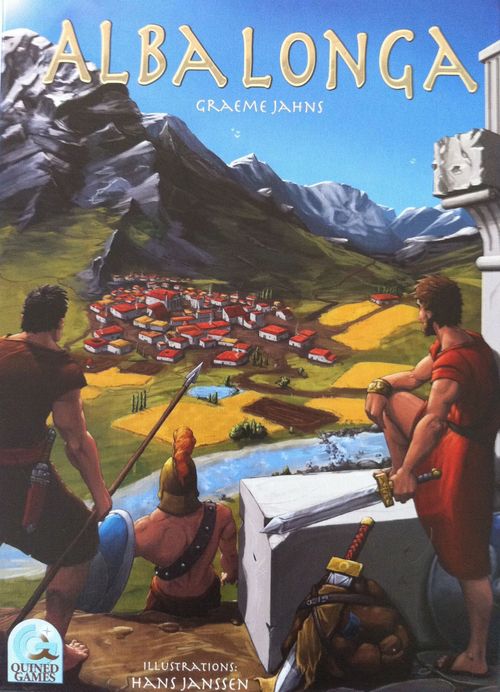
Alba Longa
Alba Longa Rulebook
Table of Contents
Table of Contents
Goal
You are the King of a powerful city state. Be the first King to construct 10 Monuments in honour of the gods, and have a population of 16 or more Peasants at the end of a year.
Components
- This Rulebook
- 4 Eight sided dice numbered 1 - 4 twice (1 Black for Soldiers, 1 Brown for Priests, 1 Grey for Merchants, and 1 White for Quarry Workers)
- 50 Wooden Monuments in 5 player colours: 10 Blue, 10 Green, 10 Purple, 10 Red, 10 Yellow
- 1 Central Board (showing the Season Track, Dice Cost Track and 6 Market Stall Spots)
- 5 City Boards (Alba Longa, Reate, Roma, Velitrae, Veii)
- 18 Discs (1 Population Track Disc, 1 Housing Track Disc, and 1 Worship Track Disc in each of the 5 player colours. 1 Black Season Track Disc, 1 Black Dice Cost Track Disc, and 1 Brown Mark of Piety)
- 100 Wooden Peasants (90 Natural regular Peasants and 10 Black Captive Peasants)
- 40 Wheat Tokens (6 tokens of 10 Wheat, 10 tokens of 5 Wheat, and 24 tokens of 1 Wheat)
- 55 Coins (40 Silver of value 1 each, 15 Gold of value 3 each)
- 20 City Cards (4 Alba Longa, 4 Reate, 4 Roma, 4 Velitrae, 4 Veii)
- 25 Hero Cards (5 sets, each of values 0 through 4)
- 10 Weather Cards (3 Dry, 4 Moderate, 3 Wet)
- 9 Blessing Cards (4 cards of 3 Wheat, 3 cards of 2 Silver, and 2 cards of 1 Monument)
- 1 King of Kings card
Preparation
Note: as an example the game setup for a four-player game is illustrated.
Important: Throughout the rulebook the word "King" refers to a "Player" and the phrase "King of Kings" refers to the "First Player".
- Place the dice and the Central Board in a location easily accessible to all Kings. Important: In a 3 player game only Market Stall Spots I through IV are used. In a 4 player game add Spot V, and in a 5 player game all 6 Market Stall Spots are used.
- Place a Black Disc on the Growing Season of the Season Track. Place a Black Disc on the space marked 0 on the Dice Cost Track.
- Each King takes a City Board, 8 Peasants, 5 Silver Coins, and the 10 Monuments and 2 Discs of their colour.
- Each King places their City Board on the table in front of them. The 8 Peasants are placed on the first 8 spaces of the city's Housing Track. One Disc is placed at the space marked 8 on the Population Track, one Disc is placed beside the Worship Track. The third Disc, used on the Housing Track, is only needed in the variant "A Job Well Done", which is explained at the end of the rulebook. Each King keeps their Coins and Monuments near their City Board in plain view for all Kings to see.
- The Wheat tokens, the remaining Peasants and coins make up the General Supply and should be kept together in an easily accessible location.
- Each King takes a set of Hero Cards and City Cards. For each King there are 9 cards in total (5 Hero Cards, and 4 City Cards) whose card backs match their City's colour and symbol. The 5 Hero Cards, numbered 0 through 4, make up each King's set of active Hero Cards. When fewer than 5 Kings are playing, Kings discard to the box any of their City Cards that are not represented in the game.
- Put aside 1 Moderate Weather Card. Group the remaining weather cards into 3 sets of cards made of 1 Dry, 1 Moderate, and 1 Wet Weather Card each. Discard 1 set to the box. Shuffle the other two sets independently, and without looking at them place one set on top of the other. Still without looking place the previously set aside Moderate Weather Card on top. Place the deck in an easily accessible location.
- Shuffle the Blessing Cards and place them in a pile in an easily accessible location.
- The youngest King at the table gives the King of Kings card to any King at the table. He may instead keep it for himself. The King of Kings, who is the first King, starts the game.
P.S.: The 10 Black Captive Peasants are only needed in the variant "Spoils of War", which is explained at the end of the rulebook.
City Board Overview
- Each King will play a large portion of their game on their City Board. The top of the board shows the city's name, colour, and symbol, along with the city's two victory tracks: the Population Track and the Monument Foundations.
- The bottom portion of the City Board is made up of 6 different locations, the village proper in the centre of the city, and five jobs locations located around the village proper.
- The top left region is the city Barracks. Peasants are assigned here to build an army to both attack other cities, and to defend their city from attack.
- The left region is the Bazaar. Peasants are assigned here in order to generate money. Money is used to assign Peasants to the different jobs in the city.
- The bottom left region is the Quarry. Peasants are assigned here in order to build Monuments.
- The bottom right region is the Temple. Peasants are assigned here to worship the gods so that the city's yearly harvest might be upgraded. The Disc by the Temple is used to keep track of the city's Worship Level. The harvest upgrade cost, located on the back of the Weather Cards, changes each Year.
- The right region contains the Fields used for farming. Peasants are assigned here to generate Wheat. Wheat is used to feed the city's existing populace and to attract new Peasants to the city.
- The village proper shows a Housing Track where Peasants begin each Season.
Order of Play
The game takes place over a series of Years. Each Year consists of two Seasons. Each Year is broken into the same 3 phases:
I - Growing Season
- Begin Season
- Assign Peasants (excluding Farmers)
- Resolve Tasks
- Return Peasants
- Assign King of Kings
II - Harvest Season
- Begin Season
- Assign Peasants (including Farmers)
- Resolve Tasks
- Return Peasants
- Assign King of Kings
III - Year End
- Population Upkeep
- Check Victory Conditions
If no King has achieved all of the victory conditions a new year starts.
I - Growing Season
Important: The description of these phases also details the steps taken during the Harvest Season unless otherwise stated.
1. Begin Season
a. Mark the current Season: In the Growing Season place the Black Disc on the Growing Season of the Season Track. In the Harvest Season place the Black Disc on the harvest location of the Season Track.
b. Reset Dice Cost: Place the Black Disc on the position marked 0 on the Dice Cost Track.
c. Sell Peasants into Slavery: Each King has the option of selling one or more Peasants into Slavery in exchange for money. A King may sell 1 Peasant for 1 Silver, or 3 Peasants for 2 Silver. Peasants sold into Slavery are returned to the General Supply.
Important: As 16 Peasants are needed to win the game, a King should only sell his Peasants into Slavery if he is very short on Coins.
2. Assign Peasants
First, every King that has a Peasant on a Free Assignment space of their Housing Track (spaces 12, 16 and 20) can place these Peasants on any valid location as per the job descriptions below without the need to roll the dice. Kings can do this simultaneously, or in clockwise turn order starting with the King of Kings, if so desired by any King.
Following the Free Assignments, if any, the King of Kings "Holds Court".
A King "Holds Court" by paying the dice cost indicated on the Dice Cost Track to a single Market Stall Spot and rolls the dice. Note: the first time a King "Holds Court" the dice cost is 0.
After rolling the dice, the King of Kings chooses one of the 4 dice and assigns a number of Peasants from his Housing Track, from 1 to the number indicated on the chosen die, to the task associated with the colour of the die, except when assigning farmers (see Assigning Farmers below). He then places the chosen die in front of himself indicating that this die cannot be chosen by any of the other Kings.
Going clockwise around the table each King chooses to purchase a die, if any remain, or to pass. To purchase a die a King must first pay 1 Silver to one Market Stall Spot, and then he assigns a number of Peasants from his Housing Track, from 1 to the number indicated on the chosen die, to the task associated with the colour of the die. A die purchased during another King's "Court" may never be used to assign Farmers. He places the purchased die in front of himself indicating that this die cannot be chosen by any of the other Kings.
Important: A King who decides to "Hold Court" must pay the dice cost indicated by the Dice Cost Track. The other Kings always pay 1 Silver when purchasing dice left over from the roll.
Important: A King that cannot afford to purchase a die, has no Peasants on his Housing Track, or no dice remain to be purchased, may not purchase one of the excess dice, and must pass.
After each King has had one opportunity to either purchase a die or pass, the King to the left of the King of Kings "Holds Court" by paying the dice cost on the Dice Cost Track and throwing the four dice etc.
After each King has had the opportunity to "Hold Court" the Black Disc on the Dice Cost Track is moved 1 space along the track. Now the King of Kings may "Hold Court" for a second time, or pass on "Holding Court". Note that the cost to "Hold Court" is now higher, as indicated by the Dice Cost Track. If the dice cost is 2 or greater, the King must pay the entire dice cost to one Market Stall Spot. Repeat this process until all Kings have either assigned all of their Peasants, or they have passed on the opportunity to "Hold Court".
Important: When presented with the opportunity to "Hold Court" a King that either has no Peasants on his Housing Track, or cannot afford to pay the dice cost to "Hold Court", must pass.
Important: When a King passes on the opportunity to "Hold Court", this King may neither "Hold Court" nor purchase dice from another King's "Court" for the remainder of the Season. When a King passes on "Holding Court" he may wish to lie down one of his remaining Peasants on his Housing Track to remind himself that he may not "Hold Court" or purchase any excess dice from another King's "Court" this Season.
Important: When a King who is not "Holding Court" passes on the opportunity to purchase excess dice from another King's "Court", he may again "Hold Court", or purchase dice from another King's "Court", this Season.
Example Play: Abby, Bernice, Colin, and David are Kings (and Queens) competing to fulfil the challenge of the gods. Abby starts the game as the King of Kings so she takes the dice in hand. The Black Disc on the Dice Cost Track starts at the location marked 0 so Abby doesn't need to pay any money to put in a Market Stall Spot to Hold Court. She rolls the dice onto the table. The Soldier (black) die displays a 3, the Merchant (grey) die a 2, the Quarry Worker (white) die a 2, and the Priest (brown) die a 4.
Abby decides that she would like to gain influence with the gods, so she takes the Priest die. First she places the Priest die in front of herself, takes 3 Peasants from her Housing Track, and places them on the first 3 spaces of her Worship Track. The die allowed her to place up to 4 Priests in the Temple, but she decided to save one for another task.
Abby passes the remaining 3 dice (the Soldier die, the Merchant die, and the Quarry Worker die) to Bernice on her left. Bernice decides she would like to assign some Peasants to her Quarry. She pays 1 Silver to one of the Market Stall Spots, places the Quarry Worker die in front of her, and assigns 2 of her unassigned Peasants to the Quarry. Bernice then passes the remaining dice (the Soldier die and the Merchant die) to Colin. Colin chooses not to purchase either die, and passes. The remaining dice move to David who also passes. All 4 dice are passed to Bernice who now Holds Court by paying the cost indicated on the Dice Cost Track, which is still at 0.
After Bernice, Colin and David each "Hold Court", and each King either purchases or passes on available dice, the dice return to Abby. At this point, Abby moves the Black Disc on the Dice Cost Track to the right one space, from 0 to 1. If Abby wants to Hold Court and roll the dice again she must first pay 1 Silver to a Market Stall Spot.
Choosing a die and assigning Peasants
When a King purchases a die he places it in front of himself and then assigns a number of Peasants from his Housing Track, between 1 and the number displayed on the chosen die, to the task associated with the colour of the die: Black for the Soldiers, Grey for Merchants, White for Quarry Workers, and Brown for Priests. Farmers are not associated with a die colour and are assigned differently (see "Assigning Farmers" below).
Important: There is no limit to the number of Soldiers/Merchants/Quarry Workers/Priests/Farmers that can be assigned!
a. Assigning Soldiers (Black): Place the Peasants anywhere on the Barracks.
b. Assigning Merchants (Grey): Place each Peasant in ascending order on the Merchant Track. If the Merchant Track is full additional Merchants are placed near the Merchant Track.
c. Assigning Quarry Workers (White): Place the Peasants anywhere in the Quarry.
d. Assigning Priests (Brown): Place each Peasant in ascending order on the Worship Track on the first available spot after the Disc. If the Worship Track is full place each additional Priest near the Temple.
e. Assigning Farmers [Harvest Season only]: Important: Farmers may only be assigned during the Harvest Season. They are assigned either through free Peasant assignments at the beginning of the Season, or by the King "Holding Court". There is no die associated with farming. To assign Farmers the King "Holding Court" chooses any die and assigns a number of Peasants from his Housing Track, from 1 to the number indicated on the chosen die. The other Kings (those not currently "Holding Court") may not assign Farmers. A King may not assign Farmers to the Fields during the Growing Season.
The first 5 Peasants are placed on the Fields. If all of the Fields are occupied each additional Peasant is placed in the Granary.
3. Resolve Tasks
After every King has assigned all of his Peasants, or passed on the opportunity to "Hold Court", each of the tasks is resolved.
Resolution occurs in the following order:
- A. Soldiers
- B. Merchants
- C. Quarry Workers
- D. Priests
- E. Farmers [Harvest Season only]
- F. Blessings of the gods [Harvest Season only]
A. Resolve Soldiers
Soldiers are used to Sabotage the plans of the other Kings, capture Peasants for use in your own city, and protect your own city from Sabotage.
a. Planning attack
-
Choose a city to attack: Every King that has assigned Soldiers secretly selects one city to attack. Each King takes the City Card matching the city they want to attack, and places it face down on the table in front of them.
Important: Even if a King has assigned Soldiers primarily to defend his own city, that King must still choose a city to attack. Because all Soldiers are used for both attack and defence, there is no penalty for doing both.
-
Reveal attacks: Once every King that has assigned Soldiers has chosen their target city, all Kings simultaneously reveal the cities that are going to be attacked.
-
Choose a Hero to lead the Soldiers: Each King that is attacking and/or defending against an attack secretly chooses a Hero to lead their forces and places a Hero Card, from his set of active Hero Cards, face down on the table in front of them, including the defending Kings that didn't assign any Soldiers. The Kings that didn't assign any Soldiers and are not being attacked by another King do not place a Hero Card. The value of the chosen Hero Card applies both to attack and defence.
-
Reveal Heroes: Once every King that is attacking and/or defending against an attack has chosen a Hero Card, all Kings simultaneously reveal their Heroes.
b. Determining a successful attack
Attacks are resolved one attacked city at a time, starting with the King of Kings' city, and going clockwise around the table.
An attack is successful if the attack strength is greater than the city's defence. In the event of a successful attack, Sabotage is carried out. The Success Value of an attack is the difference between the attack and defence values. The amount of Sabotage done against a city is determined by comparing the Success Value against the following table:
| Success value | Sabotage |
|---|---|
| 1-2 | 1 |
| 3-5 | 2 |
| 6-9 | 3 |
| 10+ | 4 |
A city may not suffer from more than 4 Sabotage per Season. If the success value is 10 or greater, a maximum of 4 sabotage will be carried out against the defending city. Sabotage is carried out one at a time, starting with the attacker who committed the strongest attack (Soldiers plus Hero) and cycles through the attackers in descending strength order. Ties are resolved by the attackers' clockwise proximity to the King of Kings. If, according to the attack's Success Value, more Sabotage may be carried out after each attacker has performed Sabotage once, cycle through the attackers again, starting with the attacker who committed the strongest attack, until all Sabotage has been carried out.
c. Carrying out Sabotage
A King carries out Sabotage by sabotaging a city's Peasants at any assigned location. Except where otherwise stated a Sabotaged Peasant is moved from his job back to the city's Housing Track. The Sabotaged Peasant does not contribute to the Season's job resolution. A job that doesn't have any Peasants assigned to it may not be Sabotaged.
Sabotaging Soldiers: It is not possible to Sabotage the defending King's soldiers.
Sabotaging Merchants: Sabotaged Merchants are returned to the city's Housing Track in reverse placement order starting with the last Merchant placed on or beside the Merchant Track. A city's Merchants may not be Sabotaged if only a lying down Merchant remains on the Merchant track.
Important: If the city's last Merchant is Sabotaged or captured, that Merchant is placed lying down on the Merchant Track instead of returning to the city's Housing Track.
Sabotaging Quarry Workers: When sabotaging Quarry Workers, any Quarry Worker is returned to the city's Housing Track.
Sabotaging Priests: Sabotaged Priests are returned to the city's Housing Track in reverse placement order, starting with the last Priest placed on or beside the Worship Track. A city's Priests may not be Sabotaged if only the Disc used to keep track of the city's Worship Level occupies the track.
Sabotaging Farmers [Harvest Season only]: When sabotaging Farmers, Farmers in the Granary are Sabotaged first, by returning them to the city's Housing Track. If no Farmers occupy the Granary one of the Farmers in the Fields is placed lying down in his field instead of returning to the city's Housing Track. This indicates that the field will produce less Wheat during the harvest. A city's Farmers may not be Sabotaged if only lying down Farmers occupy the city's Fields.
d. Discarding used Heroes
Following combat each King places their played Hero Card, of value 1 or higher, face down in their own used Heroes pile off to the side of their play area. If a King plays his Hero Card of value 0, the King returns that card to their set of active Heroes instead.
If after discarding his Hero Card, a King has only one active Hero Card left, he returns all of his used Hero Cards to his set of active Hero Cards.
Important: No King may look at the active or used Hero Cards of another King.
Example Play: Abby, Bernice, Colin, and David are resolving Soldiers. Abby (the current King of Kings) has assigned 3 Soldiers, Bernice has assigned 3, Colin 0, and David 4. Bernice has 3 Peasants in her Bazaar, 4 Peasants in her Quarry, and 5 Peasants in her Temple. She has no farmers because it is a Growing Season.
Abby, Bernice, and David now secretly choose a target to attack. Colin does not choose as he does not have any Soldiers. Once all of them have chosen, the targets are revealed. Abby has attacked Bernice, Bernice has attacked Colin, and David has also attacked Bernice.
Everyone now secretly chooses a Hero to play. Colin also chooses a hero to play, as his city is under attack. Once all of them have chosen, the Heroes are revealed. Abby plays her 0 Hero, Bernice her 1 Hero, Colin his 4 Hero, and David his 2 Hero.
Abby's city is not being attacked, so the first attack to be resolved is the attack against Bernice. Bernice's defence strength is 4 (3 Soldiers plus her 1 Hero). The attack strength against Bernice is 9 (Abby's 3 Soldiers and 0 Hero plus David's 4 Soldiers and 2 Hero). The attack succeeds with a Success Value of 5 (9 Attack minus 4 Defence). This means that 2 sabotage is carried out against Bernice.
Because David committed the larger force to the attack (David's 6 vs. Abby's 3) David is the first to carry out 1 Sabotage, and then Abby will carry out 1 Sabotage.
David decides to sabotage her Bazaar. The peasant on spot 3 of Bernice's Merchant Track returns to her Housing Track. During Merchant resolution she will now be awarded 1 Silver and 1 Merchant Stall Spot from the Bank, instead of 2 Silver and a Merchant Stall Spot.
Abby decides to Sabotage Bernice's Quarry. Bernice returns one of her Peasants in the Quarry to her Housing Track. Come Quarry Worker resolution Bernice will build 1 Monument instead of 2. All of the Sabotage has been carried out against Bernice.
Next the attack on Colin's city is resolved. Colin's defence strength is 4 (0 Soldiers and 4 Hero). Bernice's attack strength is 4 (3 Soldiers and 1 Hero). The attack fails because the attack strength is not greater than the defence strength. No sabotage is carried out against Colin.
Everyone, except Abby, discards their used Hero Cards face down into their pile of used Heroes. Abby returns her Hero card to her set of active Heroes because she played her 0 Hero.
B. Resolve Merchants
Merchants generate income for their King.
For each of spaces 1, 3 and 6 covered by a standing Merchant on the Merchant Track, a King gains 1 Silver from the bank.
A King that has at least one Peasant standing or lying down on the Merchant Track will also get all of the Coins from one of the Market Stall Spots.
The Market Stall Spot with the largest number of Coins is emptied to the bank. The King with most Merchants takes all of the Coins from the largest of the remaining Market Stall Spots. The King with the second most Merchants takes the Coins from the next largest Market Stall Spot, and so on, until every King that assigned at least one Merchant has taken all of the Coins from a Market Stall Spot. Ties are resolved by the Kings' clockwise proximity to the King of Kings.
If a King's only Merchant on his track is lying down as the result of Sabotage, then that King receives no money from the bank, but is still entitled to receive money from one of the Market Stall Spots. That King however, is last in priority for receiving money from a Market Stall Spot, even compared to Kings with only one standing Merchant.
If a King has not assigned any Merchants, he neither receives any Coins from the bank nor does he receive Coins from one of the Market Stall Spots.
Any Coins left over in any of the Market Stall Spots are returned to the bank.
C. Resolve Quarry Workers
Quarry Workers construct Monuments.
For every 2 Quarry Workers, 1 additional Monument is built on one of the city's Monument Foundations. If the King has an odd number of Quarry Workers assigned, the last Quarry Worker's work is lost. It is not possible to save work from one Season to the next.
D. Resolve Priests
Priests worship the gods to improve the city's harvest, and to bring about the gods' blessings.
Each King takes his Disc and places it on the space of the last Priest in the Worship Track.
If the current Season is the Growing Season, the location after the Disc will be the first location occupied by any Priests assigned to the Temple in the Harvest Season.
At the end of the Harvest Season the value indicated by the Disc is the city's Worship Level, indicating the total amount of worship offered to the gods in an attempt to upgrade the city's harvest.
The top Weather Card is then flipped over to reveal how much worship is required for the gods to upgrade the city's harvest.
If a city's Worship Level is equal to or greater than the number displayed on the card, that King may upgrade his harvest by moving his Disc down the Worship Track by a number of spaces equal to the number displayed on the card. A King may choose not to upgrade his harvest.
E. Resolve Farmers [Harvest Season only]
Farmers bring in the yearly harvest. The size of the harvest depends on the Weather of the current year, as indicated by the back of the top Weather Card. In a Dry year, each Farmer produces 2 Wheat. In a Moderate year each Farmer produces 3 Wheat, and in a Wet year each Farmer produces 4 Wheat.
If a King upgrades his city's harvest, each Farmer produces 1 additional Wheat, so that each Farmer produces 3 Wheat in a Dry year, 4 Wheat in a Moderate year, 5 Wheat in a Wet year.
Each Farmer that is lying down, as the result of Sabotage, produces 1 less Wheat than normal: 1 Wheat during a Dry year, 2 Wheat during a Moderate year, and 3 Wheat during a Wet year. Even if the city's harvest was upgraded a Sabotaged Farmer will never produce additional Wheat that Season.
| Season | Dry | Moderate | Wet |
|---|---|---|---|
| Food per Farmer | 2 | 3 | 4 |
| Upgraded Harvest | +1 | +1 | +1 |
| Food per Sabotaged Farmer | 1 | 2 | 3 |
Each King takes an amount of Wheat equal to the amount harvested and adds it to his Wheat stored within his city's Granary, if any.
Example Play: Abby, Bernice, Colin, and David are resolving Farmers. It is the end of a Moderate Year. Abby has 4 Farmers, and a Worship Level of 6, Bernice has 5 farmers, but one of them is lying down as a result of Sabotage. Bernice has a Worship level of 7, Colin has 5 farmers, with a Worship Level of 4, and David has 4 Farmers with a Worship Level of 8.
Because the Year is Moderate, by default each standing Farmer produces 3 Wheat, and any lying down Farmers produce 2 Wheat. The Moderate card is flipped over to reveal a 5, and also that a Dry year is up ahead! Abby, Bernice and David all choose to spend 5 of their Worship to upgrade their Harvest. Abby is left with 1 Worship, Bernice with 2, and David with 3. Their standing Farmers now produce 4 Wheat each! Colin is not able to upgrade his Harvest, but his Worship Level stays at 4 for the next year.
Abby's 4 Farmers produce 16 Wheat (3 Wheat per farmer, plus 1 Wheat per Farmer for the upgrade). Bernice's 5 Farmers produce 18 Wheat (16 Wheat for her 4 standing Farmers, and 2 Wheat for her one Farmer lying down). Colin's Farmers produce 15 Wheat (3 Wheat per farmer, because there is no upgrade) and David's 4 Farmers produce 16 Wheat.
F. Blessings of the gods [Harvest Season only]
Kings that upgraded their city's harvest may now receive an additional bonus from the Blessing Cards. Any King that wants to receive the bonus on the blessings card must move his Disc down the Worship Track by 2 spaces. A King may choose to pass on the blessings from the gods.
Important: Kings that did not upgrade their city's harvest may not receive the gods' blessings, even if their Worship Level is 2 or more.
After all Kings have decided to receive or pass on the gods' blessings, the top Blessing Card is revealed. Each King that chose to receive the blessings now receives the blessing indicated on the card: 3 Wheat, 2 Silver or 1 Monument. If the blessing is a Monument, any King that has already finished building all of their Monuments receives no blessing, but the worship is still spent. Any unused Worship remains into the next year.
Important: Even if no Kings chose, or were able, to receive the gods' blessings the top Blessing Card is still revealed.
4. Return Peasants
Following the resolution of all of the city's jobs, all of the city's Peasants are returned to the Housing Track.
5. Assign King of Kings
The current King of Kings chooses a new King of Kings for the next Season. The King of Kings may choose any King other than himself to be the new King of Kings, and passes that King the King of Kings card.
II - Harvest Season
(For a description of each phase, see I - Growing Season.)
- Begin Season
- Assign Peasants (including Farmers)
- Resolve Tasks
- Return Peasants
- Assign King of Kings
III - Year End
1. Population Upkeep
At the end of the Year (one Growing Season and one Harvest Season) each King must feed their populace, and hopefully help it grow.
a. Feeding your people: Each King must spend an amount of Wheat equal to the number of Peasants currently living in their city in order to sustain the population for the next Year. If the city has more Peasants than Wheat, the King must spend all of the city's Wheat to feed as many Peasants as possible. Any Peasants over and above the city's total Wheat leave the city and are returned to the General Supply. If a King has no Wheat in his Granary, then all the Peasants leave the city and are returned to the General Supply. The King is removed from the game, and forgotten in history. If the removed King was just chosen as the King of Kings, he immediately chooses a new King of Kings. A King may not choose to feed fewer Peasants than those that currently occupy his city.
b. Growing your population: If a King still has Wheat in his Granary after feeding his Peasants, he may spend additional Wheat to grow the city's population. The amount of Wheat a King must spend is determined by the number of Peasants to be added to the city:
| Additional Peasants | 1 | 2 | 3 | 4 | 5 | 6 |
|---|---|---|---|---|---|---|
| Total Wheat cost | 1 | 3 | 6 | 10 | 15 | 21 |
In the unlikely event that the General Supply is empty, and one or more Kings would like to grow their populace, pieces from other games make good substitutes.
c. Adjusting the marker on the Population Track: After steps a and b, each King now counts his number of available Peasants for the next round and places his marker on the space of the Population Track with the same number.
2. Check Victory Conditions
At the end of each Year (following both a Growing Season and a Harvest Season) all Kings check to see if one or more of them has completed the gods' challenge. In order to win a King must have:
- 10 constructed Monuments and
- A population of at least 16 Peasants
Both victory conditions can, of course, easily be checked by looking at the two victory tracks at the top of each City Board.
If only one King has met these conditions at the end of a year, then that King is the winner, and builds an empire of the likes of which the world has never seen! If two or more Kings meet the winning criteria at the end of the same year, then the King with the largest population wins. If the Kings are still tied, then the King with the largest total of both extra Wheat and Coins is the winner. If two or more Kings are still tied, then all tied Kings create a dominant alliance, and share the victory.
If no Kings have completed the gods' challenge a new year begins. If the Weather Card deck is exhausted, and no King has completed the challenge of the gods, the game ends and all Kings lose.
Special Rules for Playing 2 Players
A 2 Player game of Alba Longa follows the normal rules of play, except in the following cases:
- Only Market Stall Spots I - III are used.
- The Assisi variant must be used.
- "Holding Court" with 2 players plays out as if 4 people were playing the game. So the first player pays the dice cost, the second player purchases as normal (cost of 1). The first player then can purchase a second die at the cost of 1 (as if he were player 3), and then the second player has another opportunity to purchase a die at the cost of 1. After this procedure the second player starts with "Holding Court", in the same way as described above, etc.
Variants
Spoils of War
This variant provides Kings the opportunity to benefit directly from combat. Kings who successfully attack cities that have at least as many monuments built temporarily "Capture" Sabotaged workers for use in their own city. All of the normal rules of play are followed, but additional rules are added to the following sections:
Carrying out Sabotage: If the attacker has a number of Monuments equal to or less than those of the defender the attacker "Captures" Sabotaged Peasants. This is represented through the use of the 10 Captive Peasants (Black). Captive Peasants are assigned in the attacker's City at the same job that he sabotaged. Except where otherwise stated the defender still returns any Sabotaged Peasants, including those that are Captured, to his Housing Track.
Example (successful attack): Yellow performs a successful attack on Blue's Quarry Worker. The Quarry Worker returns to the Housing Track, while Yellow adds a Captive Peasant to his Quarry.
Capturing Merchants: Captured Merchants are assigned as per the regular Merchant assignment rules.
Important: If the last Merchant on the Merchant Track is Captured the defending King still places his Merchant lying down as if it was Sabotaged, but the attacking King also places a Captive Peasant at the end of his own Merchant Track as per the regular Merchant assignment rules.
Capturing Quarry Workers: Captured Quarry Workers are assigned as per the regular Quarry Worker assignment rules.
Capturing Priests: Captured Priests are assigned as per the regular Priest assignment rules.
Capturing Farmers: Farmers in the Granary are Captured first. Farmers Captured from a Granary are returned to the city's Housing Track. Farmers Captured from the Fields are still placed lying down in their field instead of returning to the city's Housing Track.
If the Spoils of War is being used in conjunction with A Job Well Done, then the attacker assigns Captive Farmers to his City Board. Captive Farmers may only be assigned to the Granary, not to an open field if one or more exist.
If the Spoils of War is not being used in conjunction with A Job Well Done, then the attacker does not assign any Captive Farmers to his City Board. However, the attacker does take 1 Wheat from the General Supply for each Farmer that he Captures from the Fields.
Return Peasants: All Captive Peasants are now returned to the General Supply.
A Job Well Done
This variant speeds up the game by rewarding Kings that assign the most Peasants to each job. Set up the game as you would normally. In addition Kings place one Disc beside their Housing Track. All of the normal rules of play are followed, but additional rules are added to the following sections:
Resolve Soldiers: Before the Kings choose which cities to attack the King with the largest army may return one Hero Card from his set of used Hero Cards to his set of active Hero Cards. In the event of a tie no King receives this bonus. During the first attack, since all Hero Cards are still active, no additional bonus is awarded for having the largest army.
Resolve Quarry Workers: The King with the most assigned Quarry Workers upgrades his city's housing by moving his Disc up one space on his Housing Track. In the event of a tie, no King receives this bonus.
Tip: The Housing Track upgrade indicated by the Disc helps players reach the Free Assignment spaces on the Housing Track with a smaller population than would normally be required.
Resolve Priests: At the end of the Harvest Season the King with the most worship gains the "Mark of Piety" (Brown Disc). The King with the Mark of Piety gains a benefit during the "Blessings of the gods". In the event of a tie for most worship, no King receives the Mark of Piety.
Resolve Farmers [Harvest Season only]: During the Harvest Season the King with the most standing Farmers, in the Fields and the Granary, receives 2 additional Wheat. In the event of a tie for most standing Farmers, no King receives this bonus.
Blessings of the gods [Harvest Season only]: Provided the King with the Mark of Piety upgraded his Harvest, he only needs to move his Disc down the Worship Track 1 space in order to receive the blessings of the gods. The King with the Mark of Piety returns the disc to the General Supply regardless of whether or not the King received the blessings of the gods.
Return Peasants: Following the resolution of all of the city's jobs, all of the city's Peasants are returned to the Housing Track starting on the space following the Housing Track Disc.
Check Victory Conditions: In order to win a King must have:
- 10 constructed Monuments and
- A population of at least 16 Peasants, not including the location of the Disc on the Housing Track.
Assisi (For 2 - 4 Players)
Kings who don't like directly attacking other Kings, or who want more choices in combat, should use this variant. This variant must be used in a 2 player game. The city of Assisi holds Pillage Items to be taken during combat. All of the normal rules of play are followed, but additional rules are added to the following sections:
Preparation: Assisi is depicted on the back of the Reate City Board. Place 3 Peasants on the Assisi City Board. The Peasants indicate Assisi's current defence. Assisi also starts with 2 Pillage Items on its City Board: 1 Silver and 2 Wheat.
Important: 2 Wheat count as 1 Pillage Item.
Kings do not discard their Reate City Cards as they will represent Assisi.
Resolve Soldiers, choose a city to attack: Kings may choose to attack Assisi instead of another King. To do this a King takes his Reate City Card, which represents Assisi, and places it face down on the table in front of them.
Determining a successful attack: Attacks are resolved one attacked city at a time, starting with Assisi, followed by the King of Kings' city, and continuing clockwise around the table. The attack success, the amount of Sabotage, if any, and how Sabotage is carried out on Assisi is determined by the normal rules of play, though Assisi does not play any hero cards in its defence.
Sabotaging Assisi: When a King Sabotages Assisi, he takes one of Assisi's Pillage Items: 1 Silver, 2 Wheat or 1 Captive Peasant (available in later Seasons). A Captive Peasant taken from Assisi may be assigned to any job, other than Soldiers, following the Captive Peasant assignment rules outlined in the Spoils of War variant.
If Assisi is being used in conjunction with A Job Well Done, Captive Peasants from Assisi may be assigned as Farmers to the Granary only.
If Assisi is not being played in conjunction with A Job Well Done then Captive Peasants from Assisi may not be assigned as Farmers.
Update Assisi: After all of the Season's attacks have been resolved, Assisi is updated. If Assisi was attacked an additional Peasant is added to Assisi's defence, regardless of whether or not the attack was successful. Assisi may never have more than 8 Peasants defending it.
The King of Kings adds 1 Pillage Item to Assisi: 1 Silver, 2 Wheat, or 1 Captive Peasant. Assisi may never hold more than 8 Pillage Items. Assisi may never hold more than 3 Pillage Items of the same type (i.e. 3 Silver, 6 Wheat or 3 Captive Peasants).