Akros
Akros Rulebook
Table of Contents
Table of Contents
Game Content
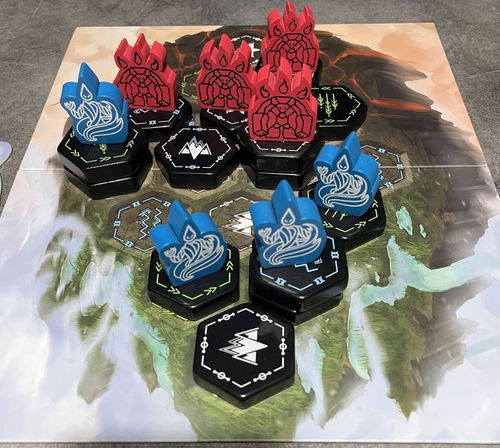
- 4 Ifrit Servants
- 4 Jinn Servants
- 1 cotton bag
- 1 Dawn of the World board
- 1 Temple of Time board
- 19 Region tiles (6 Forests, 6 Seas, 7 Mountains)
The Temple of Time board has spaces numbered 7 (for tiles 1-2-3), 8 (for tiles 4-5-6), and 9 (for tiles 7-8), used to track discarded tiles during the game.
Game Objective
Akros is an asymmetrical game for two players in which they both play as titanic creatures during the genesis of a new world. By using your elemental servants you'll have the chance to shape the scenery of a small new world to gain control of its various regions. At the end of the game, each player adds the value of all regions controlled by their servants to determine who has dominion over each environment. The player who has dominion over the majority of the three environment types will claim the merit of creation.
Setup
- Place the Dawn of the World board at the center of the table.
- Place the Temple of Time board next to it.
- Put the Region tiles in the bag and shuffle them.
- The players choose which entity to impersonate.
- The Jinn player starts first by taking the Jinn Servants and placing them as shown.
- The Ifrit player takes the Ifrit Servants and places them as shown.
Gameplay
The game is divided in two phases: the first one lasts from the first to the sixth turn, while the second one takes place from the seventh to the ninth. Then the game is over.
Ifrit Servants
Ifrit Servants move on the Dawn of the World board by traveling a single space in any adjacent unoccupied space. After movement, all regions adjacent to two or more regions occupied by Ifrit Servants are considered contested (see "Jinn Servants" below).
Jinn Servants
Jinn Servants move on the Dawn of the World board by traveling to any unoccupied and uncontested tile. If before movement one or more Jinn Servants are in contested regions, the Jinn player must move one of those Servants.
Phase 1 - Genesis
The first six game turns follow this pattern:
- The Jinn player draws three tiles at random from the bag, then chooses one of them and keeps it face up in front of her. Then the Jinn player passes the other two to the opponent.
- The Ifrit player chooses one of the received tiles and keeps it face up in front of her, while discarding the other on the Temple of Time board. Tiles discarded during the first three turns are placed in space 7, while those discarded in the three following turns are placed in space 8. This way, at the end of the sixth turn, there will be three tiles in space 7 and three in space 8.
Players can look at the tiles on the Temple of Time board at any moment.
Example A
Francesco, the Jinn player, draws 3 tiles from the bag: 1 Sea and 2 Mountains. He decides to keep 1 Mountain for himself and passes the other 2 tiles to Caterina, the Ifrit player. Caterina decides to keep the other Mountain and, since it's the fifth turn of the game, she places the Sea tile on space 8 of the Temple of Time board.
- The Ifrit player takes the tile in front of her and places it on the Dawn of the World board, upon a region of the same environment type that's not occupied by any Servant. One Ifrit Servant must also move on the placed tile, following the movement rules of Ifrit Servants. It's not possible to place a tile in a region that cannot be reached by an Ifrit Servant.
Example B
Caterina has to place her Mountain tile on a space of the corresponding environment on which she could move one of her Servants. Regions 1, 2 and 3 are already occupied, region 4 can't be reached by any of her Servants. She must choose between regions 5 and 6.
Caterina chooses to place her tile on region 5 and moves one of her Servants on it. Following this move, regions 1, 3, 7, 8 and 9 are now contested.
- The Jinn player takes the tile in front of her and places it on the Dawn of the World board, upon a region of the same environment type that's not occupied by any Servant. One Jinn Servant must also move on the placed tile, following the movement rules of Jinn Servants. It's not possible to place a tile in a region that cannot be reached by a Jinn Servant.
Example C
Francesco has to place his Mountain tile on a space of the corresponding environment on which he could move one of his Servants. Regions 2, 3 and 5 are already occupied and region 1 is contested by the Ifrit player, so he can only choose between regions 4 and 6.
Francesco chooses to place his tile on region 6. Since regions 3 and 7 are contested, he must move one of his Servants from them onto the tile 6. He chooses to move the Servant from region 3.
What if there aren't any valid spaces?
If a player can't place the chosen tile following the movement rules of her Servants, that player must remove the tile from the game.
After the sixth turn there will only be one tile left in the bag. Remove the bag and that tile from the game and proceed to the second phase of the game.
Phase 2 - The Temple of Time
During the last three turns the placing of tiles proceeds as normal, as during the previous phase. However, tiles are not drawn from the bag:
- During turns 7 and 8 the Jinn player draws three tiles from the piles on the corresponding spaces of the Temple of Time board. The two tiles discarded during these turns are both placed on space 9 of the Temple of Time board.
- During turn 9 the Jinn player draws the two tiles from the corresponding pile on the Temple of Time board.
At the end of the ninth turn the game ends immediately.
End of the Game
For each type of environment (Forest, Sea, Mountain), each player adds the number of his or her Servants and the number of tiles on which they are present. For each type of environment, the player with the highest sum claims that environment's merit. In case of a tie, no player claims that environment's merit.
The player that claims merit for most of the environment types wins the game. In case of a tie, the Ifrit player wins.
Example D
Francesco and Caterina check who claims merit for the genesis of the Forest environment. Francesco has 1 Servant on a region made up of 2 tiles and 1 Servant on a region without any tiles (1 + 1 + 2 = 4). Caterina instead has 1 Servant on a region made up of 3 tiles (1 + 3 = 4). No one claims merit for the Forest environment.
And so, finally, the new world emerged from nothingness...
…shaped by the most ancient natural forces of the Universe, now long forgotten by mortals.