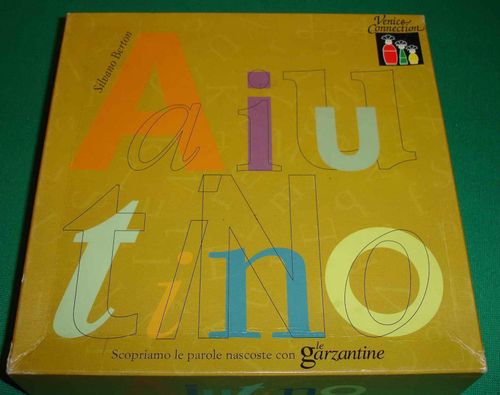
Aiutino
Aiutino Rulebook
Table of Contents
Table of Contents
Components
- 75 topic cards (schede-argomento). Each card lists 30 words related to a given topic.
- 50 helper sheets (fogli-aiutino).
- 150 solution sheets (fogli-soluzioni).
- 6 coloured pencils.
- 1 cardboard screen.
- 1 one-minute hourglass.
- These rules.
The Game
A game consists of one or more rounds (manche), as the players decide at the start.
Each round consists of as many turns as there are players, so that every player acts as the "game conductor" once per round.
Setup
At the start of each round, all players simultaneously prepare their own helper sheet (foglio-aiutino), with which they will run the game on their turn.
Each player draws 3 topic cards and chooses one: that will be their topic.
Let's suppose you have chosen the wine card:
| VINI | |
|---|---|
| Albana | Nebbiolo |
| Amarone | Orvieto |
| Barbera | Pinot |
| Cabernet | Prosecco |
| Cartizze | Raboso |
| Chardonnay | Refosco |
| Chianti | Riesling |
| Dolcetto | Sangiovese |
| Est Est Est | Sauvignon |
| Fragolino | Soave |
| Grignolino | Terlano |
| Gutturnio | Tocai |
The card lists 30 terms related to the topic; in our example, the names of 30 wines.
The player chooses 6 of them, which have 6 different initial letters, and writes them (neatly, in print) on a helper sheet, one per row. The first 4 letters of each word are highlighted one at a time, one letter per column.
Suppose you have chosen these wines:
| Col. 1 | Col. 2 | Col. 3 | Col. 4 | Rest of word |
|---|---|---|---|---|
| M | E | R | L | ot |
| T | R | E | B | biano |
| C | H | I | A | nti |
| V | A | L | P | olicella |
| P | I | N | O | t |
| S |
Caution: the helper sheets must be filled in secretly. It is very important that the opponents do not see the words you have chosen.
Playing
Once the helper sheets are filled in, the players take turns, one at a time, as the "game conductors". The conductor proposes his topic to the opponents, who try to guess the 6 chosen words as quickly as possible. The order in which the players act as conductors does not matter; what counts is that each player does it once per round.
Suppose, for example, that you are the first. Take your helper sheet and insert it behind the cardboard screen. All the other players each take a solution sheet and a pencil.
When they are ready, slide your helper sheet out from behind the screen by a few centimetres, so that the first column of letters is visible: that is the first hint (aiutino):
| Hint 1 | |
|---|---|
| 1 | M |
| 2 | T |
| 3 | C |
| 4 | V |
| 5 | P |
| 6 | S |
The opponents now have 2 minutes (that is, 2 hourglasses) to write, each with any one of the coloured pencils provided, what they believe the solutions are.
Then you show the second letter (second hint), and the opponents have 1 minute (one hourglass) to confirm what is already written or to add a new solution in the second column. The same applies to the third and fourth letters (hints): each time, 1 minute to add any solutions in the third and fourth columns.
At the end of the fourth letter the turn ends and all the sheets are revealed. Comparing the players' solutions with the helper sheet, the points are calculated as follows:
- 5 points for each word guessed in the first column.
- 3 points for each word guessed in the second column.
- 2 points for each word guessed in the third column.
- 1 point for each word guessed in the fourth column.
Let's look at the solution sheet of one of your opponents, Carlo, who scored an excellent total on the topic VINI. The printed example is reproduced below; entries in bold were circled in the original as the words that scored, and a dash (—) is an empty space on the sheet:
| 5 | 3 | 2 | 1 | Pts | |
|---|---|---|---|---|---|
| M | M alvasia | ME rlot | — | — | 3 |
| T | T ocai | TR ? | TRE bbiano | — | 2 |
| C | C hianti | — | — | — | 5 |
| V | V ? | VA lpollicella | — | — |
The column headers are the point values of each column (5, 3, 2, 1). The "?" marks a letter the player did not complete. In the example, Malvasia, Tocai, Prosecco and Sauvignon are not among the 6 words chosen by that player, so they score nothing.
Coloured pencils: once the first column is completed, and before the second hint is revealed, each player passes his pencil to the opponent on his left. This is done also before revealing each subsequent hint. In this way the columns of each player's solution sheet are written in different colours, and this prevents a less scrupulous competitor from writing in an earlier column, which is worth more points, instead of the column in play.
In the example, the player, after leaving the first column blank, finds the word Valpolicella after the second hint. At this point he could write the name of the wine not in the second column, as is correct, but in the first column, which is worth more points. However, since he must use a pencil of a different colour, if he did so everyone would easily notice.
Caution: if no competitor has guessed a given word, all of them score 5 points: the "fault" of having included a word that is too difficult falls on the game conductor of the turn!
Suggestion: if the first hint was an M and you wrote Malvasia in the first column, nobody stops you from writing MAlbech in the second column with an A at the second hint. At the end of the turn, if Malvasia is correct in the first column you will have earned 5 points, and if Malbech is correct in the second column, 3 points; and so on down to the fourth column, 1 point.
Victory
The competitors add up, turn by turn, the points they score on each turn. At the end of the rounds agreed on at the start, the player with the most points is the winner.
Word Notes
All terms on the topic cards are at least 5 letters long (so the Po and the Arno are not on the card "Italian Rivers").
Some titles or names are made up of 2 or more words. In these cases the total length does not exceed 15 letters, and they are written on the helper sheet without spaces.
In general, the name as it appears in dictionaries or encyclopedias is used; for example ROLLING STONES (not The Rolling Stones), etc.
Solution Notes
Different solutions that are pertinent to the topic and share all of the first 4 letters are accepted as valid. For example, if the term to find was BARBera and a competitor wrote BARBaresco, it is valid. The same applies to DORABALTEA and DORARIPARIA.
In case of spelling errors, especially with foreign names, we suggest not being too strict with your opponents.
For the More Expert
A compiler may choose to insert into his helper sheet some terms not included in his topic card. These must however be words which the other players, at the end of the turn, recognise as pertinent to the topic, and which are in any case findable in Garzanti dictionaries and/or encyclopedias.
Moreover, particularly skilled players may "create" topics not included in the 75 cards and compile new helper sheets.