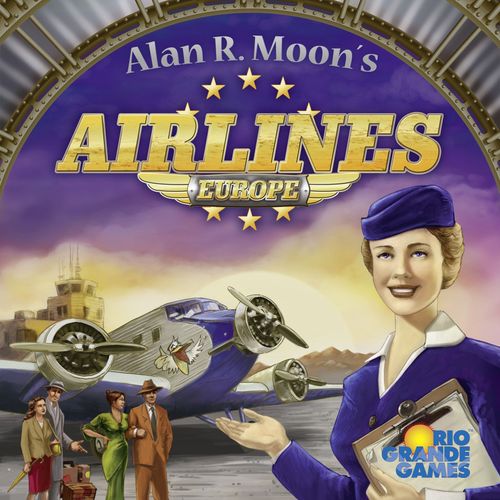
Airlines Europe
Airlines Europe Rulebook
Table of Contents
Table of Contents
Contents
- 1 game board with map of Europe and scoring track
- 3 scoring cards (w/gray backs)
- 112 share cards in the color of the airlines (w/gray backs)
- 16 Air Amigos (yellow)
- 15 Rio Grande Southern Europe (blue)
- 14 Lucky Hans Airways (violet)
- 13 Days Of Flying Wonders (red)
- 11 Brooms Bewitched (black)
- 10 Jolly Roger Airships (brown)
- 9 FF Flys (green)
- 9 It's Funagain To Fly (orange)
- 8 Flying Is Simply Fun (gray)
- 7 White Winds (white)
- 112 airplanes in the color of the airlines (16 yellow, 15 blue, 14 violet, 13 red, 11 black, 10 brown, 9 green, 9 orange, 8 gray, 7 white)
- 20 company markers in the colors of the airlines (2 each of yellow, blue, violet, red, black, brown, green, orange, gray, and white)
- 20 share cards Air ABACUS (w/red backs)
- 84 victory tokens (39 1 point, 20 5 points, 20 10 points, and 5 50 points)
- 70 paper money with total value of 150 million Euro (50 1 million and 20 5 million)
- 4 bonus connecting markers (1 each for It's Funagain To Fly (orange), FF Flys (green), Flying Is Simply Fun (gray) and White Winds (white))
- 5 game summary
- rule booklet
Preparation
Depending on the number of players, remove the share cards, airplanes, and markers for the following airlines and return them to the box:
- with 5 players – none
- with 4 players – Air Amigos (yellow)
- with 3 players – Air Amigos (yellow) and Lucky Hans Airways (violet)
- with 2 players – Air Amigos (yellow), Rio Grande Southern Europe (blue) and Lucky Hans Airways (violet)
Note: see "special rules for 2 players" when playing with 2.
Place the game board in the middle of the table in easy reach of all players. The map shows cities (as dark gray or colored circles) and white lines connecting them (routes) with 1-3 circles representing the costs for acquiring licenses to use the routes.
Place a company marker on the home airport of each participating airline to remind players which airlines are being used in the game.
Also, place one company marker for each participating airline on the space on the scoring track showing the color of that airline.
Note: Air ABACUS participates in each game, however it has neither airplanes nor company markers!
The four airlines with the fewest airplanes and shares can create bonus connections in the course of the game (It's Funagain To Fly (orange), FF Flys (green), Flying Is Simply Fun (gray), and White Winds (white)). Place the bonus connecting markers of these airlines on the appropriate spaces beside their target cities.
Sort the airplanes of the airlines used in the game separately by color. They can remain as a supply in the small sections of the plastic tray in the box.
Place the victory tokens next to the game board.
The players choose a starting player who takes 1 victory point from the supply. Next, following in clockwise order around the table, each player takes 1 victory point more than their right neighbor until, stopping just before the starting player.
Example: with 3 players, the start player takes 1 victory point, the second player takes 2, and the third player takes 3.
Each player keeps his victory tokens face down in his play area (the space near him on the table) so they are kept secret from the other players during the game.
Place the bank notes as a bank next to the game board. Count out 30 million Euros for each player in the game. With 5 players, the entire cash available is in the game. With fewer than 5 players, remove the surplus cash from the game and put it back in the box.
Each player takes 8 million Euros from the bank, placing it in his play area. Cash is not kept secret during the game.
Further, each player takes a game summary.
Place the 20 share cards for Air ABACUS face down next to the game board as a supply.
Remove the 3 scoring cards from the deck and set them aside.
Shuffle all share cards of the participating airlines, except those of Air ABACUS, forming the share deck.
Draw the top-most 5 share cards and place them face up on the designated marks of the game board. They form the stock market.
Each player draws 8 share cards from the share deck as his starting hand, keeping them secret from the other players. Although the share cards in a player's hand are secret during the game, the other players must always be able to know how many cards each player has in his hand.
Note: the number on the bottom edge on the front of each share card indicates how many shares and airplanes this airline has.
Now, each player selects 2 share cards from different airlines from his hand, which he places face down in his play area. All players turn over their selected shares at the same time so all can see them in their play areas. These shares form the players' initial share portfolios.
Share Supply Deck
From the remaining share cards, the players create the share supply:
Count out the top 10 cards from the deck (without looking at them), add one scoring card to the 10, shuffle them and place these 11 cards face down as the bottom of the share supply. Take about 1/4 of the remaining share cards from the deck and set them aside (face down without looking at them). Place another scoring card in the middle of the remaining stack of share cards. Place the third scoring card on top of this stack and then place this whole stack on top of the bottom 11 cards of the share supply. Finally, place the set-aside stack with 1/4 of the cards on top of the supply stack you have created. This is your finished share supply deck.
Note: in order to manage the game flow, we recommend the players designate different players to manage the bank, the stock market and the airplane supply.
Playing the Game
The players take turns in clockwise order. The starting player begins. On a player's turn, he chooses exactly one action to take from the four possible actions:
A) Buy one or two route licenses and take a share card
B) Play share cards from his hand and take dividend
C) Acquire Air ABACUS shares
D) Take cash
Note: the player may not select an action, which he cannot complete (exception: (D) "Take cash"; see "Special situation: Bank bankruptcy")
A) Buy One or Two Route Licenses and Take a Share Card
The player buys an available route license on any route for any airline. With the acquisition of a license the airline makes a connection between two cities. Each route offers 1-3 licenses, represented by the circled numbers on the route. The number in a circle represents the cost of the route license (later licenses cost more than those purchased earlier). The player pays the amount shown in the available route circle. Then, he takes an airplane of the airline's color from the supply and places it on the circle representing the route license he purchased. This airplane indicates that this airline has a license to operate on this route. It also indicates that this license for this route no longer is available. Then, the player moves the company marker for this airline forward on the scoring track by as many spaces as the license cost.
Note: a player need not have shares of an airline in his portfolio in order to buy a route license for the airline.
The following restrictions apply for the purchase of route licenses:
- The new route must connect directly to the home airport of that airline or connect via other routes already licensed by that airline to its home airport.
an airline's network can consist of multiple branched routes, as long as they can all be traced back to the airline's home airport.
-
The player must always buy the cheapest license on the route he selects.
-
Each airline may own only one license on each route.
-
When all available licenses have been purchased on a route, a player may not purchase a license for this route for an airline.
-
When the supply of airplanes for an airline is exhausted, a player may no longer purchase a route license for this airline.
The player may now purchase a second route license. As before, he selects any available route and any airline. The same restrictions apply as with the purchase of the previous route license.
After the player has purchased one or two route licenses, he takes 1 share from the stock market or the top card from the share supply stack. He adds the share to his hand. When a player takes a share card from the stock market, he immediately draws the top card from the share supply deck and adds it to the stock market.
Note: even when a player buys 2 licenses, he takes 1 share card!
Remote Connections
The four remote routes (those leading off the map) are handled exactly the same as every other route. Each is very expensive, but exclusive: only one license is available on each.
Bonus Connections
The four airlines with the fewest airplanes and shares receive a bonus for connecting their home airport with a certain target city:
| Airline | Home Airport | Target City |
|---|---|---|
| It's Funagain To Fly (orange) | Athens | >> London |
| FF Flys (green) | Stockholm | >> Athens |
| Flying Is Simply Fun (gray) | London | >> Ankara |
| White Winds (white) | Moscow | >> Madrid |
When such a connection is completed with the purchase of a route license, this bonus connection is created. This means that the airline has all route licenses of a continuous connection between its home airport and the target city. The player moves the company marker for this airline on the scoring track forward as many spaces as indicated by the number on the bonus connecting marker at the target city. This bonus is in addition to the increase due to the just purchased route license. Once an airline has made its bonus connection, the player takes the appropriate bonus connecting marker from the map, returning it to the box.
Airline Blocking
If players can no longer purchase route licenses for an airline as there are no valid routes available, this airline is blocked, even though it may still have airplanes in the supply. Its network cannot be extended.
B) Play Share Cards from Hand and Take Dividend
The player plays at least one share from his hand, adding it to his portfolio.
He plays either any number of share cards from one airline or exactly one share card from two different airlines and adds it to his share holdings.
Subsequently, he takes 2 million euros from the bank as a dividend for each share he played.
Example: Todd plays 4 shares of Air Amigos and takes 8 million Euros from the bank as the dividend.
Note: it is important that all players be able to know what is in the other players' portfolios during the game. To accomodate this, each player should display his portfolio separated by airline and overlapping the shares within each airline so the number held in each is easily seen.
C) Acquire Air ABACUS Shares
The player acquires either 1 or 2 Air ABACUS shares by discarding shares from his hand and/or his portfolio. He adds the acquired Air ABACUS shares to his hand.
If the player discards 1 share, he takes 1 Air ABACUS share from the supply.
If the player discards any 3 shares, he takes 2 Air ABACUS shares from the supply.
A player may not acquire more than 2 Air ABACUS shares in a single turn.
The player places discarded shares face down in the box.
Note: in order to add Air ABACUS shares to his portfolio, the player must use action B on a later turn.
Air ABACUS
Air ABACUS is a special airline. It does not have any airplanes and no route licenses can be acquired for it. Their value is pre-determined for each valuation (see game board) and rises from scoring to scoring. Air ABACUS shares are not available on the stock market. The players can only acquire Air ABACUS shares using action (C).
Note: the Air ABACUS shares are recognizable by their red backs.
D) Take Cash
The player takes 8 million Euros from the bank.
Special Situation: Bank Bankruptcy
In the unlikely event that a player is to take more money from the bank than is currently in the bank, the bank is bankrupt. The game is paused to reset the bank as follows.
All players count their cash. Players with more than 8 million Euros must reduce their cash to 8 million Euros and put the rest of their cash back in the bank. Players with 8 million Euros or less keep their cash.
Next, the players remove the share cards from the stock market, placing them face down in the box and draw 5 cards from the share supply deck, placing them face up as the new stock market.
Now, the game continues with the player who was taking cash when the bank went bankrupt. He now takes the cash he was to take.
Scoring
Triggering the Scoring
When a scoring card is drawn from the share supply deck, the player gives the scoring card to his left neighbor who places it face up in his play area. If the player drew the card to add to his hand, he immediately takes the top card from the deck and adds it to his hand.
If the player drew it to fill the stock market to five cards, he draws cards, placing them in the stock market until the stock market has 5 cards.
Now, the game is interrupted to score the airlines.
Empty the Stock Market
Beginning with the player with the scoring card and continuing in clockwise order until each player has taken a card, each player takes one share from the stock market (not the supply deck), adding it to his hand. No new share cards are added to the market during this time. After all players have taken a share, place all remaining share face down in the box and refill the stock market with five cards from the share supply deck.
Score the Airlines
Now the players score victory points for their portfolios. The player who drew the scoring card calls out all airlines on the scoring track. He starts with the airline whose company marker is farthest advanced on the scoring track and works backwards until all have been called. For each airline he calls, each player, in clockwise order says how many share cards of this airline he has in his portfolio.
Note: shares in players' hands are not counted.
The numbers beneath the area of the scoring track where the airline's company marker stands indicate the distribution of victory points to players who own shares in this airline. The player with the most shares takes victory tokens in the value of the top most number. The player with the second most shares takes victory tokens in the amount of the second number, and so on. Players with no shares of an airline take no victory tokens for that airline.
If several players have the same number of shares of the airline in their portfolios, the victory points for those positions are added together and the points shared equally among those players, rounding up, if necessary.
The victory points for Air ABACUS are distributed last. Their distribution is different for each scoring as shown below:
| Scoring | Distribution |
|---|---|
| 1st Scoring | 4-2-1-0 points |
| 2nd Scoring | 8-4-2-1-0 points |
| 3rd Scoring | 16-8-4-2-1 points |
Example: the company marker for Rio Grande stands on the scoring track in the area with the distribution of victory points listed at 6-3-2-1-0. Todd has 3 shares of the airline in his portfolio, Christine and Doris each have 2, and Bernd has none. Todd takes 6 victory points as he has the most shares in the airline. For the second and third places there are 3 and 2 points. Thus Christine and Doris share 5 (3+2) points, each taking 3 points (as the result is rounded up). Bernd gets no points as he has no shares in Rio Grande. The point for 4th place is not awarded.
After all airlines are scored, the game continues with the player with the scoring card, which he now returns to the box.
Note: players should make change with their victory tokens at any time to accomodate taking tokens.
Game End
The game ends immediately after the third scoring. The player with most victory points is the winner! In the event players tie with the most points, the player among them with the most Air ABACUS shares is the winner! If there is still a tie, those players rejoice in their shared victory!
In the unlikely case that after the purchase of a route license all airlines in the game are blocked, the game ends prematurely. The players execute one final scoring, and the winner is determined as above.
Special Rules for 2 Players
The game for two differs only with the following two modifications:
Face Down Discard Pile
All share cards which are returned to the box during the game are, instead, collected as a face down discard pile.
Note: shares are removed in the following situations:
- action (C) "Acquire Air ABACUS shares", or
- "Empty the stock market", or
- "Bank bankruptcy"
Third Scoring
The third scoring is executed as if three players were playing. Before this scoring, the following shares are placed face up as a portfolio for a fictitious third player:
- the unclaimed Air ABACUS shares
- the face up shares from the stock market
- the remaining shares of the share supply deck
- the shares in the face down discard pile
Tactical Tips
It can be useful to collect many shares of an airline in your hand in order to lay them out together.
When a player plays many share cards for an airline early in the game, he will quickly gain a majority holding in that airline. However, this may discourage other players from purchasing route licenses for this airline, forcing the majority player to invest in this airline's network alone.
A player may benefit by holding shares in his hand until an airline has a large network. In this way, others are more likely to help in building the airline's network.
The blocking of an airline can be useful in some case. However, such an undertaking is often expensive and the result uncertain.
Gaining the majority in an airline with few shares can be more easily attained. However, such airlines have few planes and, thus, can acquire only a few route licences. Shareholders in such airlines can drive its value up by purchasing more expensive route licenses. As these are typically best available late in the game, the players should note that the routes they want may become unavailable or blocked.
Shareholders of airlines with bonus connections, should take this into account when acquiring route licenses for these airlines.
The shares of the Air ABACUS can bring a large number of victory points. However, all players know this and will all watch for those others who are acquiring shares. Sometimes, it is best to leave the competition for Air ABACUS to others and focus on holdings in other airlines.
Alternate Share Supply Deck Rule
- Remove the three scoring cards.
- Deal out the starting cards to the players.
- Turn five cards face up for the stock market.
- Take 10 cards and set them aside.
- Divide the remaining deck into three approximately equal parts. Put a scoring card in each third. Reshuffle each third separately. Stack the thirds.
- Put the 10 cards that were set aside on top.
About the Author
Alan R. Moon has won the coveted "Spiel des Jahres" award ("Game Of The Year" in Germany) twice, for "Elfenland" in 1998 and for "Ticket To Ride" in 2004. He has over 80 published games. Alan's first board game was the original "Airlines", published in 1990 by ABACUSSPIELE. "Airlines" was also one of the first board games published by the company. Alan began working on "Airlines" again in 2007. He wanted the new "Airlines" to retain the feel of the original game, but give players even tougher choices. After testing more than three dozen prototypes, "Alan R. Moon's Airlines Europe" is the result.
Author: Alan R. Moon
Illustration: Das Format, Christian Fiore
© 2011 ABACUSSPIELE Verlags GmbH & Co. KG, Dreieich
All rights reserved. Made in Germany.
English Translation and distribution by Rio Grande Games
PO Box 1033, Placitas, NM 87043