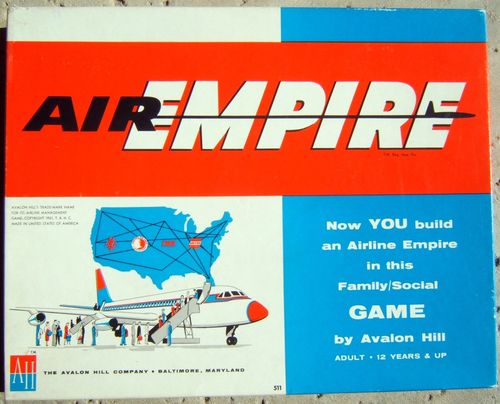
Air Empire
Air Empire Rulebook
Table of Contents
Table of Contents
Basic Game
Object of Play
The object of AIR EMPIRE is to create and expand an airline system by bidding against competing airlines for new routes. Winning is accomplished by acquiring the most CASH at the end of the basic 3-year period of play.
Planes
Each airline operates two types of planes; the PROP JET and the larger, faster SUPER JET, represented by the die-cut facsimiles. These are the planes each player must purchase from the Bank. Prop Jets cost $2,500 each; Super Jets cost $7,000 each.
There are 60 Prop Jets and 30 Super Jets available. In many cases, the bank will run out of planes before the end of the game. Limiting the supply in this manner adds another area of strategy to the play of AIR EMPIRE.
Flight Costs Table
This "labor-saving" device printed right on the playing Board, enables each player to tell at a glance exactly how much it costs to operate any combination of Super Jets and Prop Jets. FLIGHT COSTS have nothing to do with the purchase price of the planes. They refer to the amount of money it takes to operate the planes each quarter.
Route Bidding
Each quarter, one ROUTE is turned up for bids. And within each Route, more than one Class of service is available. In a 4-player and 3-player game, all 3 classes are bid on: in a 2-player game, only Class A and Class B may be bid on.
In bidding on the FLIGHT COSTS, players may bid no lower than the minimum figure stated on the Route Card. In most cases, players should bid higher than the minimum figure to insure winning the respective Class of service. Bear in mind, however, that the higher the FLIGHT COSTS bid, the less will be the FLIGHT PROFIT. As play progresses, players will become adept at determining how high they can bid and still operate at a profit.
In each quarter, a "senior president" is designated on a rotating basis. Tie bids are resolved in favor of the senior president. Tie bids not involving the senior president are resolved in favor of the player seated closest to the senior president in clockwise order.
Route Applications
The actual bidding is done on the Route Applications provided at the bottom of the Condensed Re-cap Sheet. Bidding is done "in secret" as follows:
- Record the Route City.
- Check one Class of Service.
- Enter the FLIGHT COSTS bid.
All bids must be in multiples of $1,000, as shown on the Table.
Route Cards
Route Cards provide the following information:
- Route's home base.
- Adjacent cities on which efficiency savings are based.
- Minimum Flight Costs necessary to provide the quality of service demanded by the "CAB".
- Revenue (Quarterly).
- Revenue fluctuations. (Disregard in Basic Game.)
Bidding Examples
Example 1: Let's assume in a 4-player game that the bidding went as follows:
- Player 1: Bid $12,000 for Class A.
- Player 2: Bid $11,000 for Class A.
- Player 3: Bid $9,000 for Class B.
- Player 4: Bid $9,000 for Class C.
Player 1 out-bids Player 2 for Class A service. Player 3 wins Class B and Player 4 wins Class C. Only Player 2 fails to win a bid. Players refer to FLIGHT COSTS TABLE to see what combination of planes they must operate for each bid.
Example 2:
- Player 1: Bid $12,000 for Class A.
- Player 2: Bid $12,000 for Class A.
- Player 3: Bid $10,000 for Class B.
- Player 4: Bid $9,000 for Class B.
RESULT: Players 1 and 2 are tied. Ties are resolved in favor of the "Senior President", let's assume it's Player 1. Player 3 wins Class B by overbidding Player 4. Both Players 2 and 4 fail to win a route in this example.
Players that have won Routes must put the proper number of planes in operation. If the FLIGHT COST bid is $12,000, then 2 Super Jets and 1 Prop Jet must be stacked in the corresponding Airline area. Winner of Class A service also places a marker on top of his planes.
A player is not permitted to bid on FLIGHT COST figure that he can't back up with equipment on hand. All bids must be based on planes already purchased, but not operating. If a player bids illegally and wins, that player forfeits said bid and cannot operate any class within that Route. A player must operate a Route with exactly the combination of planes stated in the Flight Costs Table for each bid - no more, no less.
After all bids have been resolved, the Route Applications are completed as follows:
- Enter REVENUE from the Route Card.
- Subtract FLIGHT COSTS from REVENUE. Enter the result on FLIGHT PROFIT line.
Class A Service
Owners of Class A service are entitled to certain "extras" not available to owners of Class B and C service.
a) Efficiency Savings. Players that are awarded Class A service in a new Route may be entitled to a "bonus" based on 20% of the new Route's FLIGHT PROFIT figure (1b). This bonus accrues if the new route is an ADJACENT city to any CLASS A Route won during a previous quarter. Let's assume that a player who has just won the San Francisco Route, also had won previously, Class A in Los Angeles. The 20% bonus would be based on the $6,000 FLIGHT PROFIT in the example. This comes to $1,200. Remember, the Efficiency Savings is based on the adjacent cities shown on the new Route's Card. If, in the above example, the same player had operated both in Los Angeles and Helena, the Efficiency Savings would be double. It would be 40% of $6,000 or $2,400.
b) Loans. Players that win two Class A routes, may borrow $5,000. Players may borrow this amount in any quarter, including the one in which the route is awarded. For each additional 2 Class A's won, a player may borrow an additional $5,000. Since these loans are considered "long-term", they are never paid back in the play of this game.
Condensed Re-cap Sheets
Each player uses one Condensed Recap Sheet throughout the entire game. In the Basic Game, ignore the following sections:
a) 1d, Revenue Fluctuations. b) 1e, FLIGHT PROFIT of route terminated. c) Phase 2, ESTIMATED TAXES section.
Beginning Play
There are 4 "phases" to be played each quarter (disregard phase 2). All players must complete work on each phase one at a time. These phases follow the logical sequence of doing business. Therefore, each phase must be done in numerical order.
Each player begins with:
- Cash: $9,000
- 3 Super Jets, worth: $21,000
- 4 Prop Jets worth: $10,000
- Total Assets: $40,000
Playing Procedure
- Players determine the senior presidents for all quarters of the game: A clockwise order is recommended.
- Shuffle all 18 Route Cards and place them face down in one pile on the board.
Phase 1. Operations. Each player follows the bidding procedure outlined earlier. Line 1a is always left blank in the first quarter. On Line 1b, enter the FLIGHT PROFIT amount computed on the ROUTE APPLICATION. If a player does not win a route, line 1b is left blank. On line 1c, enter the amount of Efficiency Savings, if any.
Failure to win a route penalizes a player. Enter a 10% stand-pat penalty, based on line 1a. For instance, if line 1a in the 2nd quarter is $6,000, the Stand-pat penalty would be $600.
NOTE: A player cannot be penalized until he has FLIGHT PROFIT. There is never a penalty in the first quarter. Receive the total amount (1g) from the Bank. Carry forward this figure to line 1a of the following quarter.
NOTE: All entries must be rounded off to the nearest $100 denomination.
Phase 2. Estimated Taxes. Disregard in Basic Game.
Phase 3. Loans. On line 3a, enter the amount of the 20-year loan obtained in the current quarter. Interest would be too small to effect play of the game, so this step has been eliminated.
Phase 4. Property & Equipment. Since AIR EMPIRE deals principally with planes, all capital expenditures such as hangers, offices, machinery, etc., is lumped into the purchase price of the planes. On line 4a enter the total cost of all Prop Jets bought each quarter. On line 4b enter the total cost of all Super Jets bought each quarter. Pay the total amount as computed on line 4c.
Remember, that for each plane purchased, the proper maintenance entry must also be made in the next Phase.
Phase 5. Maintenance & Overhaul of Property & Equipment. All maintenance and overhaul costs are grouped into one lump sum paid each quarter. This one lump sum is based on planes owned, both operating and non-operating. Players add $200 for each Prop Jet and $500 for each Super Jet purchased in current quarter.
In the first quarter enter $2,300 on Line 5a. This is the maintenance charge based on the fleet of 7 planes each player starts the game with. Enter on Line 5b, the proper maintenance charges pertaining only to planes bought (if any) in Phase 4. Line 5c is the total and is paid each month (quarter). Always remember to carry forward this amount to Line 5a in the following quarter.
Failure to pay Line 5c each and every quarter results in immediate bankruptcy.
Maintenance & Overhaul of Property & Equipment sheet: a. Total to date (5c of previous Quarter); b. Total for current Quarter ($200 each Prop Jet, $500 each Super Jet); c. Total - pay Bank.
Completion of Play
Winner is determined by the player with the most CASH at the end of the basic 3-year period.
Test of Bankruptcy
Bankruptcy occurs when a player does not have the Cash to pay the expenses of Phase 5. Bankruptcy occurs immediately. The Bank takes over all remaining Cash and all operating and non-operating planes.
Planes never can be sold back to the Bank. Players may offer non-operating planes for sale to competitors. In this event, opposing players hold a secret bidding, the highest bidder buying the plane(s). The buyer records these planes at the bid price, not purchase price, and must make the same entries as if the plane(s) had been bought from the Bank.
The seller may deduct in Phase 5, $200 for each Prop-Jet sold and $500 for each Super Jet sold.
Routes owned by bankrupt players are not put up for rebids.
Mergers
Players may conduct mergers in a 3-player game only. A merger can occur only if the total income to date of the two poorest players does not exceed the total income to date of the richest player. To complete a merger, the poorest player adds his INCOME TO DATE figure to that of the player he merges with. Both players act as one airline, combining all their planes and cash on hand.
When you have become proficient in play of the Basic Game, we recommend you try the advanced play of the Tournament Game. A complete set of Tournament Game rules follows.
NOTE: Actual cost figures as stated in this game are not realistic. Adding 3 digits (000) to each figure would reflect realistic figures.
Reminder Rules - Basic Game
- FLIGHT COSTS bids are merely "pledges". There is no payment to the Bank.
- If a player wins a bid, then sees he does not have the proper combination of planes, he forfeits the bid and takes a stand-pat penalty. The next highest bidder wins the Route.
- Efficiency Savings are based on the adjacent cities printed on the Route Card turned up for the current Quarter.
- Senior President gets first option to buy planes when a shortage occurs in the Bank.
- Players cannot sell planes back to the Bank, but may offer them to other players on a bidding arrangement. Highest bidder wins the planes.
- Planes may never be removed from a Route.
- Flight Costs Bids cannot be lower than the minimum stated on the Route Cards for each Class.
- Players may only bid on one type of Class each Quarter.
- All computations are rounded off to the nearest $100. If the computation ended up at $2,150, it is rounded off to $2,100. $2,151 would be rounded off to $2,200.
- The number of planes in the Bank are limited, especially in 3 and 4-player games. This has been done on purpose to add another area of strategy.
- Efficiency Savings apply to Class A service only.
- Players may borrow $5,000 every time 2 Class A's are won. For instance, ownership of 6 Class A's entitles a player to a maximum of $15,000.
- In case of bankruptcy, the Bank takes over cash and planes.
Air Empire Tournament Game
Introduction
The Tournament Game is simply the Basic Game with additional rules to make the play even more realistic. Basic Game rules apply except where otherwise stated. The Tournament Game ends in either of 2 ways:
- Time Limit: Play continues for a pre-set number of years, after which the player with the most CASH is declared the winner, or
- Elimination: Play continues indefinitely until all but one player has been eliminated.
Re-bidding of Routes
If play runs longer than the first 3-year period, it is necessary to re-bid on the Routes won in this period. As each new 3-year period begins, all 18 Route Cards are re-shuffled and placed face-down on the board. Cards are turned up just as in the previous period. In some cases, Routes will turn up that did not come up in the previous period. When a Route comes up that was won in the previous period, that Route's income is immediately terminated.
- All players operating a class of service in a Route up for re-bidding, must enter that Route's FLIGHT PROFIT on Line 1e, regarding it as a deduction.
- All players re-acquire the planes that were operating on the Route.
- All players proceed to bid on the Route exactly as in the Basic Game.
Players deduct only the FLIGHT PROFIT, not the Efficiency Savings. Players are eligible for another Efficiency Savings if they win back a Class A service in the Route terminated.
Revenue Fluctuations
Listed on most of the Route Cards are special situations inherent to actual airline operations. These situations either raise or lower Gross Income, and affect all airlines unless otherwise stated. Revenue Fluctuations are entered at Line 1d. If the fluctuation happens to be a decrease, circle the amount entered at Line 1d to signify a deduction. NOTE: Revenue Fluctuations do not apply to the Route of the card on which it is printed, unless that Route has been won in a previous year's bidding.
Always enter the Revenue Fluctuation before bidding. Revenue Fluctuations affect all classes of service.
Taxes
Players pay TAXES each and every Quarter. Tax payments are based on TOTAL GROSS INCOME TO DATE (1g). In reality, taxes are based on net income; however, in the play of this game, we have saved the player a step by basing taxes on Gross Income. Proper adjustments have been made for this in the Tax Table.
Refer to the TAX TABLE shown at the bottom of the Condensed Re-cap Sheet. Enter on Line 2a the tax that must be paid for Line 1g, and pay to the Bank immediately. If a player has a minus GROSS INCOME TO DATE, the Bank does not make a tax refund. Such refund may be deducted from any following tax payment due.
Failure to pay Taxes results in immediate bankruptcy.
Residual Value
In reality, planes are never allowed to fully depreciate. They are taken out of service at the end of a prescribed number of operating hours.
In this game the operating life of ALL planes is exactly 6 years.
Beginning with the first quarter of the 7th year, all Prop-Jets and Super-Jets must be taken out of service in the quarter in which they were purchased. They are "sold" back to the bank for their Residual Value: Prop-Jets - $1,000; Super-Jets - $3,000. The Bank pays each player these amounts for each plane turned in.
However, since such transactions affect planes operating on Routes, it is necessary to immediately purchase new planes to replace those removed from a Route. In this case, players merely keep the planes on the Routes by paying the bank the difference between the purchase price and Residual Value of each plane. For instance, to buy a Prop-Jet Replacement, the cost is $1,500. A Super-Jet Replacement is $4,000. Entries for Replacement purchases are the same as for new purchases. No entries are made in Phase 5 for Replacement purchases.
In the 1st Quarter of the 7th year, the original fleet of 7 planes must be taken out of service. (No entries were made then because these planes made up the starting fleet). To replace these planes completely, a total of $18,000 ($4,000 for each of 3 Super-Jets; $1,500 for each of 4 Prop-Jets) must be paid to the Bank immediately.
In the 2nd Quarter of the 7th year, 1 Prop-Jet and 1 Super-Jet must be replaced for a total cost of $5,500.
(The Property & Equipment sheet is the same for Year 1 and Year 7: a. Prop-Jets bought at $2,500 each; b. Super-Jets bought at $7,000 each; c. Total - pay Bank.)
CAUTION: It is wise for players to lay aside enough money from previous year's earnings to pay for these Replacement planes. Otherwise, if a player doesn't have enough cash to replace planes, he might have to voluntarily terminate Routes that operate planes he cannot afford to buy replacements for.
When a Route must be voluntarily terminated for this reason, its FLIGHT PROFIT figure must be deducted in the following Quarter. This deduction is entered on Line 1e.
When planes are turned in for their Residual Value and not replaced, players receive their Residual Value in Cash. The Bank simply pays $1,000 for each Prop-Jet and $3,000 for each Super-Jet turned in. Players also deduct in Phase 5, $200 for each Prop-Jet and $500 for each Super-Jet turned in.
Reminder Rules - Tournament Game
- Planes may be removed from a Route only when they have depreciated to their Residual value. This occurs 6 years after their purchase. Only then may they be removed if it is financially impossible to purchase Replacement.
- Replacement planes can be "purchased" without any planes existing in the Bank. Merely consider the original plane as the Replacement, after paying the Bank the difference between the Original purchase price and the Residual Value.
- Players deduct only the FLIGHT PROFIT, not Efficiency Savings, when routes are terminated.
- If a player wins back a Class A just terminated, he is again entitled to the Efficiency Savings.
- If players must sell planes to other players, or to the Bank for their Residual value, deductions are made in the Maintenance and Overhaul section (Phase 5).
- When a Route is terminated, players get back their Planes. Planes do not go to the Bank.
- A Route terminated in a current Quarter does not affect the Revenue Fluctuation, since Revenue Fluctuations apply only to Routes of previous Quarters.
- Revenue Fluctuations apply to all Classes of service, A through C.
- Players do not have to pay back Loans when they lose Class A Routes.
- Route Cards are reshuffled after every 3-year period, even though 6 Routes have not been turned up.